Coinbase Enables Crypto-Backed Down Payments for Fannie Mae Loans
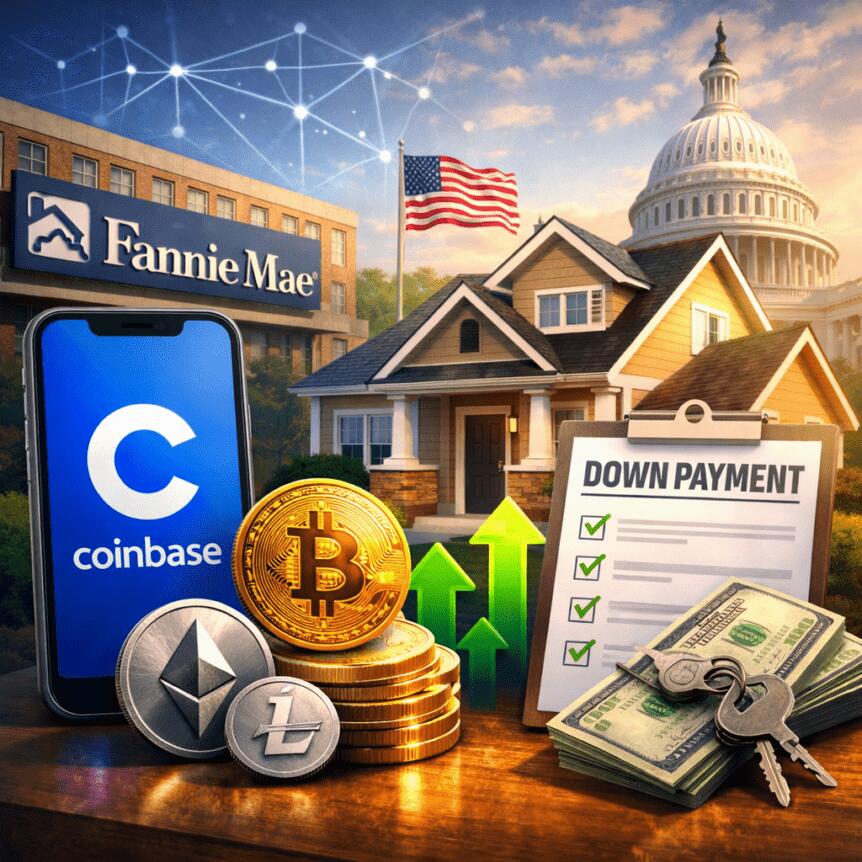
Coinbase Global has unveiled a mortgage structure with Better Home & Finance that would let qualified borrowers pledge digital assets held in Coinbase accounts to fund the down payment on a standard conforming mortgage backed by Fannie Mae. In the arrangement, borrowers would secure a separate loan—backed by their crypto holdings, such as Bitcoin or USDC—to cover the down payment, while the primary mortgage remains a conventional Fannie Mae–backed loan. Better will originate and service the mortgages.
Coinbase describes the model as enabling buyers to keep exposure to digital assets while using a crypto-backed loan to cover the down payment. In effect, the down payment is funded by a separate crypto-collateral loan, while the main loan stays tied to traditional mortgage underwriting. If the rollout proves scalable, the approach could widen crypto’s role in U.S. housing finance beyond qualifying assets to a direct funding mechanism for home purchases.
The development arrives amid broader regulatory signals about integrating crypto into mortgage frameworks. In June, the U.S. Federal Housing Finance Agency directed Fannie Mae and Freddie Mac to prepare proposals recognizing cryptocurrency as an asset in mortgage risk assessments without requiring conversion to dollars. The momentum also aligns with a string of underwriting innovations from lenders such as Newrez and Rate, which have begun incorporating crypto holdings into mortgage processes.
Key takeaways
- A crypto-backed down payment option pairs a standard conforming mortgage with a separate loan secured by digital assets to fund the down payment.
- The primary mortgage remains Fannie Mae–backed; crypto exposure is retained via the down payment loan, not through liquidation of assets.
- Regulators are signaling openness to counting crypto assets in mortgage risk assessments, potentially paving the way for broader crypto integration in housing finance.
- Lenders like Newrez and Rate have already integrated crypto into underwriting, although down payments and closing costs may still require cash in some programs.
- Borrowers face constraints such as locked collateral and market-volatility considerations that do not automatically trigger margin calls, according to Coinbase.
A new path for crypto in housing finance
Under the Coinbase–Better structure, a borrower would take out a standard conforming mortgage, while a separate loan secured by crypto holdings funds the down payment. The crypto collateral can include assets such as Bitcoin or stablecoins like USDC, but borrowers would not be allowed to trade the pledged assets while they are locked as collateral. Coinbase notes that price swings do not trigger margin calls as long as the borrower keeps making mortgage payments and the loan terms remain unchanged after activation. This approach, if widely adopted, would embed crypto more deeply into the mechanics of home financing rather than merely serving as an underwriting asset.
Better will handle the origination and servicing of the primary mortgage, while the crypto-backed down-payment loan would be a separate obligation. For investors and borrowers, this structure introduces a new dynamic: crypto assets remain a part of the balance sheet and potential wealth-building narrative, but introduce added debt and liquidity considerations tied to market volatility.
Regulatory signals and industry momentum
The initiative comes amid a broadening discourse on crypto’s place in mortgage risk assessment and underwriting. The Federal Housing Finance Agency’s directive to Fannie Mae and Freddie Mac in June reflects a push to formalize crypto as an asset category that could influence risk metrics without forcing conversion to dollars. The development sits alongside other industry moves toward crypto-inclusive underwriting, with lenders such as Newrez and Rate having publicly signaled their willingness to recognize crypto holdings in certain underwriting contexts.
Newrez, in January, said it would allow borrowers to use Bitcoin, Ether, crypto ETFs, and stablecoins as qualifying assets in underwriting, without requiring liquidation. In February, Rate launched its RateFi program, which allows verified crypto holdings to count toward reserves and, in some cases, income. However, even in RateFi, borrowers typically must convert crypto into cash for down payments and closing costs, illustrating that the integration is gradual and selective rather than a wholesale replacement of cash for home purchases.
Voices from the policy-adjacent arena
Beyond the mechanics, the transition toward crypto in housing finance has drawn commentary from policymakers and industry observers. Former Ohio representative Tim Ryan, a member of Coinbase’s advisory council who has focused on housing affordability, framed mortgage financing as a practical use case for crypto. He argued that digital assets could unlock wealth for early investors and help address a major barrier to homeownership—the down payment—if the industry moves into the housing sector in a meaningful way.
Affordability remains a central concern for U.S. homebuyers, with persistent inventory constraints and elevated mortgage rates keeping activity constrained even as average home prices have eased from their 2022 peaks. The federal data context underscores the potential appeal of crypto-linked financing to buyers who hold digital assets and seek alternative paths to accumulating a down payment.
As the crypto–mortgage conversation evolves, investors and borrowers will be watching closely for how collateral liquidity, asset valuation, and regulatory alignment interact in real-world deployments. The Coinbase–Better program represents a concrete step in testing crypto as a financing tool within a conventional housing market framework, but it also highlights the importance of clear risk management, valuation standards, and consumer protection as more lenders experiment with crypto-enabled home purchases.
Readers should keep an eye on regulator guidance and lender rollouts in the coming months, which will indicate whether crypto-backed down payments move from a pilot concept to a deployable regional or national option.
This article was originally published as Coinbase Enables Crypto-Backed Down Payments for Fannie Mae Loans on Crypto Breaking News – your trusted source for crypto news, Bitcoin news, and blockchain updates.


You May Also Like
Strategy (MSTR) Stock Drops as Company Prepares $1.25B Bitcoin Sale

Bitcoin 28% Haircut: Moody’s Sets Forced-Selling Trigger