Stock indexes retreat, oil jumps 45%, and March payrolls loom. Your guide to the critical market catalysts investors are monitoring this week. The post Market PreviewStock indexes retreat, oil jumps 45%, and March payrolls loom. Your guide to the critical market catalysts investors are monitoring this week. The post Market Preview

Market Preview: Jobs Report, Oil Shock, and Fed Signals Dominate This Week’s Outlook

2026/03/29 22:04
3 min read
For feedback or concerns regarding this content, please contact us at [email protected]

Quick Overview

  • Major U.S. equity benchmarks declined last week, leaving the Nasdaq with a 10% year-to-date loss
  • Closure of the Strait of Hormuz has driven oil prices over 45% higher in just one month
  • Friday’s March employment report projected to reveal 50,000–56,000 new jobs added
  • Consumer confidence plunged to December lows as geopolitical conflict weighs on sentiment
  • Market pricing now reflects a 22% probability of Fed rate increase by late 2026

Investors face a critical but abbreviated trading week marked by equity weakness, energy market turbulence, and employment data that could reshape market expectations.

The S&P 500 retreated 2.12% over the prior week, settling at 6,368.85. The Dow Jones Industrial Average declined 1.73%, suffering an approximately 800-point loss on Friday’s session alone. The Nasdaq Composite shed 2.2% Friday and has accumulated roughly a 10% decline year-to-date. Significantly, all three major benchmarks have now breached their 52-week moving averages, suggesting deteriorating technical support.
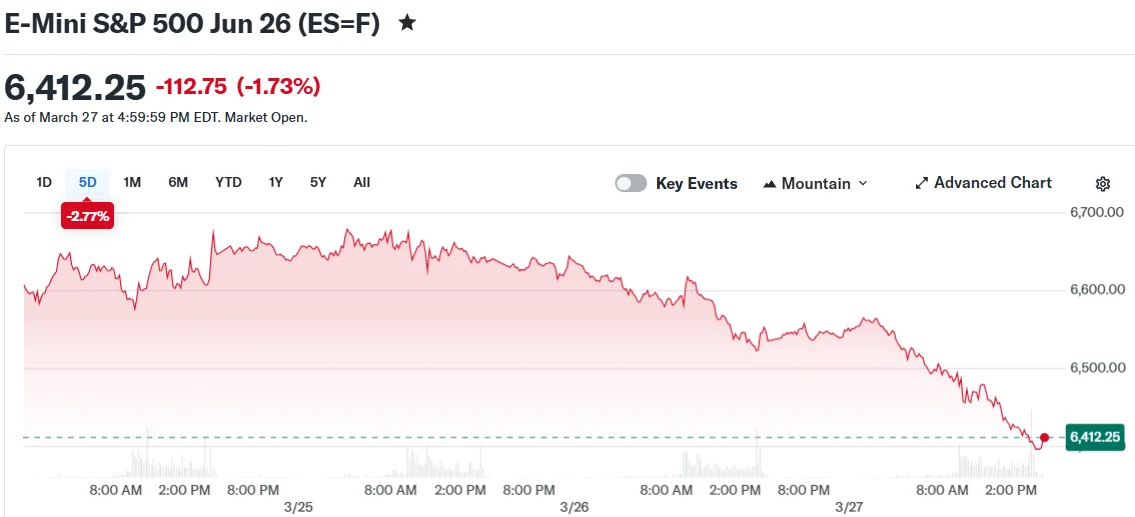
E-Mini S&P 500 Jun 26 (ES=F)E-Mini S&P 500 Jun 26 (ES=F)

The primary catalyst remains the U.S.-Israeli confrontation with Iran, now entering its fifth week. The effective blockade of the Strait of Hormuz has eliminated 15 to 16 million barrels daily from worldwide supply. Brent crude has climbed more than 45% while WTI crude has surged over 50% during the past month.

Employment Report Takes Center Stage

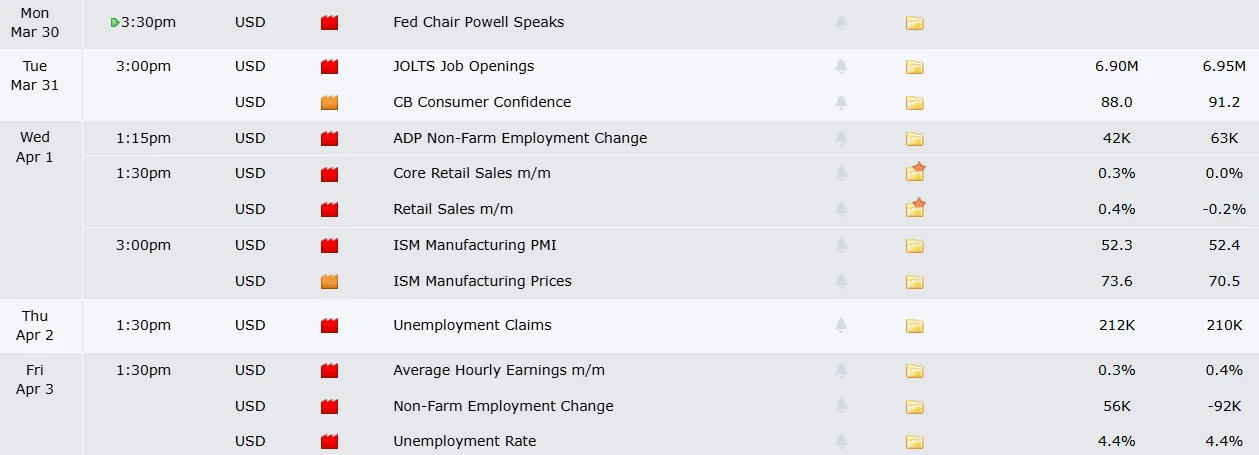
Friday’s nonfarm payrolls release represents the week’s most significant market event. Analyst consensus anticipates approximately 50,000 to 56,000 positions created during March, following February’s unexpected decline of 92,000 jobs. The unemployment rate is projected to remain unchanged at 4.4%.
Source: Forex Factory

Goldman Sachs economist Pierfrancesco Mei projects elevated energy costs will subtract roughly 10,000 monthly jobs from payroll expansion through year-end. BNP Paribas economist Andrew Husby suggested a more pronounced energy disruption would be required to disrupt the current pattern of modest hiring and limited layoffs characterizing the labor market.

Prior to Friday’s payrolls announcement, market participants will monitor Tuesday’s consumer confidence reading, Wednesday’s JOLTS job openings and ADP private payrolls data, and Thursday’s weekly jobless claims.

Central Bank Stance Shifting

Fixed-income markets are beginning to reflect expectations of a less accommodative Federal Reserve posture. The 10-year Treasury yield advanced to 4.48%, marking its peak since July. Two-year yields climbed to 4%, accumulating over 30 basis points since the Federal Reserve’s most recent policy meeting.

Headline consumer price inflation is projected to approach 3.5% annually in upcoming months as national gasoline prices near $4 per gallon.

Regarding corporate earnings, Nike delivers quarterly results Tuesday, with particular attention on Chinese market demand trends. ConAgra, Lamb Weston, and Cal-Maine Foods announce Wednesday. Tesla is scheduled to publish monthly delivery figures this week.

Federal Reserve Chair Jerome Powell addresses markets Monday, with investors scrutinizing his commentary for indications regarding the monetary policy trajectory.

The post Market Preview: Jobs Report, Oil Shock, and Fed Signals Dominate This Week’s Outlook appeared first on Blockonomi.


Disclaimer: The articles reposted on this site are sourced from public platforms and are provided for informational purposes only. They do not necessarily reflect the views of MEXC. All rights remain with the original authors. If you believe any content infringes on third-party rights, please contact [email protected] for removal. MEXC makes no guarantees regarding the accuracy, completeness, or timeliness of the content and is not responsible for any actions taken based on the information provided. The content does not constitute financial, legal, or other professional advice, nor should it be considered a recommendation or endorsement by MEXC.

You May Also Like

MAXI DOGE Holders Diversify into $GGs for Fast-Growth 2025 Crypto Presale Opportunities

MAXI DOGE Holders Diversify into $GGs for Fast-Growth 2025 Crypto Presale Opportunities

Presale crypto tokens have become some of the most active areas in Web3, offering early access to projects that blend culture, finance, and technology. Investors are constantly searching for the best crypto presale to buy right now, comparing new token presales across different niches. MAXI DOGE has gained attention for its meme-driven energy, but early [...] The post MAXI DOGE Holders Diversify into $GGs for Fast-Growth 2025 Crypto Presale Opportunities appeared first on Blockonomi.
Share
Blockonomi2025/09/18 00:00
UK crypto holders brace for FCA’s expanded regulatory reach

UK crypto holders brace for FCA’s expanded regulatory reach

The post UK crypto holders brace for FCA’s expanded regulatory reach appeared on BitcoinEthereumNews.com. British crypto holders may soon face a very different landscape as the Financial Conduct Authority (FCA) moves to expand its regulatory reach in the industry. A new consultation paper outlines how the watchdog intends to apply its rulebook to crypto firms, shaping everything from asset safeguarding to trading platform operation. According to the financial regulator, these proposals would translate into clearer protections for retail investors and stricter oversight of crypto firms. UK FCA plans Until now, UK crypto users mostly encountered the FCA through rules on promotions and anti-money laundering checks. The consultation paper goes much further. It proposes direct oversight of stablecoin issuers, custodians, and crypto-asset trading platforms (CATPs). For investors, that means the wallets, exchanges, and coins they rely on could soon be subject to the same governance and resilience standards as traditional financial institutions. The regulator has also clarified that firms need official authorization before serving customers. This condition should, in theory, reduce the risk of sudden platform failures or unclear accountability. David Geale, the FCA’s executive director of payments and digital finance, said the proposals are designed to strike a balance between innovation and protection. He explained: “We want to develop a sustainable and competitive crypto sector – balancing innovation, market integrity and trust.” Geale noted that while the rules will not eliminate investment risks, they will create consistent standards, helping consumers understand what to expect from registered firms. Why does this matter for crypto holders? The UK regulatory framework shift would provide safer custody of assets, better disclosure of risks, and clearer recourse if something goes wrong. However, the regulator was also frank in its submission, arguing that no rulebook can eliminate the volatility or inherent risks of holding digital assets. Instead, the focus is on ensuring that when consumers choose to invest, they do…
Share
BitcoinEthereumNews2025/09/17 23:52
Metaplanet raises $1.4B to fuel BTC purchases and U.S. subsidiary launch

Metaplanet raises $1.4B to fuel BTC purchases and U.S. subsidiary launch

Metaplanet Inc. has formalized the subsidiary in Miami, Florida, naming it Metaplanet Income Corp.
Share
Cryptopolitan2025/09/17 23:34