

MoonPay Acquires Meso to Build Global Payments Network

The acquisition brings two experienced payments executives to MoonPay’s leadership team. Ali Aghareza, who helped build the original Braintree platform at PayPal, becomes MoonPay’s new Chief Technology Officer. Ben Mills, former head of product at Venmo, joins as Senior Vice President of Product.
MoonPay did not share financial details of the deal. The company focuses on helping people buy and sell cryptocurrencies using regular payment methods like credit cards and bank transfers.
PayPal Veterans Join MoonPay Team
Both new executives have deep experience in digital payments. Aghareza was part of Braintree’s original engineering team before PayPal bought the company. He later led engineering teams at PayPal before starting Meso in 2022.
Mills brings product experience from major payment platforms. He worked as head of developer experience at Braintree and head of product at Venmo. Before co-founding Meso, he also worked on payments innovation at the Solana blockchain network.
“This acquisition marks a turning point for MoonPay,” said CEO Ivan Soto-Wright in a company statement. “We’ve built trusted ramps that brought millions into crypto, now we’re building the global network that will move money across every form and in every market.”
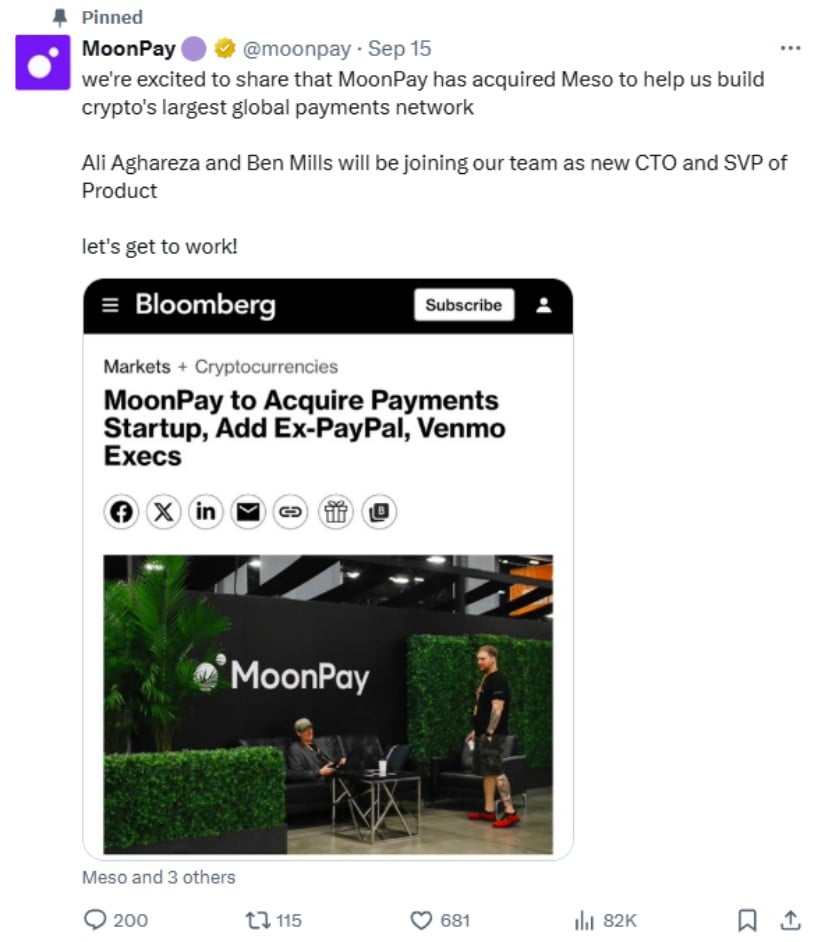
Source: @moonpay
Meso specialized in connecting traditional banking systems with cryptocurrency networks. The 2022 startup helped other fintech companies integrate both regular and crypto payment options.
Part of Bigger Acquisition Strategy
The Meso deal continues MoonPay’s busy acquisition year. The company has now bought four different companies in 2025:
-
January: Acquired Helio, a crypto payment processor, for $175 million
-
March: Bought Iron, a stablecoin infrastructure company, for over $100 million
-
September: Added Meso to improve US banking connections
Together, these acquisitions give MoonPay the pieces needed for a complete payments network. The company can now handle everything from traditional bank transfers to cryptocurrency transactions and stablecoin payments.
“With Meso, Helio, and Iron, MoonPay now brings together the critical components needed to create a single, global payments network,” the company explained in its announcement.
Strong Financial Performance Despite Challenges
MoonPay has maintained profitability even as the crypto market faced ups and downs. The company reported being profitable in 2024 and expects 2025 to be its strongest year for earnings and cash flow.
This success comes despite some difficulties. MoonPay laid off 10% of its workforce earlier in 2025 due to rising costs. However, the company continues to grow and is reportedly discussing a new funding round that could raise its valuation above the $3.4 billion mark from its 2021 investment round.
The company has been profitable since launching in 2019. It processed over $2 billion in crypto transactions and serves customers in about 160 countries.
Regulatory Approvals Across Multiple Markets
MoonPay has worked hard to get proper licenses in key markets. The company was among the first to receive MiCA approval in the Netherlands, allowing it to operate across all European Union countries.
In the United States, MoonPay secured both a BitLicense and money transmitter license from New York’s Department of Financial Services. These licenses let the company legally handle cryptocurrency transactions in one of the most regulated US states.
The regulatory approvals help MoonPay compete with traditional payment companies. The crypto industry has faced increased scrutiny from regulators, making proper licenses more important for long-term success.
Building the Future of Digital Payments
The Meso acquisition helps MoonPay improve its support for US banking systems. The deal adds better connections to ACH transfers and real-time payment networks. It also provides improved developer tools for other companies that want to integrate MoonPay’s services.
MoonPay’s goal is to let people pay with any type of money – whether dollars, euros, or Bitcoin. The company wants to make switching between traditional and digital currencies as easy as sending a text message.
The acquisition comes as more companies explore stablecoin payments. These are cryptocurrencies designed to maintain stable values, making them useful for everyday transactions. Even traditional companies like Stripe recently spent $1.1 billion to buy a crypto payment company.
MoonPay now serves over 20 million customers and works with nearly 500 partner companies. The Meso deal should help expand those numbers as more businesses look for ways to accept both traditional and crypto payments.
The Next Chapter Begins
MoonPay’s acquisition spree shows how quickly the digital payments space is changing. Companies that can connect old and new financial systems are becoming more valuable as both consumers and businesses want more payment options.
The success of this strategy will depend on whether people actually choose to use crypto for everyday purchases. While the technology has improved significantly, most consumers still prefer familiar options like credit cards and bank transfers for routine transactions.


You May Also Like

Rich Bitcoin traders lost $337M daily in first quarter of 2026

Musk Demands Wall Street Buy Grok AI Subscriptions




