President Donald Trump filed a $15 billion defamation lawsuit against the New York Times, claiming its reporting damaged his personal brand, media company, and Solana-based meme coin. The case, filed Monday in a Florida federal court, intensifies Trump’s legal offensive against major US outlets. Trump Accuses Times of Defamation and Election Bias Trump’s filing claims the New York Times abandoned journalistic standards and acted as “a full-throated mouthpiece of the Democrat Party.” It cites articles, endorsements, and the book Lucky Loser by reporters Susanne Craig and Russ Buettner. The lawsuit also names four Times reporters, along with publisher Penguin Random House, which Trump calls “false, malicious, and defamatory.” He argues the reporting caused sharp losses to Trump Media & Technology Group and hurt confidence in his crypto ventures. Trump Media, where the president is the majority shareholder, operates his Truth Social platform and has recently invested heavily in cryptocurrency. In a Truth Social post, he said the “degenerate” Times engaged in “a decades-long method of lying” about him, his family, and the MAGA movement. The complaint accuses the Times of election interference, pointing to its front-page endorsement of Kamala Harris during the 2024 campaign. It also argues the book’s release was intentionally timed with the trailer for The Apprentice film, triggering a sharp drop in Trump Media’s stock price. The lawsuit continues Trump’s aggressive litigation against media companies. He recently sued the Wall Street Journal and Rupert Murdoch, ABC anchor George Stephanopoulos, and Paramount’s 60 Minutes. Settlements exceeded $15 million, with Paramount paying $16 million in July. The Times dismissed the claims. A spokesperson said, “This lawsuit has no merit. It is an attempt to stifle and discourage independent reporting. The New York Times will not be deterred by intimidation tactics.” Trump’s Meme Coin Faces Collapse The lawsuit explicitly links reputational damage to his meme coin project, launched on Solana in January, just before his inauguration. The official Trump coin initially surged above $40 but has since fallen sharply, now trading around $8.63 with daily volumes near $175 million—an almost 80% drop from its early peak. Melania’s token has performed even worse, tumbling from launch highs of several dollars to just $0.20 by mid-September 2025. With daily trading volume at only $5.5 million, it reflects far weaker liquidity and diminished investor interest compared to Trump’s coin. Despite the downturn, Trump and his sons reportedly gained $6 billion from the launch of World Liberty Financial’s WLFI token and an additional $620 million from broader digital asset holdings. Experts estimate crypto now makes up 9% of Trump’s $6 billion fortune, while real estate has fallen to about half.President Donald Trump filed a $15 billion defamation lawsuit against the New York Times, claiming its reporting damaged his personal brand, media company, and Solana-based meme coin. The case, filed Monday in a Florida federal court, intensifies Trump’s legal offensive against major US outlets. Trump Accuses Times of Defamation and Election Bias Trump’s filing claims the New York Times abandoned journalistic standards and acted as “a full-throated mouthpiece of the Democrat Party.” It cites articles, endorsements, and the book Lucky Loser by reporters Susanne Craig and Russ Buettner. The lawsuit also names four Times reporters, along with publisher Penguin Random House, which Trump calls “false, malicious, and defamatory.” He argues the reporting caused sharp losses to Trump Media & Technology Group and hurt confidence in his crypto ventures. Trump Media, where the president is the majority shareholder, operates his Truth Social platform and has recently invested heavily in cryptocurrency. In a Truth Social post, he said the “degenerate” Times engaged in “a decades-long method of lying” about him, his family, and the MAGA movement. The complaint accuses the Times of election interference, pointing to its front-page endorsement of Kamala Harris during the 2024 campaign. It also argues the book’s release was intentionally timed with the trailer for The Apprentice film, triggering a sharp drop in Trump Media’s stock price. The lawsuit continues Trump’s aggressive litigation against media companies. He recently sued the Wall Street Journal and Rupert Murdoch, ABC anchor George Stephanopoulos, and Paramount’s 60 Minutes. Settlements exceeded $15 million, with Paramount paying $16 million in July. The Times dismissed the claims. A spokesperson said, “This lawsuit has no merit. It is an attempt to stifle and discourage independent reporting. The New York Times will not be deterred by intimidation tactics.” Trump’s Meme Coin Faces Collapse The lawsuit explicitly links reputational damage to his meme coin project, launched on Solana in January, just before his inauguration. The official Trump coin initially surged above $40 but has since fallen sharply, now trading around $8.63 with daily volumes near $175 million—an almost 80% drop from its early peak. Melania’s token has performed even worse, tumbling from launch highs of several dollars to just $0.20 by mid-September 2025. With daily trading volume at only $5.5 million, it reflects far weaker liquidity and diminished investor interest compared to Trump’s coin. Despite the downturn, Trump and his sons reportedly gained $6 billion from the launch of World Liberty Financial’s WLFI token and an additional $620 million from broader digital asset holdings. Experts estimate crypto now makes up 9% of Trump’s $6 billion fortune, while real estate has fallen to about half.

Trump’s $15B Attack on NYT: Media Bias or Meme Coin Bust?

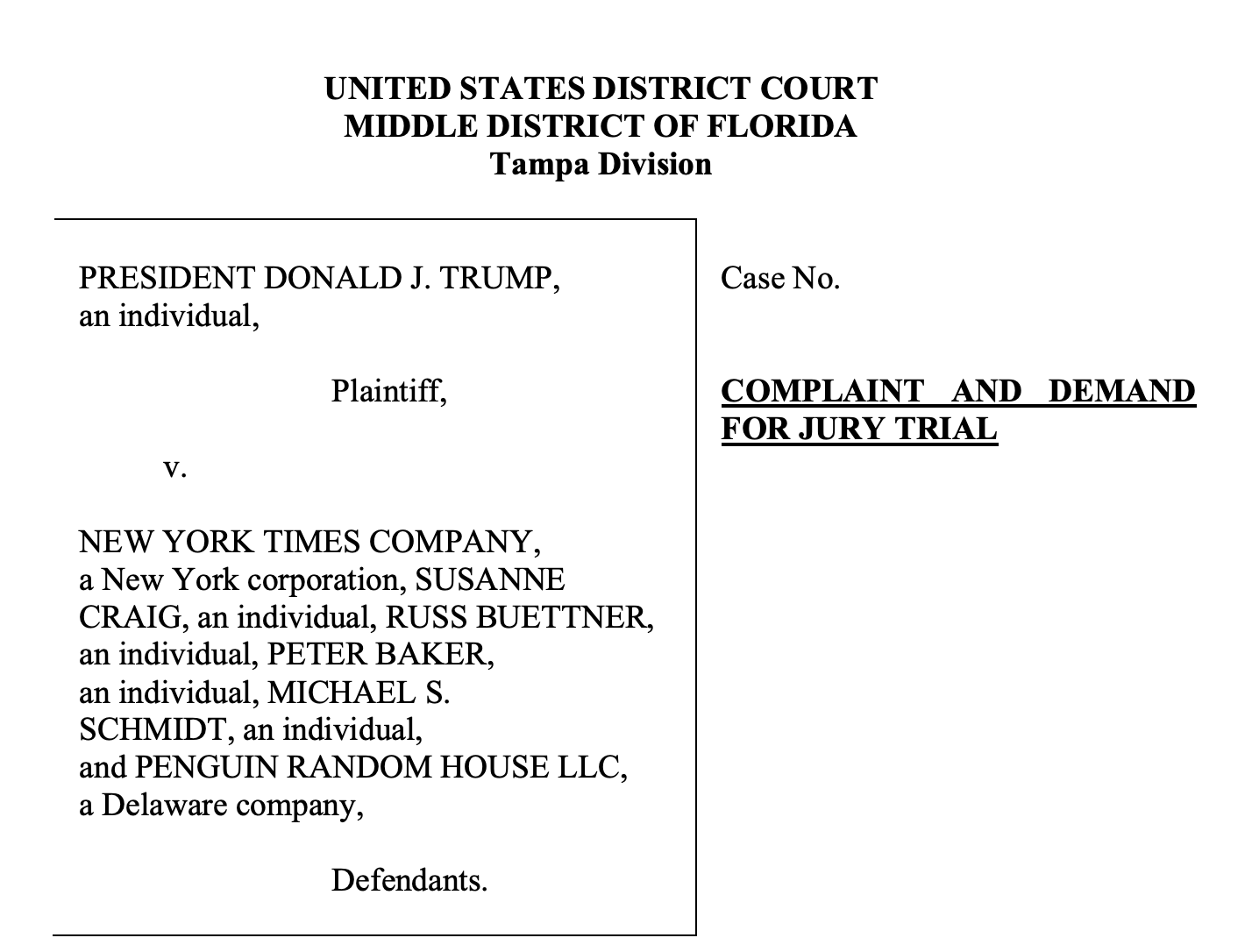
President Donald Trump filed a $15 billion defamation lawsuit against the New York Times, claiming its reporting damaged his personal brand, media company, and Solana-based meme coin.

The case, filed Monday in a Florida federal court, intensifies Trump’s legal offensive against major US outlets.

Trump Accuses Times of Defamation and Election Bias

Trump’s filing claims the New York Times abandoned journalistic standards and acted as “a full-throated mouthpiece of the Democrat Party.” It cites articles, endorsements, and the book Lucky Loser by reporters Susanne Craig and Russ Buettner. The lawsuit also names four Times reporters, along with publisher Penguin Random House, which Trump calls “false, malicious, and defamatory.”

He argues the reporting caused sharp losses to Trump Media & Technology Group and hurt confidence in his crypto ventures. Trump Media, where the president is the majority shareholder, operates his Truth Social platform and has recently invested heavily in cryptocurrency.
In a Truth Social post, he said the “degenerate” Times engaged in “a decades-long method of lying” about him, his family, and the MAGA movement.

The complaint accuses the Times of election interference, pointing to its front-page endorsement of Kamala Harris during the 2024 campaign. It also argues the book’s release was intentionally timed with the trailer for The Apprentice film, triggering a sharp drop in Trump Media’s stock price.

The lawsuit continues Trump’s aggressive litigation against media companies. He recently sued the Wall Street Journal and Rupert Murdoch, ABC anchor George Stephanopoulos, and Paramount’s 60 Minutes. Settlements exceeded $15 million, with Paramount paying $16 million in July.

The Times dismissed the claims.

A spokesperson said, “This lawsuit has no merit. It is an attempt to stifle and discourage independent reporting. The New York Times will not be deterred by intimidation tactics.”

Trump’s Meme Coin Faces Collapse

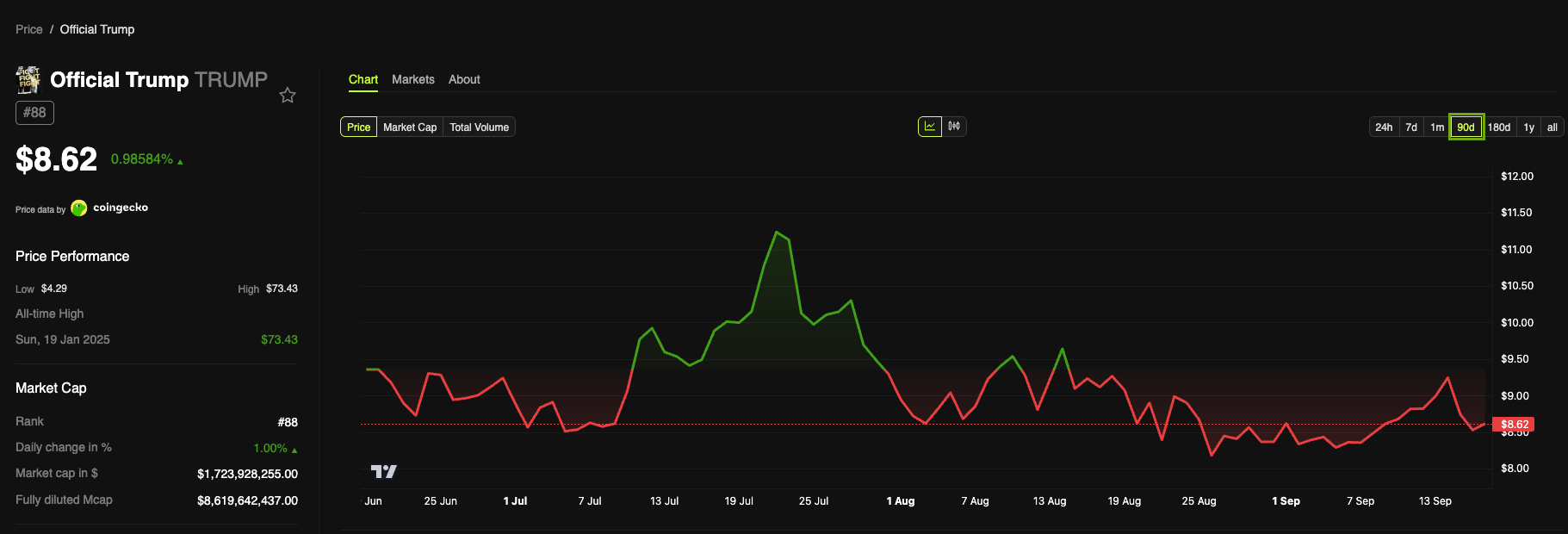
The lawsuit explicitly links reputational damage to his meme coin project, launched on Solana in January, just before his inauguration. The official Trump coin initially surged above $40 but has since fallen sharply, now trading around $8.63 with daily volumes near $175 million—an almost 80% drop from its early peak.

Melania’s token has performed even worse, tumbling from launch highs of several dollars to just $0.20 by mid-September 2025. With daily trading volume at only $5.5 million, it reflects far weaker liquidity and diminished investor interest compared to Trump’s coin.
Despite the downturn, Trump and his sons reportedly gained $6 billion from the launch of World Liberty Financial’s WLFI token and an additional $620 million from broader digital asset holdings.

Experts estimate crypto now makes up 9% of Trump’s $6 billion fortune, while real estate has fallen to about half.


Market Opportunity
NEAR Logo
NEAR Price(NEAR)
$1.54
$1.54$1.54
-1.40%
USD
NEAR (NEAR) Live Price Chart
Disclaimer: The articles reposted on this site are sourced from public platforms and are provided for informational purposes only. They do not necessarily reflect the views of MEXC. All rights remain with the original authors. If you believe any content infringes on third-party rights, please contact [email protected] for removal. MEXC makes no guarantees regarding the accuracy, completeness, or timeliness of the content and is not responsible for any actions taken based on the information provided. The content does not constitute financial, legal, or other professional advice, nor should it be considered a recommendation or endorsement by MEXC.

You May Also Like

The Channel Factories We’ve Been Waiting For

The Channel Factories We’ve Been Waiting For

The post The Channel Factories We’ve Been Waiting For appeared on BitcoinEthereumNews.com. Visions of future technology are often prescient about the broad strokes while flubbing the details. The tablets in “2001: A Space Odyssey” do indeed look like iPads, but you never see the astronauts paying for subscriptions or wasting hours on Candy Crush.  Channel factories are one vision that arose early in the history of the Lightning Network to address some challenges that Lightning has faced from the beginning. Despite having grown to become Bitcoin’s most successful layer-2 scaling solution, with instant and low-fee payments, Lightning’s scale is limited by its reliance on payment channels. Although Lightning shifts most transactions off-chain, each payment channel still requires an on-chain transaction to open and (usually) another to close. As adoption grows, pressure on the blockchain grows with it. The need for a more scalable approach to managing channels is clear. Channel factories were supposed to meet this need, but where are they? In 2025, subnetworks are emerging that revive the impetus of channel factories with some new details that vastly increase their potential. They are natively interoperable with Lightning and achieve greater scale by allowing a group of participants to open a shared multisig UTXO and create multiple bilateral channels, which reduces the number of on-chain transactions and improves capital efficiency. Achieving greater scale by reducing complexity, Ark and Spark perform the same function as traditional channel factories with new designs and additional capabilities based on shared UTXOs.  Channel Factories 101 Channel factories have been around since the inception of Lightning. A factory is a multiparty contract where multiple users (not just two, as in a Dryja-Poon channel) cooperatively lock funds in a single multisig UTXO. They can open, close and update channels off-chain without updating the blockchain for each operation. Only when participants leave or the factory dissolves is an on-chain transaction…
Share
BitcoinEthereumNews2025/09/18 00:09
Talent Technology Company Cappfinity accelerates growth plans through Chief Talent Management Officer appointment

Talent Technology Company Cappfinity accelerates growth plans through Chief Talent Management Officer appointment

LONDON, Jan. 20, 2026 /PRNewswire/ — Cappfinity is pleased to announce the promotion of Stephanie Hopper to the role of Chief Talent Management Officer, marking
Share
AI Journal2026/01/20 15:30
TRX Technical Analysis Jan 20

TRX Technical Analysis Jan 20

The post TRX Technical Analysis Jan 20 appeared on BitcoinEthereumNews.com. TRX is consolidating at the $0.31 level while showing a short-term bullish tendency
Share
BitcoinEthereumNews2026/01/20 15:27