Bitcoin needs $66,900 to hold this week to have any real hope of a rally this year
Bitcoin reclaims $67k after a weekend spent below support, while $68k sets the first test for the new week
Bitcoin price opened the new week with a modest structural improvement after spending most of the weekend below one of its most closely watched channel boundaries.
The reclaim of $66,900 shifts the immediate condition from clean downside acceptance toward early repair, while the higher boundary at $68,000 continues to define the next decision point.
That leaves the Bitcoin market in a narrow but important transition zone as traders move from a weekend defined by failed support into a macro backdrop shaped by rising oil, firmer yields, and a broad repricing of risk.
The channel map remains straightforward.
 Bitcoin price chart showing an early drop, a slide toward the low-$60,000s, and a modest rebound at the start of the week.
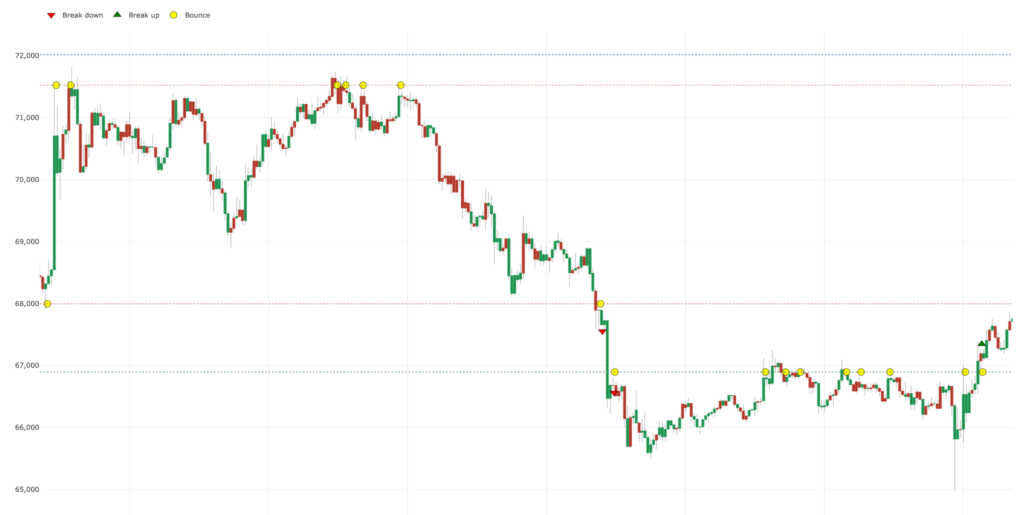
Within my channel framework, the pair of levels at $68,000 and $66,900 defines the active band that governed the late-week move. Price lost that band on Friday, spent Saturday and Sunday repeatedly reacting to $66,900 from below, then began Monday by climbing back over the lower boundary of the channel.
The sequence carries more information than the headline move alone.
Bitcoin broke structure on Friday, spent two days accepting lower, then staged a partial repair into Monday morning.
In my analysis at the start of the month, the base case was continued trade inside the reclaimed $68,000 to $71,500 range, the bull case required acceptance above $71,500 and then $72,000, and the bear case required BTC to lose $68,000 again and build acceptance below $66,900, reopening the path toward the lower $61,700 area.
 Bitcoin price chart from March 3 to present showing BTC rejecting near $74,000 resistance and bouncing from support around $67,000 with interaction signals.
Since then, price triggered the bearish pathway in part by breaking $68,000 and spending the weekend below $66,900, but the move has not yet matured into a fully restored lower range, as Monday brought a reclaim of that failure line.
In practical terms, the older downside scenario was activated, then interrupted. That leaves the market in a narrower transition: the downside break was real enough to matter, but the recovery back above $66,900 means the current question is no longer whether Bitcoin lost the old range, but whether it can now rebuild it by taking $68,000 back as support.
$66,900 becomes the pivot, $68,000 remains the first test
The most important line on the board now is $66,900, because it has already served three different roles across a compressed window.
It first gave way as support during Friday’s downside extension. It then operated as resistance over a long run of weekend interactions, with multiple rejections on Friday, March 27; Saturday, March 28; Sunday, March 29; and again into this morning, March 30.
It has now flipped back into tentative support after Monday’s reclaim.
When one boundary cycles through support, resistance, and support again in less than four days, the level becomes the center of gravity for the next move.
$68,000 sits just above it, and that line now holds the next decision point.
Friday’s break through $68,000 carried the stronger signature of acceptance. Price moved through support, the next candles confirmed the loss, and the market then failed to reclaim the boundary during the weekend rotation.
In practical terms, the move below $68,000 has already been validated more clearly than the move back above $66,900.
The current recovery leg, therefore, still has an unfinished job.
A market that has repaired the lower edge of a channel still needs to recover the upper edge before the broader range can be considered restored.
The sequence into Friday also gives the move more context.
Bitcoin spent last Monday, March 23, and Wednesday, March 25, repeatedly rejecting the $71,500 boundary. Those interactions sit far enough above the weekend range to look distant on a short-term chart, yet they remain central to the structure.
The market spent two separate sessions testing that ceiling and failing to secure acceptance above it.
Once that upper boundary held, the auction rotated lower through the middle of the range and eventually through the lower band at $68,000 and $66,900.
The late-week weakness, therefore, arrived after the market had already shown limited ability to sustain upside progress at the top of the range.
That larger sequence helps frame the weekend price action cleanly.
Bitcoin entered Friday after several failed attempts to lift through the higher boundary at $71,500.
The subsequent move lower reads as a continuation of a range failure already underway.
Macro pressure shaped the break, the weekend defined the response
The macro setting increased the sensitivity of those breaks.
Across global markets, the late-March backdrop has been dominated by the energy shock from the widening Iran conflict. Brent crude’s record monthly surge tightened the macro environment for risk assets, while Federal Reserve officials signaling that rate cuts may be over reinforced the sense that financial conditions could stay firm for longer.
Into that backdrop, U.S. equities closed Friday with another sharp weekly decline, and the Dow entered correction territory as oil climbed and inflation concerns intensified.
Bitcoin’s Friday breakdown through $68,000 landed squarely inside that broader repricing. The move carried a macro alignment that markets could not easily ignore.
Rising oil and rising yields tend to compress room for aggressive duration and risk positioning, especially when the growth outlook also starts to look more fragile.
Crypto can diverge from that environment for short windows, and weekends often provide the first place where that divergence can appear.
This time, the market used the weekend to confirm the lower range rather than reverse it.
That weekend behavior may carry more analytical value than the Monday-morning bounce.
From late Friday into early Monday UTC, the interaction pattern around $66,900 was remarkably consistent.
Rejection after rejection formed at the same boundary, with price repeatedly entering the level from below and failing to secure re-acceptance.
That repetition offers a specific insight into market control. Sellers continued to defend the level, and the market itself continued to respect the lower channel as the active domain.
Monday’s reclaim of $66,900 changes that condition, although only partially. The market has re-entered the $66,900 to $68,000 channel, which improves the near-term posture.
That strips some confidence from the cleanest bearish continuation case, because price has stepped back inside the channel. Yet the reclaim remains vulnerable to mean reversion while $68,000 remains intact overhead.
A partial re-entry into a lost channel signals that repair has begun.
A fuller recovery still requires confirmation at the top of the band.
The week ahead turns on one pivot and one validation level
The cleanest take remains narrow and controlled.
Bitcoin lost the $68,000 to $66,900 support band on Friday, accepted the lower structure during the weekend, then started Monday by reclaiming the bottom of the band.
The market has moved from breakdown to repair, with the recovery thesis still awaiting confirmation at $68,000.
The path above that, toward $71,500, remains secondary until the first test is cleared.
That leaves the current support and resistance ladder well defined.
Immediate support now sits at $66,900. That level has become the pivot point for short-term market conditions.
Immediate resistance sits at $68,000, which marks the top of the active channel and the first meaningful validation point for the rebound.
Beyond that, $71,500 remains the higher-timeframe ceiling that rejected price several times before the late-week selloff.
The structure between those levels gives the market a usable map for the days ahead.
The most likely base case coming into the new week is continued trade inside the $66,900 to $68,000 band while the market determines whether Monday’s reclaim can hold.
That range fits the current dataset.
Price has improved enough to step back inside the channel, and it still needs additional confirmation to restore the entire lost support zone.
Range repair often unfolds that way, with the first move reclaiming access to the channel and the second move testing whether the market can hold inside it under renewed pressure.
A stronger recovery path opens if Bitcoin holds $66,900 on pullbacks and then secures acceptance above $68,000.
That sequence would reverse the most consequential damage from Friday’s breakdown and reopen the route back toward the middle and upper portions of the larger range.
Under that scenario, the market could start rotating toward the prior rejection zone around $71,500, where the next major decision would sit.
A more cautious path remains close at hand
If Bitcoin slips back below $66,900 and begins rejecting that level from underneath again, Monday’s reclaim would start to look like a brief mean-reversion bounce inside a broader weekend acceptance below support.
In structural terms, that would place the market back in the lower channel, with attention shifting toward whether the weekend lows can hold under fresh macro pressure.
The broader narrative is restrained and readable.
Bitcoin entered Friday after failing several times at the upper boundary near $71,500. It then lost $68,000 and $66,900 as macro pressure intensified across global markets.
The weekend showed sustained acceptance below $66,900.
Monday brought the first meaningful repair, with price reclaiming that lower boundary and stepping back into the channel.
The recovery has started, the higher boundary still holds, and the next directional clue sits a little over $1,000 above the current price.
For now, the market begins the week with one pivot and one test.
Hold $66,900, and the repair sequence stays alive. Clear $68,000, and the market can begin to rebuild the case for a broader recovery.
Lose $66,900 again, and the weekend’s lower-acceptance structure regains control.
In a market shaped by an oil spike above $110, firmer inflation expectations, and fading hopes for 2026 Fed cuts, and a broader repricing across risk assets, the channel has narrowed the uncertainty.
Price now approaches the next threshold.
[DISCLAIMER: This is not financial advice. The levels and scenarios outlined here are analytical reference points, not recommendations to buy, sell, or allocate capital. Markets remain highly sensitive to macro and liquidity conditions, and price can invalidate any framework quickly.]
The post Bitcoin needs $66,900 to hold this week to have any real hope of a rally this year appeared first on CryptoSlate.


You May Also Like

African Tech Investment London: ATS 2026 at LSE

Best Crypto Presales to Watch While Iran Slams “Collusion”