Investors are currently sifting through a decade of market data to see if a massive spike in energy costs will sink Bitcoin and the crypto market. Related ReadingInvestors are currently sifting through a decade of market data to see if a massive spike in energy costs will sink Bitcoin and the crypto market. Related Reading

Bitcoin Faces Fresh Pressure As Oil Crosses $104 For First Time In 4 Years

2026/03/31 21:30
3 min read
For feedback or concerns regarding this content, please contact us at [email protected]

Investors are currently sifting through a decade of market data to see if a massive spike in energy costs will sink Bitcoin and the crypto market.

While many people focus on the immediate price of oil, the real damage to Bitcoin in the past often came from internal industry blowouts rather than what was happening at the gas pump.

The 2014 crash happened alongside the Mt. Gox exchange failure. In 2022, the Terra-Luna collapse wiped out billions. These events, rather than just expensive fuel, played the biggest role in deepening previous bear markets.

The Weight Of Geopolitics On Digital Assets

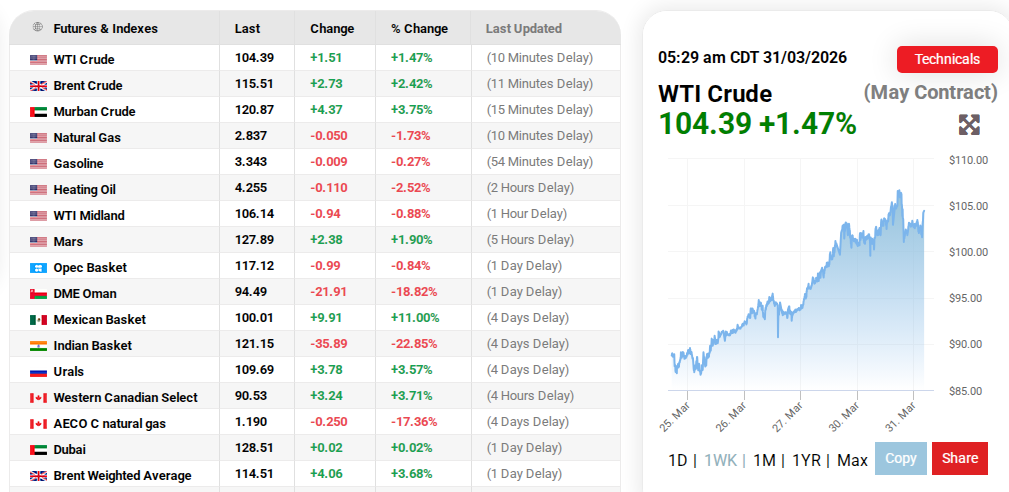
Reports indicate that West Texas Intermediate (WTI) crude oil jumped above the $104 mark on Monday. This is the highest price seen in nearly four years.

US President Donald Trump recently expressed a desire for the US to maintain indefinite control over the oil industry in Iran. Such statements and global tensions usually push oil higher.

When energy becomes this expensive, it often acts as a drag on the entire economy. It takes money out of the pockets of everyday people who might otherwise buy digital assets.

Data shows that Bitcoin miners also feel the sting because their operations require significant amounts of power.

In the past 12 years, there have only been three times when oil hit this specific $104 level. Because these events are so rare, some analysts believe it is hard to say for sure that one causes the other.

The first instance occurred in June 2014 when ISIS moved into northern Iraq. Bitcoin was trading around $600 at the time but lost 21% of its value over the next 10 weeks.

It stayed down for a long time. It actually took more than two years for the price to climb back to where it started before that specific oil spike.
Searching For Patterns In A Volatile Market

The most recent example happened in May 2022. This followed a proposal by the European Commission to phase out Russian oil imports. Bitcoin did not just dip; it fell 25% in only seven days.

That specific crash started a bear market that lasted for 19 months. Even though oil prices eventually dropped back below $100 for several years, the damage to the crypto world was already done.

Based on reports, the current return to triple-digit oil prices has many traders on edge. They are watching to see if history will repeat itself or if the market has become strong enough to handle the pressure.

A Fear Of Broad Economic Pullbacks

Not every spike leads to a permanent disaster. In March 2022, Bitcoin dropped 15% after the Russia-Ukraine war began and oil soared. However, that loss was erased in less than a month.

Even though oil stayed high, Bitcoin managed to recover its footing quickly. This shows that the relationship between the two is not always a straight line. Sometimes the market reacts to the news of war more than the actual cost of the commodity.

Featured image from Trade Brains, chart from TradingView

Market Opportunity
Notcoin Logo
Notcoin Price(NOT)
$0,0003617
$0,0003617$0,0003617
+%2,49
USD
Notcoin (NOT) Live Price Chart
Disclaimer: The articles reposted on this site are sourced from public platforms and are provided for informational purposes only. They do not necessarily reflect the views of MEXC. All rights remain with the original authors. If you believe any content infringes on third-party rights, please contact [email protected] for removal. MEXC makes no guarantees regarding the accuracy, completeness, or timeliness of the content and is not responsible for any actions taken based on the information provided. The content does not constitute financial, legal, or other professional advice, nor should it be considered a recommendation or endorsement by MEXC.
Tags:

You May Also Like

Nav3 Router: Convenient Navigation on Top of Jetpack Navigation 3

Nav3 Router: Convenient Navigation on Top of Jetpack Navigation 3

Jetpack Navigation 3 is a new Google navigation library that is fundamentally different from previous versions. The main idea of Nav3 is simple: you have a NavBackStack — a regular mutable list where each element represents a screen in your application.
Share
Hackernoon2025/09/17 20:00
Revolutionary: CME SOL XRP Futures Options Set to Transform Crypto Trading

Revolutionary: CME SOL XRP Futures Options Set to Transform Crypto Trading

BitcoinWorld Revolutionary: CME SOL XRP Futures Options Set to Transform Crypto Trading Exciting news is rippling through the cryptocurrency world! The U.S. Chicago Mercantile Exchange (CME), a titan in traditional finance, is reportedly planning to launch CME SOL XRP futures options. This significant development, initially reported by Walter Bloomberg, marks a pivotal moment for institutional involvement in the altcoin market. It signals a new era for how Solana (SOL) and Ripple (XRP) might be traded, potentially opening doors to broader adoption and increased market maturity. What Does the Launch of CME SOL XRP Futures Mean for Crypto? When an institution like CME, known for its rigorous standards and vast trading volume, enters a new market, it brings a wave of legitimacy. The introduction of CME SOL XRP futures options indicates a growing acceptance of these digital assets within mainstream finance. This move could fundamentally change how investors perceive and interact with SOL and XRP. Futures options are financial derivatives that give traders the right, but not the obligation, to buy or sell an underlying asset at a specific price on or before a certain date. For SOL and XRP, this means: Enhanced Price Discovery: More participants and trading volume can lead to more efficient and accurate pricing. Institutional Access: It provides regulated avenues for large institutional investors to gain exposure to SOL and XRP without directly owning the underlying assets. Risk Management: Traders can use these options to hedge against potential price fluctuations in their existing SOL and XRP holdings. Why Are SOL and XRP Chosen for CME SOL XRP Futures? The selection of Solana (SOL) and Ripple (XRP) for these new futures options is not arbitrary. Both cryptocurrencies hold significant positions in the market and offer distinct value propositions: Solana (SOL): Known for its high-performance blockchain, offering fast transaction speeds and low costs. Its robust ecosystem supports numerous decentralized applications (dApps), NFTs, and DeFi projects, attracting considerable developer and user interest. Ripple (XRP): Primarily focused on facilitating fast, low-cost international payments for financial institutions. Despite ongoing regulatory discussions, XRP maintains a strong market presence and a dedicated community, highlighting its potential for cross-border transactions. Their substantial market capitalization and existing liquidity make them attractive candidates for institutional-grade derivative products. This choice reflects a strategic assessment by CME of assets that can sustain significant trading interest and volume. Navigating the Landscape: Opportunities and Considerations for CME SOL XRP Futures The introduction of CME SOL XRP futures options presents a wealth of opportunities, yet it also comes with important considerations. On the opportunity front, we can expect increased liquidity, which benefits all market participants by making it easier to buy and sell without significant price impact. Moreover, it could attract new capital from traditional financial players who prefer regulated products. However, traders and investors should also consider the implications: Market Volatility: While derivatives can offer hedging, they can also amplify market movements. Regulatory Clarity: The regulatory landscape for cryptocurrencies, particularly for XRP, continues to evolve. CME’s move might encourage further clarity but also means ongoing scrutiny. Learning Curve: Understanding futures options requires a certain level of financial literacy, which new entrants to the crypto market may need to develop. These products offer sophisticated tools for managing exposure and speculating on price movements, but they demand a careful approach. What’s Next for the Crypto Market with CME SOL XRP Futures? The reported launch of CME SOL XRP futures options is more than just a new product offering; it represents a significant milestone in the ongoing convergence of traditional finance and the digital asset space. It underscores the growing maturity of the cryptocurrency market and its increasing integration into global financial systems. As institutional interest continues to surge, we can anticipate further innovation and a broader range of regulated products for other altcoins. This development is poised to offer sophisticated tools for investors and traders, potentially stabilizing market dynamics while simultaneously introducing new avenues for growth and investment. The crypto market is evolving rapidly, and CME’s latest initiative is a clear indicator of this exciting trajectory. To learn more about the latest crypto market trends, explore our article on key developments shaping the cryptocurrency market institutional adoption. Frequently Asked Questions (FAQs) What is the Chicago Mercantile Exchange (CME)? The CME is one of the world’s largest and most diverse derivatives marketplaces, offering a wide range of futures and options products across various asset classes, including equities, commodities, and now, expanding into specific cryptocurrencies. What are futures options in the context of SOL and XRP? Futures options for SOL and XRP are financial contracts that give the holder the right, but not the obligation, to buy or sell SOL or XRP futures contracts at a predetermined price on or before a specific date. They allow for hedging and speculation on price movements. Why are Solana (SOL) and Ripple (XRP) chosen for these new options? SOL and XRP were likely chosen due to their significant market capitalization, established liquidity, and distinct use cases within the crypto ecosystem, making them attractive for institutional-grade derivative products. How might CME SOL XRP futures options affect the prices of SOL and XRP? The introduction of these options could lead to increased liquidity and institutional participation, potentially influencing price discovery and stability. However, like all derivatives, they can also contribute to market volatility. When are these CME SOL XRP futures options expected to launch? While Walter Bloomberg reported CME’s plans, an official launch date has not yet been publicly announced by CME. Market participants should monitor official CME channels for updates. If you found this article insightful, please consider sharing it with your network! Help us spread the word about the exciting developments in the crypto space by sharing this article on your social media platforms. This post Revolutionary: CME SOL XRP Futures Options Set to Transform Crypto Trading first appeared on BitcoinWorld.

Share
Coinstats2025/09/18 00:45
Gold Hits $3,700 as Sprott’s Wong Says Dollar’s Store-of-Value Crown May Slip

Gold Hits $3,700 as Sprott’s Wong Says Dollar’s Store-of-Value Crown May Slip

The post Gold Hits $3,700 as Sprott’s Wong Says Dollar’s Store-of-Value Crown May Slip appeared on BitcoinEthereumNews.com. Gold is strutting its way into record territory, smashing through $3,700 an ounce Wednesday morning, as Sprott Asset Management strategist Paul Wong says the yellow metal may finally snatch the dollar’s most coveted role: store of value. Wong Warns: Fiscal Dominance Puts U.S. Dollar on Notice, Gold on Top Gold prices eased slightly to $3,678.9 […] Source: https://news.bitcoin.com/gold-hits-3700-as-sprotts-wong-says-dollars-store-of-value-crown-may-slip/
Share
BitcoinEthereumNews2025/09/18 00:33
