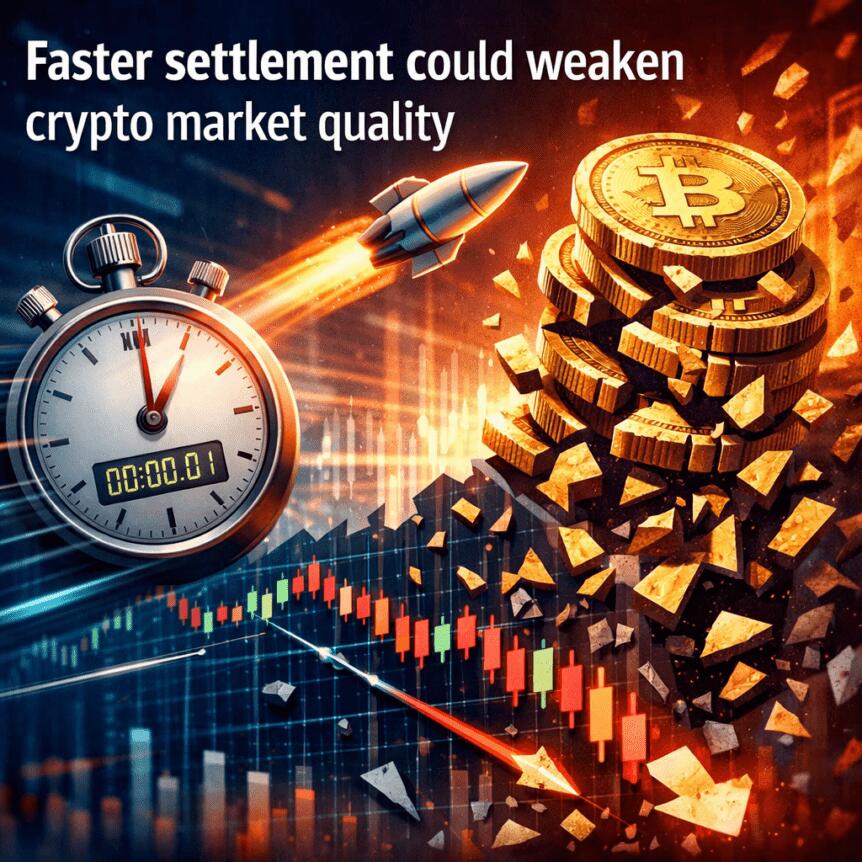
Faster settlement could weaken crypto market quality
Opinion by: Chris Kim, CEO and co-founder at Axis.
Across global markets, settlement cycles are accelerating toward real-time clearing. In 2024, the United States moved equities to T+1 settlement, a shift that follows the broader trend of faster, closer-to-live trading. Europe, the United Kingdom, and several Asian markets are expected to follow suit by around 2027. As blockchain-enabled finance pushes the envelope further, the vision of atomic settlement—where payments and asset transfers occur in a single, inseparable step—grows more tangible. Yet the speed that promises to reduce counterparty risk also demands a steady, abundant flow of capital and liquidity, creating new design questions for market infrastructure.
The overarching narrative is clear: faster settlement could redefine market efficiency, but it does not erase risk. Stablecoins and tokenized assets enable instantaneous transfers, but the financial system’s backbone—capital, liquidity, and trusted intermediaries—must still work in concert to prevent bottlenecks. As this evolved architecture takes shape, investors, traders, and builders are watching not only for speed but for how liquidity and risk are managed at scale.
Key takeaways
- Faster settlement shifts the risk calculus. Moving toward T+0–like execution compresses funding needs into each trade, reducing post-trade netting opportunities and demanding ready liquidity for every transaction.
- Capital intensity rises with speed. In traditional netted environments, a relatively small pool of capital can underpin far more trading activity. Atomic settlement tightens that loop, meaning pre-funded capital or broader liquidity buffers become essential for frequent traders and market makers.
- Intermediaries gain a new central role. Even as settlement becomes instantaneous, the orchestration of capital and liquidity is likely to rely on banks and large financial institutions to provide buffers, manage risk, and coordinate flows at scale.
- Liquidity tools may restore efficiency. Real-time netting, liquidity pooling, and cross-venue margin optimization are poised to become critical infrastructure to maintain market depth and cost-effective trading in an atomic settlement regime.
- The crypto and tokenized asset promise hinges on infrastructure. Instant settlement is compelling, but achieving it safely and transparently will require robust on-chain rails, trusted custodians, and interoperable standards across venues.
The atomic settlement paradox
At the heart of the debate is a straightforward tension: faster settlement requires more capital, not less. Traditional markets schedule final transfers later, even as trades occur throughout the day. This separation—trades executed in real time, settlement deferred—allows post-trade netting, where multiple trades offset each other and reduce the total capital that must be mobilized for settlement. Clearinghouses and centralized mechanisms have long supported this efficiency, aggregating positions and permitting FX and other arrangements to be set up with some temporal breathing room.
When settlement is atomic, the final transfer must be funded immediately and irrevocably. The opportunity to net out exposures across dozens of trades in a single day vanishes, and capital must be available in lockstep with each transaction. The result is a faster operating tempo, but a whittled-down capacity to recycle and reuse capital across the book. That fundamental shift is what proponents of atomic settlement call the paradox: speed without netting benefits can morph into a system where capital is frequently tied up rather than circulated efficiently.
Capital efficiency under pressure
To illustrate the impact, consider a netted T+2 environment. A given pool of $1 million in capital can support far more than $1 million in final settlement obligations because offsetting trades reduce net exposure. The trading volume can grow dramatically as capital circulates through multiple rounds of transactions. In an atomic settlement world, however, that same $1 million must be ready to fund the final transfer for each individual trade, one by one. The opportunity to reuse capital evaporates, and the same pool of funds becomes effectively locked for the duration of settlement.
These dynamics have real cost implications. Higher capital requirements for each trade translate into higher trading costs and potentially wider spreads as liquidity providers price in the need to pre-fund positions. For mid-sized funds and other liquidity providers, the shift could mean a reassessment of turnover strategies, as rapid entry and exit may demand larger cash buffers or a slower pace of activity to avoid bottlenecks.
The practical effect on market microstructure could be a subtle but meaningful change in how liquidity is priced and how deeply the best quotes are supported. While the grand promise of faster settlement remains attractive, the operational and capital discipline required to sustain it will shape the competitive landscape for trading venues, market makers, and liquidity providers alike.
Liquidity’s new gatekeepers
Supporters of atomic settlement argue that the benefits of speed translate into stronger risk controls and greater market resilience. Yet the opposite risk also emerges: the need to coordinate capital at scale reintroduces a layer of intermediation that blockchain and on-chain settlement were partly supposed to disrupt. Banks and large financial intermediaries, in particular, likely assume a central role in providing the capital buffers necessary to settle many transactions in real time. They act as facilitators, not merely participants, in ensuring that flows of funding and collateral remain continuous and well-managed across venues and time zones.
That reality does not spell the end of efficiency innovation. Instead, it highlights the importance of new infrastructural tools designed to preserve liquidity and price discovery in a high-speed environment. Liquidity pooling arrangements, real-time netting technologies, and cross-venue margin optimization could become essential features of the future market infrastructure. Firms that can combine scale with precise capital orchestration will be well positioned to translate speed into durable competitive advantage.
With great speed comes great responsibility
Faster settlement is not simply a back-office upgrade; it is a market-design challenge. Atomic settlement redistributes risk and reshapes who can participate, underscoring that speed alone does not eliminate the need for trusted, scalable infrastructure. As tokenized assets expand their footprint and on-chain rails mature, the most successful implementations will be those that couple high throughput with robust risk controls, transparent governance, and interoperable systems that can coordinate capital across borders and venues.
In this evolving landscape, the institutions that can align rapid settlement with disciplined operations—without freezing liquidity or raising costs to unsustainably high levels—will define the practical limits of what’s possible in modern markets. The pursuit of speed must be matched by the ability to manage capital flows, risk, and counterparty relationships at scale. Speed creates opportunity, but only when paired with systems that translate it into a sustainable, widely accessible framework for trading and settlement.
Opinion by: Chris Kim, CEO and co-founder at Axis.
This article was originally published as Faster settlement could weaken crypto market quality on Crypto Breaking News – your trusted source for crypto news, Bitcoin news, and blockchain updates.
You May Also Like

SBI VC Trade Launches Ripple’s RLUSD in Japan

Bitcoin & Ethereum Inflows Hit 1-Year Low as Crypto Investors Brace for Fed Decision – BTC Eyes $120K