

Bitcoin Whales Stop Aggressive Selling. This Is What They Are Waiting For
Bitcoin is struggling below $70,000. The market is uncertain. And the players with the most to lose have quietly stopped selling.
Top analyst Darkfost has published an assessment that reframes the current consolidation in a way the price chart alone does not permit. Bitcoin is holding a range between $62,000 and $75,000 — a level that represents approximately 47% of the all-time high reached in October. That number deserves to sit with the reader for a moment. Nearly half the value created at the cycle peak has been erased. The market that produced that peak is not the market that exists today.
And yet, Darkfost identifies a behavioral shift that cuts directly against the bearish price narrative. Whale selling activity on Binance has been declining clearly and consistently. The large players — the ones whose selling pressure helped drive the correction from the October highs — appear to be stepping back. The distribution phase that defined the first quarter of 2026 is showing signs of exhaustion.
That does not make $70,000 a floor. It does not guarantee a recovery. What it means is that the overhead selling pressure that has capped every rally attempt is quietly losing its fuel — and that changes the market’s sensitivity to any new wave of demand.
The Selling Had a Peak. That Peak Has Passed.
Darkfost’s data places the whale behavior in a precise historical context. As Bitcoin approached the $60,000 level, large holders on Binance became acutely active — the kind of activity that signals distribution rather than accumulation.
The peak arrived on February 4th: more than 11,800 BTC sent to Binance in a single day, the highest single-session whale deposit recorded in the period under review. That number did not arrive in isolation. It was the culmination of an escalating trend that pushed the 30-day moving average of daily BTC inflows from approximately 1,000 BTC to nearly 4,000 BTC by the end of February — a fourfold increase in selling infrastructure in less than a month.

What has happened since is the development the report identifies as significant. Whale deposits have declined sharply. The 30-day moving average now sits at approximately 1,600 BTC per day — still above the pre-February baseline, but less than half the peak reading. The pipeline of large-holder selling that defined February has contracted considerably.
Darkfost’s interpretation is measured and should remain so. A decline in whale deposits is not a bullish signal. It is the removal of a bearish one. Large players appear to have shifted to a wait-and-see posture — neither aggressively distributing nor aggressively accumulating. In an uncertain market, that stillness is itself information.
The pressure from above is easing. The support from below has not yet appeared to replace it.
Bitcoin Holds $66K as Downtrend Structure Remains Intact
Bitcoin is trading around the $66,000–$67,000 range, stabilizing after a sharp breakdown that defined February’s price action. The chart shows a clear transition from distribution near the $90,000–$100,000 region into a strong impulsive move lower, followed by a period of consolidation between roughly $63,000 and $70,000.
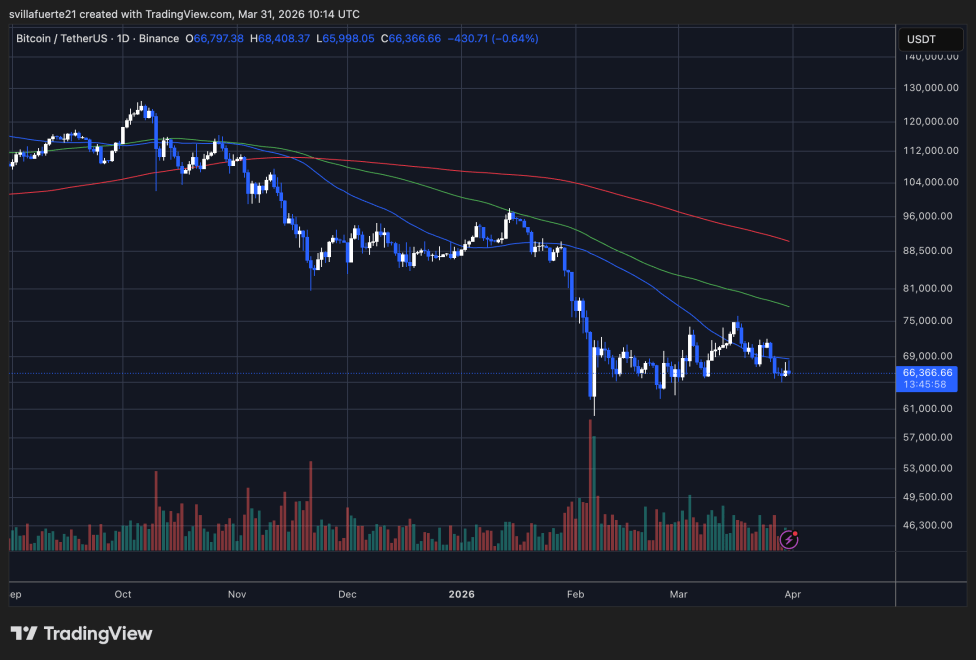
Despite this stabilization, the broader structure remains bearish. BTC continues to trade below the 50-day and 100-day moving averages, both trending downward and acting as dynamic resistance. Each recent attempt to push higher has been rejected near the $70,000–$72,000 zone, reinforcing this level as a key ceiling in the current range.
Volume dynamics support this interpretation. The largest spike occurred during the capitulation phase in February, indicating forced selling or liquidations. Since then, volume has normalized, suggesting the market is in a reaccumulation or pause phase, but without clear bullish confirmation.
Importantly, price is now compressing toward the lower half of the range. Repeated tests of the $65,000–$66,000 area suggest demand is present, but not strong enough to drive expansion.
A break above $72,000 would shift short-term momentum, while losing $63,000 could trigger another leg down, potentially targeting lower liquidity zones.
Featured image from ChatGPT, chart from TradingView.com


You May Also Like

Solana (SOL), Dogecoin (DOGE), or Little Pepe (LILPEPE): Here’s Which Coin May Deliver $10,000 in Q4 if You Invest $1,000 Right Now

NYDFS Mandates Blockchain Analysis for Banks’ Digital Asset Offerings



