The post A Decade In The Making, HaptX Team Debuts Full Body VR Haptics appeared on BitcoinEthereumNews.com. The original running man from Axon, 2016. Axon In 2017 I visited a small VR startup called AxonVR in Seattle. Founder Jake Rubin showed me concept art for a full body suspension system. A user hung in mid air inside a frame, held in place by a network of supports that allowed the arms and legs to move freely. The idea was simple to state and difficult to build. They wanted to create total immersion by capturing every motion and returning physical feedback across the user’s entire body. It looked like something from a futurist exhibit. It also captured the ambition of a team that believed VR needed more than visuals and audio to be useful. The new Nexus NX1 is expected in Q2 2026. Preorders open November 18th. 1HMX The suspension system never shipped. AxonVR changed its name to HaptX and shifted its focus to haptic gloves powered by microfluidics. The team found immediate demand for precise tactile feedback in robotics, training, and design. Gloves became the company’s core product. Enterprise customers used them to train medical staff, evaluate automotive prototypes, and operate remote manipulators. Defense agencies incorporated them into medic training modules. Robotics groups relied on them for fine motor teleoperation. That focus eventually reshaped the company. HaptX began working closely with a manufacturing group called Advanced Input Systems. The partnership deepened over the years and expanded again in 2024. The gloves became a supported product line inside the broader organization. The combined entity adopted the name 1HMX. Rubin and members of his team became part of the larger company. The resources available to them changed. The manufacturing footprint now spans several continents. The gloves matured into a stable commercial product with a large global customer base. Nexus NX1 features motorized shoes. 1HMX Last week Rubin reached out… The post A Decade In The Making, HaptX Team Debuts Full Body VR Haptics appeared on BitcoinEthereumNews.com. The original running man from Axon, 2016. Axon In 2017 I visited a small VR startup called AxonVR in Seattle. Founder Jake Rubin showed me concept art for a full body suspension system. A user hung in mid air inside a frame, held in place by a network of supports that allowed the arms and legs to move freely. The idea was simple to state and difficult to build. They wanted to create total immersion by capturing every motion and returning physical feedback across the user’s entire body. It looked like something from a futurist exhibit. It also captured the ambition of a team that believed VR needed more than visuals and audio to be useful. The new Nexus NX1 is expected in Q2 2026. Preorders open November 18th. 1HMX The suspension system never shipped. AxonVR changed its name to HaptX and shifted its focus to haptic gloves powered by microfluidics. The team found immediate demand for precise tactile feedback in robotics, training, and design. Gloves became the company’s core product. Enterprise customers used them to train medical staff, evaluate automotive prototypes, and operate remote manipulators. Defense agencies incorporated them into medic training modules. Robotics groups relied on them for fine motor teleoperation. That focus eventually reshaped the company. HaptX began working closely with a manufacturing group called Advanced Input Systems. The partnership deepened over the years and expanded again in 2024. The gloves became a supported product line inside the broader organization. The combined entity adopted the name 1HMX. Rubin and members of his team became part of the larger company. The resources available to them changed. The manufacturing footprint now spans several continents. The gloves matured into a stable commercial product with a large global customer base. Nexus NX1 features motorized shoes. 1HMX Last week Rubin reached out…

A Decade In The Making, HaptX Team Debuts Full Body VR Haptics

The original running man from Axon, 2016.

Axon

In 2017 I visited a small VR startup called AxonVR in Seattle. Founder Jake Rubin showed me concept art for a full body suspension system. A user hung in mid air inside a frame, held in place by a network of supports that allowed the arms and legs to move freely. The idea was simple to state and difficult to build. They wanted to create total immersion by capturing every motion and returning physical feedback across the user’s entire body. It looked like something from a futurist exhibit. It also captured the ambition of a team that believed VR needed more than visuals and audio to be useful.

The new Nexus NX1 is expected in Q2 2026. Preorders open November 18th.

1HMX

The suspension system never shipped. AxonVR changed its name to HaptX and shifted its focus to haptic gloves powered by microfluidics. The team found immediate demand for precise tactile feedback in robotics, training, and design. Gloves became the company’s core product. Enterprise customers used them to train medical staff, evaluate automotive prototypes, and operate remote manipulators. Defense agencies incorporated them into medic training modules. Robotics groups relied on them for fine motor teleoperation.

That focus eventually reshaped the company. HaptX began working closely with a manufacturing group called Advanced Input Systems. The partnership deepened over the years and expanded again in 2024. The gloves became a supported product line inside the broader organization. The combined entity adopted the name 1HMX. Rubin and members of his team became part of the larger company. The resources available to them changed. The manufacturing footprint now spans several continents. The gloves matured into a stable commercial product with a large global customer base.

Nexus NX1 features motorized shoes.

1HMX

Last week Rubin reached out again. The note contained a link to a new system called Nexus NX1. It launches next week under the 1HMX brand. Rubin told me it is the closest thing the company has ever built to the suspended full body concept they sketched ten years ago. The visual form is different. The purpose is the same.

eNexus NX1 joins three mature products in one turnkey system. The HaptX Gloves G1 provide detailed tactile and force feedback. The Virtuix Omni One provides a platform that enables a user to walk in any direction while remaining stationary in physical space. Freeaim robotic shoes add natural stride and foot movement. The system tracks seventy two degrees of freedom across the hands and body. It captures posture, limb rotation, foot placement, center of mass, and soft tissue movement. It returns real time tactile information from hundreds of points on the fingers and palms.

The backpack provides the force-feedback virtual hands need to create realistic touch.

1HMX

The result is a body scale interface that can control both virtual characters and physical robots. Users can walk, reach, grasp, and lift with realistic feedback. Developers can collect data describing how skilled workers move through complex tasks. Robotics teams can link the system to a humanoid robot and observe how a trained operator performs precise motions. Training groups can use it to rehearse procedures inside simulated environments.

The introduction video shows the intended use. A person walks inside the Omni platform. The shoes move with the surface. Every gesture and shift in balance flows through the system. A humanoid robot mirrors the movements. The user receives touch and pressure information through the gloves. It is not a suspended rig. It is grounded. The experience is shaped by the strengths of the components.

I asked Rubin how closely Nexus NX1 matches the vision he described in 2017. He said it aligns with the goal the team set when they were still called AxonVR. Full body input, full body output, and real physical response. The form changed. The intention remained.

Preorders for Nexus NX1 open November 18 with shipments expected in second quarter 2026. It marks a return to the idea that started the company. AxonVR imagined a full body system before the industry had a way to build it. The version arriving now comes from a far larger organization with the scale to produce it.

Source: https://www.forbes.com/sites/charliefink/2025/11/18/a-decade-in-the-making-haptx-team-debuts-full-body-vr-haptics/


Market Opportunity
Victoria VR Logo
Victoria VR Price(VR)
$0.003781
$0.003781$0.003781
+0.61%
USD
Victoria VR (VR) Live Price Chart
Disclaimer: The articles reposted on this site are sourced from public platforms and are provided for informational purposes only. They do not necessarily reflect the views of MEXC. All rights remain with the original authors. If you believe any content infringes on third-party rights, please contact [email protected] for removal. MEXC makes no guarantees regarding the accuracy, completeness, or timeliness of the content and is not responsible for any actions taken based on the information provided. The content does not constitute financial, legal, or other professional advice, nor should it be considered a recommendation or endorsement by MEXC.

You May Also Like

The Channel Factories We’ve Been Waiting For

The Channel Factories We’ve Been Waiting For

The post The Channel Factories We’ve Been Waiting For appeared on BitcoinEthereumNews.com. Visions of future technology are often prescient about the broad strokes while flubbing the details. The tablets in “2001: A Space Odyssey” do indeed look like iPads, but you never see the astronauts paying for subscriptions or wasting hours on Candy Crush.  Channel factories are one vision that arose early in the history of the Lightning Network to address some challenges that Lightning has faced from the beginning. Despite having grown to become Bitcoin’s most successful layer-2 scaling solution, with instant and low-fee payments, Lightning’s scale is limited by its reliance on payment channels. Although Lightning shifts most transactions off-chain, each payment channel still requires an on-chain transaction to open and (usually) another to close. As adoption grows, pressure on the blockchain grows with it. The need for a more scalable approach to managing channels is clear. Channel factories were supposed to meet this need, but where are they? In 2025, subnetworks are emerging that revive the impetus of channel factories with some new details that vastly increase their potential. They are natively interoperable with Lightning and achieve greater scale by allowing a group of participants to open a shared multisig UTXO and create multiple bilateral channels, which reduces the number of on-chain transactions and improves capital efficiency. Achieving greater scale by reducing complexity, Ark and Spark perform the same function as traditional channel factories with new designs and additional capabilities based on shared UTXOs.  Channel Factories 101 Channel factories have been around since the inception of Lightning. A factory is a multiparty contract where multiple users (not just two, as in a Dryja-Poon channel) cooperatively lock funds in a single multisig UTXO. They can open, close and update channels off-chain without updating the blockchain for each operation. Only when participants leave or the factory dissolves is an on-chain transaction…
Share
BitcoinEthereumNews2025/09/18 00:09
Franklin Templeton CEO Dismisses 50bps Rate Cut Ahead FOMC

Franklin Templeton CEO Dismisses 50bps Rate Cut Ahead FOMC

The post Franklin Templeton CEO Dismisses 50bps Rate Cut Ahead FOMC appeared on BitcoinEthereumNews.com. Franklin Templeton CEO Jenny Johnson has weighed in on whether the Federal Reserve should make a 25 basis points (bps) Fed rate cut or 50 bps cut. This comes ahead of the Fed decision today at today’s FOMC meeting, with the market pricing in a 25 bps cut. Bitcoin and the broader crypto market are currently trading flat ahead of the rate cut decision. Franklin Templeton CEO Weighs In On Potential FOMC Decision In a CNBC interview, Jenny Johnson said that she expects the Fed to make a 25 bps cut today instead of a 50 bps cut. She acknowledged the jobs data, which suggested that the labor market is weakening. However, she noted that this data is backward-looking, indicating that it doesn’t show the current state of the economy. She alluded to the wage growth, which she remarked is an indication of a robust labor market. She added that retail sales are up and that consumers are still spending, despite inflation being sticky at 3%, which makes a case for why the FOMC should opt against a 50-basis-point Fed rate cut. In line with this, the Franklin Templeton CEO said that she would go with a 25 bps rate cut if she were Jerome Powell. She remarked that the Fed still has the October and December FOMC meetings to make further cuts if the incoming data warrants it. Johnson also asserted that the data show a robust economy. However, she noted that there can’t be an argument for no Fed rate cut since Powell already signaled at Jackson Hole that they were likely to lower interest rates at this meeting due to concerns over a weakening labor market. Notably, her comment comes as experts argue for both sides on why the Fed should make a 25 bps cut or…
Share
BitcoinEthereumNews2025/09/18 00:36
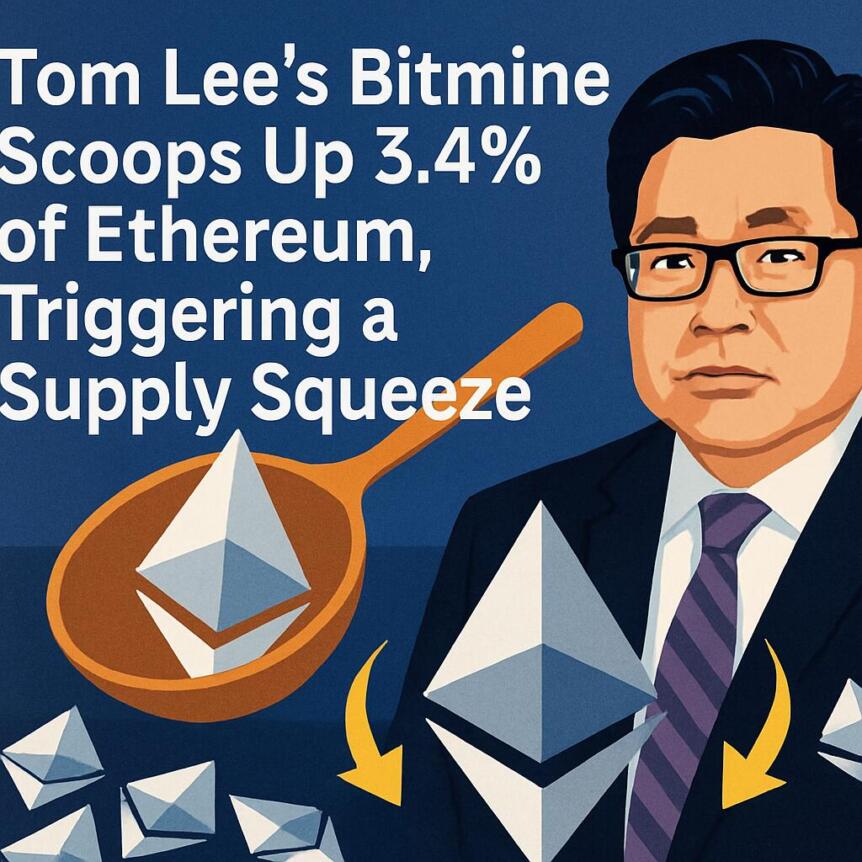
Tom Lee’s Bitmine Scoops Up 3.4% of Ethereum, Triggering a Supply Squeeze

Tom Lee’s Bitmine Scoops Up 3.4% of Ethereum, Triggering a Supply Squeeze

Bitmine Immersion now controls 3.4% of Ethereum amid shrinking exchange supply and rising institutional accumulation.
Share
Crypto Breaking News2026/01/20 16:27