This article introduces a novel arithmetical puzzle dataset designed to test and enhance AI reasoning capabilities. The puzzles involve manipulating integers through arithmetic operations to reach a target, with each number used exactly once. A data synthesis pipeline generates large-scale datasets, with controlled parameters for training, in-distribution testing, and out-of-distribution evaluation. Using the LLaMA architecture with LoRA fine-tuning, the study achieves efficient parameter reduction while benchmarking AI’s ability to generalize across numerical scales and abstract puzzle forms.This article introduces a novel arithmetical puzzle dataset designed to test and enhance AI reasoning capabilities. The puzzles involve manipulating integers through arithmetic operations to reach a target, with each number used exactly once. A data synthesis pipeline generates large-scale datasets, with controlled parameters for training, in-distribution testing, and out-of-distribution evaluation. Using the LLaMA architecture with LoRA fine-tuning, the study achieves efficient parameter reduction while benchmarking AI’s ability to generalize across numerical scales and abstract puzzle forms.

A Framework for Synthesizing Arithmetical Puzzle Datasets for Large Language Models

2025/08/24 00:35

:::info Authors:

(1) Haolong Li, Tongji Universiy and work done during internship at ByteDance ([email protected]);

(2) Yu Ma, Seed Foundation, ByteDance ([email protected]);

(3) Yinqi Zhang, East China Normal University and work done during internship at ByteDance ([email protected]);

(4) Chen Ye (Corresponding Author), ESSC Lab, Tongji Universiy ([email protected]);

(5) Jie Chen, Seed Foundation, ByteDance and a Project Leader ([email protected]).

:::

Abstract and 1 Introduction

2 Problem Definition

2.1 Arithmetical Puzzle Problem

2.2 Data Synthesizing

2.3 Dataset

3 Model

4 Experiments

4.1 Evaluation

4.2 Results

4.3 Case Studies

5 Conclusion and Acknowledgements

6 Limitations

7 Ethics Statement and References

\ A Appendix

A.1 Hyperparameter Settings

A.2 Evaluation of the Base Model

A.3 Case Study

A.4 Visualization of the Proposed Puzzle

2.1 Arithmetical Puzzle Problem

Arithmetical puzzle problem denotes a mathematical puzzle involving arithmetic operations and requires logical reasoning and numerical manipulation to derive a solution. The 24 Puzzle and Arithmetic Grid Puzzle are well-known examples of arithmetical puzzle problems.

\ In this paper, we propose a challenging arithmetical puzzle. Its objective is intricate yet precise: to deftly manipulate a set of given integers through a calculated sequence of arithmetic operations, to achieve a predetermined target integer. The problem strictly limits each integer to be used by one time exactly. For example, for the integers 3, 6, 7, 51, 58 and the target integer 4, one possible solution is: 58−51 = 7, 6−7 = −1, 3×−1 = −3, −3 + 7 = 4, as shown in Figure 5 in Appendix A.4.

\
2.2 Data Synthesizing

Given the arithmetical puzzle described above in Section 2.1, we create a data synthesizing pipeline to efficiently generate the proposed dataset.

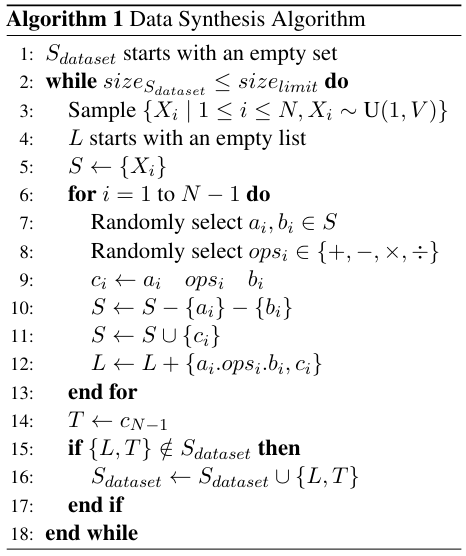
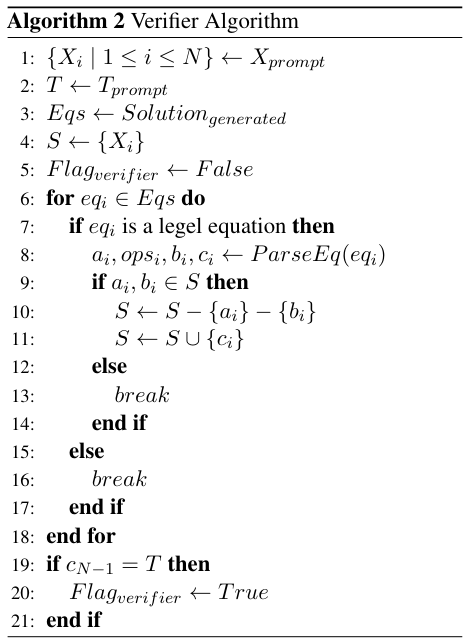
\ Denote the set of candidate integers as X = {X1, X2, . . . , XN } and the target number as T, where N is the total number of candidate integers in a puzzle sample. Each candidate integer Xi is independently sampled from a uniform distribution Xi ∼ U(1, V ), where V is the upper bound of the sampled integers. To avoid data overlapping, we have strictly ensured that for each puzzle, the candidate integers are a set of distinct numbers. The arithmetic operators involved in this problem are ops = {+, −, ×, ÷} and all operations are limited to integer operations. For example, when solving the puzzle with a division operator, the operation should be considered in integer division like 14/3 = 4. The detailed steps of synthesizing data for this puzzle is described in Algorithm 1.

\ Besides, to construct the SFT dataset, the prompt is deliberately designed to excludes any natural language cues and instead focuses on purely symbolic language. See Table 1 for an example of the constructed prompt and response.

2.3 Dataset

We split the dataset into training and in-distribution and out-of-distribution test dataset by controlling the total number of candidate integers N and the upper bound of the sampled integers V . We set

\ \
\ \ V = 60 for the training dataset, and sampled the candidate integers with N = 5, 6, 7. Three training datasets with different sizes scaling from 1 million to 10 millions and 100 millions are generated. And another 7500 samples (2500 samples for each N) under the same setting are generated as the in-distribution test dataset. Figure. 1 shows the distribution of N and X in these three training datasets. And the corresponding distribution of the tokenized prompt and response length is shown in Figure. 2.

\ To further evaluate the model’s performance on extrapolation, we have also designed two benchmarks of out-of-distribution dataset:

\ Numerical OOD test datasets. The upper bound of the sampled integers V is raised to 100 and 1000 separately to test the model’s generalization ability with unseen larger numbers. Specifically, 6000 samples are generated for each value of V with 2000 samples for each N. An additional filtering pipeline is applied to ensure that for each sample, there exists at least one integer Xi that satisfies 60 < Xi < 100 for the dataset with V = 100 and 100 < Xi < 1000 for that with V = 1000.

\ Form OOD test dataset. In mathematics, abstract forms often extend, such as expanding from a two-variable linear equation to one with three variables. For the proposed arithmetic puzzle, the extrapolation of abstract forms can be achieved by changing the number of candidate integers N. Clearly, when N increases, the exploration space leading to a feasible solution would expand exponentially, which results in an increased demand for precise reasoning steps. From another perspective, when the total number of the candidate integers changes, it actually requires the model’s ability to absorb and adapt to the puzzle’s abstract forms. Therefore, to test the model’s generalization capability from this point of view, we create another benchmark for OOD test dataset with 5000 samples generated with setting N to 8. To control variables, all the candidate integers in this dataset are sampled with the same upper bound V = 60 as the training dataset.

3 Model

3.1 Framework

We adopt the llama architecture (Touvron et al., 2023a) and employ low-rank adaptation (LoRA) tuning (Hu et al., 2021) based on the implementation of TRL full stack library (von Werra et al., 2020). LoRA achieves a remarkable reduction of 89% in our trainable parameters, from 3B to 0.3B.

3.2 Implementation Details

We train our model by fine-tuning open-llama-3B. We systematically apply left-padding to the query text and right-padding to the answer text to control the overall context length. All experiments are conducted with 8× NVIDIA A100-SXM4-80GB GPUs. The specific hyperparameter settings are listed in Table 3 in Appendix A.1.

\

:::info This paper is available on arxiv under CC BY-NC-SA 4.0 Deed (Attribution-Noncommercial-Sharelike 4.0 International) license.

:::

\

Disclaimer: The articles reposted on this site are sourced from public platforms and are provided for informational purposes only. They do not necessarily reflect the views of MEXC. All rights remain with the original authors. If you believe any content infringes on third-party rights, please contact [email protected] for removal. MEXC makes no guarantees regarding the accuracy, completeness, or timeliness of the content and is not responsible for any actions taken based on the information provided. The content does not constitute financial, legal, or other professional advice, nor should it be considered a recommendation or endorsement by MEXC.

You May Also Like

The Future of Secure Messaging: Why Decentralization Matters

The Future of Secure Messaging: Why Decentralization Matters

The post The Future of Secure Messaging: Why Decentralization Matters appeared on BitcoinEthereumNews.com. From encrypted chats to decentralized messaging Encrypted messengers are having a second wave. Apps like WhatsApp, iMessage and Signal made end-to-end encryption (E2EE) a default expectation. But most still hinge on phone numbers, centralized servers and a lot of metadata, such as who you talk to, when, from which IP and on which device. That is what Vitalik Buterin is aiming at in his recent X post and donation. He argues the next steps for secure messaging are permissionless account creation with no phone numbers or Know Your Customer (KYC) and much stronger metadata privacy. In that context he highlighted Session and SimpleX and sent 128 Ether (ETH) to each to keep pushing in that direction. Session is a good case study because it tries to combine E2E encryption with decentralization. There is no central message server, traffic is routed through onion paths, and user IDs are keys instead of phone numbers. Did you know? Forty-three percent of people who use public WiFi report experiencing a data breach, with man-in-the-middle attacks and packet sniffing against unencrypted traffic among the most common causes. How Session stores your messages Session is built around public key identities. When you sign up, the app generates a keypair locally and derives a Session ID from it with no phone number or email required. Messages travel through a network of service nodes using onion routing so that no single node can see both the sender and the recipient. (You can see your message’s node path in the settings.) For asynchronous delivery when you are offline, messages are stored in small groups of nodes called “swarms.” Each Session ID is mapped to a specific swarm, and your messages are stored there encrypted until your client fetches them. Historically, messages had a default time-to-live of about two weeks…
Share
BitcoinEthereumNews2025/12/08 14:40
Grayscale Files Sui Trust as 21Shares Launches First SUI ETF Amid Rising Demand

Grayscale Files Sui Trust as 21Shares Launches First SUI ETF Amid Rising Demand

The post Grayscale Files Sui Trust as 21Shares Launches First SUI ETF Amid Rising Demand appeared on BitcoinEthereumNews.com. The Grayscale Sui Trust filing and 21Shares’ launch of the first SUI ETF highlight surging interest in regulated Sui investments. These products offer investors direct exposure to the SUI token through spot-style structures, simplifying access to the Sui blockchain’s growth without direct custody needs, amid expanding altcoin ETF options. Grayscale’s spot Sui Trust seeks to track SUI price performance for long-term holders. 21Shares’ SUI ETF provides leveraged exposure, targeting traders with 2x daily returns. Early trading data shows over 4,700 shares exchanged, with volumes exceeding $24 per unit in the debut session. Explore Grayscale Sui Trust filing and 21Shares SUI ETF launch: Key developments in regulated Sui investments for 2025. Stay informed on altcoin ETF trends. What is the Grayscale Sui Trust? The Grayscale Sui Trust is a proposed spot-style investment product filed via S-1 registration with the U.S. Securities and Exchange Commission, aimed at providing investors with direct exposure to the SUI token’s price movements. This trust mirrors the performance of SUI, the native cryptocurrency of the Sui blockchain, minus applicable fees, offering a regulated avenue for long-term participation in the network’s ecosystem. By holding SUI assets on behalf of investors, it eliminates the need for individuals to manage token storage or transactions directly. ⚡ LATEST: GRAYSCALE FILES S-1 FOR $SUI TRUSTThe “Grayscale Sui Trust,” is a spot-style ETF designed to provide direct exposure to the $SUI token. Grayscale’s goal is to mirror SUI’s market performance, minus fees, giving long-term investors a regulated, hassle-free way to… pic.twitter.com/mPQMINLrYC — CryptosRus (@CryptosR_Us) December 6, 2025 How does the 21Shares SUI ETF differ from traditional funds? The 21Shares SUI ETF, launched under the ticker TXXS, introduces a leveraged approach with 2x daily exposure to SUI’s price fluctuations, utilizing derivatives for amplified returns rather than direct spot holdings. This structure appeals to short-term…
Share
BitcoinEthereumNews2025/12/08 14:20