Encointer introduces a new approach to decentralized monetary policy through local community currencies. Instead of inflation or fixed supply, Encointer uses demurrage—a built-in “money burn” mechanism—to preserve the real value of its unconditional basic income. This model incentivizes circulation over hoarding, keeping local economies active and fair. By linking transaction fees to local purchasing power, Encointer ensures inclusivity while empowering each community to set its own economic parameters via on-chain governance.Encointer introduces a new approach to decentralized monetary policy through local community currencies. Instead of inflation or fixed supply, Encointer uses demurrage—a built-in “money burn” mechanism—to preserve the real value of its unconditional basic income. This model incentivizes circulation over hoarding, keeping local economies active and fair. By linking transaction fees to local purchasing power, Encointer ensures inclusivity while empowering each community to set its own economic parameters via on-chain governance.

A New Way to Design Universal Basic Income in Token Economies

Abstract and I. Motivation

II. Local Currencies

III. Unique Pop Ceremonies

IV. Monetary Policy

V. Purchasing-Power Adjusted Transaction Fees

VI. Architecture

VII. Trusted Execution Environment Security

VIII. Encointer Association

IX. Known Limitations

X. Conclusion and References

IV. MONETARY POLICY

Unlike Bitcoin, Encointer local currencies don’t have a hard-capped supply. The more people are joining the ecosystem, the more money is issued. Every PoP-ceremony participant will receive one reward per attended ceremony as an unconditional basic income (UBI).

\ To analyze the macroeconomics of such a basic income scheme let’s look at the steady state of a stationary economy with a fixed population and no economic growth.

\ If we’d just issue a fixed reward after every ceremony, constant absolute nominal inflation would result. The real value of one (constant) reward would decrease over time and our UBI would become meaningless. If we want our UBI to maintain meaningful value, we can either introduce increasing rewards which may be negatively perceived as hyperinflation.

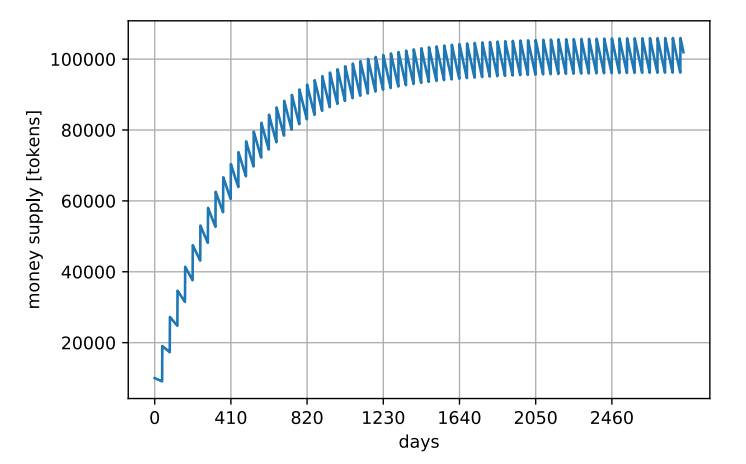
\ Fig. 2. Money supply for a stationary economy with a demurrage fee of 7% per month and a population of 10’000 participants. After an initial phase, the UBI of 1 token per ceremony maintains a constant ratio to the total money supply and therefore maintains a constant real value.
\ Or we introduce a demurrage fee [6], constantly ”burning” money. Demurrage has been tested with local currencies [24], [25] and the cryptocurrency Freicoin [26]. Encointer will employ demurrage as a nominally deflationary measure to compensate for the inflation due to ceremonies. This way, a parametrizable percentage of the money supply will be frequently redistributed in egalitarian fashion. The demurrage fee can thus be understood as a tax to the ”decentralized state” that performs the redistribution of wealth.

\ Fig 2 shows our example economy reaching an equilibrium state. For an example demurrage of 7% per month, the money supply saturates at around 100’000 tokens. Such a demurrage causes a deliberate incentive to spend as quickly as possible instead of saving. A high money velocity can be expected. For simplicity, we assume a money velocity of one per ceremony (the sum of money changing hands between two subsequent ceremonies equals the total money supply). With a stable money supply around 100’000 tokens the total of our ceremony rewards (10’000 tokens) will maintain a constant real value of 10% of all the spending during one period. That ratio will decrease with decreasing rates of demurrage.

\ Real economies are not stationary and it is not obvious, what a good amount of UBI would be. Encointer therefore allows local currencies to choose their parameters freely by means of on-chain governance.

\ One must expect that people with idle currency will try to avoid demurrage and buy assets better suited to store value, thereby reducing the real value of the Encointer currency. A nation state can enforce a legal tender and force citizens to pay taxes in national currency. An Encointer communitiy on the other hand could promote the use of its currency by social pressure.

\ Another way of applying this technology would be to use Encointer tokens as trusted vouchers for cash transfer schemes in fiat currency, run by a state or by NGOs. In this case demurrage should be disabled and replaced by verifiably burning tokens upon exanging them for fiat.

\

V. PURCHASING-POWER ADJUSTED TRANSACTION FEES

Bitcoin transactions pay a fee to the miner including the transaction in his block. Because Bitcoin has a hard cap on block size, a market develops for fees and miners choose the best-paying transactions to fill a block. This global fee market restricts adoption in developing countries where many people have very little purchasing power in global perspective. While IOTA [20] and Nano [21] have zero transaction fees they must use a small PoW as a measure against spam transactions. Even though small, PoW limits the possibilities to use mobile or IoT devices to send transactions.

\ Because Encointer currencies are local with an independent valuation, fees can be charged according to purchasing power within each community, as a percentage of the UBI which everybody can get. These fees in local currency are charged by the TEE sidechain validators who maintain the community shard.

\

:::info Author:

(1) Alain Brenzikofer ([email protected]).

:::


:::info This paper is available on arxiv under CC BY-NC-SA 4.0 DEED license.

:::

\

Market Opportunity
TokenFi Logo
TokenFi Price(TOKEN)
$0.00514
$0.00514$0.00514
+2.00%
USD
TokenFi (TOKEN) Live Price Chart
Disclaimer: The articles reposted on this site are sourced from public platforms and are provided for informational purposes only. They do not necessarily reflect the views of MEXC. All rights remain with the original authors. If you believe any content infringes on third-party rights, please contact [email protected] for removal. MEXC makes no guarantees regarding the accuracy, completeness, or timeliness of the content and is not responsible for any actions taken based on the information provided. The content does not constitute financial, legal, or other professional advice, nor should it be considered a recommendation or endorsement by MEXC.

You May Also Like

Trading time: Tonight, the US GDP and the upcoming non-farm data will become the market focus. Institutions are bullish on BTC to $120,000 in the second quarter.

Trading time: Tonight, the US GDP and the upcoming non-farm data will become the market focus. Institutions are bullish on BTC to $120,000 in the second quarter.

Daily market key data review and trend analysis, produced by PANews.
Share
PANews2025/04/30 13:50
CEO Sandeep Nailwal Shared Highlights About RWA on Polygon

CEO Sandeep Nailwal Shared Highlights About RWA on Polygon

The post CEO Sandeep Nailwal Shared Highlights About RWA on Polygon appeared on BitcoinEthereumNews.com. Polygon CEO Sandeep Nailwal highlighted Polygon’s lead in global bonds, Spiko US T-Bill, and Spiko Euro T-Bill. Polygon published an X post to share that its roadmap to GigaGas was still scaling. Sentiments around POL price were last seen to be bearish. Polygon CEO Sandeep Nailwal shared key pointers from the Dune and RWA.xyz report. These pertain to highlights about RWA on Polygon. Simultaneously, Polygon underlined its roadmap towards GigaGas. Sentiments around POL price were last seen fumbling under bearish emotions. Polygon CEO Sandeep Nailwal on Polygon RWA CEO Sandeep Nailwal highlighted three key points from the Dune and RWA.xyz report. The Chief Executive of Polygon maintained that Polygon PoS was hosting RWA TVL worth $1.13 billion across 269 assets plus 2,900 holders. Nailwal confirmed from the report that RWA was happening on Polygon. The Dune and https://t.co/W6WSFlHoQF report on RWA is out and it shows that RWA is happening on Polygon. Here are a few highlights: – Leading in Global Bonds: Polygon holds 62% share of tokenized global bonds (driven by Spiko’s euro MMF and Cashlink euro issues) – Spiko U.S.… — Sandeep | CEO, Polygon Foundation (※,※) (@sandeepnailwal) September 17, 2025 The X post published by Polygon CEO Sandeep Nailwal underlined that the ecosystem was leading in global bonds by holding a 62% share of tokenized global bonds. He further highlighted that Polygon was leading with Spiko US T-Bill at approximately 29% share of TVL along with Ethereum, adding that the ecosystem had more than 50% share in the number of holders. Finally, Sandeep highlighted from the report that there was a strong adoption for Spiko Euro T-Bill with 38% share of TVL. He added that 68% of returns were on Polygon across all the chains. Polygon Roadmap to GigaGas In a different update from Polygon, the community…
Share
BitcoinEthereumNews2025/09/18 01:10
Why Are Disaster Recovery Services Essential for SMBs?

Why Are Disaster Recovery Services Essential for SMBs?

Small and medium-sized businesses operate in an environment where downtime, data loss, or system failure can quickly turn into an existential threat. Unlike large
Share
Techbullion2026/01/14 01:16
