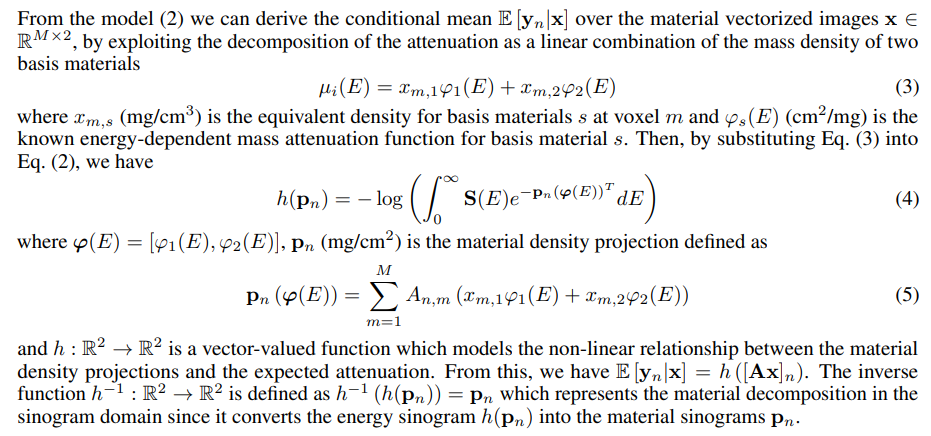
Dual-energy computed tomography (DECT) uses the energy dependence of X-ray attenuation to allow material decomposition, however traditional image-domain or model-based approaches have drawbacks such as beam-hardening effects, large processing costs, or a need for manually segmented training data. By embedding the DECT spectral model into the training loss and integrating learnt priors in the material image domain, we present End-to-End Material Decomposition (E2E-DEcomp), a deep learning system that directly maps CT projection data to quantitative material images.Dual-energy computed tomography (DECT) uses the energy dependence of X-ray attenuation to allow material decomposition, however traditional image-domain or model-based approaches have drawbacks such as beam-hardening effects, large processing costs, or a need for manually segmented training data. By embedding the DECT spectral model into the training loss and integrating learnt priors in the material image domain, we present End-to-End Material Decomposition (E2E-DEcomp), a deep learning system that directly maps CT projection data to quantitative material images.

AI-Powered Breakthrough in CT Scans: Faster, Smarter Material Imaging

:::info Authors:

(1) Jiandong Wang, Shenzhen Xilaiheng Medical Electronics, (HORRON), China and Centre for Medical Engineering and Technology, University of Dundee, DD1 4HN, UK ([email protected]);

(2) Alessandro Perelli, Centre for Medical Engineering and Technology, University of Dundee, DD1 4HN, UK ([email protected]).

:::

Abstract and 1 Introduction

  1. Dual-Energy CT Forward Model
  2. [Model-based Optimization Problem]()
  3. End-to-End Model-based Deep Learning for Material Decomposition (E2E-Decomp)
  4. Numerical Results
  5. Conclusion
  6. Compliance with Ethical Standards and References

Abstract

Dual energy X-ray Computed Tomography (DECT) enables to automatically decompose materials in clinical images without the manual segmentation using the dependency of the Xray linear attenuation with energy. In this work we propose a deep learning procedure called End-to-End Material Decomposition (E2E-DEcomp) for quantitative material decomposition which directly convert the CT projection data into material images. The algorithm is based on incorporating the knowledge of the spectral model DECT system into the deep learning training loss and combining a data-learned prior in the material image domain. Furthermore, the training does not require any energy-based images in the dataset but rather only sinogram and material images. We show the effectiveness of the proposed direct E2E-DEcomp method on the AAPM spectral CT dataset Sidky and Pan [2023] compared with state of the art supervised deep learning networks.

1 Introduction

Dual-energy computed tomography (DECT) is one spectral CT technology which is based on the deployment of two X-ray sources at different energies which can potentially allow to discriminate different materials in a specimen or to reconstruct virtual mono-energetic images which is of utmost interest in clinical imaging applications and industrial non-destructive testing Mendonça et al. [2013]. The dependency of the attenuation coefficient of different materials respect to the X-ray energy can be leveraged in the DECT material decomposition procedure whose aim is to estimate each pixel’s value as a linear combination of two different basis materials Johnson et al. [2007].

\ Different approaches have been developed to obtain material images: the image domain techniques are based on first reconstructing independently the energy dependent attenuation in each pixel Maaß et al. [2009]. The majority of the proposed networks such as U-Net Nadkarni et al. [2022] and generative adversarial network (GAN) Shi et al. [2021] are trained with a supervised learning approach which requires the pair of energy reconstructed Dual-energy computed tomography (DECT) images and basis material segmented images in the dataset. However these methods do not account from the beam-hardening effect, caused by the poly-energetic nature of the X-ray source. Moreover this approach leads to propagate the estimation errors from the reconstruction to the subsequent material decomposition.

\ In order to account for the beam-hardening effect, one-step methods directly estimate basis materials images from Cai et al. [2013] measurements projects by leveraging a model-based optimization function to minimize. However because of the highly non-linear due to the energies X-ray source coupling, this leads to minimize non-convex cost functions which require high computational cost Long and Fessler [2014].

\ An alternative approach is based on decomposing the high and low energy sinogram into two independent measurements which correspond to a single basis material. Different approximations of the decomposition function that convert the dual energy sinograms into materials independent sinograms have been proposed in Alvarez and Macovski [1976]. Afterwards each material sinogram is converted into the image domain using model-based optimization methods Mechlem et al. [2018] with spatial regularization.

\ Recently, other works have exploited the paradigm of combining deep learning and the knowledge of the physics of the DECT model within the optimisation problem. The one-step material decomposition is implemented using supervised unrolling algorithms in Eguizabal et al. [2022], Perelli and Andersen [2021] or using the Noise2Inverse framework which uses pair of sub-sampled noisy sinograms and training dataset Fang et al. [2021]. One limitation of these methods is the computational cost of the iterative solver which hinders the usage in applications which require strict time constraints.

\ In this work, we propose a new optimization framework called End-to-End Material Decomposition (E2EDEcomp) based on the idea to directly embedding the material decomposition function into the model-based optimization function. The optimization problem to solve becomes linear and the mapping is learned from the data during the iteration procedure of the solver.

\ Furthermore, the proposed method does not require any system calibration procedures to determine the material decomposition function as needed in previous approaches. The designed cost function contains the data consistency term in the material sinogram domain and a regularization term, acting in the material image domain, which is learned through an implicit denoising neural network-based function.

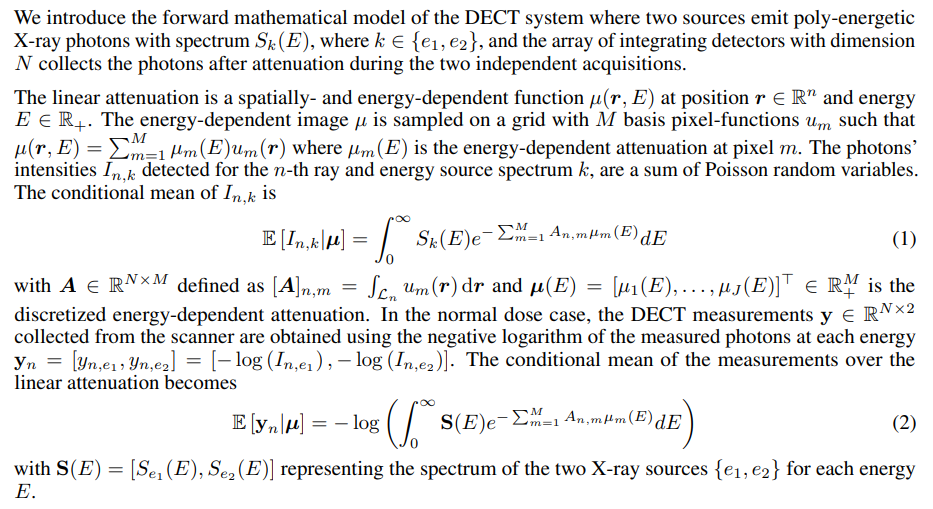
2 Dual-Energy CT Forward Model
\

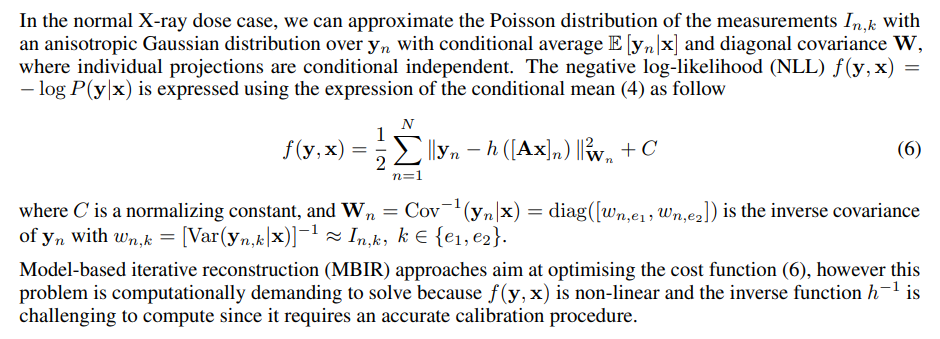
3 Model-based Optimization Problem
\

:::info This paper is available on arxiv under CC BY 4.0 DEED license.

:::

\

Market Opportunity
Sleepless AI Logo
Sleepless AI Price(AI)
$0.03658
$0.03658$0.03658
+2.49%
USD
Sleepless AI (AI) Live Price Chart
Disclaimer: The articles reposted on this site are sourced from public platforms and are provided for informational purposes only. They do not necessarily reflect the views of MEXC. All rights remain with the original authors. If you believe any content infringes on third-party rights, please contact [email protected] for removal. MEXC makes no guarantees regarding the accuracy, completeness, or timeliness of the content and is not responsible for any actions taken based on the information provided. The content does not constitute financial, legal, or other professional advice, nor should it be considered a recommendation or endorsement by MEXC.

You May Also Like

Unleashing A New Era Of Seller Empowerment

Unleashing A New Era Of Seller Empowerment

The post Unleashing A New Era Of Seller Empowerment appeared on BitcoinEthereumNews.com. Amazon AI Agent: Unleashing A New Era Of Seller Empowerment Skip to content Home AI News Amazon AI Agent: Unleashing a New Era of Seller Empowerment Source: https://bitcoinworld.co.in/amazon-ai-seller-tools/
Share
BitcoinEthereumNews2025/09/18 00:10
Foreigner’s Lou Gramm Revisits The Band’s Classic ‘4’ Album, Now Reissued

Foreigner’s Lou Gramm Revisits The Band’s Classic ‘4’ Album, Now Reissued

The post Foreigner’s Lou Gramm Revisits The Band’s Classic ‘4’ Album, Now Reissued appeared on BitcoinEthereumNews.com. American-based rock band Foreigner performs onstage at the Rosemont Horizon, Rosemont, Illinois, November 8, 1981. Pictured are, from left, Mick Jones, on guitar, and vocalist Lou Gramm. (Photo by Paul Natkin/Getty Images) Getty Images Singer Lou Gramm has a vivid memory of recording the ballad “Waiting for a Girl Like You” at New York City’s Electric Lady Studio for his band Foreigner more than 40 years ago. Gramm was adding his vocals for the track in the control room on the other side of the glass when he noticed a beautiful woman walking through the door. “She sits on the sofa in front of the board,” he says. “She looked at me while I was singing. And every now and then, she had a little smile on her face. I’m not sure what that was, but it was driving me crazy. “And at the end of the song, when I’m singing the ad-libs and stuff like that, she gets up,” he continues. “She gives me a little smile and walks out of the room. And when the song ended, I would look up every now and then to see where Mick [Jones] and Mutt [Lange] were, and they were pushing buttons and turning knobs. They were not aware that she was even in the room. So when the song ended, I said, ‘Guys, who was that woman who walked in? She was beautiful.’ And they looked at each other, and they went, ‘What are you talking about? We didn’t see anything.’ But you know what? I think they put her up to it. Doesn’t that sound more like them?” “Waiting for a Girl Like You” became a massive hit in 1981 for Foreigner off their album 4, which peaked at number one on the Billboard chart for 10 weeks and…
Share
BitcoinEthereumNews2025/09/18 01:26
One Of Frank Sinatra’s Most Famous Albums Is Back In The Spotlight

One Of Frank Sinatra’s Most Famous Albums Is Back In The Spotlight

The post One Of Frank Sinatra’s Most Famous Albums Is Back In The Spotlight appeared on BitcoinEthereumNews.com. Frank Sinatra’s The World We Knew returns to the Jazz Albums and Traditional Jazz Albums charts, showing continued demand for his timeless music. Frank Sinatra performs on his TV special Frank Sinatra: A Man and his Music Bettmann Archive These days on the Billboard charts, Frank Sinatra’s music can always be found on the jazz-specific rankings. While the art he created when he was still working was pop at the time, and later classified as traditional pop, there is no such list for the latter format in America, and so his throwback projects and cuts appear on jazz lists instead. It’s on those charts where Sinatra rebounds this week, and one of his popular projects returns not to one, but two tallies at the same time, helping him increase the total amount of real estate he owns at the moment. Frank Sinatra’s The World We Knew Returns Sinatra’s The World We Knew is a top performer again, if only on the jazz lists. That set rebounds to No. 15 on the Traditional Jazz Albums chart and comes in at No. 20 on the all-encompassing Jazz Albums ranking after not appearing on either roster just last frame. The World We Knew’s All-Time Highs The World We Knew returns close to its all-time peak on both of those rosters. Sinatra’s classic has peaked at No. 11 on the Traditional Jazz Albums chart, just missing out on becoming another top 10 for the crooner. The set climbed all the way to No. 15 on the Jazz Albums tally and has now spent just under two months on the rosters. Frank Sinatra’s Album With Classic Hits Sinatra released The World We Knew in the summer of 1967. The title track, which on the album is actually known as “The World We Knew (Over and…
Share
BitcoinEthereumNews2025/09/18 00:02