Investors have piled into Solana-linked products and on-chain cash, pushing the network back into the spotlight. Based on reports, the total supply of stablecoins sitting on Solana recently climbed to about $15 billion, a new peak that traders say is adding fuel to activity on the chain. Related Reading: 2%–4% In Crypto? Morgan Stanley Thinks That’s The Smart Move Now Stablecoin Liquidity Hits A Milestone The bulk of that supply is held in USDC, which accounts for roughly 75% of stablecoins on Solana, according to analytics cited by market commentators. That concentration has helped trading desks and decentralized apps move larger sums with less friction than on some rival chains. On top of the on-chain cash, US-listed ETFs tied to Solana and related products have recorded fast early takeup, giving institutions a simpler route into the token and staking rewards. The REX-Osprey SOL + Staking ETF, known by the ticker SSK, passed the $100 million AUM mark within days of launch, showing how appetite for regulated access to Solana can materialize quickly. ETFs Bring Fresh Flows And Visibility Reports show that REX-Osprey’s suite of crypto ETFs has now crossed half a billion dollars in combined assets under management, a sign that product innovation on Wall Street is translating into real capital flows into the sector. Market watchers say ETFs let big investors get exposure without interacting directly with wallets and custody solutions. Network Upgrades, Use Cases Part Of The Move Observers point to recent code upgrades and faster settlement as part of why more stablecoins are parked on Solana. Those changes aim to reduce delays and lower costs for traders who move USDC and other dollar-pegged tokens. Although technical gains in and of itself do not produce price movement, they can enhance a network’s attractiveness for high-frequency activity and for projects focused on tokenized assets that require transaction finality. Related Reading: Bitcoin Breaks $123,000 As Rising Open Interest Signals More Action Ahead Regulatory Framework Remains Relevant Regulation and approvals in the United States have influenced this impulse. Asset managers have filed for Solana ETFs and modified their necessary paperwork with the SEC while awaiting permits to list a product tied to the token. According to a recent reports, multiple firms have updated their submissions while the regulator is still reviewing. The broader political backdrop, including comments from US President Donald Trump and others, has kept attention on how policy could tilt institutional demand. Featured image from Unsplash, chart from TradingViewInvestors have piled into Solana-linked products and on-chain cash, pushing the network back into the spotlight. Based on reports, the total supply of stablecoins sitting on Solana recently climbed to about $15 billion, a new peak that traders say is adding fuel to activity on the chain. Related Reading: 2%–4% In Crypto? Morgan Stanley Thinks That’s The Smart Move Now Stablecoin Liquidity Hits A Milestone The bulk of that supply is held in USDC, which accounts for roughly 75% of stablecoins on Solana, according to analytics cited by market commentators. That concentration has helped trading desks and decentralized apps move larger sums with less friction than on some rival chains. On top of the on-chain cash, US-listed ETFs tied to Solana and related products have recorded fast early takeup, giving institutions a simpler route into the token and staking rewards. The REX-Osprey SOL + Staking ETF, known by the ticker SSK, passed the $100 million AUM mark within days of launch, showing how appetite for regulated access to Solana can materialize quickly. ETFs Bring Fresh Flows And Visibility Reports show that REX-Osprey’s suite of crypto ETFs has now crossed half a billion dollars in combined assets under management, a sign that product innovation on Wall Street is translating into real capital flows into the sector. Market watchers say ETFs let big investors get exposure without interacting directly with wallets and custody solutions. Network Upgrades, Use Cases Part Of The Move Observers point to recent code upgrades and faster settlement as part of why more stablecoins are parked on Solana. Those changes aim to reduce delays and lower costs for traders who move USDC and other dollar-pegged tokens. Although technical gains in and of itself do not produce price movement, they can enhance a network’s attractiveness for high-frequency activity and for projects focused on tokenized assets that require transaction finality. Related Reading: Bitcoin Breaks $123,000 As Rising Open Interest Signals More Action Ahead Regulatory Framework Remains Relevant Regulation and approvals in the United States have influenced this impulse. Asset managers have filed for Solana ETFs and modified their necessary paperwork with the SEC while awaiting permits to list a product tied to the token. According to a recent reports, multiple firms have updated their submissions while the regulator is still reviewing. The broader political backdrop, including comments from US President Donald Trump and others, has kept attention on how policy could tilt institutional demand. Featured image from Unsplash, chart from TradingView

All Eyes On Solana: $15-B Stablecoin Supply, ETF Demand Drive Next Leg Up

2025/10/07 06:30
2 min read
For feedback or concerns regarding this content, please contact us at [email protected]

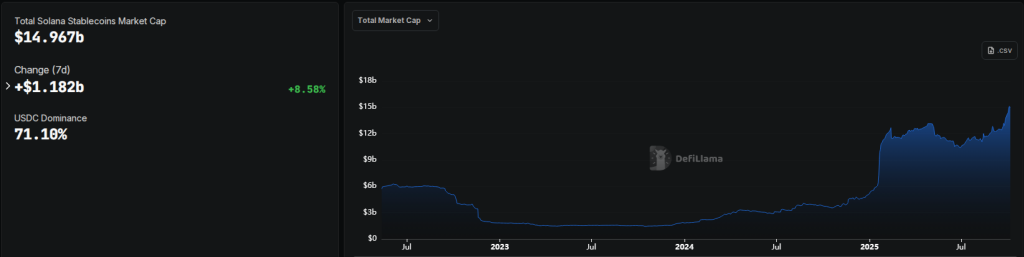
Investors have piled into Solana-linked products and on-chain cash, pushing the network back into the spotlight. Based on reports, the total supply of stablecoins sitting on Solana recently climbed to about $15 billion, a new peak that traders say is adding fuel to activity on the chain.

Stablecoin Liquidity Hits A Milestone

The bulk of that supply is held in USDC, which accounts for roughly 75% of stablecoins on Solana, according to analytics cited by market commentators. That concentration has helped trading desks and decentralized apps move larger sums with less friction than on some rival chains.

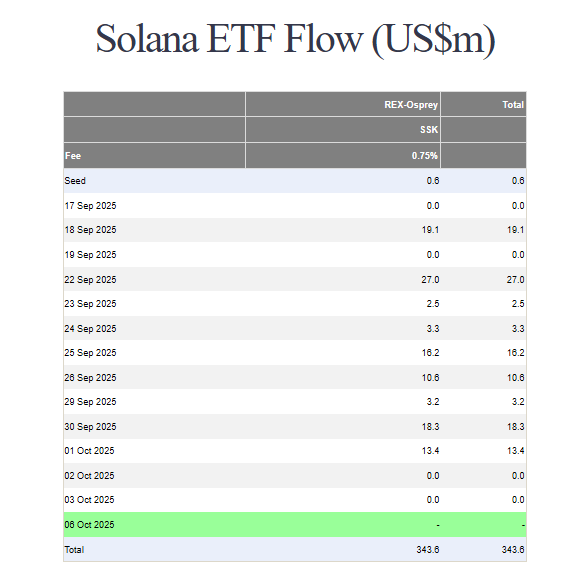
On top of the on-chain cash, US-listed ETFs tied to Solana and related products have recorded fast early takeup, giving institutions a simpler route into the token and staking rewards.

The REX-Osprey SOL + Staking ETF, known by the ticker SSK, passed the $100 million AUM mark within days of launch, showing how appetite for regulated access to Solana can materialize quickly.
ETFs Bring Fresh Flows And Visibility

Reports show that REX-Osprey’s suite of crypto ETFs has now crossed half a billion dollars in combined assets under management, a sign that product innovation on Wall Street is translating into real capital flows into the sector.

Market watchers say ETFs let big investors get exposure without interacting directly with wallets and custody solutions.
Network Upgrades, Use Cases Part Of The Move

Observers point to recent code upgrades and faster settlement as part of why more stablecoins are parked on Solana. Those changes aim to reduce delays and lower costs for traders who move USDC and other dollar-pegged tokens.

Although technical gains in and of itself do not produce price movement, they can enhance a network’s attractiveness for high-frequency activity and for projects focused on tokenized assets that require transaction finality.

Regulatory Framework Remains Relevant

Regulation and approvals in the United States have influenced this impulse. Asset managers have filed for Solana ETFs and modified their necessary paperwork with the SEC while awaiting permits to list a product tied to the token.

According to a recent reports, multiple firms have updated their submissions while the regulator is still reviewing.

The broader political backdrop, including comments from US President Donald Trump and others, has kept attention on how policy could tilt institutional demand.

Featured image from Unsplash, chart from TradingView

Market Opportunity
B Logo
B Price(B)
$0.23519
$0.23519$0.23519
-3.66%
USD
B (B) Live Price Chart
Disclaimer: The articles reposted on this site are sourced from public platforms and are provided for informational purposes only. They do not necessarily reflect the views of MEXC. All rights remain with the original authors. If you believe any content infringes on third-party rights, please contact [email protected] for removal. MEXC makes no guarantees regarding the accuracy, completeness, or timeliness of the content and is not responsible for any actions taken based on the information provided. The content does not constitute financial, legal, or other professional advice, nor should it be considered a recommendation or endorsement by MEXC.

You May Also Like

CME Group to launch options on XRP and SOL futures

CME Group to launch options on XRP and SOL futures

The post CME Group to launch options on XRP and SOL futures appeared on BitcoinEthereumNews.com. CME Group will offer options based on the derivative markets on Solana (SOL) and XRP. The new markets will open on October 13, after regulatory approval.  CME Group will expand its crypto products with options on the futures markets of Solana (SOL) and XRP. The futures market will start on October 13, after regulatory review and approval.  The options will allow the trading of MicroSol, XRP, and MicroXRP futures, with expiry dates available every business day, monthly, and quarterly. The new products will be added to the existing BTC and ETH options markets. ‘The launch of these options contracts builds on the significant growth and increasing liquidity we have seen across our suite of Solana and XRP futures,’ said Giovanni Vicioso, CME Group Global Head of Cryptocurrency Products. The options contracts will have two main sizes, tracking the futures contracts. The new market will be suitable for sophisticated institutional traders, as well as active individual traders. The addition of options markets singles out XRP and SOL as liquid enough to offer the potential to bet on a market direction.  The options on futures arrive a few months after the launch of SOL futures. Both SOL and XRP had peak volumes in August, though XRP activity has slowed down in September. XRP and SOL options to tap both institutions and active traders Crypto options are one of the indicators of market attitudes, with XRP and SOL receiving a new way to gauge sentiment. The contracts will be supported by the Cumberland team.  ‘As one of the biggest liquidity providers in the ecosystem, the Cumberland team is excited to support CME Group’s continued expansion of crypto offerings,’ said Roman Makarov, Head of Cumberland Options Trading at DRW. ‘The launch of options on Solana and XRP futures is the latest example of the…
Share
BitcoinEthereumNews2025/09/18 00:56
Health Insurers To Cover Covid Vaccines Despite RFK, Jr. Moves

Health Insurers To Cover Covid Vaccines Despite RFK, Jr. Moves

The post Health Insurers To Cover Covid Vaccines Despite RFK, Jr. Moves appeared on BitcoinEthereumNews.com. The nation’s biggest health insurance companies will continue to cover vaccinations – including those against Covid-19 and seasonal flu – previously recommended by a federal advisory committee, America’s Health Insurance Plans said Wednesday, Sept. 17, 2025. In this photo is a free flu and Covid-19 vaccine shots available sign, CVS, Queens, New York. (Photo by: Lindsey Nicholson/Universal Images Group via Getty Images) UCG/Universal Images Group via Getty Images The nation’s biggest health insurance companies will continue to cover vaccinations – including those against Covid-19 and seasonal flu – previously recommended by a federal advisory committee. The announcement by America’s Health Insurance Plans (AHIP), which includes CVS Health’s Aetna, Humana, Cigna, Centene and an array of Blue Cross and Blue Shield plans as members, comes ahead of the first meeting of the reconstituted Advisory Committee on Immunization Practices, which now has new members chosen by U.S. Health and Human Services Secretary Robert F. Kennedy Jr., a vaccine critic. “Health plans are committed to maintaining and ensuring affordable access to vaccines,” AHIP said in a statement Wednesday. “Health plan coverage decisions for immunizations are grounded in each plan’s ongoing, rigorous review of scientific and clinical evidence, and continual evaluation of multiple sources of data.” The move by AHIP is good news for millions of Americans at a time of year when they flock to drugstores, pharmacies, physician’s offices and outpatient clinics to get their seasonal flu and Covid shots. Kennedy’s changes to U.S. vaccine policy have created confusion across the country over whether certain vaccines long covered by insurance would continue to be. AHIP has now provided some clarity for millions of Americans. “Health plans will continue to cover all ACIP-recommended immunizations that were recommended as of September 1, 2025, including updated formulations of the COVID-19 and influenza vaccines, with no cost-sharing…
Share
BitcoinEthereumNews2025/09/18 03:11
US, UK, Canada Launch Operation Atlantic to Tackle Crypto Scams

US, UK, Canada Launch Operation Atlantic to Tackle Crypto Scams

Law enforcement agencies from the United States, United Kingdom, and Canada have launched Operation Atlantic, a joint effort to combat rising crypto scams and protect
Share
Coinlaw2026/03/17 22:11