On-chain data shows Bitcoin network metrics have diverged recently, with active addresses falling even as transaction volume shoots up. Bitcoin Activity Metrics Are Showing A Mixed Picture In its latest Market Pulse report, on-chain analytics firm Glassnode has talked about how a few different activity-related Bitcoin indicators have changed during the past week. The first […]On-chain data shows Bitcoin network metrics have diverged recently, with active addresses falling even as transaction volume shoots up. Bitcoin Activity Metrics Are Showing A Mixed Picture In its latest Market Pulse report, on-chain analytics firm Glassnode has talked about how a few different activity-related Bitcoin indicators have changed during the past week. The first […]

Bitcoin Network Shows Split: Active Users Fall, While Volume Surges 8%

2025/08/27 12:00

On-chain data shows Bitcoin network metrics have diverged recently, with active addresses falling even as transaction volume shoots up.

Bitcoin Activity Metrics Are Showing A Mixed Picture

In its latest Market Pulse report, on-chain analytics firm Glassnode has talked about how a few different activity-related Bitcoin indicators have changed during the past week.

The first metric of interest is the “Active Address Count,” which measures, as its name suggests, the unique total number of addresses that are becoming involved in some kind of transaction activity on the blockchain every day.

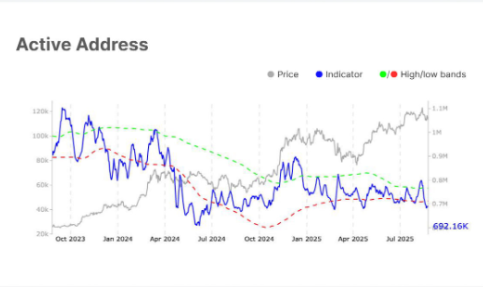
Now, here is a chart that shows the trend in the Bitcoin Active Address Count over the last couple of years:
Bitcoin Active Addresses

As displayed in the above graph, the Bitcoin Active Address Count spiked above the high statistical band earlier in the month when the cryptocurrency’s price set a new all-time high (ATH) above $124,000. This suggests user participation rose with the rally.

With the price decline that has followed the peak, however, the indicator’s value has plummeted. The metric is currently sitting at 692,000, which is down 2.2% compared to last week. This value is also below the 712,000 low statistical band, indicating that trader attention in the cryptocurrency has taken an especially big hit.

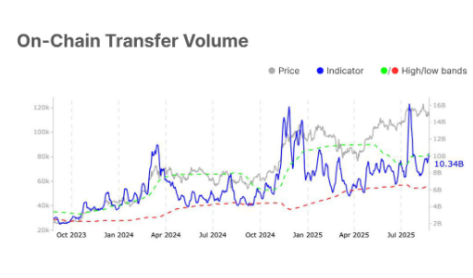
While the Active Address Count has plunged, another metric, the On-Chain Transfer Volume, has gone up instead.
Bitcoin On-Chain Volume

From the chart, it’s visible that the Bitcoin On-Chain Transfer Volume saw an uptick alongside the ATH break this month, but instead of cooling off with the price, the metric has only climbed higher since then.

The indicator has surged by 7.8% to $10.3 billion, which is above the high statistical band of $10.15 billion. But one question arises: if the number of users taking part in transfer activity has gone down as suggested by the trend in the Active Address Count, why has the On-Chain Transfer Volume gone up?

The answer is that, although both of these metrics relate to network activity, they correspond to different segments of the investors. Small hands significantly outweigh large entities in population, so the Active Address Count reflects the activity of the retail investors. On the other hand, whale transactions eclipse retail moves, so the On-Chain Transfer Volume is usually dominated by moves from big-money holders.

The divergence that has cropped up between the two Bitcoin indicators could signal that retail speculation has become muted after the price decline, while whales have ramped up activity to reposition themselves.

BTC Price

Bearish momentum has continued for Bitcoin during the last 24 hours as its price has slipped to $109,900.

Bitcoin Price Chart

Disclaimer: The articles reposted on this site are sourced from public platforms and are provided for informational purposes only. They do not necessarily reflect the views of MEXC. All rights remain with the original authors. If you believe any content infringes on third-party rights, please contact [email protected] for removal. MEXC makes no guarantees regarding the accuracy, completeness, or timeliness of the content and is not responsible for any actions taken based on the information provided. The content does not constitute financial, legal, or other professional advice, nor should it be considered a recommendation or endorsement by MEXC.

You May Also Like

BFX Presale Raises $7.5M as Solana Holds $243 and Avalanche Eyes $1B Treasury — Best Cryptos to Buy in 2025
BFX Presale Raises $7.5M as Solana Holds $243 and Avalanche Eyes $1B Treasury — Best Cryptos to Buy in 2025

BFX presale hits $7.5M with tokens at $0.024 and 30% bonus code BLOCK30, while Solana holds $243 and Avalanche builds a $1B treasury to attract institutions.
Share
Blockchainreporter2025/09/18 01:07
Major Banks Rush to Get Crypto Charters in 2025

Major Banks Rush to Get Crypto Charters in 2025

The post Major Banks Rush to Get Crypto Charters in 2025 appeared on BitcoinEthereumNews.com. Key Highlights In the latest statement, the OCC revealed a major development that approves new federally chartered banks This might open the door for crypto and fintech companies to become regulated institutions An OCC official has raised his support for the authority of existing trust banks to hold digital assets for clients, stating that they have legally provided this custody service for decades and that crypto is not different  The U.S.’s leading banking regulator has revealed that many new federally chartered banks are going to be approved soon and stated that firms working with digital assets should have a clear regulatory framework to become regulated banks.  Our first public panel of the day: @USComptroller Jonathan Gould delivers a keynote and sits for a conversation to discuss the @USOCC’s modernization agenda and GENIUS Act implementation. Tune in to watch the livestream here: https://t.co/6gK6lZakdz — Blockchain Association (@BlockchainAssn) December 8, 2025 US Regulator Welcomes New Crypto-Friendly Banks Comptroller of the Currency’s head, Jonathan V. Gould, shared a statement at a Blockchain Association Summit on December 8, where he unveiled the regulator’s plan to integrate financial innovations into the existing financial infrastructure. In his official statement, he slammed the last 15 years of “completely stagnated” new bank formations by blaming regulators for discouraging applicants.  “Over the past 15 years, de novo chartering has completely stagnated. In the late 1990s, the OCC received over 100 de novo charter applications each year, and nearly 50 per year in the early 2000s. But from 2011 through 2024, the OCC received, on average, less than four charter applications per year,” he said. Jonathan V. Gould further added into his statement, “Following the financial crisis, there were years when the OCC received only one or two charter applications—as well as years when the OCC did not receive a…
Share
BitcoinEthereumNews2025/12/09 05:26
