Bitcoin price hovers near $107,000 as legacy wallets quietly sell into institutional demand, keeping prices range-bound despite rising activity. At press time, Bitcoin was trading at $107,619, down 2.8% from the previous day. The coin moved between $107,623 and $111,555…Bitcoin price hovers near $107,000 as legacy wallets quietly sell into institutional demand, keeping prices range-bound despite rising activity. At press time, Bitcoin was trading at $107,619, down 2.8% from the previous day. The coin moved between $107,623 and $111,555…

Bitcoin price trades sideways as old wallets sell into institutional demand

Bitcoin price hovers near $107,000 as legacy wallets quietly sell into institutional demand, keeping prices range-bound despite rising activity.

Summary
  • Bitcoin trades sideways, hovering near $107K after a volatile week.
  • Long-term holders continue selling into institutional inflows, limiting upside.
  • Technicals stay neutral-to-bearish with resistance at $115K and support near $107K.

At press time, Bitcoin was trading at $107,619, down 2.8% from the previous day. The coin moved between $107,623 and $111,555 during the period, extending a 5% weekly and 7% monthly decline. After weeks of volatility, Bitcoin is now 14% below its all-time high of $126,080 set on Oct. 6.

Trading activity has picked up slightly, with $60.7 billion in volume over the last day, an 11.4% increase from the previous session. This rise shows that traders are becoming more active around current Bitcoin (BTC) price levels. However, according to CoinGlass data, open interest fell 2.3% to $70.12 billion, while derivatives volume fell 19% to $102.37 billion.

These figures suggest traders are reducing short-term holdings, which often indicates uncertainty and a wait-and-see attitude in the market.

Bitcoin selling pressure and market dynamics

A new report by 10x Research, published on Oct. 21, highlights two major forces holding Bitcoin back. The first is that digital asset treasury firms have slowed their buying, with companies like Strategy now adding smaller amounts of Bitcoin compared to previous quarters. The second is that long-term holders are selling into the demand created by Bitcoin exchange-traded funds.

This steady selling has prevented a strong breakout, keeping prices in a tight range near $110,000. According to 10x Research, Bitcoin’s performance depends more on new capital entering the market than on interest rates or macroeconomic policy. Without a clear wave of new inflows, volatility is expected to stay low and the price action subdued.

This view is supported by another Oct. 21 analysis by CryptoQuant Arab Chain. They pointed out that in October, sellers dominated Bitcoin futures, which caused the long/short ratio to drop to 0.955. This implies that traders are exercising caution and have a slight bearish outlook. Despite this, Bitcoin has held above $107,000, showing that buyers are still active at lower levels.

Bitcoin price technical analysis

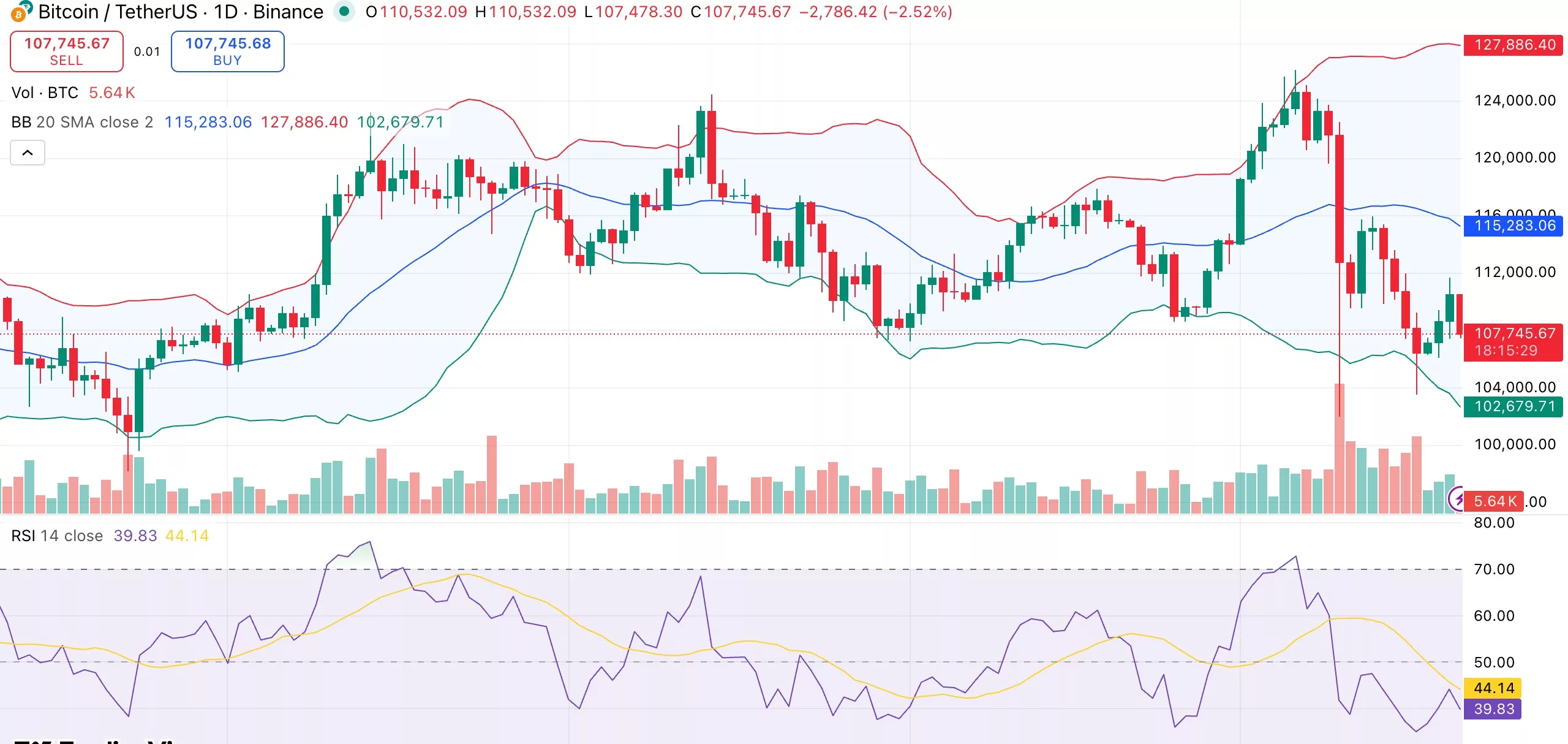
Bitcoin’s technical indicators reflect a neutral-to-bearish setup. Although the momentum has slowed, the relative strength index, which is at 40, has not yet reached oversold territory. Both the momentum and MACD indicators continue to send sell signals, confirming mild downside pressure.
Bitcoin price trades sideways as old wallets sell into institutional demand - 1

All of the major moving averages from the 10-day to the 200-day line are above the current price. This points to a bearish trend for the medium term. While resistance can be found between $112,000 and $115,000, immediate support is located near $107,000.

Bitcoin could fall back toward $102,000 if it is unable to maintain its current range. On the upside, a strong move above $115,000 might pave the way for a return to $120,000 and higher.

Disclosure: This article does not represent investment advice. The content and materials featured on this page are for educational purposes only.

Market Opportunity
NEAR Logo
NEAR Price(NEAR)
$1.552
$1.552$1.552
-0.64%
USD
NEAR (NEAR) Live Price Chart
Disclaimer: The articles reposted on this site are sourced from public platforms and are provided for informational purposes only. They do not necessarily reflect the views of MEXC. All rights remain with the original authors. If you believe any content infringes on third-party rights, please contact [email protected] for removal. MEXC makes no guarantees regarding the accuracy, completeness, or timeliness of the content and is not responsible for any actions taken based on the information provided. The content does not constitute financial, legal, or other professional advice, nor should it be considered a recommendation or endorsement by MEXC.

You May Also Like

The Channel Factories We’ve Been Waiting For

The Channel Factories We’ve Been Waiting For

The post The Channel Factories We’ve Been Waiting For appeared on BitcoinEthereumNews.com. Visions of future technology are often prescient about the broad strokes while flubbing the details. The tablets in “2001: A Space Odyssey” do indeed look like iPads, but you never see the astronauts paying for subscriptions or wasting hours on Candy Crush.  Channel factories are one vision that arose early in the history of the Lightning Network to address some challenges that Lightning has faced from the beginning. Despite having grown to become Bitcoin’s most successful layer-2 scaling solution, with instant and low-fee payments, Lightning’s scale is limited by its reliance on payment channels. Although Lightning shifts most transactions off-chain, each payment channel still requires an on-chain transaction to open and (usually) another to close. As adoption grows, pressure on the blockchain grows with it. The need for a more scalable approach to managing channels is clear. Channel factories were supposed to meet this need, but where are they? In 2025, subnetworks are emerging that revive the impetus of channel factories with some new details that vastly increase their potential. They are natively interoperable with Lightning and achieve greater scale by allowing a group of participants to open a shared multisig UTXO and create multiple bilateral channels, which reduces the number of on-chain transactions and improves capital efficiency. Achieving greater scale by reducing complexity, Ark and Spark perform the same function as traditional channel factories with new designs and additional capabilities based on shared UTXOs.  Channel Factories 101 Channel factories have been around since the inception of Lightning. A factory is a multiparty contract where multiple users (not just two, as in a Dryja-Poon channel) cooperatively lock funds in a single multisig UTXO. They can open, close and update channels off-chain without updating the blockchain for each operation. Only when participants leave or the factory dissolves is an on-chain transaction…
Share
BitcoinEthereumNews2025/09/18 00:09
Franklin Templeton CEO Dismisses 50bps Rate Cut Ahead FOMC
Franklin Templeton CEO Dismisses 50bps Rate Cut Ahead FOMC

The post Franklin Templeton CEO Dismisses 50bps Rate Cut Ahead FOMC appeared on BitcoinEthereumNews.com. Franklin Templeton CEO Jenny Johnson has weighed in on whether the Federal Reserve should make a 25 basis points (bps) Fed rate cut or 50 bps cut. This comes ahead of the Fed decision today at today’s FOMC meeting, with the market pricing in a 25 bps cut. Bitcoin and the broader crypto market are currently trading flat ahead of the rate cut decision. Franklin Templeton CEO Weighs In On Potential FOMC Decision In a CNBC interview, Jenny Johnson said that she expects the Fed to make a 25 bps cut today instead of a 50 bps cut. She acknowledged the jobs data, which suggested that the labor market is weakening. However, she noted that this data is backward-looking, indicating that it doesn’t show the current state of the economy. She alluded to the wage growth, which she remarked is an indication of a robust labor market. She added that retail sales are up and that consumers are still spending, despite inflation being sticky at 3%, which makes a case for why the FOMC should opt against a 50-basis-point Fed rate cut. In line with this, the Franklin Templeton CEO said that she would go with a 25 bps rate cut if she were Jerome Powell. She remarked that the Fed still has the October and December FOMC meetings to make further cuts if the incoming data warrants it. Johnson also asserted that the data show a robust economy. However, she noted that there can’t be an argument for no Fed rate cut since Powell already signaled at Jackson Hole that they were likely to lower interest rates at this meeting due to concerns over a weakening labor market. Notably, her comment comes as experts argue for both sides on why the Fed should make a 25 bps cut or…
Share
BitcoinEthereumNews2025/09/18 00:36
Tom Lee’s Bitmine Scoops Up 3.4% of Ethereum, Triggering a Supply Squeeze

Tom Lee’s Bitmine Scoops Up 3.4% of Ethereum, Triggering a Supply Squeeze

Bitmine Immersion now controls 3.4% of Ethereum amid shrinking exchange supply and rising institutional accumulation.
Share
Crypto Breaking News2026/01/20 16:27