Bitcoin spot exchange-traded funds (ETFs) in the United States recorded their first significant outflow in over a week, with $51.28 million leaving the market on September 17, according to data from SoSoValue. The reversal came after seven consecutive sessions of inflows that had fueled optimism among institutional investors. The retreat came just one day after U.S. Bitcoin ETFs recorded $292.27 million in net inflows on September 16. Bitcoin Spot ETF Loses Momentum While Ethereum Funds Struggle With Persistent Outflows The sudden shift reflects rapid repositioning across major issuers. Fidelity’s FBTC was the hardest hit, posting $116.03 million in daily outflows, despite holding a historical net inflow of $12.56 billion. Grayscale’s flagship GBTC also logged heavy losses, with $62.64 million withdrawn, while Ark and 21Shares’ ARKB shed $32.29 million. Smaller declines were seen at Bitwise’s BITB, which lost $12.58 million.Bitcoin ETFs Flow September 17 Source: SoSoValue Not all funds recorded redemptions, however. BlackRock’s iShares Bitcoin Trust (IBIT) continued to attract capital, pulling in $149.73 million on the day. Grayscale’s lower-fee Bitcoin Mini Trust ($BTC) also posted $22.54 million in inflows, raising its lifetime tally to $1.84 billion. The net outflows left the total assets under management for Bitcoin spot ETFs at $152.45 billion, equivalent to 6.62% of Bitcoin’s market capitalization. Cumulative net inflows across all products since launch stand at $57.33 billion. Prices tracked lower alongside the shift in flows, with many ETFs ending the day down just over 1%. Ethereum ETFs, meanwhile, remain under pressure. On September 17, Ether products saw $1.89 million in net outflows, extending a streak of withdrawals that has persisted since early September.Ethereum ETFs Flow September 17 Source: SoSoValue Fidelity’s FETH was the largest loser, with $29.19 million in redemptions. Bitwise’s ETHW also saw $9.67 million exit the fund. Inflows at BlackRock’s ETHA, which added $25.86 million, and smaller gains at Grayscale’s products were not enough to offset the broader weakness. Total assets under management for Ether ETFs now stand at $29.72 billion, or 5.47% of Ethereum’s market capitalization. Cumulative inflows are reported at $13.66 billion. The figures follow a period of heavy selling earlier this month, when Ether ETFs lost more than $1 billion over six consecutive sessions, including a $446.7 million single-day withdrawal on September 9. By contrast, Bitcoin ETFs have shown stronger resilience. Earlier in September, funds added more than $1.7 billion in inflows over four days, reversing weakness from late August when Bitcoin ETFs posted their first weekly outflows since June. Ether funds continue to bleed assets after a brief rebound mid-month, raising questions about institutional conviction in Ethereum compared to Bitcoin. SEC Approves New Listing Standards, Paving Way for More Crypto Spot ETFs The ETF market has seen renewed institutional interest. A fresh wave of cryptocurrency ETF filings has landed at the U.S. Securities and Exchange Commission (SEC), showing the industry’s push beyond traditional Bitcoin and Ether products. On Tuesday, five applications were submitted, ranging from Bitwise’s proposed spot Avalanche ETF to Tuttle’s “Income Blast” funds targeting Bonk, Litecoin, and Sui. Defiance also filed for ETFs built around Bitcoin and Ethereum basis trades, while T-Rex submitted paperwork for a leveraged 2x Orbs ETF. ETF Institute co-founder Nate Geraci noted that the industry should brace for “what’s coming over the next few months,” as the number of active applications climbs past 92, with many facing autumn deadlines. The filings arrive just as REX-Osprey prepares to launch XRP and Dogecoin ETFs on Thursday through the faster 40 Act structure, which bypasses traditional SEC approval bottlenecks. Momentum picked up further on Wednesday when the SEC approved new listing rules for major exchanges, including Nasdaq, Cboe BZX, and NYSE Arca. The decision allows generic listing standards for commodity-based trust shares, clearing the way for spot ETFs tied to a wider range of cryptocurrencies. Bloomberg analyst James Seyffart described the move as the “crypto ETP framework we’ve been waiting for,” predicting Solana and XRP could be first in line. In a separate development, the regulator cleared Grayscale’s Digital Large Cap Fund, the first multi-asset crypto ETP in the U.S., providing investors exposure to Bitcoin, Ether, XRP, Solana, and Cardano. Crypto Steadies as Fed Trims Rates 25 Bps, Bitcoin Eyes $118K Resistance Bitcoin held above $117,000 on Thursday after the Federal Reserve delivered its first interest rate cut since December, trimming the federal funds rate by 25 basis points to a range of 4.00%–4.25%. The cryptocurrency was last trading at $117,173, up 1% over 24 hours and 5.7% in the past two weeks. Ethereum followed with stronger momentum, climbing 1.8% on the day to $4,568, extending gains to 6.2% over 30 days. The Fed cited weaker job growth and a softer economic outlook for the decision, noting that 911,000 fewer jobs were created in the past year than previously reported. Inflation remains at 2.9%, above the bank’s 2% target. Chair Jerome Powell said future cuts would remain data-dependent, while President Donald Trump has pressed for deeper reductions. Market reaction was immediate. More than $105 million in crypto positions were liquidated within an hour of Powell’s remarks, with longs bearing the brunt. The global crypto market cap briefly fell 0.9% to $4.08 trillion, while Bitcoin dipped to $115,089 before recovering. On-chain data points to easing sell pressure. Bitcoin exchange inflows dropped to a yearly low, with the 7-day moving average falling to 25,000 BTC, down from 51,000 in July. Average BTC deposits have halved since mid-summer. Ethereum showed similar trends, with inflows sliding to a two-month low of 783,000 ETH.Source: X/Michaël van de Poppe Traders are now focused on the $118,000 resistance level. Analysts say a break above could open the door to retesting Bitcoin’s record high near $124,000Bitcoin spot exchange-traded funds (ETFs) in the United States recorded their first significant outflow in over a week, with $51.28 million leaving the market on September 17, according to data from SoSoValue. The reversal came after seven consecutive sessions of inflows that had fueled optimism among institutional investors. The retreat came just one day after U.S. Bitcoin ETFs recorded $292.27 million in net inflows on September 16. Bitcoin Spot ETF Loses Momentum While Ethereum Funds Struggle With Persistent Outflows The sudden shift reflects rapid repositioning across major issuers. Fidelity’s FBTC was the hardest hit, posting $116.03 million in daily outflows, despite holding a historical net inflow of $12.56 billion. Grayscale’s flagship GBTC also logged heavy losses, with $62.64 million withdrawn, while Ark and 21Shares’ ARKB shed $32.29 million. Smaller declines were seen at Bitwise’s BITB, which lost $12.58 million.Bitcoin ETFs Flow September 17 Source: SoSoValue Not all funds recorded redemptions, however. BlackRock’s iShares Bitcoin Trust (IBIT) continued to attract capital, pulling in $149.73 million on the day. Grayscale’s lower-fee Bitcoin Mini Trust ($BTC) also posted $22.54 million in inflows, raising its lifetime tally to $1.84 billion. The net outflows left the total assets under management for Bitcoin spot ETFs at $152.45 billion, equivalent to 6.62% of Bitcoin’s market capitalization. Cumulative net inflows across all products since launch stand at $57.33 billion. Prices tracked lower alongside the shift in flows, with many ETFs ending the day down just over 1%. Ethereum ETFs, meanwhile, remain under pressure. On September 17, Ether products saw $1.89 million in net outflows, extending a streak of withdrawals that has persisted since early September.Ethereum ETFs Flow September 17 Source: SoSoValue Fidelity’s FETH was the largest loser, with $29.19 million in redemptions. Bitwise’s ETHW also saw $9.67 million exit the fund. Inflows at BlackRock’s ETHA, which added $25.86 million, and smaller gains at Grayscale’s products were not enough to offset the broader weakness. Total assets under management for Ether ETFs now stand at $29.72 billion, or 5.47% of Ethereum’s market capitalization. Cumulative inflows are reported at $13.66 billion. The figures follow a period of heavy selling earlier this month, when Ether ETFs lost more than $1 billion over six consecutive sessions, including a $446.7 million single-day withdrawal on September 9. By contrast, Bitcoin ETFs have shown stronger resilience. Earlier in September, funds added more than $1.7 billion in inflows over four days, reversing weakness from late August when Bitcoin ETFs posted their first weekly outflows since June. Ether funds continue to bleed assets after a brief rebound mid-month, raising questions about institutional conviction in Ethereum compared to Bitcoin. SEC Approves New Listing Standards, Paving Way for More Crypto Spot ETFs The ETF market has seen renewed institutional interest. A fresh wave of cryptocurrency ETF filings has landed at the U.S. Securities and Exchange Commission (SEC), showing the industry’s push beyond traditional Bitcoin and Ether products. On Tuesday, five applications were submitted, ranging from Bitwise’s proposed spot Avalanche ETF to Tuttle’s “Income Blast” funds targeting Bonk, Litecoin, and Sui. Defiance also filed for ETFs built around Bitcoin and Ethereum basis trades, while T-Rex submitted paperwork for a leveraged 2x Orbs ETF. ETF Institute co-founder Nate Geraci noted that the industry should brace for “what’s coming over the next few months,” as the number of active applications climbs past 92, with many facing autumn deadlines. The filings arrive just as REX-Osprey prepares to launch XRP and Dogecoin ETFs on Thursday through the faster 40 Act structure, which bypasses traditional SEC approval bottlenecks. Momentum picked up further on Wednesday when the SEC approved new listing rules for major exchanges, including Nasdaq, Cboe BZX, and NYSE Arca. The decision allows generic listing standards for commodity-based trust shares, clearing the way for spot ETFs tied to a wider range of cryptocurrencies. Bloomberg analyst James Seyffart described the move as the “crypto ETP framework we’ve been waiting for,” predicting Solana and XRP could be first in line. In a separate development, the regulator cleared Grayscale’s Digital Large Cap Fund, the first multi-asset crypto ETP in the U.S., providing investors exposure to Bitcoin, Ether, XRP, Solana, and Cardano. Crypto Steadies as Fed Trims Rates 25 Bps, Bitcoin Eyes $118K Resistance Bitcoin held above $117,000 on Thursday after the Federal Reserve delivered its first interest rate cut since December, trimming the federal funds rate by 25 basis points to a range of 4.00%–4.25%. The cryptocurrency was last trading at $117,173, up 1% over 24 hours and 5.7% in the past two weeks. Ethereum followed with stronger momentum, climbing 1.8% on the day to $4,568, extending gains to 6.2% over 30 days. The Fed cited weaker job growth and a softer economic outlook for the decision, noting that 911,000 fewer jobs were created in the past year than previously reported. Inflation remains at 2.9%, above the bank’s 2% target. Chair Jerome Powell said future cuts would remain data-dependent, while President Donald Trump has pressed for deeper reductions. Market reaction was immediate. More than $105 million in crypto positions were liquidated within an hour of Powell’s remarks, with longs bearing the brunt. The global crypto market cap briefly fell 0.9% to $4.08 trillion, while Bitcoin dipped to $115,089 before recovering. On-chain data points to easing sell pressure. Bitcoin exchange inflows dropped to a yearly low, with the 7-day moving average falling to 25,000 BTC, down from 51,000 in July. Average BTC deposits have halved since mid-summer. Ethereum showed similar trends, with inflows sliding to a two-month low of 783,000 ETH.Source: X/Michaël van de Poppe Traders are now focused on the $118,000 resistance level. Analysts say a break above could open the door to retesting Bitcoin’s record high near $124,000

Bitcoin Spot ETF Records $51M Outflow Snaps 7-Day Inflow Streak as ETH Bleeds Again

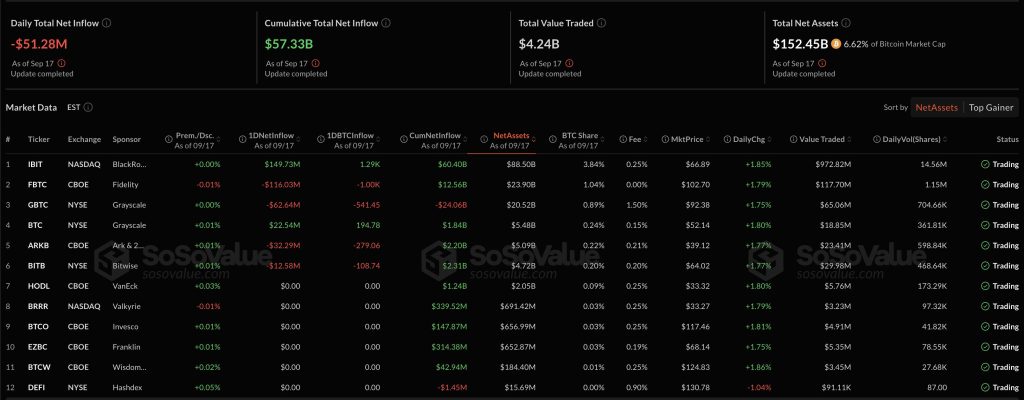
Bitcoin spot exchange-traded funds (ETFs) in the United States recorded their first significant outflow in over a week, with $51.28 million leaving the market on September 17, according to data from SoSoValue.

The reversal came after seven consecutive sessions of inflows that had fueled optimism among institutional investors. The retreat came just one day after U.S. Bitcoin ETFs recorded $292.27 million in net inflows on September 16.

Bitcoin Spot ETF Loses Momentum While Ethereum Funds Struggle With Persistent Outflows

The sudden shift reflects rapid repositioning across major issuers. Fidelity’s FBTC was the hardest hit, posting $116.03 million in daily outflows, despite holding a historical net inflow of $12.56 billion.

Grayscale’s flagship GBTC also logged heavy losses, with $62.64 million withdrawn, while Ark and 21Shares’ ARKB shed $32.29 million. Smaller declines were seen at Bitwise’s BITB, which lost $12.58 million.
Bitcoin ETFs Flow September 17 Source: SoSoValue

Not all funds recorded redemptions, however. BlackRock’s iShares Bitcoin Trust (IBIT) continued to attract capital, pulling in $149.73 million on the day.

Grayscale’s lower-fee Bitcoin Mini Trust ($BTC) also posted $22.54 million in inflows, raising its lifetime tally to $1.84 billion.

The net outflows left the total assets under management for Bitcoin spot ETFs at $152.45 billion, equivalent to 6.62% of Bitcoin’s market capitalization.

Cumulative net inflows across all products since launch stand at $57.33 billion. Prices tracked lower alongside the shift in flows, with many ETFs ending the day down just over 1%.

Ethereum ETFs, meanwhile, remain under pressure. On September 17, Ether products saw $1.89 million in net outflows, extending a streak of withdrawals that has persisted since early September.

Ethereum ETFs Flow September 17 Source: SoSoValue

Fidelity’s FETH was the largest loser, with $29.19 million in redemptions. Bitwise’s ETHW also saw $9.67 million exit the fund.

Inflows at BlackRock’s ETHA, which added $25.86 million, and smaller gains at Grayscale’s products were not enough to offset the broader weakness.

Total assets under management for Ether ETFs now stand at $29.72 billion, or 5.47% of Ethereum’s market capitalization. Cumulative inflows are reported at $13.66 billion.

The figures follow a period of heavy selling earlier this month, when Ether ETFs lost more than $1 billion over six consecutive sessions, including a $446.7 million single-day withdrawal on September 9.

By contrast, Bitcoin ETFs have shown stronger resilience. Earlier in September, funds added more than $1.7 billion in inflows over four days, reversing weakness from late August when Bitcoin ETFs posted their first weekly outflows since June.

Ether funds continue to bleed assets after a brief rebound mid-month, raising questions about institutional conviction in Ethereum compared to Bitcoin.

SEC Approves New Listing Standards, Paving Way for More Crypto Spot ETFs

The ETF market has seen renewed institutional interest. A fresh wave of cryptocurrency ETF filings has landed at the U.S. Securities and Exchange Commission (SEC), showing the industry’s push beyond traditional Bitcoin and Ether products.

On Tuesday, five applications were submitted, ranging from Bitwise’s proposed spot Avalanche ETF to Tuttle’s “Income Blast” funds targeting Bonk, Litecoin, and Sui.

Defiance also filed for ETFs built around Bitcoin and Ethereum basis trades, while T-Rex submitted paperwork for a leveraged 2x Orbs ETF.

ETF Institute co-founder Nate Geraci noted that the industry should brace for “what’s coming over the next few months,” as the number of active applications climbs past 92, with many facing autumn deadlines.

The filings arrive just as REX-Osprey prepares to launch XRP and Dogecoin ETFs on Thursday through the faster 40 Act structure, which bypasses traditional SEC approval bottlenecks.

Momentum picked up further on Wednesday when the SEC approved new listing rules for major exchanges, including Nasdaq, Cboe BZX, and NYSE Arca.

The decision allows generic listing standards for commodity-based trust shares, clearing the way for spot ETFs tied to a wider range of cryptocurrencies.

Bloomberg analyst James Seyffart described the move as the “crypto ETP framework we’ve been waiting for,” predicting Solana and XRP could be first in line.

In a separate development, the regulator cleared Grayscale’s Digital Large Cap Fund, the first multi-asset crypto ETP in the U.S., providing investors exposure to Bitcoin, Ether, XRP, Solana, and Cardano.

Crypto Steadies as Fed Trims Rates 25 Bps, Bitcoin Eyes $118K Resistance

Bitcoin held above $117,000 on Thursday after the Federal Reserve delivered its first interest rate cut since December, trimming the federal funds rate by 25 basis points to a range of 4.00%–4.25%.

The cryptocurrency was last trading at $117,173, up 1% over 24 hours and 5.7% in the past two weeks. Ethereum followed with stronger momentum, climbing 1.8% on the day to $4,568, extending gains to 6.2% over 30 days.

The Fed cited weaker job growth and a softer economic outlook for the decision, noting that 911,000 fewer jobs were created in the past year than previously reported.

Inflation remains at 2.9%, above the bank’s 2% target. Chair Jerome Powell said future cuts would remain data-dependent, while President Donald Trump has pressed for deeper reductions.

Market reaction was immediate. More than $105 million in crypto positions were liquidated within an hour of Powell’s remarks, with longs bearing the brunt.

The global crypto market cap briefly fell 0.9% to $4.08 trillion, while Bitcoin dipped to $115,089 before recovering.

On-chain data points to easing sell pressure. Bitcoin exchange inflows dropped to a yearly low, with the 7-day moving average falling to 25,000 BTC, down from 51,000 in July.

Average BTC deposits have halved since mid-summer. Ethereum showed similar trends, with inflows sliding to a two-month low of 783,000 ETH.

Source: X/Michaël van de Poppe

Traders are now focused on the $118,000 resistance level. Analysts say a break above could open the door to retesting Bitcoin’s record high near $124,000.

Market Opportunity
Ethereum Logo
Ethereum Price(ETH)
$3,212.85
$3,212.85$3,212.85
+0.89%
USD
Ethereum (ETH) Live Price Chart
Disclaimer: The articles reposted on this site are sourced from public platforms and are provided for informational purposes only. They do not necessarily reflect the views of MEXC. All rights remain with the original authors. If you believe any content infringes on third-party rights, please contact [email protected] for removal. MEXC makes no guarantees regarding the accuracy, completeness, or timeliness of the content and is not responsible for any actions taken based on the information provided. The content does not constitute financial, legal, or other professional advice, nor should it be considered a recommendation or endorsement by MEXC.

You May Also Like

CEO Sandeep Nailwal Shared Highlights About RWA on Polygon

CEO Sandeep Nailwal Shared Highlights About RWA on Polygon

The post CEO Sandeep Nailwal Shared Highlights About RWA on Polygon appeared on BitcoinEthereumNews.com. Polygon CEO Sandeep Nailwal highlighted Polygon’s lead in global bonds, Spiko US T-Bill, and Spiko Euro T-Bill. Polygon published an X post to share that its roadmap to GigaGas was still scaling. Sentiments around POL price were last seen to be bearish. Polygon CEO Sandeep Nailwal shared key pointers from the Dune and RWA.xyz report. These pertain to highlights about RWA on Polygon. Simultaneously, Polygon underlined its roadmap towards GigaGas. Sentiments around POL price were last seen fumbling under bearish emotions. Polygon CEO Sandeep Nailwal on Polygon RWA CEO Sandeep Nailwal highlighted three key points from the Dune and RWA.xyz report. The Chief Executive of Polygon maintained that Polygon PoS was hosting RWA TVL worth $1.13 billion across 269 assets plus 2,900 holders. Nailwal confirmed from the report that RWA was happening on Polygon. The Dune and https://t.co/W6WSFlHoQF report on RWA is out and it shows that RWA is happening on Polygon. Here are a few highlights: – Leading in Global Bonds: Polygon holds 62% share of tokenized global bonds (driven by Spiko’s euro MMF and Cashlink euro issues) – Spiko U.S.… — Sandeep | CEO, Polygon Foundation (※,※) (@sandeepnailwal) September 17, 2025 The X post published by Polygon CEO Sandeep Nailwal underlined that the ecosystem was leading in global bonds by holding a 62% share of tokenized global bonds. He further highlighted that Polygon was leading with Spiko US T-Bill at approximately 29% share of TVL along with Ethereum, adding that the ecosystem had more than 50% share in the number of holders. Finally, Sandeep highlighted from the report that there was a strong adoption for Spiko Euro T-Bill with 38% share of TVL. He added that 68% of returns were on Polygon across all the chains. Polygon Roadmap to GigaGas In a different update from Polygon, the community…
Share
BitcoinEthereumNews2025/09/18 01:10
Why Are Disaster Recovery Services Essential for SMBs?

Why Are Disaster Recovery Services Essential for SMBs?

Small and medium-sized businesses operate in an environment where downtime, data loss, or system failure can quickly turn into an existential threat. Unlike large
Share
Techbullion2026/01/14 01:16
The Android OS Architecture:  Part 1 — What an Operating System Actually Does

The Android OS Architecture: Part 1 — What an Operating System Actually Does

An operating system acts as the central coordinator between hardware and software, managing processes, memory, security, hardware access, and the user interface
Share
Hackernoon2026/01/14 00:32