On Friday afternoon, after powering up to 970 exahash per second (EH/s) the day prior, Bitcoin’s computational force cranked even further, hitting 976 EH/s—just 24 EH/s shy of the colossal 1 zettahash per second (ZH/s) threshold. Bitcoin’s Mining Might Continues to Flex The hashrate kept pushing upward and, a mere ten blocks before the network’s […]On Friday afternoon, after powering up to 970 exahash per second (EH/s) the day prior, Bitcoin’s computational force cranked even further, hitting 976 EH/s—just 24 EH/s shy of the colossal 1 zettahash per second (ZH/s) threshold. Bitcoin’s Mining Might Continues to Flex The hashrate kept pushing upward and, a mere ten blocks before the network’s […]

Bitcoin’s Hashrate Roars to 976 EH/S — Just a Hair From 1 ZH/s Glory

For feedback or concerns regarding this content, please contact us at [email protected]

On Friday afternoon, after powering up to 970 exahash per second (EH/s) the day prior, Bitcoin’s computational force cranked even further, hitting 976 EH/s—just 24 EH/s shy of the colossal 1 zettahash per second (ZH/s) threshold.

Bitcoin’s Mining Might Continues to Flex

The hashrate kept pushing upward and, a mere ten blocks before the network’s next difficulty adjustment, the reading reached 976 EH/s based on the seven-day simple moving average (SMA), according to hashrateindex.com metrics.
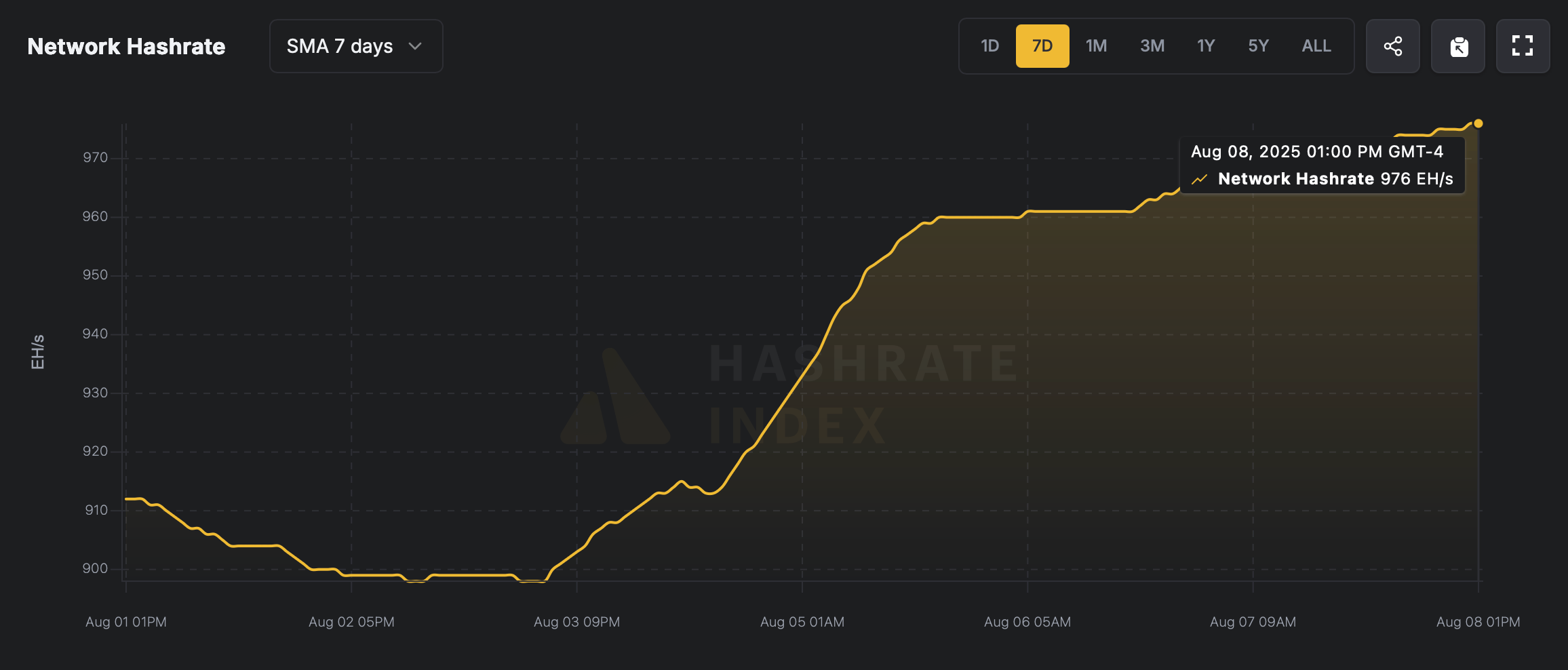
Bitcoin’s Hashrate Roars to 976 EH/S — Just a Hair From 1 ZH/s GloryComputational power metrics recorded by hashrateindex.com.

The seven-day SMA metric smooths out short-term swings by averaging data over the set period, making it easier to spot true directional trends since pinpointing the exact hashrate is notoriously tricky.

The seven-day SMA has become the go-to measure in the industry, providing a standardized snapshot that keeps analyses consistent. For example, the three-day simple moving average (SMA) paints a much loftier picture of Bitcoin’s horsepower, showing that the network briefly touched 1 zettahash between Aug. 5 and 6 earlier this week.

At 2:05 p.m. Eastern time, the live read-out clocked 972 EH/s, with Foundry powering a massive 278 EH/s—28.64% of the total. Antpool comes in second, steering 18.1% of the hashrate with more than 175 EH/s, while Viabtc follows with 128 EH/s (13.25%). F2pool holds fourth place, contributing just over 100 EH/s, or 10.35% of the network.
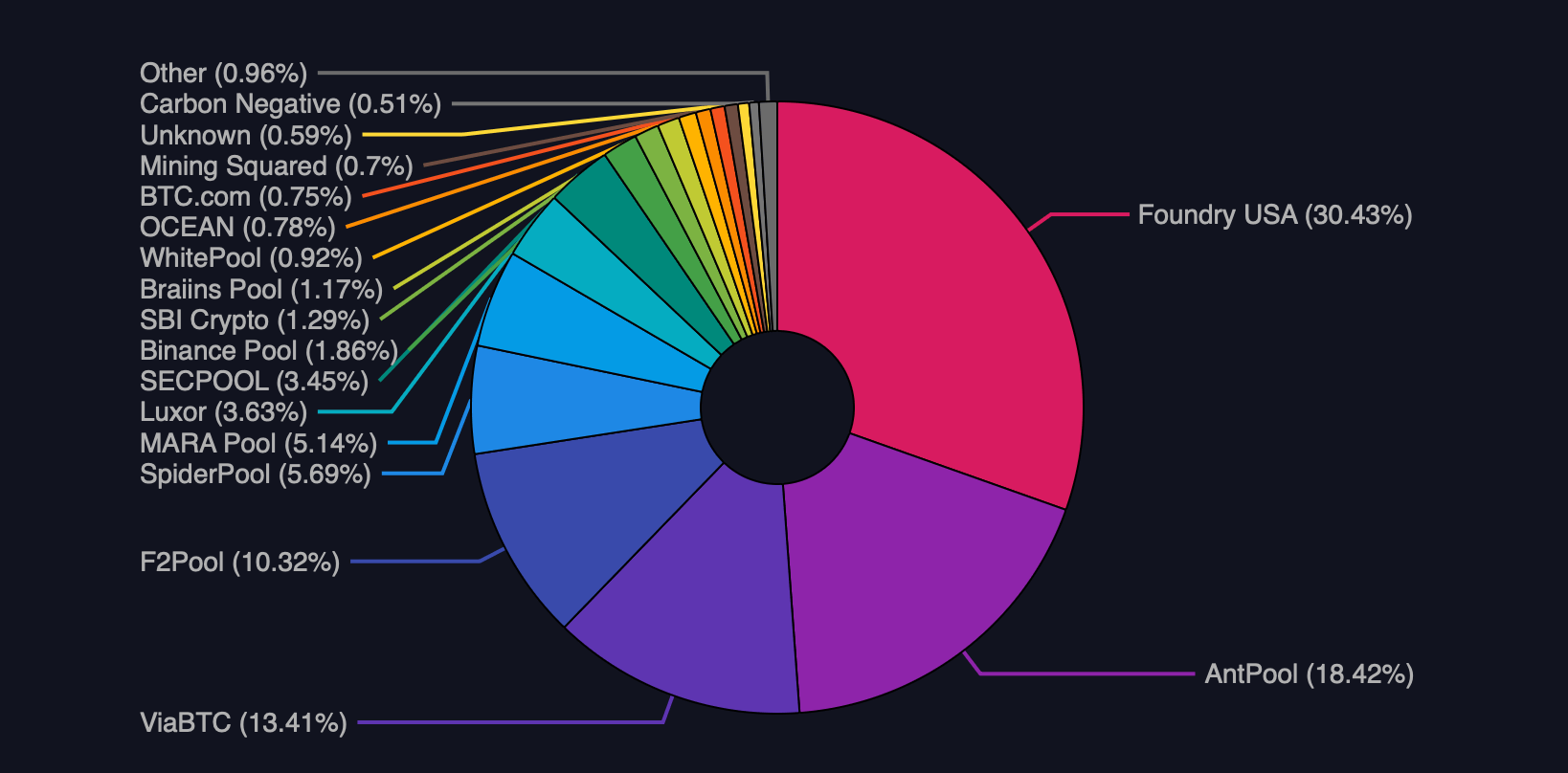
Bitcoin’s Hashrate Roars to 976 EH/S — Just a Hair From 1 ZH/s GloryMining pool distribution according to mempool.space.

In fifth place, Spiderpool runs at 83 EH/s, claiming 8.5% of Bitcoin’s collective computing firepower. If growth continues at this pace, the milestone could soon be surpassed, potentially redefining industry benchmarks and reinforcing the protocol’s standing as the most secure and resilient blockchain on the planet.

Bitcoin’s climb toward the 1 zettahash mark (1 sextillion hashes per second) signals a pivotal moment for the network, hinting at the sheer scale of resources now backing its security. If growth continues at this pace, the milestone could soon be surpassed and be constant, potentially redefining industry benchmarks and reinforcing the protocol’s standing as the most secure and resilient blockchain on the planet.

Such computational intensity also reflects the increasing competitiveness among mining pools, where efficiency and scale can dictate dominance. As leading players edge forward with ever-higher contributions, the race for hashrate control could spark new investments in hardware, energy sourcing, and global mining infrastructure, reshaping the balance of power in the bitcoin mining arena.

Disclaimer: The articles reposted on this site are sourced from public platforms and are provided for informational purposes only. They do not necessarily reflect the views of MEXC. All rights remain with the original authors. If you believe any content infringes on third-party rights, please contact [email protected] for removal. MEXC makes no guarantees regarding the accuracy, completeness, or timeliness of the content and is not responsible for any actions taken based on the information provided. The content does not constitute financial, legal, or other professional advice, nor should it be considered a recommendation or endorsement by MEXC.

You May Also Like

Forward Industries Bets Big on Solana With $4B Capital Plan

Forward Industries Bets Big on Solana With $4B Capital Plan

The firm has filed with the U.S. Securities and Exchange Commission to launch a $4 billion at-the-market (ATM) equity program, […] The post Forward Industries Bets Big on Solana With $4B Capital Plan appeared first on Coindoo.
Share
Coindoo2025/09/18 04:15
Long-Term Ripples of Crypto Breaches

Long-Term Ripples of Crypto Breaches

The post Long-Term Ripples of Crypto Breaches appeared on BitcoinEthereumNews.com. The release of a new report by cybersecurity platform Immunefi sheds light on
Share
BitcoinEthereumNews2026/03/23 04:58
Michael Saylor Pushes Digital Capital Narrative At Bitcoin Treasuries Unconference

Michael Saylor Pushes Digital Capital Narrative At Bitcoin Treasuries Unconference

The post Michael Saylor Pushes Digital Capital Narrative At Bitcoin Treasuries Unconference appeared on BitcoinEthereumNews.com. The suitcoiners are in town.  From a low-key, circular podium in the middle of a lavish New York City event hall, Strategy executive chairman Michael Saylor took the mic and opened the Bitcoin Treasuries Unconference event. He joked awkwardly about the orange ties, dresses, caps and other merch to the (mostly male) audience of who’s-who in the bitcoin treasury company world.  Once he got onto the regular beat, it was much of the same: calm and relaxed, speaking freely and with confidence, his keynote was heavy on the metaphors and larger historical stories. Treasury companies are like Rockefeller’s Standard Oil in its early years, Michael Saylor said: We’ve just discovered crude oil and now we’re making sense of the myriad ways in which we can use it — the automobile revolution and jet fuel is still well ahead of us.  Established, trillion-dollar companies not using AI because of “security concerns” make them slow and stupid — just like companies and individuals rejecting digital assets now make them poor and weak.  “I’d like to think that we understood our business five years ago; we didn’t.”  We went from a defensive investment into bitcoin, Saylor said, to opportunistic, to strategic, and finally transformational; “only then did we realize that we were different.” Michael Saylor: You Come Into My Financial History House?! Jokes aside, Michael Saylor is very welcome to the warm waters of our financial past. He acquitted himself honorably by invoking the British Consol — though mispronouncing it, and misdating it to the 1780s; Pelham’s consolidation of debts happened in the 1750s and perpetual government debt existed well before then — and comparing it to the gold standard and the future of bitcoin. He’s right that Strategy’s STRC product in many ways imitates the consols; irredeemable, perpetual debt, issued at par, with…
Share
BitcoinEthereumNews2025/09/18 02:12