Author: hitesh.eth , Crypto KOL Compiled by Felix, PANews This article delves into Bittensor, explaining why it is not a decentralized OpenAI, but rather a decentralized AI economy; it also explains how dTAO reshapes incentive mechanism design, how subnet economies work, and why TAO represents a cultural resistance to centralized AI. What changed after dTAO? Many may be wondering what Bittensor is trying to achieve. Is it trying to create a decentralized OpenAI, or is there something deeper at play? In fact, the crypto community generally believed that it could be a decentralized OpenAI, but confusion arose when it removed subnet restrictions and introduced the dTAO (which also involved subnet tokens) to make it more competitive. This shift was crucial because it shifted the network's reward distribution from centralized voting by a small number of validators to a fully market-driven system. The introduction of dynamic TAOs (dTAOs) fundamentally changed the ecosystem's operating mechanisms. The allocation of daily TAO issuance shifted entirely from the root validator (Subnet 0, which critics called an oligarchic voting system) to the market price of each subnet's alpha token. Each mining subnet received its own alpha (α) token and its own automated market maker (AMM) pool. This enabled each subnet to develop an independent, capital-driven economy. Staking shifted from delegating TAOs to a single validator (Subnet 0 staking) to purchasing and staking subnet-specific alpha tokens (α). Stakers now bear market risk but can directly influence resource allocation. The previously rigid 50/50 reward split between miners and validators evolved to the current 41/41/18 split to better fund subnet owners (18%) and encourage continued innovation in the subnet's core incentive mechanisms. Grand Vision Today, Bittensor competes with centralized AI development and distribution platforms, providing developers with the infrastructure to build diverse AI use cases across various industries. This is crucial to understanding Bittensor's total addressable market (TAM). While companies like OpenAI compete in the multi-billion dollar immediate market, selling finished AI products like subscriptions or API access, Bittensor targets the multi-trillion dollar market for the entire AI value chain—including computing infrastructure, data validation, model training, and the peer-reviewed intelligence layer. If successful, Bittensor, as the foundational, permissionless platform for all decentralized AI, will have a TAM far exceeding that of any single proprietary AI company. Bittensor is developing and deploying diverse AI models, building a coordination engine for a distributed and decentralized AI ecosystem while simultaneously incentivizing the provision of funding and computing resources to achieve the highest levels of quality, efficiency, and trust in outcomes across decentralized AI projects for diverse use cases. This is more like building a decentralized AI value chain in which anyone can participate with capital, knowledge, and computing power. Bittensor is for everyone, not just the 0.000001% of the world who can participate in OpenAI. Bittensor's overall vision is to build a neural internet. Over the past four years, Bittensor has built a loyal community that brings together top VCs like DCG, crypto researchers like Sami Kasab, and many talented people who work every day to advance this vision. They create content, do podcasts, develop products, and are starting a movement. Bittensor has also built a subnet ecosystem, with approximately 126 subnets currently active. The current cost of a subnet is approximately 1,600 TAOs ($640,000 USD), and this cost is dynamic and will change based on the frequency of new subnet registrations. After a few months of suspension, new subnet registrations are now open again. Grayscale, founded in 2013 by Barry Silbert, one of the earliest Bitcoin pioneers, aimed to attract institutional investors to Bitcoin. Now, Grayscale is creating a similar fund for subnet tokens. The fund, called the Yuma Subnet Composite Fund, will invest in the top subnet tokens by market capitalization. Subnet Tokens Subnet tokens are currently one of the most overlooked assets on crypto Twitter. 99% of users are completely unaware of this space. The core concept behind subnet token prices is that they are denominated in TAO, rather than simply pegged, and are determined by the liquidity ratio in their automated market maker (AMM) pools. The higher the value of a subnet token relative to TAO, the more it is issued. More issuance attracts more miners to host and run AI models and provide computing resources. Miners compete to optimize the output of subnet models, and better results lead to higher prices. More precisely, better service attracts more staking demand, which drives up prices, ensuring the overall output quality of AI models used in different subnets for different use cases. Validators ensure that miners maintain quality. Their job is to verify the miners' work and assign a score to it. Based on this score, the miners receive issuance from the subnet. Approximately 7,200 TAOs are issued daily, and this number will be halved over the next two months, with the first Bittensor halving event in December. This means there's currently intense competition within the mining ecosystem for the highest returns. Most miners will stick to mining on the best-performing subnets, and if they mine on top subnets, the price of those subnet tokens will rise accordingly. Increased mining demand driven by high issuance always leads to higher subnet token prices. Initial demand for mining on a subnet often comes from speculation about the use case it's building, the team behind it, its track record, and the backing of a major corporation. Currently, the top subnet tokens with the highest issuance volume include Chutes, Ridges, and Gradient. Some of these subnets are also venture-backed. For example, Gradient is building the AI Trains platform. It was built by Rayon Labs, which also operates Chutes, the leading subnet by issuance volume. Many of these subnets are collaborating with each other to exchange services. For example, Ridges is a Chutes client; Sportstensor is building AI models for sports betting and prediction; and there are subnets like OpenKaito, which powers Kaito's InfoFi Pioneer. Taofi is also part of Bittensor. They have launched a DEX that allows you to easily bridge and exchange subnet tokens from the Base network. Trust TAO If you're asking which subnet tokens will attract demand, you need to track the growth of the subnet token's price relative to TAO. The more growth you see over different timeframes, the higher the demand. Then, you need to look at the ADR (alpha distribution ratio). It should be less than 1, as token withdrawals are now permitted. The worst-performing subnets are withdrawn weekly. If the ADR ratio is above 1, the community may lose a portion of the value of the TAO collateral staked to acquire that token due to the liquidation discount upon withdrawal. You can also track staking pools for different subnets. The more TAO is staked to acquire subnet tokens, the more likely the price will rise. Therefore, the value of subnet tokens depends largely on how long they can maintain high issuance. If they maintain high issuance and the businesses surrounding the subnet generate revenue from the services and products they provide, the price of the subnet token is likely to continue to rise. The overall market capitalization growth surrounding the subnet will directly drive TAO price increases. However, it's recommended to stay away from things you don't understand. Subnet tokens aren't like your average altcoin or junk coin. They require a deeper logical understanding, so if you believe in their vision, invest in TAO. TAO isn't meant to be traded, but rather a cultural symbol against AI centralization. The question isn’t whether decentralized AI will exist, but who will own it. Bittensor has made its choice, and others will too. Related Reading: Bittensor Subnet Investment Guide: Seizing the Next AI TrendAuthor: hitesh.eth , Crypto KOL Compiled by Felix, PANews This article delves into Bittensor, explaining why it is not a decentralized OpenAI, but rather a decentralized AI economy; it also explains how dTAO reshapes incentive mechanism design, how subnet economies work, and why TAO represents a cultural resistance to centralized AI. What changed after dTAO? Many may be wondering what Bittensor is trying to achieve. Is it trying to create a decentralized OpenAI, or is there something deeper at play? In fact, the crypto community generally believed that it could be a decentralized OpenAI, but confusion arose when it removed subnet restrictions and introduced the dTAO (which also involved subnet tokens) to make it more competitive. This shift was crucial because it shifted the network's reward distribution from centralized voting by a small number of validators to a fully market-driven system. The introduction of dynamic TAOs (dTAOs) fundamentally changed the ecosystem's operating mechanisms. The allocation of daily TAO issuance shifted entirely from the root validator (Subnet 0, which critics called an oligarchic voting system) to the market price of each subnet's alpha token. Each mining subnet received its own alpha (α) token and its own automated market maker (AMM) pool. This enabled each subnet to develop an independent, capital-driven economy. Staking shifted from delegating TAOs to a single validator (Subnet 0 staking) to purchasing and staking subnet-specific alpha tokens (α). Stakers now bear market risk but can directly influence resource allocation. The previously rigid 50/50 reward split between miners and validators evolved to the current 41/41/18 split to better fund subnet owners (18%) and encourage continued innovation in the subnet's core incentive mechanisms. Grand Vision Today, Bittensor competes with centralized AI development and distribution platforms, providing developers with the infrastructure to build diverse AI use cases across various industries. This is crucial to understanding Bittensor's total addressable market (TAM). While companies like OpenAI compete in the multi-billion dollar immediate market, selling finished AI products like subscriptions or API access, Bittensor targets the multi-trillion dollar market for the entire AI value chain—including computing infrastructure, data validation, model training, and the peer-reviewed intelligence layer. If successful, Bittensor, as the foundational, permissionless platform for all decentralized AI, will have a TAM far exceeding that of any single proprietary AI company. Bittensor is developing and deploying diverse AI models, building a coordination engine for a distributed and decentralized AI ecosystem while simultaneously incentivizing the provision of funding and computing resources to achieve the highest levels of quality, efficiency, and trust in outcomes across decentralized AI projects for diverse use cases. This is more like building a decentralized AI value chain in which anyone can participate with capital, knowledge, and computing power. Bittensor is for everyone, not just the 0.000001% of the world who can participate in OpenAI. Bittensor's overall vision is to build a neural internet. Over the past four years, Bittensor has built a loyal community that brings together top VCs like DCG, crypto researchers like Sami Kasab, and many talented people who work every day to advance this vision. They create content, do podcasts, develop products, and are starting a movement. Bittensor has also built a subnet ecosystem, with approximately 126 subnets currently active. The current cost of a subnet is approximately 1,600 TAOs ($640,000 USD), and this cost is dynamic and will change based on the frequency of new subnet registrations. After a few months of suspension, new subnet registrations are now open again. Grayscale, founded in 2013 by Barry Silbert, one of the earliest Bitcoin pioneers, aimed to attract institutional investors to Bitcoin. Now, Grayscale is creating a similar fund for subnet tokens. The fund, called the Yuma Subnet Composite Fund, will invest in the top subnet tokens by market capitalization. Subnet Tokens Subnet tokens are currently one of the most overlooked assets on crypto Twitter. 99% of users are completely unaware of this space. The core concept behind subnet token prices is that they are denominated in TAO, rather than simply pegged, and are determined by the liquidity ratio in their automated market maker (AMM) pools. The higher the value of a subnet token relative to TAO, the more it is issued. More issuance attracts more miners to host and run AI models and provide computing resources. Miners compete to optimize the output of subnet models, and better results lead to higher prices. More precisely, better service attracts more staking demand, which drives up prices, ensuring the overall output quality of AI models used in different subnets for different use cases. Validators ensure that miners maintain quality. Their job is to verify the miners' work and assign a score to it. Based on this score, the miners receive issuance from the subnet. Approximately 7,200 TAOs are issued daily, and this number will be halved over the next two months, with the first Bittensor halving event in December. This means there's currently intense competition within the mining ecosystem for the highest returns. Most miners will stick to mining on the best-performing subnets, and if they mine on top subnets, the price of those subnet tokens will rise accordingly. Increased mining demand driven by high issuance always leads to higher subnet token prices. Initial demand for mining on a subnet often comes from speculation about the use case it's building, the team behind it, its track record, and the backing of a major corporation. Currently, the top subnet tokens with the highest issuance volume include Chutes, Ridges, and Gradient. Some of these subnets are also venture-backed. For example, Gradient is building the AI Trains platform. It was built by Rayon Labs, which also operates Chutes, the leading subnet by issuance volume. Many of these subnets are collaborating with each other to exchange services. For example, Ridges is a Chutes client; Sportstensor is building AI models for sports betting and prediction; and there are subnets like OpenKaito, which powers Kaito's InfoFi Pioneer. Taofi is also part of Bittensor. They have launched a DEX that allows you to easily bridge and exchange subnet tokens from the Base network. Trust TAO If you're asking which subnet tokens will attract demand, you need to track the growth of the subnet token's price relative to TAO. The more growth you see over different timeframes, the higher the demand. Then, you need to look at the ADR (alpha distribution ratio). It should be less than 1, as token withdrawals are now permitted. The worst-performing subnets are withdrawn weekly. If the ADR ratio is above 1, the community may lose a portion of the value of the TAO collateral staked to acquire that token due to the liquidation discount upon withdrawal. You can also track staking pools for different subnets. The more TAO is staked to acquire subnet tokens, the more likely the price will rise. Therefore, the value of subnet tokens depends largely on how long they can maintain high issuance. If they maintain high issuance and the businesses surrounding the subnet generate revenue from the services and products they provide, the price of the subnet token is likely to continue to rise. The overall market capitalization growth surrounding the subnet will directly drive TAO price increases. However, it's recommended to stay away from things you don't understand. Subnet tokens aren't like your average altcoin or junk coin. They require a deeper logical understanding, so if you believe in their vision, invest in TAO. TAO isn't meant to be traded, but rather a cultural symbol against AI centralization. The question isn’t whether decentralized AI will exist, but who will own it. Bittensor has made its choice, and others will too. Related Reading: Bittensor Subnet Investment Guide: Seizing the Next AI Trend

Bittensor (TAO) Explained: A Trillion-Dollar Market Opportunity

2025/10/14 10:56
7 min read

Author: hitesh.eth , Crypto KOL

Compiled by Felix, PANews

This article delves into Bittensor, explaining why it is not a decentralized OpenAI, but rather a decentralized AI economy; it also explains how dTAO reshapes incentive mechanism design, how subnet economies work, and why TAO represents a cultural resistance to centralized AI.

What changed after dTAO?

Many may be wondering what Bittensor is trying to achieve. Is it trying to create a decentralized OpenAI, or is there something deeper at play? In fact, the crypto community generally believed that it could be a decentralized OpenAI, but confusion arose when it removed subnet restrictions and introduced the dTAO (which also involved subnet tokens) to make it more competitive. This shift was crucial because it shifted the network's reward distribution from centralized voting by a small number of validators to a fully market-driven system.

The introduction of dynamic TAOs (dTAOs) fundamentally changed the ecosystem's operating mechanisms. The allocation of daily TAO issuance shifted entirely from the root validator (Subnet 0, which critics called an oligarchic voting system) to the market price of each subnet's alpha token. Each mining subnet received its own alpha (α) token and its own automated market maker (AMM) pool. This enabled each subnet to develop an independent, capital-driven economy. Staking shifted from delegating TAOs to a single validator (Subnet 0 staking) to purchasing and staking subnet-specific alpha tokens (α). Stakers now bear market risk but can directly influence resource allocation. The previously rigid 50/50 reward split between miners and validators evolved to the current 41/41/18 split to better fund subnet owners (18%) and encourage continued innovation in the subnet's core incentive mechanisms.

Grand Vision

Today, Bittensor competes with centralized AI development and distribution platforms, providing developers with the infrastructure to build diverse AI use cases across various industries. This is crucial to understanding Bittensor's total addressable market (TAM). While companies like OpenAI compete in the multi-billion dollar immediate market, selling finished AI products like subscriptions or API access, Bittensor targets the multi-trillion dollar market for the entire AI value chain—including computing infrastructure, data validation, model training, and the peer-reviewed intelligence layer.

If successful, Bittensor, as the foundational, permissionless platform for all decentralized AI, will have a TAM far exceeding that of any single proprietary AI company. Bittensor is developing and deploying diverse AI models, building a coordination engine for a distributed and decentralized AI ecosystem while simultaneously incentivizing the provision of funding and computing resources to achieve the highest levels of quality, efficiency, and trust in outcomes across decentralized AI projects for diverse use cases. This is more like building a decentralized AI value chain in which anyone can participate with capital, knowledge, and computing power.

Bittensor is for everyone, not just the 0.000001% of the world who can participate in OpenAI.

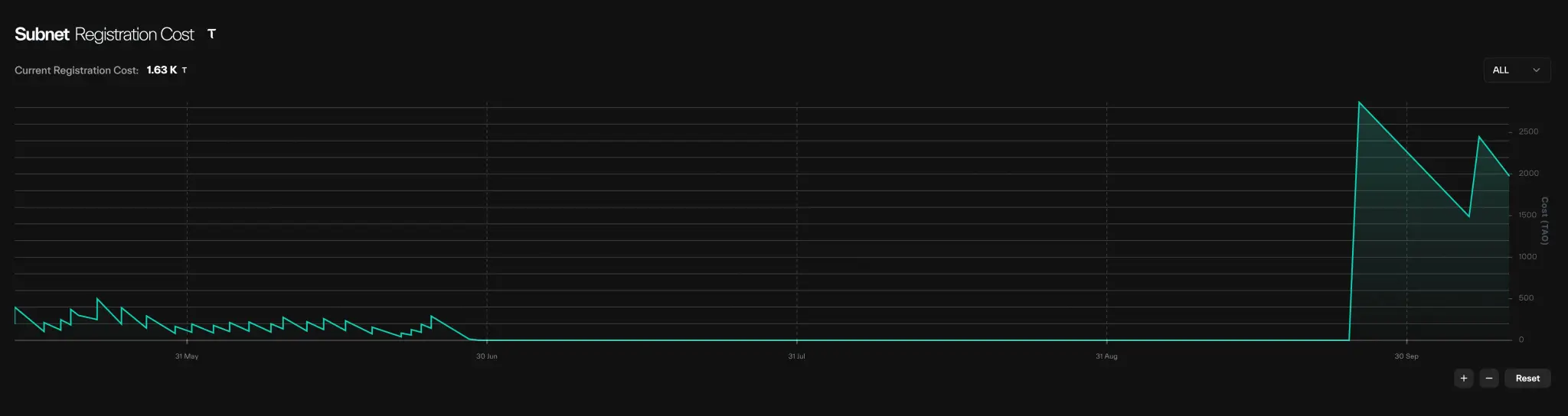
Bittensor's overall vision is to build a neural internet. Over the past four years, Bittensor has built a loyal community that brings together top VCs like DCG, crypto researchers like Sami Kasab, and many talented people who work every day to advance this vision. They create content, do podcasts, develop products, and are starting a movement. Bittensor has also built a subnet ecosystem, with approximately 126 subnets currently active. The current cost of a subnet is approximately 1,600 TAOs ($640,000 USD), and this cost is dynamic and will change based on the frequency of new subnet registrations. After a few months of suspension, new subnet registrations are now open again.

Grayscale, founded in 2013 by Barry Silbert, one of the earliest Bitcoin pioneers, aimed to attract institutional investors to Bitcoin. Now, Grayscale is creating a similar fund for subnet tokens. The fund, called the Yuma Subnet Composite Fund, will invest in the top subnet tokens by market capitalization.

Subnet Tokens

Subnet tokens are currently one of the most overlooked assets on crypto Twitter. 99% of users are completely unaware of this space. The core concept behind subnet token prices is that they are denominated in TAO, rather than simply pegged, and are determined by the liquidity ratio in their automated market maker (AMM) pools. The higher the value of a subnet token relative to TAO, the more it is issued. More issuance attracts more miners to host and run AI models and provide computing resources. Miners compete to optimize the output of subnet models, and better results lead to higher prices. More precisely, better service attracts more staking demand, which drives up prices, ensuring the overall output quality of AI models used in different subnets for different use cases. Validators ensure that miners maintain quality.

Their job is to verify the miners' work and assign a score to it. Based on this score, the miners receive issuance from the subnet. Approximately 7,200 TAOs are issued daily, and this number will be halved over the next two months, with the first Bittensor halving event in December.
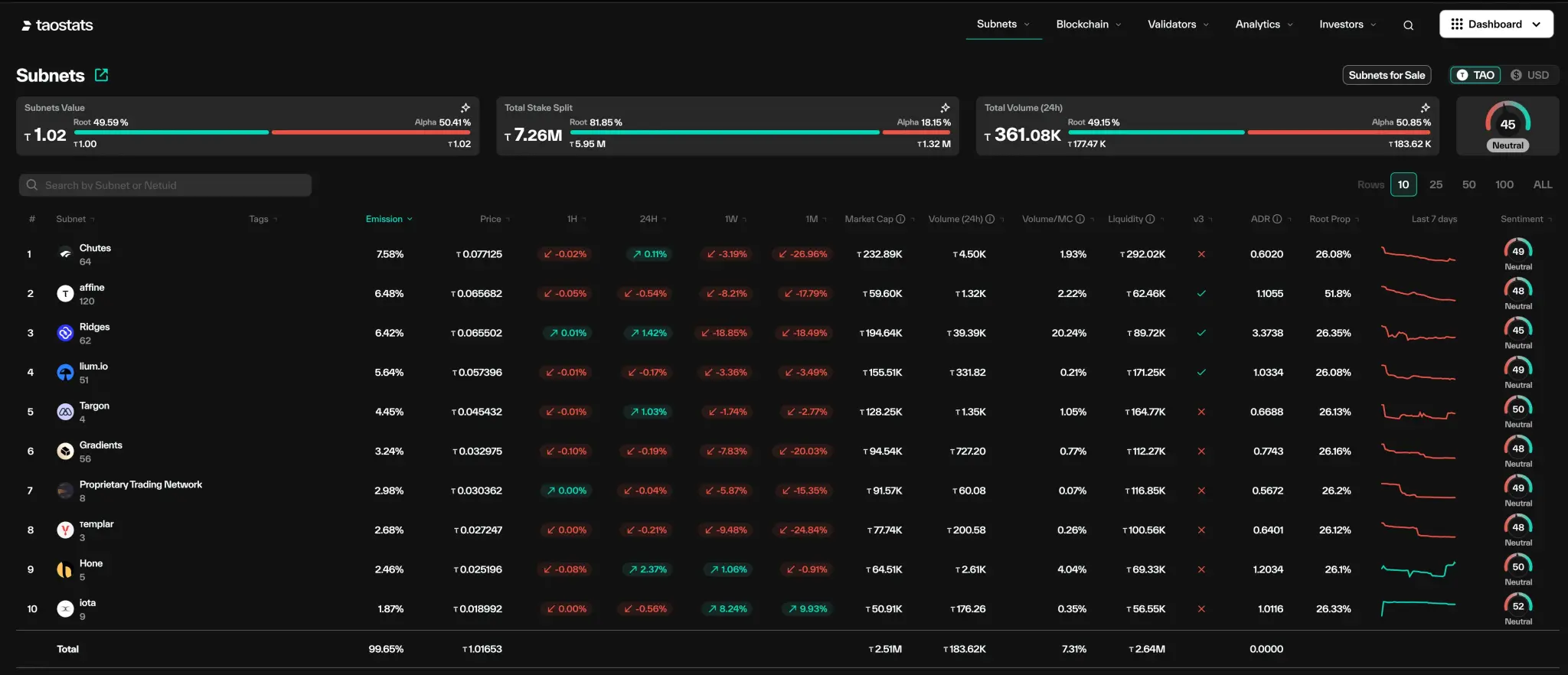
This means there's currently intense competition within the mining ecosystem for the highest returns. Most miners will stick to mining on the best-performing subnets, and if they mine on top subnets, the price of those subnet tokens will rise accordingly. Increased mining demand driven by high issuance always leads to higher subnet token prices. Initial demand for mining on a subnet often comes from speculation about the use case it's building, the team behind it, its track record, and the backing of a major corporation.

Currently, the top subnet tokens with the highest issuance volume include Chutes, Ridges, and Gradient. Some of these subnets are also venture-backed. For example, Gradient is building the AI Trains platform. It was built by Rayon Labs, which also operates Chutes, the leading subnet by issuance volume. Many of these subnets are collaborating with each other to exchange services. For example, Ridges is a Chutes client; Sportstensor is building AI models for sports betting and prediction; and there are subnets like OpenKaito, which powers Kaito's InfoFi Pioneer. Taofi is also part of Bittensor. They have launched a DEX that allows you to easily bridge and exchange subnet tokens from the Base network.

Trust TAO

If you're asking which subnet tokens will attract demand, you need to track the growth of the subnet token's price relative to TAO. The more growth you see over different timeframes, the higher the demand. Then, you need to look at the ADR (alpha distribution ratio). It should be less than 1, as token withdrawals are now permitted. The worst-performing subnets are withdrawn weekly. If the ADR ratio is above 1, the community may lose a portion of the value of the TAO collateral staked to acquire that token due to the liquidation discount upon withdrawal.
You can also track staking pools for different subnets. The more TAO is staked to acquire subnet tokens, the more likely the price will rise. Therefore, the value of subnet tokens depends largely on how long they can maintain high issuance. If they maintain high issuance and the businesses surrounding the subnet generate revenue from the services and products they provide, the price of the subnet token is likely to continue to rise. The overall market capitalization growth surrounding the subnet will directly drive TAO price increases.

However, it's recommended to stay away from things you don't understand. Subnet tokens aren't like your average altcoin or junk coin. They require a deeper logical understanding, so if you believe in their vision, invest in TAO. TAO isn't meant to be traded, but rather a cultural symbol against AI centralization.

The question isn’t whether decentralized AI will exist, but who will own it. Bittensor has made its choice, and others will too.

Related Reading: Bittensor Subnet Investment Guide: Seizing the Next AI Trend

Market Opportunity
Bittensor Logo
Bittensor Price(TAO)
$173.48
$173.48$173.48
-1.95%
USD
Bittensor (TAO) Live Price Chart
Disclaimer: The articles reposted on this site are sourced from public platforms and are provided for informational purposes only. They do not necessarily reflect the views of MEXC. All rights remain with the original authors. If you believe any content infringes on third-party rights, please contact [email protected] for removal. MEXC makes no guarantees regarding the accuracy, completeness, or timeliness of the content and is not responsible for any actions taken based on the information provided. The content does not constitute financial, legal, or other professional advice, nor should it be considered a recommendation or endorsement by MEXC.

You May Also Like

What Could Stop Gold from Its 8th Consecutive Green Month

What Could Stop Gold from Its 8th Consecutive Green Month

The post What Could Stop Gold from Its 8th Consecutive Green Month appeared on BitcoinEthereumNews.com. Gold is on the verge of an unprecedented eighth consecutive
Share
BitcoinEthereumNews2026/02/23 03:47
Elizabeth Warren raises ethics concerns over White House crypto czar David Sacks’ tenure

Elizabeth Warren raises ethics concerns over White House crypto czar David Sacks’ tenure

The post Elizabeth Warren raises ethics concerns over White House crypto czar David Sacks’ tenure appeared on BitcoinEthereumNews.com. Democratic lawmakers pressed David Sacks, President Donald Trump’s “crypto and AI czar,” on Sept. 17 to disclose whether he has exceeded the time limits of his temporary White House appointment, raising questions about possible ethics violations. In a letter signed by Senator Elizabeth Warren and seven other members of Congress, the lawmakers said Sacks may have surpassed the 130-day cap for Special Government Employees, a category that allows private-sector professionals to serve the government on a part-time or temporary basis. The Office of Government Ethics sets the cap to minimize conflicts of interest, as SGEs are permitted to continue receiving outside salaries while in government service. Warren has previously raised similar concerns around Sacks’ appointment. Conflict-of-interest worries Sacks, a venture capitalist and general partner at Craft Ventures, has played a high-profile role in shaping Trump administration policy on digital assets and artificial intelligence. Lawmakers argued that his private financial ties to Silicon Valley raise serious ethical questions if he is no longer within the bounds of SGE status. According to the letter: “When issuing your ethics waiver, the White House noted that the careful balance in conflict-of-interest rules for SGEs was reached with the understanding that they would only serve the public ‘on a temporary basis. For you in particular, compliance with the SGE time limit is critical, given the scale of your conflicts of interest.” The group noted that Sacks’ private salary from Craft Ventures is permissible only under the temporary provisions of his appointment. If he has worked past the legal limit, the lawmakers warned, his continued dual roles could represent a breach of ethics. Counting the days According to the letter, Sacks was appointed in December 2024 and began working around Trump’s inauguration on Jan. 20, 2025. By the lawmakers’ calculation, he reached the 130-day threshold in…
Share
BitcoinEthereumNews2025/09/18 07:37
Fed renteverlaging veroorzaakt marktdaling: Cryptomarkt crash?

Fed renteverlaging veroorzaakt marktdaling: Cryptomarkt crash?

Connect met Like-minded Crypto Enthusiasts! Connect op Discord! Check onze Discord   De Federal Reserve (Fed) heeft vandaag, 17 september 2025, een rentebesluit gemaakt. Het Fed rentebesluit is bekend en de rente is verlaagd. De voorzitter van de Fed, Jerome Powell, kondigde aan dat er voldoende ruimte was voor een renteverlaging. Maar waarom daalt de cryptomarkt hierdoor en komt er een cryptomarkt crash?  Federal Reserve (FED) verlaagt de rente Vandaag, op 17 september 2025, heeft Jerome Powell names de Fed de rente verlaagt met 0,25%. Dit betekent dat de rente van 4,25% tot 4,50% naar 4,00% tot 4,25% gaat. De rente is niet meer verlaagd sinds december 2024, maar Powell besloot nu wel de rente te verlagen. Wil je meer lezen over waarom Powell de rente nu omlaag heeft gehaald? Lees dan dit artikel! Bitcoin reageert op renteverlaging Vele investeerders dachten dat een renteverlaging voor een positief sentiment zal zorgen op de cryptomarkt. Helaas voor deze optimistische investeerders is niets minder waar. Op het moment van schrijven zien we dat Bitcoin (BTC) juist de andere kant op reageert. Bitcoin is aan het dalen in plaats van aan het stijgen. In de afgelopen 24 uur zagen we een daling van meer dan 1%. BTC daalde zelfs kortstondig onder de $ 115.000. Dit wijst erop dat de renteverlaging niet voor een positief, maar voor een negatief sentiment heeft gezorgd op de cryptomarkt. Fed renteverlaging: Hoe reageren altcoins op deze verlaging? Bitcoin is misschien de grootste coin, maar niet de enige coin op de markt. Ook altcoins zijn voor vele investeerders van groot belang. Van hoe de markt het afgelopen uur heeft gereageerd zien we in ieder geval dat Ethereum (ETH), Solana (SOL), XRP (de Ripple coin) en Cardano (ADA) aan het dalen zijn. In de afgelopen 24 uur zien we eigenlijk geen groene cijfers meer op de cryptomarkt. Dit betekent dat ook de altcoins reageren op het besluit van de Fed en niet op een positieve manier. Zal dit er juist voor kunnen zorgen dat we een marktcrash gaan zien? Hoe Bitcoin kopen?Bitcoin kopen? Wij leggen je uit hoe en waar je dat het beste kan doen! Waar Bitcoin kopen in 2025? Het kopen van BTC of crypto wordt in Nederland steeds makkelijker. In deze handleiding laten we je precies zien hoe je dit doet. Stap voor stap leren we u waar en hoe u Bitcoin kunt kopen. Van het kiezen van een betrouwbaar platform tot het uitvoeren van uw eerste transactie, we… Continue reading Fed renteverlaging veroorzaakt marktdaling: Cryptomarkt crash? document.addEventListener('DOMContentLoaded', function() { var screenWidth = window.innerWidth; var excerpts = document.querySelectorAll('.lees-ook-description'); excerpts.forEach(function(description) { var excerpt = description.getAttribute('data-description'); var wordLimit = screenWidth wordLimit) { var trimmedDescription = excerpt.split(' ').slice(0, wordLimit).join(' ') + '...'; description.textContent = trimmedDescription; } }); }); Gaat de cryptomarkt crashen door de Fed renteverlaging? De meeste investeerders dachten dat de markt nu groene cijfers zal zien, maar helaas is dit niet zo. De markt is aan het dalen. Zit er misschien zelfs een crash aan te komen? Een crash is een benaming die voor iedereen wat anders betekent. Gemiddeld wordt een crash als benaming gebruikt als een koers met 10% of meer daalt in 24 uur. Op dit moment is dit nog niet aan de orde, maar we zien wel dat alle koersen die op dit moment belangrijk zijn in het rood staan. Hierdoor kan er lichte paniek ontstaan bij kleine investeerders. Wanneer kleine investeerders in paniek raken, kan er een kettingreactie ontstaan. De eerste golf aan investeerders verkoopt dan na het besluit van de Fed. Vervolgens ziet een golf aan kleine investeerders dat er een groep andere investeerders de coins verkocht hebben. Hierdoor kunnen de onervaren investeerders besluiten om ook te verkopen, waardoor er weer een nieuwe daling in de koers zichtbaar is. Op die manier kan een coin steeds weer opnieuw dalen en kan er een crash op de algehele markt veroorzaakt worden. Daarom wordt er altijd geadviseerd om niet te handelen vanuit je emotie, maar te vertrouwen op de informatie die er beschikbaar is en op je eigen strategie. Gaat de cryptomarkt crashen in september 2025? Nu is het de vraag of dit op het moment ook aan de orde is. Op dit moment lijkt er geen sprake van een crash te zijn, maar een daling op de algehele markt. Het is mogelijk dat er later dit jaar een crash aan zit te komen. Maar het is onaannemelijk om er vanuit te gaan dit het rentebesluit van de Fed ervoor kan zorgen dat er in september 2025 een cryptomarkt crash plaatst vindt. Best wallet - betrouwbare en anonieme wallet Best wallet - betrouwbare en anonieme wallet Meer dan 60 chains beschikbaar voor alle crypto Vroege toegang tot nieuwe projecten Hoge staking belongingen Lage transactiekosten Best wallet review Koop nu via Best Wallet Let op: cryptocurrency is een zeer volatiele en ongereguleerde investering. Doe je eigen onderzoek. Het bericht Fed renteverlaging veroorzaakt marktdaling: Cryptomarkt crash? is geschreven door Jessy Zuidema en verscheen als eerst op Bitcoinmagazine.nl.
Share
Coinstats2025/09/18 03:31