The Brazilian Real stablecoin BBRL, issued by Braza Bank on the XRP Ledger (XRPL), reportedly processed $1 billion in customer payments during Q3 2025. Notably, the achievement was highlighted by Stake City founder Luke Judges on X on Thursday. He noted that the growth shows how XRPL-based assets are addressing real-world challenges for financial institutions. $1B in Stablecoin Payments Using BBRL on XRP Ledger While Judges did not share a source confirming that Braza Bank processed $1 billion in stablecoin payments on XRPL in Q3, the claim largely aligns with figures Ripple reported in an official statement in May. Notably, Ripple’s statement announced Braza Bank’s further stablecoin expansion on XRPL, which included the launch of USDB. In the announcement, Ripple stated that Braza processed $1.079 billion (nearly BRL 6 billion) in a single day this April. BBRL is part of Braza Group’s broader strategy to integrate traditional finance with blockchain infrastructure. The coin launched earlier in 2025. Shortly after, the bank also introduced USDB, a dollar-pegged stablecoin backed by U.S. and Brazilian government bonds. Both stablecoins are on XRPL. It gives Braza a scalable framework to support cross-border transactions, mass payouts, and settlements for businesses. In July, Braza Bank minted over $4.2 million in BBRL. This further confirms increased use of the XRP Ledger for cross-border payments and real-world asset settlements. $4.2 million BBRL Minted on XRP Ledger Notably, the bank reported a balance sheet of more than $500 million as of 2024 and ranks sixth in Brazil’s interbank market. Euro Stablecoin on the Horizon Meanwhile, Judges also revealed that Braza has a "line of sight" to a euro-denominated stablecoin, which he believes could achieve similar transaction volumes soon. This suggests the bank is preparing to expand its offering beyond the Brazilian Real and U.S. Dollar. Such a move would position Braza to manage BRL, USD, and EUR stablecoins simultaneously on the XRPL. This will establish a robust on-chain infrastructure for global currency flows. Ripple’s Role in Brazil’s Stablecoin Push Ripple executives have emphasized the XRPL’s role in enabling compliant, reliable, and efficient tokenization at scale. According to Ripple’s LATAM Managing Director Silvio Pegado, the ledger’s features are designed to support regulated financial institutions like Braza as they move billions across borders. The partnership forms part of an effort to modernize Brazil’s financial system. Braza is also participating in the Brazilian Central Bank’s DREX project, which explores integrating blockchain with traditional banking infrastructure. Braza Bank’s Outlook for 2025 and Beyond Notably, Braza CEO Marcelo Sacomori has projected that USDB could capture 30% of Brazil’s USD-pegged stablecoin market by 2026. Sacomori believes stablecoins will dominate global foreign exchange within five years, with Braza positioning itself to lead the transition.The Brazilian Real stablecoin BBRL, issued by Braza Bank on the XRP Ledger (XRPL), reportedly processed $1 billion in customer payments during Q3 2025. Notably, the achievement was highlighted by Stake City founder Luke Judges on X on Thursday. He noted that the growth shows how XRPL-based assets are addressing real-world challenges for financial institutions. $1B in Stablecoin Payments Using BBRL on XRP Ledger While Judges did not share a source confirming that Braza Bank processed $1 billion in stablecoin payments on XRPL in Q3, the claim largely aligns with figures Ripple reported in an official statement in May. Notably, Ripple’s statement announced Braza Bank’s further stablecoin expansion on XRPL, which included the launch of USDB. In the announcement, Ripple stated that Braza processed $1.079 billion (nearly BRL 6 billion) in a single day this April. BBRL is part of Braza Group’s broader strategy to integrate traditional finance with blockchain infrastructure. The coin launched earlier in 2025. Shortly after, the bank also introduced USDB, a dollar-pegged stablecoin backed by U.S. and Brazilian government bonds. Both stablecoins are on XRPL. It gives Braza a scalable framework to support cross-border transactions, mass payouts, and settlements for businesses. In July, Braza Bank minted over $4.2 million in BBRL. This further confirms increased use of the XRP Ledger for cross-border payments and real-world asset settlements. $4.2 million BBRL Minted on XRP Ledger Notably, the bank reported a balance sheet of more than $500 million as of 2024 and ranks sixth in Brazil’s interbank market. Euro Stablecoin on the Horizon Meanwhile, Judges also revealed that Braza has a "line of sight" to a euro-denominated stablecoin, which he believes could achieve similar transaction volumes soon. This suggests the bank is preparing to expand its offering beyond the Brazilian Real and U.S. Dollar. Such a move would position Braza to manage BRL, USD, and EUR stablecoins simultaneously on the XRPL. This will establish a robust on-chain infrastructure for global currency flows. Ripple’s Role in Brazil’s Stablecoin Push Ripple executives have emphasized the XRPL’s role in enabling compliant, reliable, and efficient tokenization at scale. According to Ripple’s LATAM Managing Director Silvio Pegado, the ledger’s features are designed to support regulated financial institutions like Braza as they move billions across borders. The partnership forms part of an effort to modernize Brazil’s financial system. Braza is also participating in the Brazilian Central Bank’s DREX project, which explores integrating blockchain with traditional banking infrastructure. Braza Bank’s Outlook for 2025 and Beyond Notably, Braza CEO Marcelo Sacomori has projected that USDB could capture 30% of Brazil’s USD-pegged stablecoin market by 2026. Sacomori believes stablecoins will dominate global foreign exchange within five years, with Braza positioning itself to lead the transition.
Brazil’s Braza Bank Completed $1B in Stablecoin Payments on the XRP Ledger

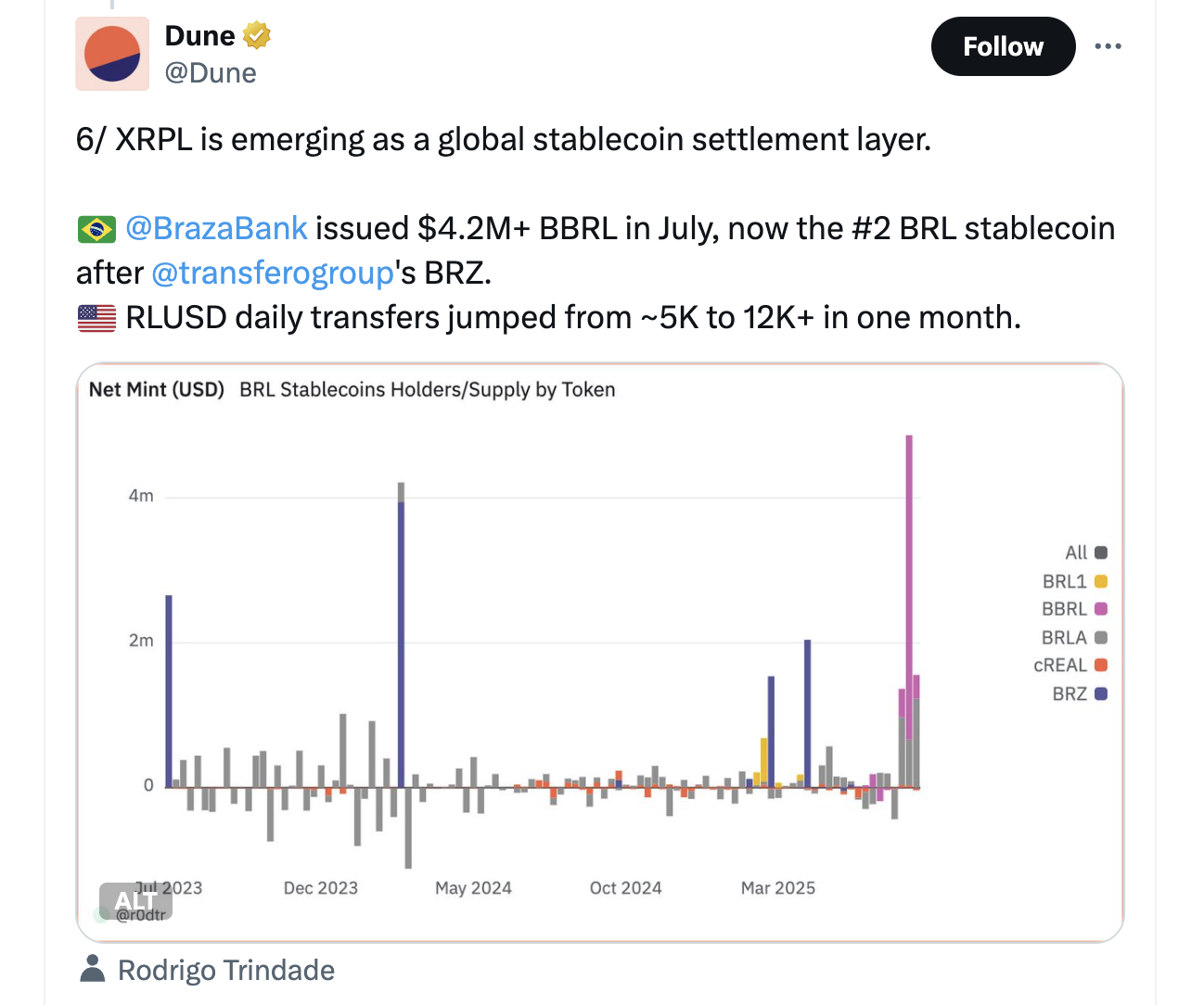
The Brazilian Real stablecoin BBRL, issued by Braza Bank on the XRP Ledger (XRPL), reportedly processed $1 billion in customer payments during Q3 2025. Notably, the achievement was highlighted by Stake City founder Luke Judges on X on Thursday. He noted that the growth shows how XRPL-based assets are addressing real-world challenges for financial institutions. $1B in Stablecoin Payments Using BBRL on XRP Ledger While Judges did not share a source confirming that Braza Bank processed $1 billion in stablecoin payments on XRPL in Q3, the claim largely aligns with figures Ripple reported in an official statement in May. Notably, Ripple’s statement announced Braza Bank’s further stablecoin expansion on XRPL, which included the launch of USDB. In the announcement, Ripple stated that Braza processed $1.079 billion (nearly BRL 6 billion) in a single day this April. BBRL is part of Braza Group’s broader strategy to integrate traditional finance with blockchain infrastructure. The coin launched earlier in 2025. Shortly after, the bank also introduced USDB, a dollar-pegged stablecoin backed by U.S. and Brazilian government bonds. Both stablecoins are on XRPL. It gives Braza a scalable framework to support cross-border transactions, mass payouts, and settlements for businesses. In July, Braza Bank minted over $4.2 million in BBRL. This further confirms increased use of the XRP Ledger for cross-border payments and real-world asset settlements. $4.2 million BBRL Minted on XRP Ledger$4.2 million BBRL Minted on XRP Ledger Notably, the bank reported a balance sheet of more than $500 million as of 2024 and ranks sixth in Brazil’s interbank market. Euro Stablecoin on the Horizon Meanwhile, Judges also revealed that Braza has a "line of sight" to a euro-denominated stablecoin, which he believes could achieve similar transaction volumes soon. This suggests the bank is preparing to expand its offering beyond the Brazilian Real and U.S. Dollar. Such a move would position Braza to manage BRL, USD, and EUR stablecoins simultaneously on the XRPL. This will establish a robust on-chain infrastructure for global currency flows. Ripple’s Role in Brazil’s Stablecoin Push Ripple executives have emphasized the XRPL’s role in enabling compliant, reliable, and efficient tokenization at scale. According to Ripple’s LATAM Managing Director Silvio Pegado, the ledger’s features are designed to support regulated financial institutions like Braza as they move billions across borders. The partnership forms part of an effort to modernize Brazil’s financial system. Braza is also participating in the Brazilian Central Bank’s DREX project, which explores integrating blockchain with traditional banking infrastructure. Braza Bank’s Outlook for 2025 and Beyond Notably, Braza CEO Marcelo Sacomori has projected that USDB could capture 30% of Brazil’s USD-pegged stablecoin market by 2026. Sacomori believes stablecoins will dominate global foreign exchange within five years, with Braza positioning itself to lead the transition.

Market Opportunity
Manchester City Fan Logo
Manchester City Fan Price(CITY)
$0.658
$0.658$0.658
-1.15%
USD
Manchester City Fan (CITY) Live Price Chart
Disclaimer: The articles reposted on this site are sourced from public platforms and are provided for informational purposes only. They do not necessarily reflect the views of MEXC. All rights remain with the original authors. If you believe any content infringes on third-party rights, please contact [email protected] for removal. MEXC makes no guarantees regarding the accuracy, completeness, or timeliness of the content and is not responsible for any actions taken based on the information provided. The content does not constitute financial, legal, or other professional advice, nor should it be considered a recommendation or endorsement by MEXC.

You May Also Like

Fed Q1 2026 Outlook and Its Potential Impact on Crypto Markets

Fed Q1 2026 Outlook and Its Potential Impact on Crypto Markets

The post Fed Q1 2026 Outlook and Its Potential Impact on Crypto Markets appeared on BitcoinEthereumNews.com. Key takeaways: Fed pauses could pressure crypto, but
Share
BitcoinEthereumNews2025/12/26 07:41
Taiko Makes Chainlink Data Streams Its Official Oracle

Taiko Makes Chainlink Data Streams Its Official Oracle

The post Taiko Makes Chainlink Data Streams Its Official Oracle appeared on BitcoinEthereumNews.com. Key Notes Taiko has officially integrated Chainlink Data Streams for its Layer 2 network. The integration provides developers with high-speed market data to build advanced DeFi applications. The move aims to improve security and attract institutional adoption by using Chainlink’s established infrastructure. Taiko, an Ethereum-based ETH $4 514 24h volatility: 0.4% Market cap: $545.57 B Vol. 24h: $28.23 B Layer 2 rollup, has announced the integration of Chainlink LINK $23.26 24h volatility: 1.7% Market cap: $15.75 B Vol. 24h: $787.15 M Data Streams. The development comes as the underlying Ethereum network continues to see significant on-chain activity, including large sales from ETH whales. The partnership establishes Chainlink as the official oracle infrastructure for the network. It is designed to provide developers on the Taiko platform with reliable and high-speed market data, essential for building a wide range of decentralized finance (DeFi) applications, from complex derivatives platforms to more niche projects involving unique token governance models. According to the project’s official announcement on Sept. 17, the integration enables the creation of more advanced on-chain products that require high-quality, tamper-proof data to function securely. Taiko operates as a “based rollup,” which means it leverages Ethereum validators for transaction sequencing for strong decentralization. Boosting DeFi and Institutional Interest Oracles are fundamental services in the blockchain industry. They act as secure bridges that feed external, off-chain information to on-chain smart contracts. DeFi protocols, in particular, rely on oracles for accurate, real-time price feeds. Taiko leadership stated that using Chainlink’s infrastructure aligns with its goals. The team hopes the partnership will help attract institutional crypto investment and support the development of real-world applications, a goal that aligns with Chainlink’s broader mission to bring global data on-chain. Integrating real-world economic information is part of a broader industry trend. Just last week, Chainlink partnered with the Sei…
Share
BitcoinEthereumNews2025/09/18 03:34
Choosing an AI for Coding: A Practical Guide

Choosing an AI for Coding: A Practical Guide

There are now so many AI tools for coding that it can be confusing to know which one to pick. Some act as simple helpers (Assistant), while others can do the work
Share
Hackernoon2025/12/26 02:00