The world is facing a water crisis that is expected to have a major impact on humanity in the coming years. A report from the United Nations predicts that by 2030, global demand for water will exceed sustainable supply by 40 percent. The World Economic Forum further not es that terrestrial water storage decreased by almost 1.3 trillion tonnes between 2005 and 2015. Blockchain For Solving Water Shortages While it’s frightening to think that a water shortage may soon devastate the world, blockchain technology and cryptocurrency are being leveraged to solve some of these challenges. Pietro Gorgazzini, managing director at Hypercube, told Cryptonews that with sufficient funds, virtually any region in the world could extract enough water from alternative sources to solve water scarcity. “Over 70 percent of our planet is covered by water, so the common misconception is we have plenty, but only 2.5 percent of this is freshwater, and only a fraction of that is considered sustainable and renewable, therefore useful for human survival,” Gorgazzini said. “Hypercube is on a mission to prove that drinking water can be found from wastewater, the sea, the air, and even high depths.” Gorgazzini elaborated that Hypercube has created a global water credit system to demonstrate how water can be used from alternative sources. “Hypercube selects virtuous water facilities worldwide and conducts both remote and on-site audits through appointed third parties, making sure they fully comply with water credit protocol to qualify as originators,” he said. “We then connect flowmeters to our system through APIs, registering each cubic meter of water being reclaimed along with all relevant data on the Algorand blockchain, which serves as a public and immutable registry.” The transparency that blockchain provides allows all parties to have access to the data generated by participating water facilities. In addition, for each cubic meter of water recorded, a “WTR token” worth an equivalent water credit is issued. 💧 Tokenized Water Credits on Algorand! Indaqua, one of Portugal’s leading water and wastewater management providers, is pioneering tokenized water credits on Algorand in collaboration with Hypercube and its @wtrtoken (WRT). Wastewater is being converted into tokenized WRT… pic.twitter.com/PPOBQEB2V9 — Algorand Foundation (@AlgoFoundation) March 31, 2025 “Water-intensive companies can purchase WTR tokens and retire them—returning them irreversibly to redeem the equivalent water offset for their ESG reports,” Gorgazzini noted. Funds from each transaction are also used to reward water facilitators of the underlying reclaimed cubic meters. Gorgazzini explained that these funds can be used to cover the cost of infrastructure, including audits, and fund new water initiatives in regions and communities that need it the most. Although Hypercube was launched in April 2024, the company has already tokenized over 50 million cubic meters of reclaimed water. Gorgazzini hopes Hypercube will hit 100 million cubic meters by the end of the year. “We’ve successfully onboarded some of the largest international NGOs, leading auditing companies, consulting firms, and all the relevant stakeholders needed to ensure global endorsement,” Gorgazzini shared. He added that the most important achievement to date has been the current initiatives that wouldn’t have been possible without tokenization . “For example, Hypercube enabled the full revamping of a wastewater reuse facility in northern Italy, which now processes over 7 million cubic meters per year,” he said. Tokenization For Profitable Water Production A project known as WaterLab is also using tokenization to generate freshwater by funding the deployment of water desalination systems. Aaron Mandell, founder and CEO of WaterLab, told Cryptonews that he believes water is actually a limitless resource, yet most of it needs to be refined—or desalinated —before use. Unfortunately, water desalination is often challenging and costly. In order to combat this, Mandell explained that WaterLab issues a tokenized water credit to fund the costs of desalination. “We finance the desalination system by selling water credits, which are tokenized water contracts,” he said. “Each token is a contract for one unit of water (1 token = 1 m3). Water credits are generated by producers of water or desalination plants, which WaterLAB then tokenizes and sells to water holders.” saltwater is unlimited – as soon as we harness desalination there will be no one without water. https://t.co/eroG9YgrO8 — WaterLAB (@_WaterDAO) July 25, 2025 Mandell elaborated that water holders can be described as people who want to buy water purely as a financial hedge (like an oil future) or those who ultimately want to redeem their contract for the delivery of physical water. WaterLab has currently deployed water desalination systems in the US, Nicaragua and in the Bahamas, where additional water is needed or there is limited infrastructure. WaterLab Water Miner. Source: WaterLab “We have enough desalination capacity currently in operation to produce 1 million units of water (1M m3), which makes up the current supply of credits. We are also funding desalination research to further advance the technology,” Mandell remarked. Crypto Donations For New Water Campaign While blockchain and tokenization are solving water production challenges, crypto donations are currently being raised to bring clean water to 2 million people across five continents. A creator-led fundraising campaign known as “TeamWater” was launched on August 1 and will run through the entire month of August. The campaign’s goal is to raise $40 million in just one month to fund long-term, community-driven water solutions. TeamWater just crossed the $10,000,000 mark!!! We’re now 25% of the way to the goal of giving 2,000,000 people clean water for decades each 🥰🥰 GO DONATE – https://t.co/ECmQ6pJq7o pic.twitter.com/N6XcdDJuXq — MrBeast (@MrBeast) August 6, 2025 Crypto donation platform The Giving Block is the official crypto partner behind TeamWater. Pat Duffy, co-founder of The Giving Block, told Cryptonews that as of August 4, the campaign had already raised over $2.7 million in crypto donations alone. “This represents an impressive 40 percent of the total donation amount received so far. The crypto community is showing up in a big way to help drive this movement forward,” Duffy said. Web3 Models Have Potential, But Challenges Remain Although there is potential for blockchain and cryptocurrency to help solve the water crisis, a number of challenges may slow progress. According to Gorgazzini, the biggest challenge from a business development perspective is that many traditional industries remain skeptical of Web3 models . “Just mentioning blockchain can trigger concerns,” he said. In order to overcome this, Gorgazzini believes that education is key. “We need to engage with stakeholders and policy makers early on.” Mandell added that while the Web3 community is passionate about solving environmental issues related to water, many of these individuals remain well-versed in cryptocurrency, but not blockchain models. “This also needs to change in order for the market to grow,” he said. “Web3 will be most impactful when it becomes entirely invisible—when individuals can buy water assets without realizing the profit is related to tokenization.”The world is facing a water crisis that is expected to have a major impact on humanity in the coming years. A report from the United Nations predicts that by 2030, global demand for water will exceed sustainable supply by 40 percent. The World Economic Forum further not es that terrestrial water storage decreased by almost 1.3 trillion tonnes between 2005 and 2015. Blockchain For Solving Water Shortages While it’s frightening to think that a water shortage may soon devastate the world, blockchain technology and cryptocurrency are being leveraged to solve some of these challenges. Pietro Gorgazzini, managing director at Hypercube, told Cryptonews that with sufficient funds, virtually any region in the world could extract enough water from alternative sources to solve water scarcity. “Over 70 percent of our planet is covered by water, so the common misconception is we have plenty, but only 2.5 percent of this is freshwater, and only a fraction of that is considered sustainable and renewable, therefore useful for human survival,” Gorgazzini said. “Hypercube is on a mission to prove that drinking water can be found from wastewater, the sea, the air, and even high depths.” Gorgazzini elaborated that Hypercube has created a global water credit system to demonstrate how water can be used from alternative sources. “Hypercube selects virtuous water facilities worldwide and conducts both remote and on-site audits through appointed third parties, making sure they fully comply with water credit protocol to qualify as originators,” he said. “We then connect flowmeters to our system through APIs, registering each cubic meter of water being reclaimed along with all relevant data on the Algorand blockchain, which serves as a public and immutable registry.” The transparency that blockchain provides allows all parties to have access to the data generated by participating water facilities. In addition, for each cubic meter of water recorded, a “WTR token” worth an equivalent water credit is issued. 💧 Tokenized Water Credits on Algorand! Indaqua, one of Portugal’s leading water and wastewater management providers, is pioneering tokenized water credits on Algorand in collaboration with Hypercube and its @wtrtoken (WRT). Wastewater is being converted into tokenized WRT… pic.twitter.com/PPOBQEB2V9 — Algorand Foundation (@AlgoFoundation) March 31, 2025 “Water-intensive companies can purchase WTR tokens and retire them—returning them irreversibly to redeem the equivalent water offset for their ESG reports,” Gorgazzini noted. Funds from each transaction are also used to reward water facilitators of the underlying reclaimed cubic meters. Gorgazzini explained that these funds can be used to cover the cost of infrastructure, including audits, and fund new water initiatives in regions and communities that need it the most. Although Hypercube was launched in April 2024, the company has already tokenized over 50 million cubic meters of reclaimed water. Gorgazzini hopes Hypercube will hit 100 million cubic meters by the end of the year. “We’ve successfully onboarded some of the largest international NGOs, leading auditing companies, consulting firms, and all the relevant stakeholders needed to ensure global endorsement,” Gorgazzini shared. He added that the most important achievement to date has been the current initiatives that wouldn’t have been possible without tokenization . “For example, Hypercube enabled the full revamping of a wastewater reuse facility in northern Italy, which now processes over 7 million cubic meters per year,” he said. Tokenization For Profitable Water Production A project known as WaterLab is also using tokenization to generate freshwater by funding the deployment of water desalination systems. Aaron Mandell, founder and CEO of WaterLab, told Cryptonews that he believes water is actually a limitless resource, yet most of it needs to be refined—or desalinated —before use. Unfortunately, water desalination is often challenging and costly. In order to combat this, Mandell explained that WaterLab issues a tokenized water credit to fund the costs of desalination. “We finance the desalination system by selling water credits, which are tokenized water contracts,” he said. “Each token is a contract for one unit of water (1 token = 1 m3). Water credits are generated by producers of water or desalination plants, which WaterLAB then tokenizes and sells to water holders.” saltwater is unlimited – as soon as we harness desalination there will be no one without water. https://t.co/eroG9YgrO8 — WaterLAB (@_WaterDAO) July 25, 2025 Mandell elaborated that water holders can be described as people who want to buy water purely as a financial hedge (like an oil future) or those who ultimately want to redeem their contract for the delivery of physical water. WaterLab has currently deployed water desalination systems in the US, Nicaragua and in the Bahamas, where additional water is needed or there is limited infrastructure. WaterLab Water Miner. Source: WaterLab “We have enough desalination capacity currently in operation to produce 1 million units of water (1M m3), which makes up the current supply of credits. We are also funding desalination research to further advance the technology,” Mandell remarked. Crypto Donations For New Water Campaign While blockchain and tokenization are solving water production challenges, crypto donations are currently being raised to bring clean water to 2 million people across five continents. A creator-led fundraising campaign known as “TeamWater” was launched on August 1 and will run through the entire month of August. The campaign’s goal is to raise $40 million in just one month to fund long-term, community-driven water solutions. TeamWater just crossed the $10,000,000 mark!!! We’re now 25% of the way to the goal of giving 2,000,000 people clean water for decades each 🥰🥰 GO DONATE – https://t.co/ECmQ6pJq7o pic.twitter.com/N6XcdDJuXq — MrBeast (@MrBeast) August 6, 2025 Crypto donation platform The Giving Block is the official crypto partner behind TeamWater. Pat Duffy, co-founder of The Giving Block, told Cryptonews that as of August 4, the campaign had already raised over $2.7 million in crypto donations alone. “This represents an impressive 40 percent of the total donation amount received so far. The crypto community is showing up in a big way to help drive this movement forward,” Duffy said. Web3 Models Have Potential, But Challenges Remain Although there is potential for blockchain and cryptocurrency to help solve the water crisis, a number of challenges may slow progress. According to Gorgazzini, the biggest challenge from a business development perspective is that many traditional industries remain skeptical of Web3 models . “Just mentioning blockchain can trigger concerns,” he said. In order to overcome this, Gorgazzini believes that education is key. “We need to engage with stakeholders and policy makers early on.” Mandell added that while the Web3 community is passionate about solving environmental issues related to water, many of these individuals remain well-versed in cryptocurrency, but not blockchain models. “This also needs to change in order for the market to grow,” he said. “Web3 will be most impactful when it becomes entirely invisible—when individuals can buy water assets without realizing the profit is related to tokenization.”

Can Tokenization Unlock Sustainable Water? Hypercube, WaterLab, and Algorand Bet Big

2025/08/09 03:28
6 min read
For feedback or concerns regarding this content, please contact us at [email protected]

The world is facing a water crisis that is expected to have a major impact on humanity in the coming years.

A report from the United Nations predicts that by 2030, global demand for water will exceed sustainable supply by 40 percent. The World Economic Forum further notes that terrestrial water storage decreased by almost 1.3 trillion tonnes between 2005 and 2015.

Blockchain For Solving Water Shortages

While it’s frightening to think that a water shortage may soon devastate the world, blockchain technology and cryptocurrency are being leveraged to solve some of these challenges.

Pietro Gorgazzini, managing director at Hypercube, told Cryptonews that with sufficient funds, virtually any region in the world could extract enough water from alternative sources to solve water scarcity.

“Over 70 percent of our planet is covered by water, so the common misconception is we have plenty, but only 2.5 percent of this is freshwater, and only a fraction of that is considered sustainable and renewable, therefore useful for human survival,” Gorgazzini said. “Hypercube is on a mission to prove that drinking water can be found from wastewater, the sea, the air, and even high depths.”

Gorgazzini elaborated that Hypercube has created a global water credit system to demonstrate how water can be used from alternative sources.

“Hypercube selects virtuous water facilities worldwide and conducts both remote and on-site audits through appointed third parties, making sure they fully comply with water credit protocol to qualify as originators,” he said. “We then connect flowmeters to our system through APIs, registering each cubic meter of water being reclaimed along with all relevant data on the Algorand blockchain, which serves as a public and immutable registry.”

The transparency that blockchain provides allows all parties to have access to the data generated by participating water facilities. In addition, for each cubic meter of water recorded, a “WTR token” worth an equivalent water credit is issued.

“Water-intensive companies can purchase WTR tokens and retire them—returning them irreversibly to redeem the equivalent water offset for their ESG reports,” Gorgazzini noted.

Funds from each transaction are also used to reward water facilitators of the underlying reclaimed cubic meters. Gorgazzini explained that these funds can be used to cover the cost of infrastructure, including audits, and fund new water initiatives in regions and communities that need it the most.

Although Hypercube was launched in April 2024, the company has already tokenized over 50 million cubic meters of reclaimed water. Gorgazzini hopes Hypercube will hit 100 million cubic meters by the end of the year.

“We’ve successfully onboarded some of the largest international NGOs, leading auditing companies, consulting firms, and all the relevant stakeholders needed to ensure global endorsement,” Gorgazzini shared.

He added that the most important achievement to date has been the current initiatives that wouldn’t have been possible without tokenization.

“For example, Hypercube enabled the full revamping of a wastewater reuse facility in northern Italy, which now processes over 7 million cubic meters per year,” he said.

Tokenization For Profitable Water Production

A project known as WaterLab is also using tokenization to generate freshwater by funding the deployment of water desalination systems.

Aaron Mandell, founder and CEO of WaterLab, told Cryptonews that he believes water is actually a limitless resource, yet most of it needs to be refined—or desalinated—before use.

Unfortunately, water desalination is often challenging and costly. In order to combat this, Mandell explained that WaterLab issues a tokenized water credit to fund the costs of desalination.

“We finance the desalination system by selling water credits, which are tokenized water contracts,” he said. “Each token is a contract for one unit of water (1 token = 1 m3). Water credits are generated by producers of water or desalination plants, which WaterLAB then tokenizes and sells to water holders.”

Mandell elaborated that water holders can be described as people who want to buy water purely as a financial hedge (like an oil future) or those who ultimately want to redeem their contract for the delivery of physical water.

WaterLab has currently deployed water desalination systems in the US, Nicaragua and in the Bahamas, where additional water is needed or there is limited infrastructure.
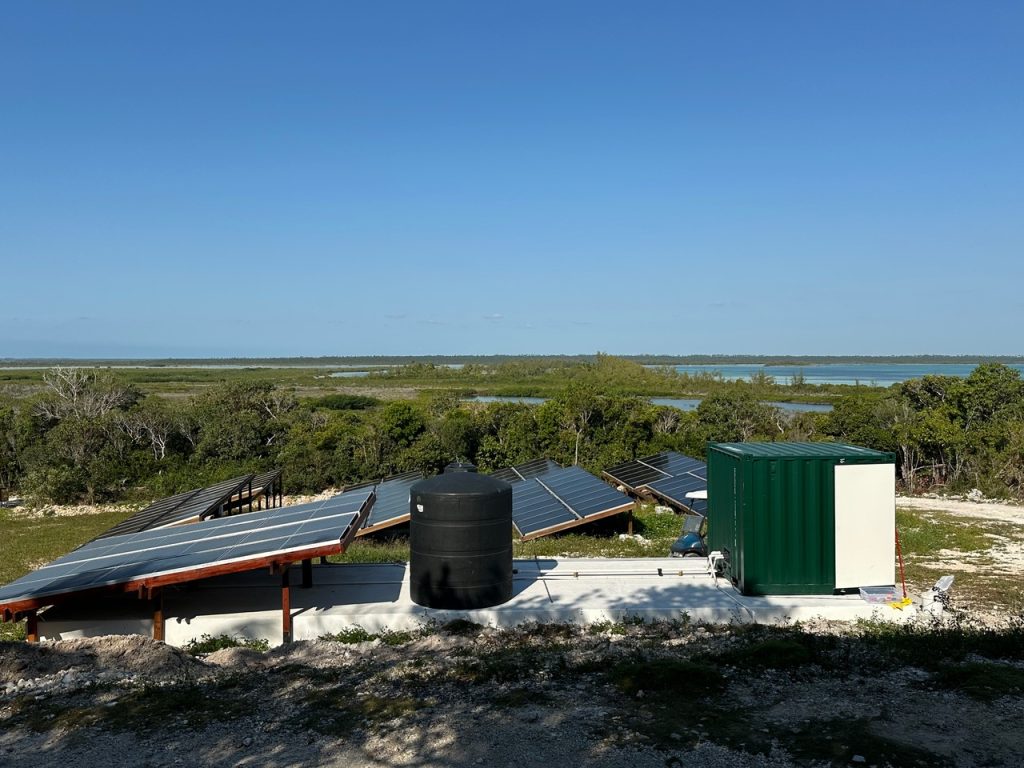
WaterLab Water Miner. Source: WaterLab

“We have enough desalination capacity currently in operation to produce 1 million units of water (1M m3), which makes up the current supply of credits. We are also funding desalination research to further advance the technology,” Mandell remarked.

Crypto Donations For New Water Campaign

While blockchain and tokenization are solving water production challenges, crypto donations are currently being raised to bring clean water to 2 million people across five continents.

A creator-led fundraising campaign known as “TeamWater” was launched on August 1 and will run through the entire month of August. The campaign’s goal is to raise $40 million in just one month to fund long-term, community-driven water solutions.

Crypto donation platform The Giving Block is the official crypto partner behind TeamWater. Pat Duffy, co-founder of The Giving Block, told Cryptonews that as of August 4, the campaign had already raised over $2.7 million in crypto donations alone.

“This represents an impressive 40 percent of the total donation amount received so far. The crypto community is showing up in a big way to help drive this movement forward,” Duffy said.

Web3 Models Have Potential, But Challenges Remain

Although there is potential for blockchain and cryptocurrency to help solve the water crisis, a number of challenges may slow progress.

According to Gorgazzini, the biggest challenge from a business development perspective is that many traditional industries remain skeptical of Web3 models.

“Just mentioning blockchain can trigger concerns,” he said.

In order to overcome this, Gorgazzini believes that education is key. “We need to engage with stakeholders and policy makers early on.”

Mandell added that while the Web3 community is passionate about solving environmental issues related to water, many of these individuals remain well-versed in cryptocurrency, but not blockchain models.

“This also needs to change in order for the market to grow,” he said. “Web3 will be most impactful when it becomes entirely invisible—when individuals can buy water assets without realizing the profit is related to tokenization.”

Market Opportunity
Threshold Logo
Threshold Price(T)
$0.007113
$0.007113$0.007113
+2.43%
USD
Threshold (T) Live Price Chart
Disclaimer: The articles reposted on this site are sourced from public platforms and are provided for informational purposes only. They do not necessarily reflect the views of MEXC. All rights remain with the original authors. If you believe any content infringes on third-party rights, please contact [email protected] for removal. MEXC makes no guarantees regarding the accuracy, completeness, or timeliness of the content and is not responsible for any actions taken based on the information provided. The content does not constitute financial, legal, or other professional advice, nor should it be considered a recommendation or endorsement by MEXC.
Tags:

You May Also Like

CME Group to launch options on XRP and SOL futures

CME Group to launch options on XRP and SOL futures

The post CME Group to launch options on XRP and SOL futures appeared on BitcoinEthereumNews.com. CME Group will offer options based on the derivative markets on Solana (SOL) and XRP. The new markets will open on October 13, after regulatory approval.  CME Group will expand its crypto products with options on the futures markets of Solana (SOL) and XRP. The futures market will start on October 13, after regulatory review and approval.  The options will allow the trading of MicroSol, XRP, and MicroXRP futures, with expiry dates available every business day, monthly, and quarterly. The new products will be added to the existing BTC and ETH options markets. ‘The launch of these options contracts builds on the significant growth and increasing liquidity we have seen across our suite of Solana and XRP futures,’ said Giovanni Vicioso, CME Group Global Head of Cryptocurrency Products. The options contracts will have two main sizes, tracking the futures contracts. The new market will be suitable for sophisticated institutional traders, as well as active individual traders. The addition of options markets singles out XRP and SOL as liquid enough to offer the potential to bet on a market direction.  The options on futures arrive a few months after the launch of SOL futures. Both SOL and XRP had peak volumes in August, though XRP activity has slowed down in September. XRP and SOL options to tap both institutions and active traders Crypto options are one of the indicators of market attitudes, with XRP and SOL receiving a new way to gauge sentiment. The contracts will be supported by the Cumberland team.  ‘As one of the biggest liquidity providers in the ecosystem, the Cumberland team is excited to support CME Group’s continued expansion of crypto offerings,’ said Roman Makarov, Head of Cumberland Options Trading at DRW. ‘The launch of options on Solana and XRP futures is the latest example of the…
Share
BitcoinEthereumNews2025/09/18 00:56
Health Insurers To Cover Covid Vaccines Despite RFK, Jr. Moves

Health Insurers To Cover Covid Vaccines Despite RFK, Jr. Moves

The post Health Insurers To Cover Covid Vaccines Despite RFK, Jr. Moves appeared on BitcoinEthereumNews.com. The nation’s biggest health insurance companies will continue to cover vaccinations – including those against Covid-19 and seasonal flu – previously recommended by a federal advisory committee, America’s Health Insurance Plans said Wednesday, Sept. 17, 2025. In this photo is a free flu and Covid-19 vaccine shots available sign, CVS, Queens, New York. (Photo by: Lindsey Nicholson/Universal Images Group via Getty Images) UCG/Universal Images Group via Getty Images The nation’s biggest health insurance companies will continue to cover vaccinations – including those against Covid-19 and seasonal flu – previously recommended by a federal advisory committee. The announcement by America’s Health Insurance Plans (AHIP), which includes CVS Health’s Aetna, Humana, Cigna, Centene and an array of Blue Cross and Blue Shield plans as members, comes ahead of the first meeting of the reconstituted Advisory Committee on Immunization Practices, which now has new members chosen by U.S. Health and Human Services Secretary Robert F. Kennedy Jr., a vaccine critic. “Health plans are committed to maintaining and ensuring affordable access to vaccines,” AHIP said in a statement Wednesday. “Health plan coverage decisions for immunizations are grounded in each plan’s ongoing, rigorous review of scientific and clinical evidence, and continual evaluation of multiple sources of data.” The move by AHIP is good news for millions of Americans at a time of year when they flock to drugstores, pharmacies, physician’s offices and outpatient clinics to get their seasonal flu and Covid shots. Kennedy’s changes to U.S. vaccine policy have created confusion across the country over whether certain vaccines long covered by insurance would continue to be. AHIP has now provided some clarity for millions of Americans. “Health plans will continue to cover all ACIP-recommended immunizations that were recommended as of September 1, 2025, including updated formulations of the COVID-19 and influenza vaccines, with no cost-sharing…
Share
BitcoinEthereumNews2025/09/18 03:11
US, UK, Canada Launch Operation Atlantic to Tackle Crypto Scams

US, UK, Canada Launch Operation Atlantic to Tackle Crypto Scams

Law enforcement agencies from the United States, United Kingdom, and Canada have launched Operation Atlantic, a joint effort to combat rising crypto scams and protect
Share
Coinlaw2026/03/17 22:11