In a significant development for the future of blockchain-based financial infrastructure, SWIFT has announced plans to develop its upcoming blockchain payment settlement platform on the Ethereum Layer 2 scaling solution, Linea. This move signals a major integration of traditional banking infrastructure with innovative decentralized technology, potentially transforming cross-border payments by leveraging blockchain’s efficiencies and cost [...]In a significant development for the future of blockchain-based financial infrastructure, SWIFT has announced plans to develop its upcoming blockchain payment settlement platform on the Ethereum Layer 2 scaling solution, Linea. This move signals a major integration of traditional banking infrastructure with innovative decentralized technology, potentially transforming cross-border payments by leveraging blockchain’s efficiencies and cost [...]

ConsenSys CEO Reveals SWIFT is Leveraging Linea for Payments
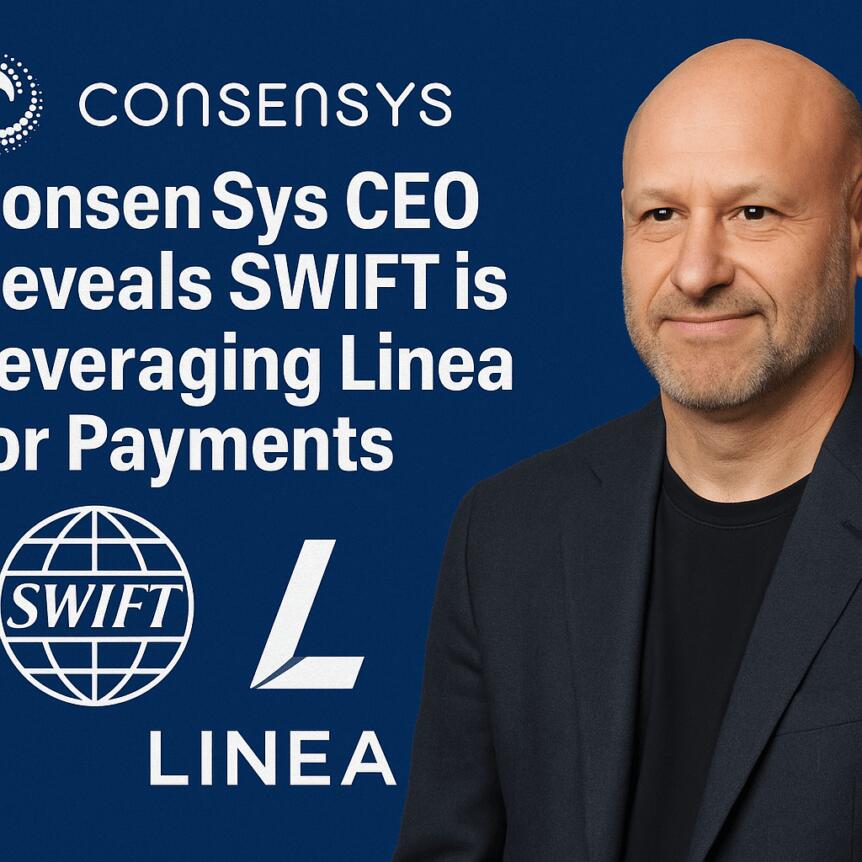
Consensys Ceo Reveals Swift Is Leveraging Linea For Payments
In a significant development for the future of blockchain-based financial infrastructure, SWIFT has announced plans to develop its upcoming blockchain payment settlement platform on the Ethereum Layer 2 scaling solution, Linea. This move signals a major integration of traditional banking infrastructure with innovative decentralized technology, potentially transforming cross-border payments by leveraging blockchain’s efficiencies and cost advantages.
  • SWIFT will build its new blockchain payment system on Ethereum Layer 2 Linea, confirmed by Consensys CEO Joe Lubin.
  • The platform aims to facilitate 24/7 real-time crypto payments, involving over 30 traditional financial institutions.
  • Linea, developed by Consensys, offers high transaction throughput at a fraction of Ethereum costs, with over $2.2 billion in total value locked.
  • Major banks including Bank of America, Citi, JPMorgan Chase, and Toronto-Dominion Bank are participating in trial phases.
  • This initiative could challenge existing blockchain-based payment systems like Ripple’s XRP Ledger, emphasizing widespread crypto adoption in banking.

SWIFT, the global messaging network responsible for overseeing around $150 trillion in international payments annually, is taking a significant step into blockchain technology. The organization plans to develop its new blockchain payment settlement platform on Ethereum’s Layer 2 scaling solution, Linea. This development was confirmed by Consensys CEO Joe Lubin during a recent conference, marking a notable collaboration between traditional finance (TradFi) and blockchain innovators.

Initially, SWIFT announced that over 30 traditional financial institutions would be involved in building infrastructure for a 24/7, real-time crypto payments system, though it did not specify the blockchain chain involved. Lubin clarified during the Token2049 conference in Singapore that Linea was the chosen platform, highlighting the strategic importance of this move. The announcement was deliberately “soft rolled out” to the banking sector, which Lubin said was received positively as a step toward bridging the gap between DeFi and TradFi.

Developed by Consensys, Linea utilizes zk-EVM rollup technology, offering processing speeds of around 1.5 transactions per second at approximately one-fifteenth the cost of Ethereum mainnet transactions. It currently boasts over $2.27 billion in total value locked (TVL), ranking as the fourth-largest Ethereum Layer 2 solution behind Arbitrum One, Base Chain, and OP Mainnet, according to L2BEAT data.

This move could have transformative implications for global finance, particularly because SWIFT manages a vast network of financial messaging that facilitates international transactions. Involving major banks such as Bank of America, Citi, JPMorgan Chase, and Toronto-Dominion Bank, SWIFT’s trial on Linea aims to pioneer near-instant settlement and reduce intermediaries, costs, and errors in cross-border payments. The initiative could emerge as a significant competitor to Ripple’s XRP Ledger, which is already being adopted by some banks for blockchain-based transactions.

Some of the biggest banks involved

Leading financial institutions like Bank of America, Citi, JPMorgan Chase, and Toronto-Dominion Bank are participating in SWIFT’s blockchain trial efforts. Their involvement underscores the industry’s growing acceptance of blockchain technology for secure, efficient payments. This collaboration might accelerate the adoption of decentralized blockchain systems in mainstream banking, challenging existing payment solutions like Ripple’s.

For years, the integration of blockchain into traditional finance has been anticipated, promising benefits such as instant settlement, lower fees, and reduced settlement errors. The collaboration between SWIFT and Linea could also inspire broader adoption of blockchain infrastructure in global payment networks, ushering a new era of financial operations.

Linea’s broader potential

Beyond payments, Lubin described Linea as a platform capable of supporting a “user-generated civilization,” where content and infrastructure can be built collectively. By leveraging Ethereum’s trustless settlement layer, communities could develop decentralized applications, rules, and frameworks from the ground up — a stark contrast to the top-down approach of traditional hierarchies.

Decentralized autonomous organizations (DAOs) are already experimenting with decentralized governance and smart contracts, aiming to operate without centralized control. While few have scaled successfully, the potential for a bottom-up digital society is rapidly evolving, with blockchain technologies like Linea playing a central role.

This article was originally published as ConsenSys CEO Reveals SWIFT is Leveraging Linea for Payments on Crypto Breaking News – your trusted source for crypto news, Bitcoin news, and blockchain updates.

Market Opportunity
LINEA Logo
LINEA Price(LINEA)
$0.006641
$0.006641$0.006641
-0.61%
USD
LINEA (LINEA) Live Price Chart
Disclaimer: The articles reposted on this site are sourced from public platforms and are provided for informational purposes only. They do not necessarily reflect the views of MEXC. All rights remain with the original authors. If you believe any content infringes on third-party rights, please contact [email protected] for removal. MEXC makes no guarantees regarding the accuracy, completeness, or timeliness of the content and is not responsible for any actions taken based on the information provided. The content does not constitute financial, legal, or other professional advice, nor should it be considered a recommendation or endorsement by MEXC.

You May Also Like

WIF price reclaims 200-day moving average

WIF price reclaims 200-day moving average

WIF (WIF) price is entering a critical technical phase as price action reclaims the 200-day moving average, a level that often separates bearish control from bullish
Share
Crypto.news2026/01/13 23:44
China Blocks Nvidia’s RTX Pro 6000D as Local Chips Rise

China Blocks Nvidia’s RTX Pro 6000D as Local Chips Rise

The post China Blocks Nvidia’s RTX Pro 6000D as Local Chips Rise appeared on BitcoinEthereumNews.com. China Blocks Nvidia’s RTX Pro 6000D as Local Chips Rise China’s internet regulator has ordered the country’s biggest technology firms, including Alibaba and ByteDance, to stop purchasing Nvidia’s RTX Pro 6000D GPUs. According to the Financial Times, the move shuts down the last major channel for mass supplies of American chips to the Chinese market. Why Beijing Halted Nvidia Purchases Chinese companies had planned to buy tens of thousands of RTX Pro 6000D accelerators and had already begun testing them in servers. But regulators intervened, halting the purchases and signaling stricter controls than earlier measures placed on Nvidia’s H20 chip. Image: Nvidia An audit compared Huawei and Cambricon processors, along with chips developed by Alibaba and Baidu, against Nvidia’s export-approved products. Regulators concluded that Chinese chips had reached performance levels comparable to the restricted U.S. models. This assessment pushed authorities to advise firms to rely more heavily on domestic processors, further tightening Nvidia’s already limited position in China. China’s Drive Toward Tech Independence The decision highlights Beijing’s focus on import substitution — developing self-sufficient chip production to reduce reliance on U.S. supplies. “The signal is now clear: all attention is focused on building a domestic ecosystem,” said a representative of a leading Chinese tech company. Nvidia had unveiled the RTX Pro 6000D in July 2025 during CEO Jensen Huang’s visit to Beijing, in an attempt to keep a foothold in China after Washington restricted exports of its most advanced chips. But momentum is shifting. Industry sources told the Financial Times that Chinese manufacturers plan to triple AI chip production next year to meet growing demand. They believe “domestic supply will now be sufficient without Nvidia.” What It Means for the Future With Huawei, Cambricon, Alibaba, and Baidu stepping up, China is positioning itself for long-term technological independence. Nvidia, meanwhile, faces…
Share
BitcoinEthereumNews2025/09/18 01:37
Trump: Powell did a bad job.

Trump: Powell did a bad job.

PANews reported on January 13th that, according to Jinshi Data, US President Trump stated: "Federal Reserve Chairman Powell is either incompetent or dishonest.
Share
PANews2026/01/13 23:40