BitcoinWorld Crucial Crypto Fear & Greed Index Reveals Persistent Market Caution Are you feeling the market jitters? The latest update on the Crypto Fear & Greed Index shows that fear continues to grip the cryptocurrency market. This crucial indicator, which provides a snapshot of investor sentiment, recently rose four points to 33. While a slight increase, it still firmly places the market in a state of ‘fear,’ according to data from Alternative.me. Understanding this index is vital for anyone navigating the volatile world of digital assets. What is the Crypto Fear & Greed Index and Why Does it Matter? The Crypto Fear & Greed Index is more than just a number; it’s a powerful tool designed to measure the prevailing emotional state of the crypto market. It operates on a simple principle: extreme fear can signal a buying opportunity, while excessive greed often indicates a market correction is imminent. This index helps investors gauge whether the market is overly emotional, which can lead to irrational decisions. How exactly does this index arrive at its score? It’s a sophisticated calculation, pulling data from various corners of the crypto ecosystem. Here’s a breakdown of its key components: Volatility (25%): This measures how much Bitcoin’s price fluctuates compared to its average. Higher volatility often suggests a fearful market. Market Volume (25%): Analyzing current trading volumes and momentum helps determine if there’s strong buying or selling pressure. Social Media Mentions (15%): Tracking keywords and sentiment on platforms like Twitter can reveal widespread emotional responses. Surveys (15%): Although currently paused, these polls directly ask investors about their market outlook. Bitcoin Dominance (10%): An increasing Bitcoin market cap dominance can sometimes indicate fear, as investors might be flocking to the perceived ‘safer’ asset. Google Search Volume (10%): Analyzing search trends for crypto-related terms helps identify public interest and potential panic or excitement. Navigating the ‘Fear’ Zone: What Does a Score of 33 Imply? A score of 33 on the Crypto Fear & Greed Index means the market is experiencing significant fear. This isn’t necessarily a bad thing; in fact, many seasoned investors view periods of high fear as potential opportunities. When fear is high, prices often drop, creating a chance to acquire assets at lower valuations. However, it also presents challenges: Potential for Panic Selling: New or inexperienced investors might sell their holdings at a loss due to widespread fear. Increased Volatility: Fearful markets can be unpredictable, with sharp price swings. Uncertainty: The future direction of the market becomes less clear, demanding careful research. Conversely, a score closer to 100, indicating ‘extreme greed,’ often signals that the market might be overheated and due for a correction. Historically, buying during extreme fear and selling during extreme greed has proven to be a successful strategy for some. Actionable Insights: How Can Investors Respond to the Crypto Fear & Greed Index? When the Crypto Fear & Greed Index points to fear, it’s a signal to act thoughtfully, not impulsively. Here are some actionable insights: Research Diligently: Use this time to delve into projects you believe have strong fundamentals. Lower prices can make strong assets more attractive. Consider Dollar-Cost Averaging (DCA): Instead of trying to time the bottom, consistently invest a fixed amount over time. This strategy helps mitigate risk in volatile markets. Manage Emotions: The index itself is a reminder that emotions drive markets. Avoid making decisions based purely on fear or excitement. Stick to your investment plan. Diversify Your Portfolio: Don’t put all your eggs in one basket. A diversified portfolio can help weather market downturns. Remember, the index is a tool, not a crystal ball. It provides valuable context, but individual investment decisions should always align with your personal financial goals and risk tolerance. The Enduring Value of the Crypto Fear & Greed Index in a Dynamic Market In conclusion, the current reading of 33 on the Crypto Fear & Greed Index underscores a market still wrestling with apprehension. While this state of fear can be daunting, it also presents a unique opportunity for those who approach it with a well-informed and disciplined strategy. By understanding the components of this index and its historical implications, investors can make more rational decisions, potentially turning market anxiety into long-term gains. It’s a powerful reminder that in the world of crypto, emotional intelligence can be as valuable as market analysis. Frequently Asked Questions (FAQs) Q1: What does a low score on the Crypto Fear & Greed Index indicate? A low score, particularly below 25, indicates ‘extreme fear.’ This suggests that investors are highly anxious, often leading to panic selling and lower asset prices. Historically, these periods have sometimes presented buying opportunities for long-term investors. Q2: How often is the Crypto Fear & Greed Index updated? The index is typically updated daily, providing a fresh perspective on market sentiment based on the latest data points from volatility, trading volume, social media, and other factors. Q3: Is the Crypto Fear & Greed Index solely based on Bitcoin? While Bitcoin’s market cap dominance is one factor, the index considers broader market sentiment indicators, including social media mentions and Google search trends that often reflect overall cryptocurrency interest, not just Bitcoin specifically. Q4: Can I rely solely on the Crypto Fear & Greed Index for investment decisions? No, the Crypto Fear & Greed Index should be used as one of many tools in your investment analysis. It provides valuable insight into market psychology but should be combined with fundamental analysis, technical analysis, and your personal financial strategy. Did you find this analysis of the Crypto Fear & Greed Index helpful? Share this article with your friends and fellow investors on social media to help them understand current market sentiment and make more informed decisions! To learn more about the latest crypto market trends, explore our article on key developments shaping Bitcoin price action. This post Crucial Crypto Fear & Greed Index Reveals Persistent Market Caution first appeared on BitcoinWorld.BitcoinWorld Crucial Crypto Fear & Greed Index Reveals Persistent Market Caution Are you feeling the market jitters? The latest update on the Crypto Fear & Greed Index shows that fear continues to grip the cryptocurrency market. This crucial indicator, which provides a snapshot of investor sentiment, recently rose four points to 33. While a slight increase, it still firmly places the market in a state of ‘fear,’ according to data from Alternative.me. Understanding this index is vital for anyone navigating the volatile world of digital assets. What is the Crypto Fear & Greed Index and Why Does it Matter? The Crypto Fear & Greed Index is more than just a number; it’s a powerful tool designed to measure the prevailing emotional state of the crypto market. It operates on a simple principle: extreme fear can signal a buying opportunity, while excessive greed often indicates a market correction is imminent. This index helps investors gauge whether the market is overly emotional, which can lead to irrational decisions. How exactly does this index arrive at its score? It’s a sophisticated calculation, pulling data from various corners of the crypto ecosystem. Here’s a breakdown of its key components: Volatility (25%): This measures how much Bitcoin’s price fluctuates compared to its average. Higher volatility often suggests a fearful market. Market Volume (25%): Analyzing current trading volumes and momentum helps determine if there’s strong buying or selling pressure. Social Media Mentions (15%): Tracking keywords and sentiment on platforms like Twitter can reveal widespread emotional responses. Surveys (15%): Although currently paused, these polls directly ask investors about their market outlook. Bitcoin Dominance (10%): An increasing Bitcoin market cap dominance can sometimes indicate fear, as investors might be flocking to the perceived ‘safer’ asset. Google Search Volume (10%): Analyzing search trends for crypto-related terms helps identify public interest and potential panic or excitement. Navigating the ‘Fear’ Zone: What Does a Score of 33 Imply? A score of 33 on the Crypto Fear & Greed Index means the market is experiencing significant fear. This isn’t necessarily a bad thing; in fact, many seasoned investors view periods of high fear as potential opportunities. When fear is high, prices often drop, creating a chance to acquire assets at lower valuations. However, it also presents challenges: Potential for Panic Selling: New or inexperienced investors might sell their holdings at a loss due to widespread fear. Increased Volatility: Fearful markets can be unpredictable, with sharp price swings. Uncertainty: The future direction of the market becomes less clear, demanding careful research. Conversely, a score closer to 100, indicating ‘extreme greed,’ often signals that the market might be overheated and due for a correction. Historically, buying during extreme fear and selling during extreme greed has proven to be a successful strategy for some. Actionable Insights: How Can Investors Respond to the Crypto Fear & Greed Index? When the Crypto Fear & Greed Index points to fear, it’s a signal to act thoughtfully, not impulsively. Here are some actionable insights: Research Diligently: Use this time to delve into projects you believe have strong fundamentals. Lower prices can make strong assets more attractive. Consider Dollar-Cost Averaging (DCA): Instead of trying to time the bottom, consistently invest a fixed amount over time. This strategy helps mitigate risk in volatile markets. Manage Emotions: The index itself is a reminder that emotions drive markets. Avoid making decisions based purely on fear or excitement. Stick to your investment plan. Diversify Your Portfolio: Don’t put all your eggs in one basket. A diversified portfolio can help weather market downturns. Remember, the index is a tool, not a crystal ball. It provides valuable context, but individual investment decisions should always align with your personal financial goals and risk tolerance. The Enduring Value of the Crypto Fear & Greed Index in a Dynamic Market In conclusion, the current reading of 33 on the Crypto Fear & Greed Index underscores a market still wrestling with apprehension. While this state of fear can be daunting, it also presents a unique opportunity for those who approach it with a well-informed and disciplined strategy. By understanding the components of this index and its historical implications, investors can make more rational decisions, potentially turning market anxiety into long-term gains. It’s a powerful reminder that in the world of crypto, emotional intelligence can be as valuable as market analysis. Frequently Asked Questions (FAQs) Q1: What does a low score on the Crypto Fear & Greed Index indicate? A low score, particularly below 25, indicates ‘extreme fear.’ This suggests that investors are highly anxious, often leading to panic selling and lower asset prices. Historically, these periods have sometimes presented buying opportunities for long-term investors. Q2: How often is the Crypto Fear & Greed Index updated? The index is typically updated daily, providing a fresh perspective on market sentiment based on the latest data points from volatility, trading volume, social media, and other factors. Q3: Is the Crypto Fear & Greed Index solely based on Bitcoin? While Bitcoin’s market cap dominance is one factor, the index considers broader market sentiment indicators, including social media mentions and Google search trends that often reflect overall cryptocurrency interest, not just Bitcoin specifically. Q4: Can I rely solely on the Crypto Fear & Greed Index for investment decisions? No, the Crypto Fear & Greed Index should be used as one of many tools in your investment analysis. It provides valuable insight into market psychology but should be combined with fundamental analysis, technical analysis, and your personal financial strategy. Did you find this analysis of the Crypto Fear & Greed Index helpful? Share this article with your friends and fellow investors on social media to help them understand current market sentiment and make more informed decisions! To learn more about the latest crypto market trends, explore our article on key developments shaping Bitcoin price action. This post Crucial Crypto Fear & Greed Index Reveals Persistent Market Caution first appeared on BitcoinWorld.

Crucial Crypto Fear & Greed Index Reveals Persistent Market Caution

BitcoinWorld

Crucial Crypto Fear & Greed Index Reveals Persistent Market Caution

Are you feeling the market jitters? The latest update on the Crypto Fear & Greed Index shows that fear continues to grip the cryptocurrency market. This crucial indicator, which provides a snapshot of investor sentiment, recently rose four points to 33. While a slight increase, it still firmly places the market in a state of ‘fear,’ according to data from Alternative.me. Understanding this index is vital for anyone navigating the volatile world of digital assets.

What is the Crypto Fear & Greed Index and Why Does it Matter?

The Crypto Fear & Greed Index is more than just a number; it’s a powerful tool designed to measure the prevailing emotional state of the crypto market. It operates on a simple principle: extreme fear can signal a buying opportunity, while excessive greed often indicates a market correction is imminent. This index helps investors gauge whether the market is overly emotional, which can lead to irrational decisions.

How exactly does this index arrive at its score? It’s a sophisticated calculation, pulling data from various corners of the crypto ecosystem. Here’s a breakdown of its key components:

  • Volatility (25%): This measures how much Bitcoin’s price fluctuates compared to its average. Higher volatility often suggests a fearful market.
  • Market Volume (25%): Analyzing current trading volumes and momentum helps determine if there’s strong buying or selling pressure.
  • Social Media Mentions (15%): Tracking keywords and sentiment on platforms like Twitter can reveal widespread emotional responses.
  • Surveys (15%): Although currently paused, these polls directly ask investors about their market outlook.
  • Bitcoin Dominance (10%): An increasing Bitcoin market cap dominance can sometimes indicate fear, as investors might be flocking to the perceived ‘safer’ asset.
  • Google Search Volume (10%): Analyzing search trends for crypto-related terms helps identify public interest and potential panic or excitement.

A score of 33 on the Crypto Fear & Greed Index means the market is experiencing significant fear. This isn’t necessarily a bad thing; in fact, many seasoned investors view periods of high fear as potential opportunities. When fear is high, prices often drop, creating a chance to acquire assets at lower valuations. However, it also presents challenges:

  • Potential for Panic Selling: New or inexperienced investors might sell their holdings at a loss due to widespread fear.
  • Increased Volatility: Fearful markets can be unpredictable, with sharp price swings.
  • Uncertainty: The future direction of the market becomes less clear, demanding careful research.

Conversely, a score closer to 100, indicating ‘extreme greed,’ often signals that the market might be overheated and due for a correction. Historically, buying during extreme fear and selling during extreme greed has proven to be a successful strategy for some.

Actionable Insights: How Can Investors Respond to the Crypto Fear & Greed Index?

When the Crypto Fear & Greed Index points to fear, it’s a signal to act thoughtfully, not impulsively. Here are some actionable insights:

  1. Research Diligently: Use this time to delve into projects you believe have strong fundamentals. Lower prices can make strong assets more attractive.
  2. Consider Dollar-Cost Averaging (DCA): Instead of trying to time the bottom, consistently invest a fixed amount over time. This strategy helps mitigate risk in volatile markets.
  3. Manage Emotions: The index itself is a reminder that emotions drive markets. Avoid making decisions based purely on fear or excitement. Stick to your investment plan.
  4. Diversify Your Portfolio: Don’t put all your eggs in one basket. A diversified portfolio can help weather market downturns.

Remember, the index is a tool, not a crystal ball. It provides valuable context, but individual investment decisions should always align with your personal financial goals and risk tolerance.

The Enduring Value of the Crypto Fear & Greed Index in a Dynamic Market

In conclusion, the current reading of 33 on the Crypto Fear & Greed Index underscores a market still wrestling with apprehension. While this state of fear can be daunting, it also presents a unique opportunity for those who approach it with a well-informed and disciplined strategy. By understanding the components of this index and its historical implications, investors can make more rational decisions, potentially turning market anxiety into long-term gains. It’s a powerful reminder that in the world of crypto, emotional intelligence can be as valuable as market analysis.


Frequently Asked Questions (FAQs)

Q1: What does a low score on the Crypto Fear & Greed Index indicate?
A low score, particularly below 25, indicates ‘extreme fear.’ This suggests that investors are highly anxious, often leading to panic selling and lower asset prices. Historically, these periods have sometimes presented buying opportunities for long-term investors.

Q2: How often is the Crypto Fear & Greed Index updated?
The index is typically updated daily, providing a fresh perspective on market sentiment based on the latest data points from volatility, trading volume, social media, and other factors.

Q3: Is the Crypto Fear & Greed Index solely based on Bitcoin?
While Bitcoin’s market cap dominance is one factor, the index considers broader market sentiment indicators, including social media mentions and Google search trends that often reflect overall cryptocurrency interest, not just Bitcoin specifically.

Q4: Can I rely solely on the Crypto Fear & Greed Index for investment decisions?
No, the Crypto Fear & Greed Index should be used as one of many tools in your investment analysis. It provides valuable insight into market psychology but should be combined with fundamental analysis, technical analysis, and your personal financial strategy.


Did you find this analysis of the Crypto Fear & Greed Index helpful? Share this article with your friends and fellow investors on social media to help them understand current market sentiment and make more informed decisions!

To learn more about the latest crypto market trends, explore our article on key developments shaping Bitcoin price action.

This post Crucial Crypto Fear & Greed Index Reveals Persistent Market Caution first appeared on BitcoinWorld.

Market Opportunity
Index Cooperative Logo
Index Cooperative Price(INDEX)
$0.5057
$0.5057$0.5057
+3.11%
USD
Index Cooperative (INDEX) Live Price Chart
Disclaimer: The articles reposted on this site are sourced from public platforms and are provided for informational purposes only. They do not necessarily reflect the views of MEXC. All rights remain with the original authors. If you believe any content infringes on third-party rights, please contact [email protected] for removal. MEXC makes no guarantees regarding the accuracy, completeness, or timeliness of the content and is not responsible for any actions taken based on the information provided. The content does not constitute financial, legal, or other professional advice, nor should it be considered a recommendation or endorsement by MEXC.

You May Also Like

The Channel Factories We’ve Been Waiting For

The Channel Factories We’ve Been Waiting For

The post The Channel Factories We’ve Been Waiting For appeared on BitcoinEthereumNews.com. Visions of future technology are often prescient about the broad strokes while flubbing the details. The tablets in “2001: A Space Odyssey” do indeed look like iPads, but you never see the astronauts paying for subscriptions or wasting hours on Candy Crush.  Channel factories are one vision that arose early in the history of the Lightning Network to address some challenges that Lightning has faced from the beginning. Despite having grown to become Bitcoin’s most successful layer-2 scaling solution, with instant and low-fee payments, Lightning’s scale is limited by its reliance on payment channels. Although Lightning shifts most transactions off-chain, each payment channel still requires an on-chain transaction to open and (usually) another to close. As adoption grows, pressure on the blockchain grows with it. The need for a more scalable approach to managing channels is clear. Channel factories were supposed to meet this need, but where are they? In 2025, subnetworks are emerging that revive the impetus of channel factories with some new details that vastly increase their potential. They are natively interoperable with Lightning and achieve greater scale by allowing a group of participants to open a shared multisig UTXO and create multiple bilateral channels, which reduces the number of on-chain transactions and improves capital efficiency. Achieving greater scale by reducing complexity, Ark and Spark perform the same function as traditional channel factories with new designs and additional capabilities based on shared UTXOs.  Channel Factories 101 Channel factories have been around since the inception of Lightning. A factory is a multiparty contract where multiple users (not just two, as in a Dryja-Poon channel) cooperatively lock funds in a single multisig UTXO. They can open, close and update channels off-chain without updating the blockchain for each operation. Only when participants leave or the factory dissolves is an on-chain transaction…
Share
BitcoinEthereumNews2025/09/18 00:09
Franklin Templeton CEO Dismisses 50bps Rate Cut Ahead FOMC
Franklin Templeton CEO Dismisses 50bps Rate Cut Ahead FOMC

The post Franklin Templeton CEO Dismisses 50bps Rate Cut Ahead FOMC appeared on BitcoinEthereumNews.com. Franklin Templeton CEO Jenny Johnson has weighed in on whether the Federal Reserve should make a 25 basis points (bps) Fed rate cut or 50 bps cut. This comes ahead of the Fed decision today at today’s FOMC meeting, with the market pricing in a 25 bps cut. Bitcoin and the broader crypto market are currently trading flat ahead of the rate cut decision. Franklin Templeton CEO Weighs In On Potential FOMC Decision In a CNBC interview, Jenny Johnson said that she expects the Fed to make a 25 bps cut today instead of a 50 bps cut. She acknowledged the jobs data, which suggested that the labor market is weakening. However, she noted that this data is backward-looking, indicating that it doesn’t show the current state of the economy. She alluded to the wage growth, which she remarked is an indication of a robust labor market. She added that retail sales are up and that consumers are still spending, despite inflation being sticky at 3%, which makes a case for why the FOMC should opt against a 50-basis-point Fed rate cut. In line with this, the Franklin Templeton CEO said that she would go with a 25 bps rate cut if she were Jerome Powell. She remarked that the Fed still has the October and December FOMC meetings to make further cuts if the incoming data warrants it. Johnson also asserted that the data show a robust economy. However, she noted that there can’t be an argument for no Fed rate cut since Powell already signaled at Jackson Hole that they were likely to lower interest rates at this meeting due to concerns over a weakening labor market. Notably, her comment comes as experts argue for both sides on why the Fed should make a 25 bps cut or…
Share
BitcoinEthereumNews2025/09/18 00:36
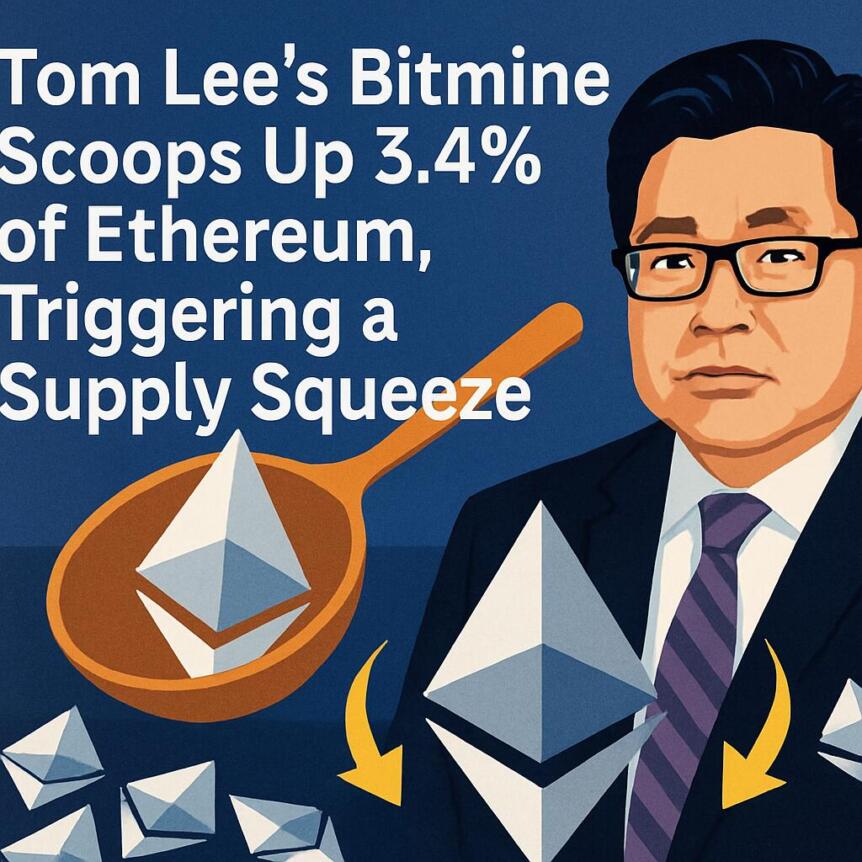
Tom Lee’s Bitmine Scoops Up 3.4% of Ethereum, Triggering a Supply Squeeze

Tom Lee’s Bitmine Scoops Up 3.4% of Ethereum, Triggering a Supply Squeeze

Bitmine Immersion now controls 3.4% of Ethereum amid shrinking exchange supply and rising institutional accumulation.
Share
Crypto Breaking News2026/01/20 16:27