Crypto treasury companies that raised capital through private investment in public equity (PIPE) deals face a growing risk of their stock prices crashing by as much as 50%, according to a new market report from analytics platform CryptoQuant. The firm said PIPE-backed companies have already suffered steep declines, with share prices often gravitating toward their PIPE issuance levels. Researchers noted that when lock-up periods expire, investors frequently exit positions to secure profits, creating heavy selling pressure. PIPE Issuances Create Overhang Across Crypto Treasury Sector, Analysts Warn PIPE deals allow private investors to buy new shares below market price, offering companies fast access to liquidity in a competitive sector. While effective for raising cash, CryptoQuant warned that these arrangements dilute existing shareholders and leave an overhang of shares that weighs on stock performance. One of the starkest examples is Kindly MD (NAKA), a medical company that pivoted into Bitcoin treasury holdings earlier this year. Its stock surged from $1.80 in late April to nearly $35 by late May after announcing a PIPE raise. However, once PIPE shares unlocked, the stock collapsed 97%, falling to $1.16, almost identical to its PIPE offering price of $1.12. CryptoQuant described the retracement as a case of “PIPE price gravity.”Source: CryptoQuant Other crypto treasury firms may now be following the same path. Strive Inc. (ASST) peaked at $13 in May but has since dropped 78% to $2.75. CryptoQuant said its PIPE was priced at $1.35, implying the stock could face another 55% decline as investors prepare to sell when the lock-up ends next month. Cantor Equity Partners (CEP), a special purpose acquisition company merging with Twenty One Capital, also conducted a PIPE priced at $10. CEP’s shares have already slipped nearly 70% from their highs to below $20. CryptoQuant suggested the stock could fall another 50% from current levels once PIPE investors begin to sell. The report noted that even well-established crypto treasuries are under pressure as the value of their digital asset holdings approaches parity with their overall company valuations. This dynamic could further accelerate sell-offs if investors perceive limited upside in stock performance compared to direct crypto exposure. CryptoQuant concluded that only a strong and sustained Bitcoin rally is likely to counteract the downward pressure facing treasury stocks tied to PIPE deals. Without such a rebound, it warned that many companies are likely to continue trending toward or below their PIPE issuance levels. At present, the trend has already left PIPE-funded crypto treasury stocks exposed to sharp losses, with investors closely watching how upcoming unlocks will impact market sentiment in the weeks ahead. Small-Cap Firms Turn to Borrowing as Crypto Treasury Strategy Falters On the other hand, the crypto treasury strategy that surged across small-cap firms in 2024 is showing signs of strain as companies turn to debt-funded share buybacks to support collapsing valuations. According to a CryptoNews report, at least seven firms, including gaming, biotech, and electric vehicle companies, have launched repurchase programs despite trading below the value of their crypto holdings. Analysts say the trend reflects investor skepticism and undermines the premise that digital assets alone can boost stock performance. One high-profile case is ETHZilla, formerly 180 Life Sciences, which rebranded after buying ether. Its stock has fallen 76% since August. The company recently secured $80 million in debt from Cumberland DRW to finance a $250 million buyback. Critics argue the move signals distress. “They’re borrowing money to buy time, not tokens,” said Kaiko analyst Adam Morgan McCarthy. Similar tactics are emerging elsewhere. Empery Digital, once Volcon, expanded its debt facility to $85 million despite holding $476 million in Bitcoin, more than its $378 million market value. SharpLink Gaming, Ton Strategy, and CEA Industries are pursuing comparable measures. Research from K33 shows one in four public Bitcoin treasuries now trade below their net asset value, with the average NAV multiple falling to 2.8 from 3.76 in April. Smaller firms such as NAKA and Semler Scientific face mounting pressure, while larger players like MicroStrategy continue to command premiums. The slowdown in BTC accumulation suggests the once-celebrated crypto treasury playbook may be nearing its limitsCrypto treasury companies that raised capital through private investment in public equity (PIPE) deals face a growing risk of their stock prices crashing by as much as 50%, according to a new market report from analytics platform CryptoQuant. The firm said PIPE-backed companies have already suffered steep declines, with share prices often gravitating toward their PIPE issuance levels. Researchers noted that when lock-up periods expire, investors frequently exit positions to secure profits, creating heavy selling pressure. PIPE Issuances Create Overhang Across Crypto Treasury Sector, Analysts Warn PIPE deals allow private investors to buy new shares below market price, offering companies fast access to liquidity in a competitive sector. While effective for raising cash, CryptoQuant warned that these arrangements dilute existing shareholders and leave an overhang of shares that weighs on stock performance. One of the starkest examples is Kindly MD (NAKA), a medical company that pivoted into Bitcoin treasury holdings earlier this year. Its stock surged from $1.80 in late April to nearly $35 by late May after announcing a PIPE raise. However, once PIPE shares unlocked, the stock collapsed 97%, falling to $1.16, almost identical to its PIPE offering price of $1.12. CryptoQuant described the retracement as a case of “PIPE price gravity.”Source: CryptoQuant Other crypto treasury firms may now be following the same path. Strive Inc. (ASST) peaked at $13 in May but has since dropped 78% to $2.75. CryptoQuant said its PIPE was priced at $1.35, implying the stock could face another 55% decline as investors prepare to sell when the lock-up ends next month. Cantor Equity Partners (CEP), a special purpose acquisition company merging with Twenty One Capital, also conducted a PIPE priced at $10. CEP’s shares have already slipped nearly 70% from their highs to below $20. CryptoQuant suggested the stock could fall another 50% from current levels once PIPE investors begin to sell. The report noted that even well-established crypto treasuries are under pressure as the value of their digital asset holdings approaches parity with their overall company valuations. This dynamic could further accelerate sell-offs if investors perceive limited upside in stock performance compared to direct crypto exposure. CryptoQuant concluded that only a strong and sustained Bitcoin rally is likely to counteract the downward pressure facing treasury stocks tied to PIPE deals. Without such a rebound, it warned that many companies are likely to continue trending toward or below their PIPE issuance levels. At present, the trend has already left PIPE-funded crypto treasury stocks exposed to sharp losses, with investors closely watching how upcoming unlocks will impact market sentiment in the weeks ahead. Small-Cap Firms Turn to Borrowing as Crypto Treasury Strategy Falters On the other hand, the crypto treasury strategy that surged across small-cap firms in 2024 is showing signs of strain as companies turn to debt-funded share buybacks to support collapsing valuations. According to a CryptoNews report, at least seven firms, including gaming, biotech, and electric vehicle companies, have launched repurchase programs despite trading below the value of their crypto holdings. Analysts say the trend reflects investor skepticism and undermines the premise that digital assets alone can boost stock performance. One high-profile case is ETHZilla, formerly 180 Life Sciences, which rebranded after buying ether. Its stock has fallen 76% since August. The company recently secured $80 million in debt from Cumberland DRW to finance a $250 million buyback. Critics argue the move signals distress. “They’re borrowing money to buy time, not tokens,” said Kaiko analyst Adam Morgan McCarthy. Similar tactics are emerging elsewhere. Empery Digital, once Volcon, expanded its debt facility to $85 million despite holding $476 million in Bitcoin, more than its $378 million market value. SharpLink Gaming, Ton Strategy, and CEA Industries are pursuing comparable measures. Research from K33 shows one in four public Bitcoin treasuries now trade below their net asset value, with the average NAV multiple falling to 2.8 from 3.76 in April. Smaller firms such as NAKA and Semler Scientific face mounting pressure, while larger players like MicroStrategy continue to command premiums. The slowdown in BTC accumulation suggests the once-celebrated crypto treasury playbook may be nearing its limits

Crypto Treasury Stocks at Risk of 50% Crash After PIPE Deals — CryptoQuant Warns

Crypto treasury companies that raised capital through private investment in public equity (PIPE) deals face a growing risk of their stock prices crashing by as much as 50%, according to a new market report from analytics platform CryptoQuant.

The firm said PIPE-backed companies have already suffered steep declines, with share prices often gravitating toward their PIPE issuance levels.

Researchers noted that when lock-up periods expire, investors frequently exit positions to secure profits, creating heavy selling pressure.

PIPE Issuances Create Overhang Across Crypto Treasury Sector, Analysts Warn

PIPE deals allow private investors to buy new shares below market price, offering companies fast access to liquidity in a competitive sector.

While effective for raising cash, CryptoQuant warned that these arrangements dilute existing shareholders and leave an overhang of shares that weighs on stock performance.

One of the starkest examples is Kindly MD (NAKA), a medical company that pivoted into Bitcoin treasury holdings earlier this year.

Its stock surged from $1.80 in late April to nearly $35 by late May after announcing a PIPE raise. However, once PIPE shares unlocked, the stock collapsed 97%, falling to $1.16, almost identical to its PIPE offering price of $1.12.

CryptoQuant described the retracement as a case of “PIPE price gravity.”
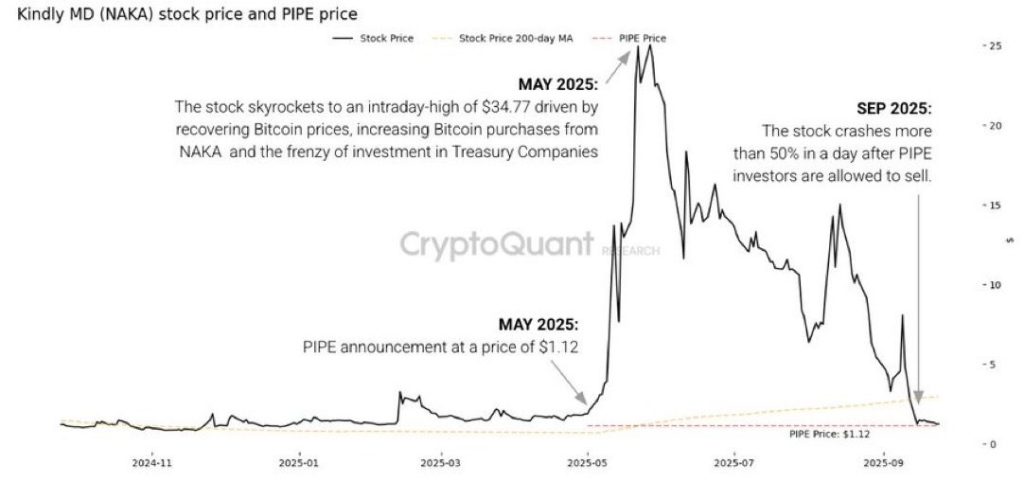
Source: CryptoQuant

Other crypto treasury firms may now be following the same path. Strive Inc. (ASST) peaked at $13 in May but has since dropped 78% to $2.75.

CryptoQuant said its PIPE was priced at $1.35, implying the stock could face another 55% decline as investors prepare to sell when the lock-up ends next month.

Cantor Equity Partners (CEP), a special purpose acquisition company merging with Twenty One Capital, also conducted a PIPE priced at $10. CEP’s shares have already slipped nearly 70% from their highs to below $20.

CryptoQuant suggested the stock could fall another 50% from current levels once PIPE investors begin to sell.

The report noted that even well-established crypto treasuries are under pressure as the value of their digital asset holdings approaches parity with their overall company valuations.

This dynamic could further accelerate sell-offs if investors perceive limited upside in stock performance compared to direct crypto exposure.

CryptoQuant concluded that only a strong and sustained Bitcoin rally is likely to counteract the downward pressure facing treasury stocks tied to PIPE deals.

Without such a rebound, it warned that many companies are likely to continue trending toward or below their PIPE issuance levels.

At present, the trend has already left PIPE-funded crypto treasury stocks exposed to sharp losses, with investors closely watching how upcoming unlocks will impact market sentiment in the weeks ahead.

Small-Cap Firms Turn to Borrowing as Crypto Treasury Strategy Falters

On the other hand, the crypto treasury strategy that surged across small-cap firms in 2024 is showing signs of strain as companies turn to debt-funded share buybacks to support collapsing valuations.

According to a CryptoNews report, at least seven firms, including gaming, biotech, and electric vehicle companies, have launched repurchase programs despite trading below the value of their crypto holdings.

Analysts say the trend reflects investor skepticism and undermines the premise that digital assets alone can boost stock performance.

One high-profile case is ETHZilla, formerly 180 Life Sciences, which rebranded after buying ether. Its stock has fallen 76% since August.

The company recently secured $80 million in debt from Cumberland DRW to finance a $250 million buyback.

Critics argue the move signals distress. “They’re borrowing money to buy time, not tokens,” said Kaiko analyst Adam Morgan McCarthy.

Similar tactics are emerging elsewhere. Empery Digital, once Volcon, expanded its debt facility to $85 million despite holding $476 million in Bitcoin, more than its $378 million market value.

SharpLink Gaming, Ton Strategy, and CEA Industries are pursuing comparable measures.

Research from K33 shows one in four public Bitcoin treasuries now trade below their net asset value, with the average NAV multiple falling to 2.8 from 3.76 in April.

Smaller firms such as NAKA and Semler Scientific face mounting pressure, while larger players like MicroStrategy continue to command premiums.

The slowdown in BTC accumulation suggests the once-celebrated crypto treasury playbook may be nearing its limits.

Disclaimer: The articles reposted on this site are sourced from public platforms and are provided for informational purposes only. They do not necessarily reflect the views of MEXC. All rights remain with the original authors. If you believe any content infringes on third-party rights, please contact [email protected] for removal. MEXC makes no guarantees regarding the accuracy, completeness, or timeliness of the content and is not responsible for any actions taken based on the information provided. The content does not constitute financial, legal, or other professional advice, nor should it be considered a recommendation or endorsement by MEXC.

You May Also Like

Fed forecasts only one rate cut in 2026, a more conservative outlook than expected

Fed forecasts only one rate cut in 2026, a more conservative outlook than expected

The post Fed forecasts only one rate cut in 2026, a more conservative outlook than expected appeared on BitcoinEthereumNews.com. Federal Reserve Chairman Jerome Powell talks to reporters following the regular Federal Open Market Committee meetings at the Fed on July 30, 2025 in Washington, DC. Chip Somodevilla | Getty Images The Federal Reserve is projecting only one rate cut in 2026, fewer than expected, according to its median projection. The central bank’s so-called dot plot, which shows 19 individual members’ expectations anonymously, indicated a median estimate of 3.4% for the federal funds rate at the end of 2026. That compares to a median estimate of 3.6% for the end of this year following two expected cuts on top of Wednesday’s reduction. A single quarter-point reduction next year is significantly more conservative than current market pricing. Traders are currently pricing in at two to three more rate cuts next year, according to the CME Group’s FedWatch tool, updated shortly after the decision. The gauge uses prices on 30-day fed funds futures contracts to determine market-implied odds for rate moves. Here are the Fed’s latest targets from 19 FOMC members, both voters and nonvoters: Zoom In IconArrows pointing outwards The forecasts, however, showed a large difference of opinion with two voting members seeing as many as four cuts. Three officials penciled in three rate reductions next year. “Next year’s dot plot is a mosaic of different perspectives and is an accurate reflection of a confusing economic outlook, muddied by labor supply shifts, data measurement concerns, and government policy upheaval and uncertainty,” said Seema Shah, chief global strategist at Principal Asset Management. The central bank has two policy meetings left for the year, one in October and one in December. Economic projections from the Fed saw slightly faster economic growth in 2026 than was projected in June, while the outlook for inflation was updated modestly higher for next year. There’s a lot of uncertainty…
Share
BitcoinEthereumNews2025/09/18 02:59
While Ethereum and Hedera Hold Steady, ZKP Crypto Shakes the Market with a $1.7B Raise in Motion

While Ethereum and Hedera Hold Steady, ZKP Crypto Shakes the Market with a $1.7B Raise in Motion

Learn how Hedera and Ethereum are shaping up, and why analysts say ZKP crypto’s $1.7B auction makes it the best crypto to buy before demand overtakes supply.
Share
coinlineup2026/01/21 12:00
Massachusetts Can Ban Kalshi Sports Markets for Now, Judge Rules

Massachusetts Can Ban Kalshi Sports Markets for Now, Judge Rules

The post Massachusetts Can Ban Kalshi Sports Markets for Now, Judge Rules appeared on BitcoinEthereumNews.com. In brief A Massachusetts judge allowed state regulators
Share
BitcoinEthereumNews2026/01/21 12:23