Bitcoin registered 1.58% gains while the S&P 500 dropped 1.48% on September 2, breaking their historical correlation pattern. Market signals point to a potential altseason beginning. The post Decoupling: Crypto Goes Up While US Stock Market Goes Down appeared first on Coinspeaker.Bitcoin registered 1.58% gains while the S&P 500 dropped 1.48% on September 2, breaking their historical correlation pattern. Market signals point to a potential altseason beginning. The post Decoupling: Crypto Goes Up While US Stock Market Goes Down appeared first on Coinspeaker.

Decoupling: Crypto Goes Up While US Stock Market Goes Down

Historically, the cryptocurrency market, led by Bitcoin BTC $110 619 24h volatility: 1.2% Market cap: $2.20 T Vol. 24h: $53.56 B , has registered a significant correlation to the US stock market, most of the time moving upward when stocks go up and downward when stocks go down. This correlation is now being challenged on September 2, with the United States back from Labor Day holidays.

In particular, the S&P 500 started the day with a 1.48% drop at 6,364 points, while BTC was registering 1.58% gains at $110,987 per coin, according to data from Google Finance.
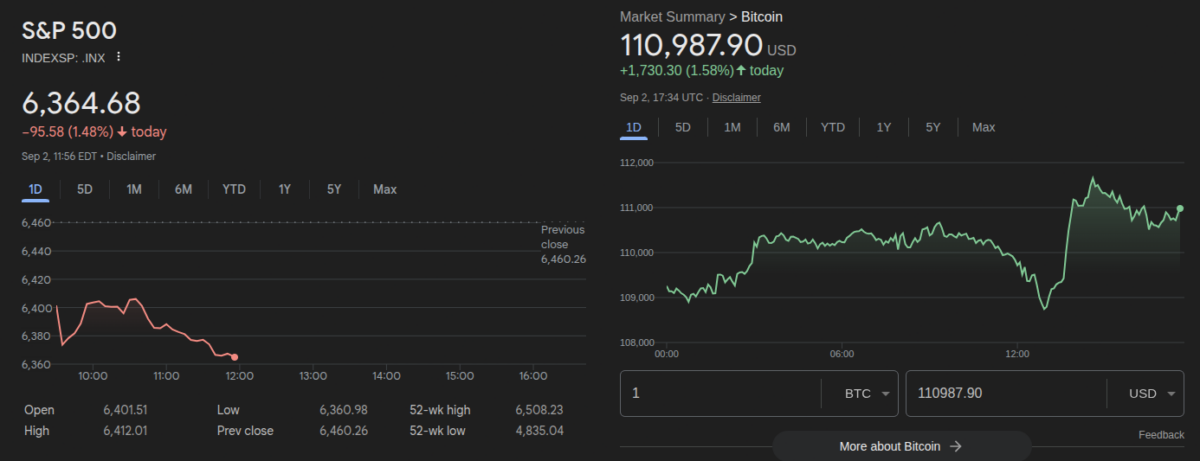
S&P 500 chart (left) and Bitcoin price chart (right) on September 2 | Source: Google Finance

S&P 500 chart (left) and Bitcoin price chart (right) on September 2 | Source: Google Finance

Moreover, not only is Bitcoin decoupling from the US stock market. Altcoins are also registering significant gains, as TradingView’s crypto total market cap index hovers above $3.77 trillion, up 1.5% intraday.

Earlier today, Coinspeaker covered Michael van de Poppe blaming gold’s rally for the delayed altseason, mentioning a risk-on and risk-off positioning battle for institutional and retail investors. Nevertheless, the market is giving signals of a starting altseason while gold continues to register new highs.

Among these signals, there is the Bitcoin Dominance Index (BTC.D), which has broken down from a multi-year uptrend, with BTC capital slowly rotating to altcoins. A trend is also seen among institutional investors regarding ETH ETF inflows and old Bitcoin whales selling BTC to accumulate Ethereum—both previously reported by Coinspeaker.

Additionally, the Altseason Index on Coinglass “has climbed to 61,” the crypto analyst who goes by Lucky highlighted on X. According to him, this stage sets the way for the next altcoin season.

Bitcoin Diverges from S&P 500 Trading Pattern

Bitcoin price has a historical correlation to the S&P 500, with both making similar movements up and down, as observed in the cross-asset chart from TradingView. Nevertheless, there are moments in the chart where we can see BTC decoupling from the US stock market leading indicator to, first, print huge gains and, later, experience large crashes back to the correlation trail.

Two notable moments of such activity were in 2017—marking the second-largest bull market in crypto history, followed by the first relevant altseason with BTC.D dropping from over 90% to sub-40%—and 2021, marking the largest crypto bull market, featuring the second big altseason with Bitcoin market cap dominance dropping from 70% to, again, sub-40%.
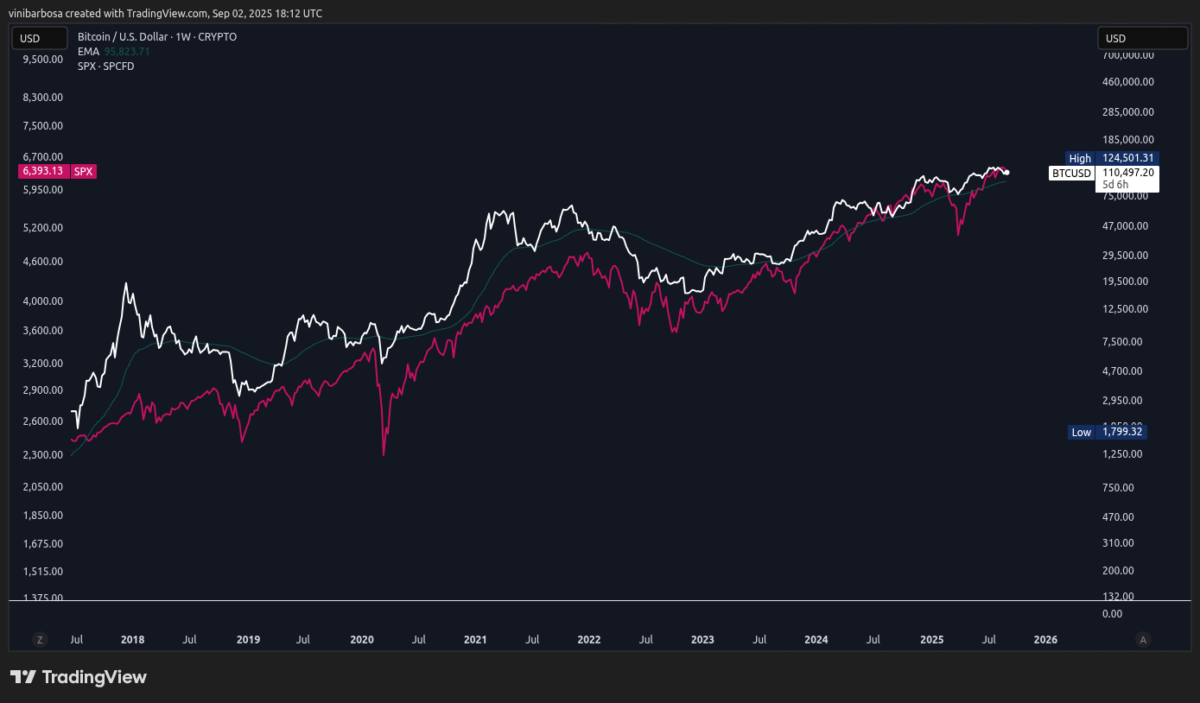
BTC/USD and SPX 1W correlation chart | Source: TradingView

BTC/USD and SPX 1W correlation chart | Source: TradingView

As of this writing, BTC.D goes at around 58%, after peaking at 65% this cycle, and Bitcoin teases a decoupling from the stock market. In an intersection between the two worlds, Michael Saylor’s company Strategy (NASDAQ:MSTR) announced another massive Bitcoin purchase, scooping over 4,000 BTC for $449 million, close to what could be a local bottom.

next

The post Decoupling: Crypto Goes Up While US Stock Market Goes Down appeared first on Coinspeaker.

Market Opportunity
GAINS Logo
GAINS Price(GAINS)
$0.01366
$0.01366$0.01366
+0.07%
USD
GAINS (GAINS) Live Price Chart
Disclaimer: The articles reposted on this site are sourced from public platforms and are provided for informational purposes only. They do not necessarily reflect the views of MEXC. All rights remain with the original authors. If you believe any content infringes on third-party rights, please contact [email protected] for removal. MEXC makes no guarantees regarding the accuracy, completeness, or timeliness of the content and is not responsible for any actions taken based on the information provided. The content does not constitute financial, legal, or other professional advice, nor should it be considered a recommendation or endorsement by MEXC.

You May Also Like

WIF price reclaims 200-day moving average

WIF price reclaims 200-day moving average

WIF (WIF) price is entering a critical technical phase as price action reclaims the 200-day moving average, a level that often separates bearish control from bullish
Share
Crypto.news2026/01/13 23:44
China Blocks Nvidia’s RTX Pro 6000D as Local Chips Rise

China Blocks Nvidia’s RTX Pro 6000D as Local Chips Rise

The post China Blocks Nvidia’s RTX Pro 6000D as Local Chips Rise appeared on BitcoinEthereumNews.com. China Blocks Nvidia’s RTX Pro 6000D as Local Chips Rise China’s internet regulator has ordered the country’s biggest technology firms, including Alibaba and ByteDance, to stop purchasing Nvidia’s RTX Pro 6000D GPUs. According to the Financial Times, the move shuts down the last major channel for mass supplies of American chips to the Chinese market. Why Beijing Halted Nvidia Purchases Chinese companies had planned to buy tens of thousands of RTX Pro 6000D accelerators and had already begun testing them in servers. But regulators intervened, halting the purchases and signaling stricter controls than earlier measures placed on Nvidia’s H20 chip. Image: Nvidia An audit compared Huawei and Cambricon processors, along with chips developed by Alibaba and Baidu, against Nvidia’s export-approved products. Regulators concluded that Chinese chips had reached performance levels comparable to the restricted U.S. models. This assessment pushed authorities to advise firms to rely more heavily on domestic processors, further tightening Nvidia’s already limited position in China. China’s Drive Toward Tech Independence The decision highlights Beijing’s focus on import substitution — developing self-sufficient chip production to reduce reliance on U.S. supplies. “The signal is now clear: all attention is focused on building a domestic ecosystem,” said a representative of a leading Chinese tech company. Nvidia had unveiled the RTX Pro 6000D in July 2025 during CEO Jensen Huang’s visit to Beijing, in an attempt to keep a foothold in China after Washington restricted exports of its most advanced chips. But momentum is shifting. Industry sources told the Financial Times that Chinese manufacturers plan to triple AI chip production next year to meet growing demand. They believe “domestic supply will now be sufficient without Nvidia.” What It Means for the Future With Huawei, Cambricon, Alibaba, and Baidu stepping up, China is positioning itself for long-term technological independence. Nvidia, meanwhile, faces…
Share
BitcoinEthereumNews2025/09/18 01:37
Trump: Powell did a bad job.

Trump: Powell did a bad job.

PANews reported on January 13th that, according to Jinshi Data, US President Trump stated: "Federal Reserve Chairman Powell is either incompetent or dishonest.
Share
PANews2026/01/13 23:40