

Devs Suggest Removing Solana’s Block Limit for Enhanced Performance
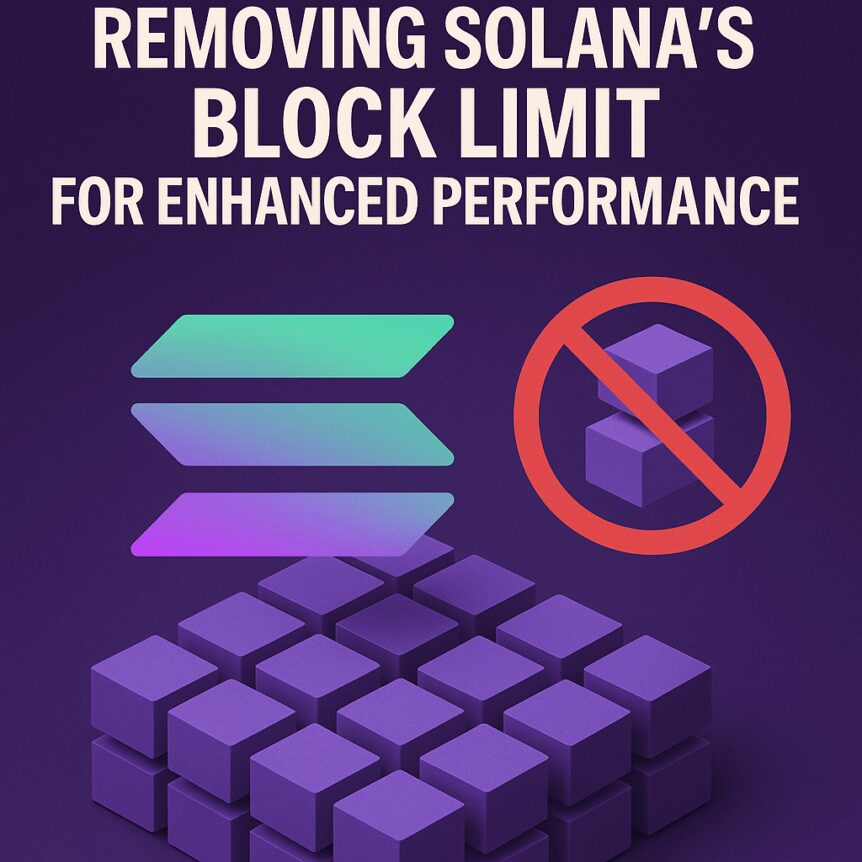
In an effort to enhance Solana’s blockchain performance and promote network decentralization, Jump Crypto has proposed removing the network’s fixed compute block limit. This move aims to motivate validators with less powerful hardware to upgrade, paving the way for greater scalability and efficiency on one of the industry’s most prominent Proof-of-Stake (PoS) networks.
- Jump Crypto advocates for lifting Solana’s fixed compute block cap to boost network performance.
- The proposal follows Solana’s upcoming Alpenglow upgrade, which aims to improve network resilience and transaction finality.
- Removing static block caps could incentivize validator hardware upgrades, fostering a performance-driven ecosystem.
- Concerns exist over potential centralization risks as larger validators might outpace smaller ones in hardware upgrades.
- Solana’s rapid growth and high throughput have driven ongoing efforts to improve network stability amid increasing adoption.
Web3 infrastructure firm Jump Crypto has put forward a proposal to eliminate Solana’s current fixed compute block limit, a move designed to improve network throughput and incentivize validator upgrades. The proposal, known as SIMD-0370, is targeted for implementation after the upcoming Alpenglow upgrade, which the Solana community recently approved through a nearly unanimous vote and is expected to deploy on testnet this December.
Jump, a key developer behind the high-performance Firedancer validator client, argues that removing static block caps would create a ‘performance flywheel.’ As validator hardware improves, they can process more complex blocks, thereby increasing transaction capacity and network efficiency. This, in turn, encourages validators to upgrade their equipment to maximize rewards, fostering a faster, more scalable blockchain ecosystem.
The SIMD-0370 initiative aligns with broader efforts to bolster Solana’s resilience and diversify its validator ecosystem. The Firedancer client launched on mainnet earlier this year, demonstrating ongoing commitment to improving network speed and stability. Currently, Solana serves as a popular blockchain for retail use, thanks to its rapid, low-cost transactions and vibrant ecosystem of decentralized applications. At times, Solana’s decentralized exchange trading volume has even surpassed Ethereum’s, underscoring its rising prominence.
However, increasing network activity has also exposed vulnerabilities, leading to past outages. Upgrades like SIMD-0370 aim to mitigate these challenges by enhancing overall stability as the network scales.
Earlier proposals considered raising the block limit to 100 million CU
Currently, Solana’s fixed compute unit (CU) per block is capped at 60 million. Removing this limit would allow the block size to expand dynamically based on transaction volume, reducing bottlenecks during peak activity. This idea gained traction following a proposal by Jito Labs CEO Lucas Bruder, who in May suggested raising the limit to 100 million CU under the SIMD-0286 plan.
Concerns over centralization risks
While the initiative aims to promote hardware upgrades among validators, some engineers caution that it could inadvertently foster centralization. Akhilesh Singhania highlighted concerns that larger validators investing in expensive hardware might squeeze out smaller operators, resulting in fewer, more powerful validators dominating the network.
Alpenglow — the potential for Solana’s most significant upgrade yet
Proposed by Anza, the Alpenglow upgrade seeks to overhaul Solana’s proof-of-stake consensus mechanism. This comprehensive update promises to drastically cut transaction finality time from approximately 12.8 seconds to as little as 150 milliseconds, while improving network resilience and security.
The successful deployment of Alpenglow could position Solana to challenge traditional internet infrastructure, making it a formidable player in blockchain scalability and security. Anza describes the upgrade as “the biggest change to Solana’s core protocol,” with the potential to reshape its future. Major enhancements aim to make the network more robust during high activity periods, boosting user confidence and adoption.
—
This article was originally published as Devs Suggest Removing Solana’s Block Limit for Enhanced Performance on Crypto Breaking News – your trusted source for crypto news, Bitcoin news, and blockchain updates.
You May Also Like

Mutuum Finance (MUTM) Holder Count Explodes as Phase 6 Nears 100% Allocation Ahead of Q1 Protocol Launch, Best Crypto to Buy?
Micron Technology (MU) Stock: Up 4.7% Following Record Revenue and AI-Centric Expansion
