Middle East escalation is taking a back seat in the markets as traders await Fed's decision.Middle East escalation is taking a back seat in the markets as traders await Fed's decision.

Dow Jones up 100 points as Fed takes focus away from Israel-Iran war

2025/06/19 00:59
2 min read

Stock markets are zeroing in on the Federal Reserve’s key interest rate decision, while the conflict in the Middle East takes a step out of the spotlight.

Major U.S. stock indices were higher ahead of the announcement. On Wednesday, June 18, the Dow Jones rose 132 points, or 0.31%. At the same time, the S&P 500 gained 0.40%, while the NASDAQ climbed 0.55%.
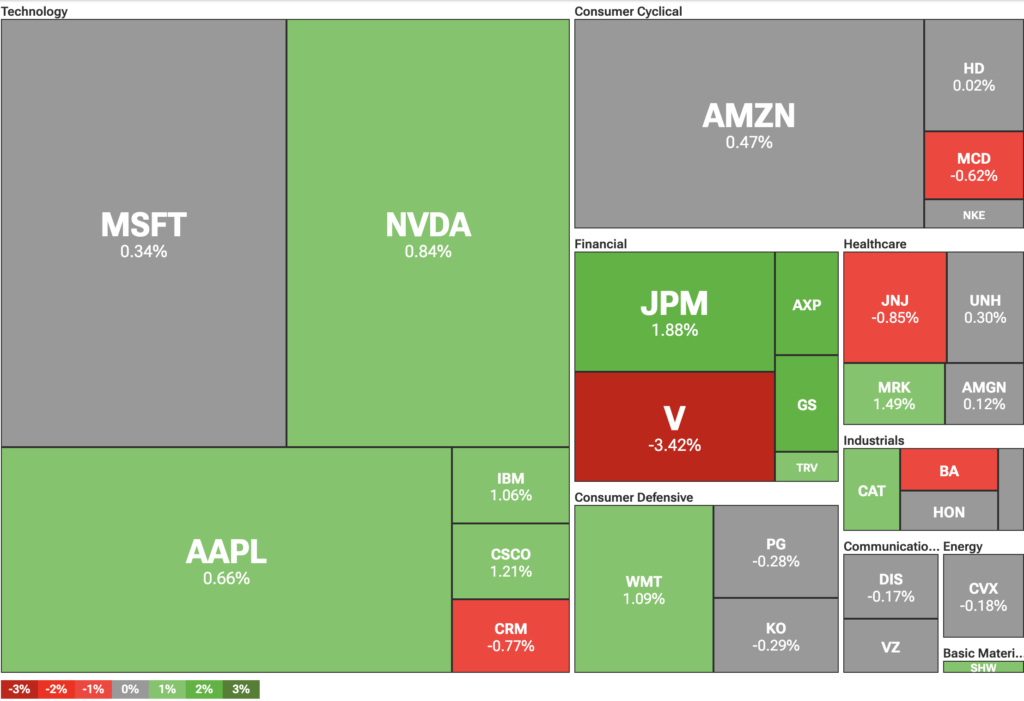
Dow Jones Industrial Average heatmap

The Fed is scheduled to announce its interest rate decision on June 18 at 2 p.m. Eastern Time. Market consensus expects the central bank to keep rates steady. The Fed remains concerned about rising inflation, particularly following the introduction of former President Donald Trump’s “Liberation Day” tariffs.

Trump also anticipates no rate cuts. Earlier, he remarked that “stupid” Fed Chair Jerome Powell probably won’t cut rates. That remark is part of the ongoing pressure by the U.S. President on the Fed.

Trump has said interest rates should be at least two percentage points lower to support the economy. However, that scenario appears unlikely, especially as rising oil prices, driven by the Israel-Iran war, add to inflation concerns.

Trump escalates rhetoric over Iran

While markets are focusing on the Fed, tensions in the Middle East threaten to escalate further. Notably, Trump confronted Iran with a threatening tone, refusing to rule out direct U.S. military involvement. He stated that “it’s very late to be talking” with Iran.

“Nobody knows what I’m going to do,” Trump told reporters when asked whether or not the U.S. would strike Iran. U.S. continues to support Israel with its strikes on Iran, which have already done significant damage to its military capabilities. However, Iran is also retaliating against Israel with missiles and drones.

While Qatar and Oman are trying to mediate a ceasefire, they are urging Israel to de-escalate. On the other hand, Israel is doing its best to get the U.S. directly involved in the war, which would likely have immediate consequences on the entire region and the global oil market.

Disclaimer: The articles reposted on this site are sourced from public platforms and are provided for informational purposes only. They do not necessarily reflect the views of MEXC. All rights remain with the original authors. If you believe any content infringes on third-party rights, please contact [email protected] for removal. MEXC makes no guarantees regarding the accuracy, completeness, or timeliness of the content and is not responsible for any actions taken based on the information provided. The content does not constitute financial, legal, or other professional advice, nor should it be considered a recommendation or endorsement by MEXC.

You May Also Like

Strategy CEO to discuss Bitcoin with Morgan Stanley’s digital asset head next week

Strategy CEO to discuss Bitcoin with Morgan Stanley’s digital asset head next week

The post Strategy CEO to discuss Bitcoin with Morgan Stanley’s digital asset head next week appeared on BitcoinEthereumNews.com. Strategy CEO Phong Le will join
Share
BitcoinEthereumNews2026/02/21 14:48
Stablecoin Yield ‘Effectively Off The Table’: White House Narrows Rewards Debate In Latest Meeting

Stablecoin Yield ‘Effectively Off The Table’: White House Narrows Rewards Debate In Latest Meeting

The White House reportedly took the lead during the latest Crypto Council meeting, narrowing the stablecoin rewards dispute that has delayed progress in the long
Share
Bitcoinist2026/02/21 15:30
Aave DAO to Shut Down 50% of L2s While Doubling Down on GHO

Aave DAO to Shut Down 50% of L2s While Doubling Down on GHO

The post Aave DAO to Shut Down 50% of L2s While Doubling Down on GHO appeared on BitcoinEthereumNews.com. Aave DAO is gearing up for a significant overhaul by shutting down over 50% of underperforming L2 instances. It is also restructuring its governance framework and deploying over $100 million to boost GHO. This could be a pivotal moment that propels Aave back to the forefront of on-chain lending or sparks unprecedented controversy within the DeFi community. Sponsored Sponsored ACI Proposes Shutting Down 50% of L2s The “State of the Union” report by the Aave Chan Initiative (ACI) paints a candid picture. After a turbulent period in the DeFi market and internal challenges, Aave (AAVE) now leads in key metrics: TVL, revenue, market share, and borrowing volume. Aave’s annual revenue of $130 million surpasses the combined cash reserves of its competitors. Tokenomics improvements and the AAVE token buyback program have also contributed to the ecosystem’s growth. Aave global metrics. Source: Aave However, the ACI’s report also highlights several pain points. First, regarding the Layer-2 (L2) strategy. While Aave’s L2 strategy was once a key driver of success, it is no longer fit for purpose. Over half of Aave’s instances on L2s and alt-L1s are not economically viable. Based on year-to-date data, over 86.6% of Aave’s revenue comes from the mainnet, indicating that everything else is a side quest. On this basis, ACI proposes closing underperforming networks. The DAO should invest in key networks with significant differentiators. Second, ACI is pushing for a complete overhaul of the “friendly fork” framework, as most have been unimpressive regarding TVL and revenue. In some cases, attackers have exploited them to Aave’s detriment, as seen with Spark. Sponsored Sponsored “The friendly fork model had a good intention but bad execution where the DAO was too friendly towards these forks, allowing the DAO only little upside,” the report states. Third, the instance model, once a smart…
Share
BitcoinEthereumNews2025/09/18 02:28