As digital transactions continue to rise across Europe, the European Central Bank (ECB) is doubling down on its commitment to preserve physical cash. In a blog post titled “Making euro cash fit for the future,” ECB Executive Board Member Piero Cipollone outlines why cash remains indispensable—and how the ECB plans to ensure it stays that way. Cash is indispensable as a way to pay and to store value, says Executive Board member Piero Cipollone. We are modernising banknotes, ensuring they remain accessible and widely accepted. A digital euro will complement this by bringing the benefits of cash to digital payments. — European Central Bank (@ecb) August 4, 2025 A Dual Payment Future: Cash and Digital Euro The ECB explains that while digital payments are growing rapidly, especially following the COVID-19 pandemic, Cipollone made it clear: physical cash isn’t being phased out. Instead, it’s being preserved and modernised to coexist with digital innovations, such as the upcoming digital euro. To support this dual system, the European Commission’s 2023 Single Currency Package introduced two legislative proposals. One protects the legal tender status of euro cash, and the other lays the groundwork for a digital euro. Together, these laws aim to ensure that Europeans continue to have a wide range of payment choices—both online and offline. Cash Still in High Demand Across Europe Despite digital trends, the ECB reports that euro banknotes remain a trusted store of value. Over €1.6 trillion worth of euro banknotes—around €5,000 per eurozone citizen—is currently in circulation. While usage dipped slightly during interest rate hikes, cash demand continues to rise at an annual rate of 2.3% in volume. Cipollone stresses that during past crises—the 2008 financial crash, the sovereign debt crisis, and the pandemic—cash demand surged, reinforcing its role as a stabilising tool in uncertain times. “Cash is always there when you need it,” he notes. Access to Cash Must Be Protected, Says ECB One of the ECB’s key concerns is making sure there is equitable access to cash services. As bank branches close and ATMs become less common, rural and underserved regions risk being cut off. To counter this, the proposed Legal Tender of Cash Regulation includes mandatory monitoring and assessment of cash access points across the eurozone. The ECB says it is working with national central banks to create metrics that account for geographic and population differences. Cipollone stresses that commercial banks have a duty to maintain both withdrawal and deposit services—essential for keeping cash circulating in local economies. No-Cash Policies Face Legal Pushback Retailers and public services increasingly refusing to accept cash is another red flag for the ECB. The central bank has criticised “no cash” signs and has called for rules to enforce cash acceptance, particularly in essential services like public transport. The Court of Justice of the European Union supports this stance, affirming that cash must be accepted unless both parties agree otherwise. The ECB also plans to modernise banknotes—both in design and anti-counterfeit technology—to ensure they remain practical and appealing well into the digital age. The ECB is clear—cash is not going anywhere. Instead, it’s being future-proofed to stand strong alongside the digital euro, offering Europeans flexibility, security, and inclusivity in how they pay. ECB Approves Central Bank Money for DLT Transactions In July, the ECB approved a two-track plan that will utilise central bank money for distributed ledger technology (DLT) transactions. The first short-term track approach, dubbed “Pontes”, will connect DLT platforms with Eurosystem TARGET services, to be launched by 2026. The track will ensure the free flow of cash, securities and collateral across Europe. Meanwhile, before the launch of the Pontes pilot in Q3 2026, the ECB will consider DLT-based trial and experiment requests.As digital transactions continue to rise across Europe, the European Central Bank (ECB) is doubling down on its commitment to preserve physical cash. In a blog post titled “Making euro cash fit for the future,” ECB Executive Board Member Piero Cipollone outlines why cash remains indispensable—and how the ECB plans to ensure it stays that way. Cash is indispensable as a way to pay and to store value, says Executive Board member Piero Cipollone. We are modernising banknotes, ensuring they remain accessible and widely accepted. A digital euro will complement this by bringing the benefits of cash to digital payments. — European Central Bank (@ecb) August 4, 2025 A Dual Payment Future: Cash and Digital Euro The ECB explains that while digital payments are growing rapidly, especially following the COVID-19 pandemic, Cipollone made it clear: physical cash isn’t being phased out. Instead, it’s being preserved and modernised to coexist with digital innovations, such as the upcoming digital euro. To support this dual system, the European Commission’s 2023 Single Currency Package introduced two legislative proposals. One protects the legal tender status of euro cash, and the other lays the groundwork for a digital euro. Together, these laws aim to ensure that Europeans continue to have a wide range of payment choices—both online and offline. Cash Still in High Demand Across Europe Despite digital trends, the ECB reports that euro banknotes remain a trusted store of value. Over €1.6 trillion worth of euro banknotes—around €5,000 per eurozone citizen—is currently in circulation. While usage dipped slightly during interest rate hikes, cash demand continues to rise at an annual rate of 2.3% in volume. Cipollone stresses that during past crises—the 2008 financial crash, the sovereign debt crisis, and the pandemic—cash demand surged, reinforcing its role as a stabilising tool in uncertain times. “Cash is always there when you need it,” he notes. Access to Cash Must Be Protected, Says ECB One of the ECB’s key concerns is making sure there is equitable access to cash services. As bank branches close and ATMs become less common, rural and underserved regions risk being cut off. To counter this, the proposed Legal Tender of Cash Regulation includes mandatory monitoring and assessment of cash access points across the eurozone. The ECB says it is working with national central banks to create metrics that account for geographic and population differences. Cipollone stresses that commercial banks have a duty to maintain both withdrawal and deposit services—essential for keeping cash circulating in local economies. No-Cash Policies Face Legal Pushback Retailers and public services increasingly refusing to accept cash is another red flag for the ECB. The central bank has criticised “no cash” signs and has called for rules to enforce cash acceptance, particularly in essential services like public transport. The Court of Justice of the European Union supports this stance, affirming that cash must be accepted unless both parties agree otherwise. The ECB also plans to modernise banknotes—both in design and anti-counterfeit technology—to ensure they remain practical and appealing well into the digital age. The ECB is clear—cash is not going anywhere. Instead, it’s being future-proofed to stand strong alongside the digital euro, offering Europeans flexibility, security, and inclusivity in how they pay. ECB Approves Central Bank Money for DLT Transactions In July, the ECB approved a two-track plan that will utilise central bank money for distributed ledger technology (DLT) transactions. The first short-term track approach, dubbed “Pontes”, will connect DLT platforms with Eurosystem TARGET services, to be launched by 2026. The track will ensure the free flow of cash, securities and collateral across Europe. Meanwhile, before the launch of the Pontes pilot in Q3 2026, the ECB will consider DLT-based trial and experiment requests.

ECB Says Cash Will Stay, Even as Digital Payments Grow

2025/08/04 19:05
3 min read
For feedback or concerns regarding this content, please contact us at [email protected]

As digital transactions continue to rise across Europe, the European Central Bank (ECB) is doubling down on its commitment to preserve physical cash.

In a blog post titled “Making euro cash fit for the future,” ECB Executive Board Member Piero Cipollone outlines why cash remains indispensable—and how the ECB plans to ensure it stays that way.

A Dual Payment Future: Cash and Digital Euro

The ECB explains that while digital payments are growing rapidly, especially following the COVID-19 pandemic, Cipollone made it clear: physical cash isn’t being phased out. Instead, it’s being preserved and modernised to coexist with digital innovations, such as the upcoming digital euro.

To support this dual system, the European Commission’s 2023 Single Currency Package introduced two legislative proposals.

One protects the legal tender status of euro cash, and the other lays the groundwork for a digital euro. Together, these laws aim to ensure that Europeans continue to have a wide range of payment choices—both online and offline.

Cash Still in High Demand Across Europe

Despite digital trends, the ECB reports that euro banknotes remain a trusted store of value. Over €1.6 trillion worth of euro banknotes—around €5,000 per eurozone citizen—is currently in circulation. While usage dipped slightly during interest rate hikes, cash demand continues to rise at an annual rate of 2.3% in volume.
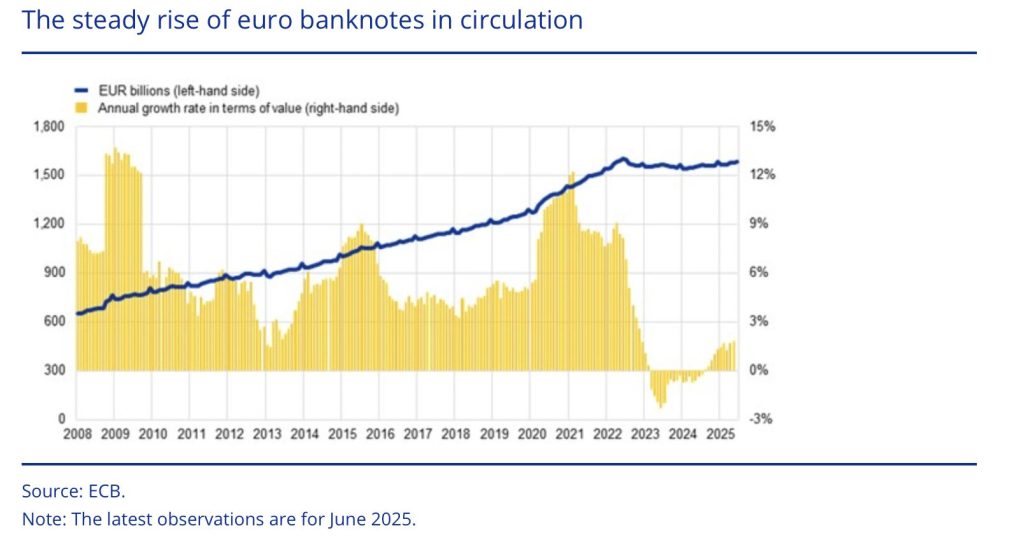
Cipollone stresses that during past crises—the 2008 financial crash, the sovereign debt crisis, and the pandemic—cash demand surged, reinforcing its role as a stabilising tool in uncertain times. “Cash is always there when you need it,” he notes.

Access to Cash Must Be Protected, Says ECB

One of the ECB’s key concerns is making sure there is equitable access to cash services. As bank branches close and ATMs become less common, rural and underserved regions risk being cut off. To counter this, the proposed Legal Tender of Cash Regulation includes mandatory monitoring and assessment of cash access points across the eurozone.

The ECB says it is working with national central banks to create metrics that account for geographic and population differences. Cipollone stresses that commercial banks have a duty to maintain both withdrawal and deposit services—essential for keeping cash circulating in local economies.

No-Cash Policies Face Legal Pushback

Retailers and public services increasingly refusing to accept cash is another red flag for the ECB. The central bank has criticised “no cash” signs and has called for rules to enforce cash acceptance, particularly in essential services like public transport.

The Court of Justice of the European Union supports this stance, affirming that cash must be accepted unless both parties agree otherwise. The ECB also plans to modernise banknotes—both in design and anti-counterfeit technology—to ensure they remain practical and appealing well into the digital age.

The ECB is clear—cash is not going anywhere. Instead, it’s being future-proofed to stand strong alongside the digital euro, offering Europeans flexibility, security, and inclusivity in how they pay.

ECB Approves Central Bank Money for DLT Transactions

In July, the ECB approved a two-track plan that will utilise central bank money for distributed ledger technology (DLT) transactions.

The first short-term track approach, dubbed “Pontes”, will connect DLT platforms with Eurosystem TARGET services, to be launched by 2026. The track will ensure the free flow of cash, securities and collateral across Europe.

Meanwhile, before the launch of the Pontes pilot in Q3 2026, the ECB will consider DLT-based trial and experiment requests.

Market Opportunity
Threshold Logo
Threshold Price(T)
$0.006294
$0.006294$0.006294
-1.85%
USD
Threshold (T) Live Price Chart
Disclaimer: The articles reposted on this site are sourced from public platforms and are provided for informational purposes only. They do not necessarily reflect the views of MEXC. All rights remain with the original authors. If you believe any content infringes on third-party rights, please contact [email protected] for removal. MEXC makes no guarantees regarding the accuracy, completeness, or timeliness of the content and is not responsible for any actions taken based on the information provided. The content does not constitute financial, legal, or other professional advice, nor should it be considered a recommendation or endorsement by MEXC.

You May Also Like

Crypto Shows Mixed Reaction To Rate Cuts and Powell’s Speech

Crypto Shows Mixed Reaction To Rate Cuts and Powell’s Speech

The post Crypto Shows Mixed Reaction To Rate Cuts and Powell’s Speech appeared on BitcoinEthereumNews.com. Jerome Powell gave a speech justifying the Fed’s decision to push one rate cut today. Even though a cut took place as predicted, most leading cryptoassets began falling after a momentary price boost. Additionally, Powell directly addressed President Trump’s attempts to influence Fed policy, claiming that it didn’t impact today’s decisions. In previous speeches, he skirted around this elephant in the room. Sponsored Sponsored Powell’s FOMC Speech The FOMC just announced its decision to cut US interest rates, a highly-telegraphed move with substantial market implications. Jerome Powell, Chair of the Federal Reserve, gave a speech to help explain this moderate decision. In his speech, Powell discussed several negative economic factors in the US right now, including dour Jobs Reports and inflation concerns. These contribute to a degree of fiscal uncertainty which led Powell to stick with his conservative instincts, leaving tools available for future action. “At today’s meeting, the Committee decided to lower the target range…by a quarter percentage point… and to continue reducing the size of our balance sheet. Changes to government policies continue to evolve, and their impacts on the economy remain uncertain,” he claimed. Crypto’s Muted Response The Fed is in a delicate position, balancing the concerns of inflation and employment. This conservative approach may help explain why crypto markets did not react much to Powell’s speech: Bitcoin (BTC) Price Performance. Source: CoinGecko Sponsored Sponsored Bitcoin, alongside the other leading cryptoassets, exhibited similar movements during the rate cuts and Powell’s speech. Although there were brief price spikes immediately after the announcement, subsequent drops ate these gains. BTC, ETH, XRP, DOGE, ADA, and more all fell more than 1% since the Fed’s announcement. Breaking with Precedent However, Powell’s speech did differ from his previous statements in one key respect: he directly addressed claims that President Trump is attacking…
Share
BitcoinEthereumNews2025/09/18 09:01
Coinbase Joins Ethereum Foundation to Back Open Intents Framework

Coinbase Joins Ethereum Foundation to Back Open Intents Framework

Coinbase Payments has joined the Open Intents Framework as a core contributor, working alongside Ethereum Foundation and other major players. The initiative aims to simplify complex multi-chain interactions through automated solver technology. The post Coinbase Joins Ethereum Foundation to Back Open Intents Framework appeared first on Coinspeaker.
Share
Coinspeaker2025/09/18 02:43
Solana’s (SOL) Recent Rally May Impress, But Investors Targeting Life-Changing ROI Are Looking Elsewhere

Solana’s (SOL) Recent Rally May Impress, But Investors Targeting Life-Changing ROI Are Looking Elsewhere

The post Solana’s (SOL) Recent Rally May Impress, But Investors Targeting Life-Changing ROI Are Looking Elsewhere appeared on BitcoinEthereumNews.com. Solana’s (SOL) latest rally has attracted investors from all over, but the bigger story for vision-minded investors is where the next surges of life-altering returns are heading.  As Solana continues to see high levels of ecosystem usage and network utilization, the stage is slowly being set for Mutuum Finance (MUTM).  MUTM is priced at $0.035 in its fast-growing presale. Price appreciation of 14.3% is what the investors are going to anticipate in the next phase. Over $15.85 million has been raised as the presale keeps gaining momentum. Unlike the majority of the tokens surfing short-term waves of hype, Mutuum Finance is becoming a utility-focused choice with more value potential and therefore an increasingly better option for investors looking for more than price action alone. Solana Maintains Gains Near $234 As Speculation Persists Solana (SOL) is trading at $234.08 currently, holding its 24hr range around $234.42 to $248.19 as it illustrates the recent trend. The token has recorded strong seven-day gains of nearly 13%, far exceeding most of its peers, as it is supported by rising volume and institutional buying. Resistance is at $250-$260, and support appears to be at $220-$230, and thus these are significant levels for potential breakout or pullback.  However, new DeFi crypto Mutuum Finance, is being considered by market watchers to have more upside potential, being still in presale.  Mutuum Finance Phase 6 Presale Mutuum Finance is currently in Presale Stage 6 and offering tokens for $0.035. Presale has been going on very fast, and investors have raised over $15.85 million. The project also looks forward to a USD-pegged stablecoin on the Ethereum blockchain for convenient payments and as a keeper of long-term value. Mutuum Finance is a dual-lending, multi-purpose DeFi platform that benefits borrowers and lenders alike. It provides the network to retail as well as…
Share
BitcoinEthereumNews2025/09/18 06:23