TLDR Ethereum transactions and active addresses are at all-time highs in October 2025. Average Ethereum gas fees remain low despite record mainnet usage. Layer-2 networks like Arbitrum and Optimism help keep Ethereum fees low. Rollups and EIP-4844 upgrades are improving Ethereum’s efficiency at scale. Ethereum has recorded its highest-ever on-chain activity, with transaction volumes and [...] The post Ethereum Activity Hits Record High While Gas Fees Remain Near All-time lows appeared first on CoinCentral.TLDR Ethereum transactions and active addresses are at all-time highs in October 2025. Average Ethereum gas fees remain low despite record mainnet usage. Layer-2 networks like Arbitrum and Optimism help keep Ethereum fees low. Rollups and EIP-4844 upgrades are improving Ethereum’s efficiency at scale. Ethereum has recorded its highest-ever on-chain activity, with transaction volumes and [...] The post Ethereum Activity Hits Record High While Gas Fees Remain Near All-time lows appeared first on CoinCentral.

Ethereum Activity Hits Record High While Gas Fees Remain Near All-time lows

TLDR

  • Ethereum transactions and active addresses are at all-time highs in October 2025.
  • Average Ethereum gas fees remain low despite record mainnet usage.
  • Layer-2 networks like Arbitrum and Optimism help keep Ethereum fees low.
  • Rollups and EIP-4844 upgrades are improving Ethereum’s efficiency at scale.

Ethereum has recorded its highest-ever on-chain activity, with transaction volumes and unique active addresses reaching new peaks. According to Token Terminal, these records were set without the typical rise in gas fees. Despite the surge in demand, transaction costs on Ethereum have remained close to historic lows. This development has captured attention across the blockchain industry, especially among users, developers, and long-term participants.

Record Activity on Ethereum Mainnet

Recent data from Token Terminal shows that ETH Layer 1 (L1) has reached record numbers in daily transactions and unique active addresses. The network is currently processing millions of transactions each day, surpassing past monthly averages.

Analytics platforms confirm that usage across decentralized finance (DeFi), NFT platforms, and other on-chain applications is increasing. This activity is helping to push Ethereum usage to its highest levels to date. Developers have also reported that the network is handling the increased load without notable congestion issues.
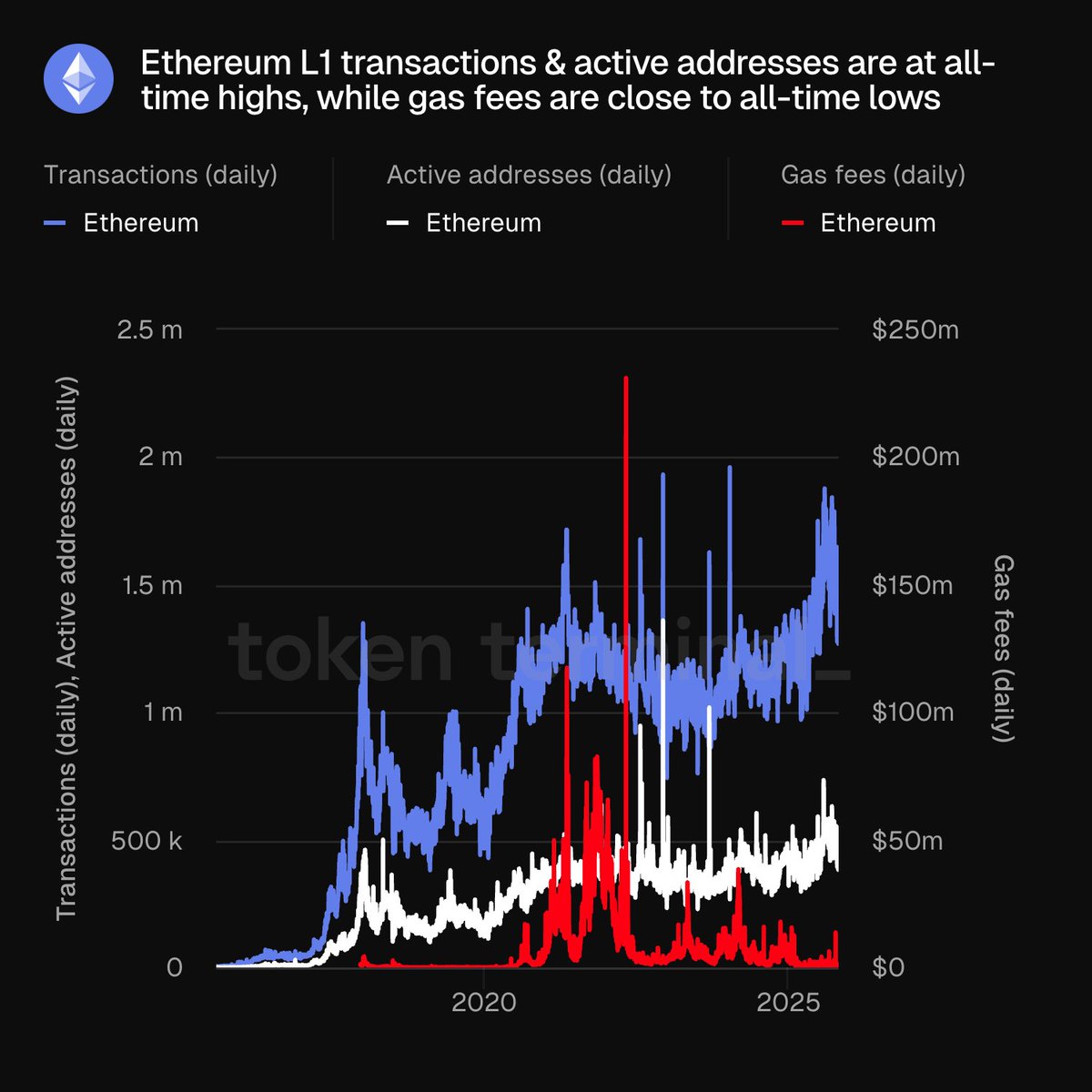
Line charts display Ethereum L1 daily transactions in blue peaking at 2 million, active addresses in black reaching 1.5 million, and gas fees in red dropping to around 50 dollars, all at all-time highs or lows from 2020 to 2025 with Token Terminal watermark.Source: Token Terminal

Much of this growth is tied to higher engagement with decentralized applications and improved user experiences. Ethereum’s throughput on the mainnet has expanded in both volume and scale, further showing the rising demand for on-chain services. This activity suggests that more users are interacting directly with Ethereum or through connected applications.

Gas Fees Remain Low Despite Heavy Network Usage

Gas fees have remained low even as activity on Ethereum has climbed to new highs. Historically, any rise in transactions on Ethereum would lead to higher gas costs due to congestion. This time, however, that pattern has not occurred.

Ethereum’s current average gas fees are near historic lows. Market observers suggest this shift is due to the growing use of Layer-2 (L2) networks such as Arbitrum, Optimism, and Base. These L2 chains bundle transactions off-chain and settle them on the mainnet in batches.

By offloading traffic from the base layer, L2s reduce the number of direct transactions on Ethereum L1. This system allows for high throughput while keeping user transaction fees lower. Developers also note that new smart contract designs and protocol upgrades are improving how efficiently Ethereum handles load.

Technology Upgrades Help Support High Activity

The Ethereum network has benefited from a series of infrastructure upgrades that improve its ability to scale. One such upgrade, known as EIP-4844 or proto-danksharding, is expected to further reduce costs and boost data availability on L2 networks.

Since Ethereum transitioned from proof-of-work to proof-of-stake, it has become more energy-efficient and structurally flexible. These changes have laid the foundation for handling increased activity without slowing the network or raising fees.

Rollups, which are a key part of ETH roadmap, are being adopted at a growing pace. These scaling solutions process transactions efficiently and help maintain a balanced load on the mainnet. Together with protocol upgrades, they are creating better conditions for both users and developers.

Outlook for Ethereum Network Scalability

Maintaining strong performance while keeping transaction costs low will be a key challenge going forward. ETH developers continue to focus on expanding its capacity while protecting decentralization and security.

The rise in Layer-2 adoption is expected to continue, which may help Ethereum scale more sustainably. As user activity increases across Web3 services, Ethereum will need to keep pace with demand without returning to high gas fee conditions.

For now, Ethereum’s infrastructure appears to be handling the increased pressure well. If these trends continue, Ethereum could remain a central hub for blockchain activity without the high transaction costs that once limited its usability.

The post Ethereum Activity Hits Record High While Gas Fees Remain Near All-time lows appeared first on CoinCentral.

Market Opportunity
NEAR Logo
NEAR Price(NEAR)
$1.821
$1.821$1.821
+0.49%
USD
NEAR (NEAR) Live Price Chart
Disclaimer: The articles reposted on this site are sourced from public platforms and are provided for informational purposes only. They do not necessarily reflect the views of MEXC. All rights remain with the original authors. If you believe any content infringes on third-party rights, please contact [email protected] for removal. MEXC makes no guarantees regarding the accuracy, completeness, or timeliness of the content and is not responsible for any actions taken based on the information provided. The content does not constitute financial, legal, or other professional advice, nor should it be considered a recommendation or endorsement by MEXC.

You May Also Like

The Channel Factories We’ve Been Waiting For

The Channel Factories We’ve Been Waiting For

The post The Channel Factories We’ve Been Waiting For appeared on BitcoinEthereumNews.com. Visions of future technology are often prescient about the broad strokes while flubbing the details. The tablets in “2001: A Space Odyssey” do indeed look like iPads, but you never see the astronauts paying for subscriptions or wasting hours on Candy Crush.  Channel factories are one vision that arose early in the history of the Lightning Network to address some challenges that Lightning has faced from the beginning. Despite having grown to become Bitcoin’s most successful layer-2 scaling solution, with instant and low-fee payments, Lightning’s scale is limited by its reliance on payment channels. Although Lightning shifts most transactions off-chain, each payment channel still requires an on-chain transaction to open and (usually) another to close. As adoption grows, pressure on the blockchain grows with it. The need for a more scalable approach to managing channels is clear. Channel factories were supposed to meet this need, but where are they? In 2025, subnetworks are emerging that revive the impetus of channel factories with some new details that vastly increase their potential. They are natively interoperable with Lightning and achieve greater scale by allowing a group of participants to open a shared multisig UTXO and create multiple bilateral channels, which reduces the number of on-chain transactions and improves capital efficiency. Achieving greater scale by reducing complexity, Ark and Spark perform the same function as traditional channel factories with new designs and additional capabilities based on shared UTXOs.  Channel Factories 101 Channel factories have been around since the inception of Lightning. A factory is a multiparty contract where multiple users (not just two, as in a Dryja-Poon channel) cooperatively lock funds in a single multisig UTXO. They can open, close and update channels off-chain without updating the blockchain for each operation. Only when participants leave or the factory dissolves is an on-chain transaction…
Share
BitcoinEthereumNews2025/09/18 00:09
Markets await Fed’s first 2025 cut, experts bet “this bull market is not even close to over”

Markets await Fed’s first 2025 cut, experts bet “this bull market is not even close to over”

Will the Fed’s first rate cut of 2025 fuel another leg higher for Bitcoin and equities, or does September’s history point to caution? First rate cut of 2025 set against a fragile backdrop The Federal Reserve is widely expected to…
Share
Crypto.news2025/09/18 00:27
Buterin pushes Layer 2 interoperability as cornerstone of Ethereum’s future

Buterin pushes Layer 2 interoperability as cornerstone of Ethereum’s future

Ethereum founder, Vitalik Buterin, has unveiled new goals for the Ethereum blockchain today at the Japan Developer Conference. The plan lays out short-term, mid-term, and long-term goals touching on L2 interoperability and faster responsiveness among others. In terms of technology, he said again that he is sure that Layer 2 options are the best way […]
Share
Cryptopolitan2025/09/18 01:15