2025-12-26 Friday

Crypto News

Indulge in the Hottest Crypto News and Market Updates
Can Ethereum (ETH) Break the $3.5K Resistance?

Can Ethereum (ETH) Break the $3.5K Resistance?

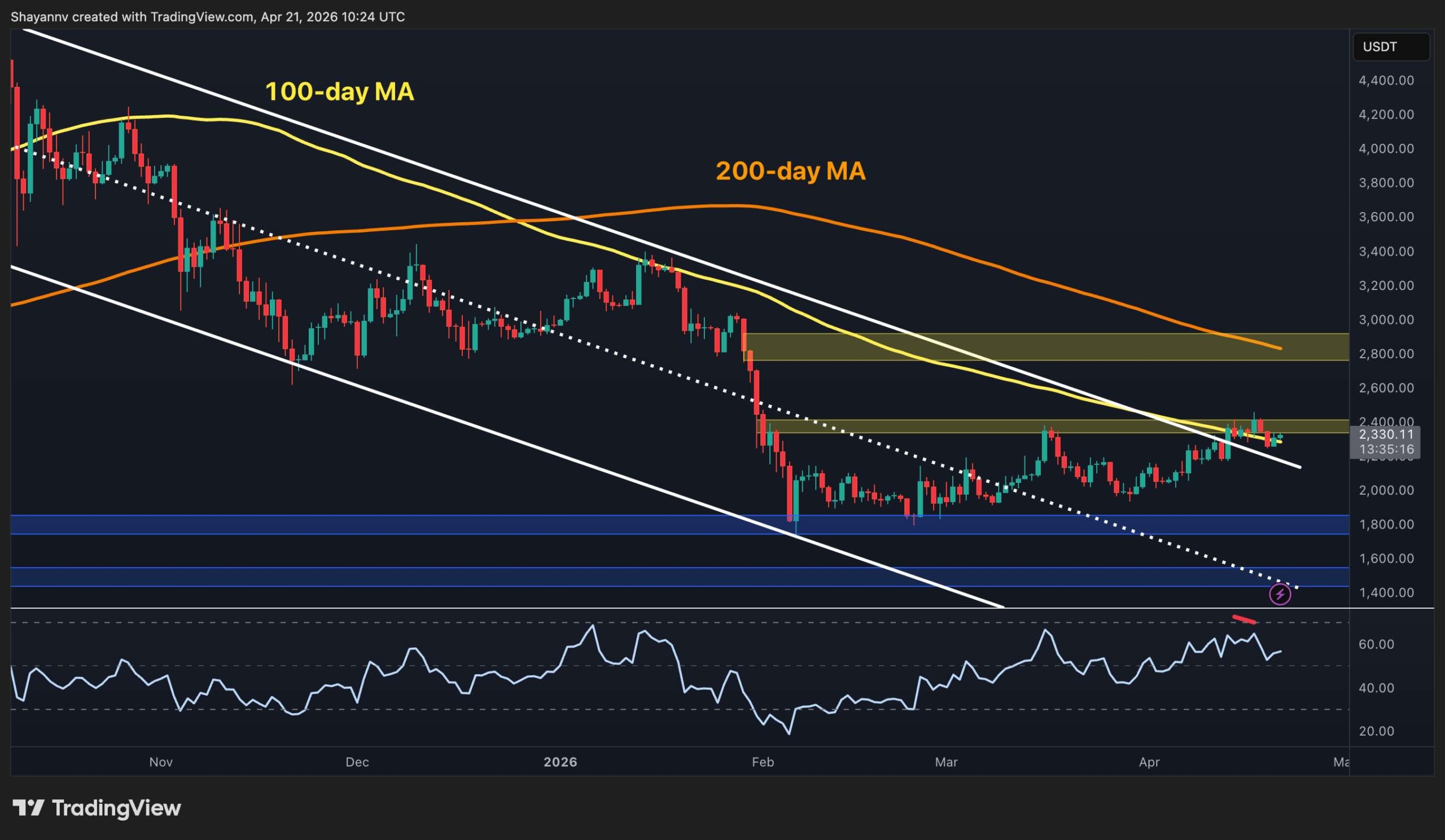
The post Can Ethereum (ETH) Break the $3.5K Resistance? appeared on BitcoinEthereumNews.com. Ethereum is currently trading around the $3.1K mark. ETH’s daily trading volume has skyrocketed by over 130%. The 1.72% uptick in the crypto market has briefly pushed the tokens to the green zone. The prices are attempting to gain momentum, to hit recent highs. But the market is still in fear, with the Fear and Greed Index value at 24. Meanwhile, Ethereum (ETH) has begun trading on the upside.  The altcoin has spiked by over 2.65% in the last 24 hours, and in the early hours, ETH was trading at a low of $2,930.65. With the bullish appearance, the price has risen to a high range of $3,148.77. Further upward move of the largest altcoin could strengthen the bulls to enter a steady bullish phase.   At press time, Ethereum traded at around $3,126, with its daily trading volume having exploded by over 130.96%, and reaching the $23.91 billion mark. Besides, the Coinglass data has reported that the market has experienced a liquidation of $184.24 million worth of ETH during this period. Will Ethereum Keep Riding This Early Bullish Push? Ethereum’s Moving Average Convergence Divergence (MACD) line is found above the signal line. This crossover indicates the momentum is shifting toward the bullish side, but not strongly enough. In addition, the Chaikin Money Flow (CMF) indicator settled at 0.10, suggesting mild buying pressure in the ETH market. It is a positive but moderate bullish signal. The money is flowing into the asset.  Zooming in on the 4-hour trading pattern of the ETH/USDT pair exhibits that the price could climb to the nearest resistance at around $3,136. An extended upside correction may trigger the formation of the golden cross and send the price up to the $3,146 range.  Assuming a bearish reversal of Ethereum, the price might fall to the immediate support…
High-leverage stablecoin arbitrage tool? A detailed analysis of Fluid's 39x leverage strategy and the duality of its "low liquidation penalty".

High-leverage stablecoin arbitrage tool? A detailed analysis of Fluid's 39x leverage strategy and the duality of its "low liquidation penalty".

Fluid is an interesting, difficult-to-understand, and highly controversial DeFi protocol. As a "new" DeFi protocol launched in 2024, its peak TVL exceeded $2.6 billion, and it still has $1.785 billion in TVL. With a trading volume of $16.591 billion over the past 30 days, Ethereum's mainnet trading volume accounts for 43.68% of Uniswap's total trading volume. This is a remarkable achievement. Fluid combines lending with a DEX, accepting LPs (such as ETH/wBTC) as collateral, allowing LPs to still earn fees while providing collateral. Fluid calls this Smart Collateral. Okay, it seems rather ordinary. Image generated by Nano Banana Pro - Gemini AI based on the original text. Smart Debt is a unique design feature of Fluid. Normally, in lending, users borrow money and pay interest. In Fluid smart debt, users also borrow LP trading pairs. That's right. If you want to borrow 1000 USDT, you will borrow 500 USDT + 500 USDC. The trading pair borrowed by the user will be automatically deposited into Fluid DEX as liquidity. In other words, users can choose to withdraw the funds for other purposes, just like a regular loan, or they can choose to pledge LPs to borrow from LPs and then deposit them into the DEX to earn more transaction fees. Essentially, smart debt encourages borrowers to leverage LPs within Fluid for revolving lending. This protocol increases liquidity, attracts more traders, and allows LPs to earn more transaction fees. This is precisely the flywheel that Fluid ultimately aims to build. Therefore, if you have studied Fluid, you will see many articles describing Fluid as a "DEX-on-lending" protocol, and this is the reason. The Fluid architecture is like a composite structure; you can think of it as a main road and auxiliary roads, a trunk and tributaries, a two-layer cake, or anything like that. The core underlying component is the unified Liquidity Layer, a smart contract used to store the liquidity of all assets. It is responsible for managing all the money and handling deposits, withdrawals, loans, and repayments. Above the liquidity layer are multiple sub-protocols and Vault. The sub-protocols have their own business logic, but they do not directly hold assets. Instead, they use the liquidity layer to manage the deposit and withdrawal of funds. The various sub-protocols are interconnected through a liquidity layer. For example, assets deposited by a user through a lending sub-protocol can be lent out by other Vault sub-protocols; Assets deposited through smart lending can be lent out by Vault and simultaneously provide trading liquidity for DEX sub-protocols. Ordinary users only need to interact with the various sub-protocols to conduct deposit or loan operations, without having to directly access the liquidity layer. Specific operating methods Typical lending agreements: Alice deposits: 100 ETH (single token) Bob lends out: 5000 USDC (single token) Fluid method: Usage 1: Ordinary Loans Just like Aave and Compound, you deposit collateral and your wallet receives a loan, except that the loan is lent out by LPs, such as USDT + USC, and the loan can be used anywhere. Use Case 2: Smart Debt While both involve depositing collateral and lending to limited partners (LPs), the difference lies in the fact that the Fluid protocol directly injects this money into Fluid's DEX trading pool. Users earn transaction fees through debt, and the liquidity pool expands its liquidity through debt. Then, users can revolve the loan. This means using LPs as collateral to borrow from other LPs, then collateralizing again to borrow more, and so on in a continuous cycle. The official documentation gives a theoretical maximum leverage of 39 times based on a 95% LTV (Loan-to-Value) calculation. What are the trade-offs of Fluid? Fluid attempts to unify lending and trading within a single liquidity layer. To achieve this unification, certain compromises must be made, and these compromises are precisely the root cause of additional losses suffered by limited partners (LPs) during volatile market conditions. In Uniswap V3, when the market price exceeds the LP price range, users only temporarily lose to earn transaction fees, and their positions become 100% of a single asset (e.g., all converted to USDC). This is impermanent loss, and the loss may disappear once the price returns to its normal range. Fluid rebalancing transforms "impermanent loss" into "permanent loss". Fluid automatically adjusts the liquidity price range for certain Valuts in order to maintain high capital utilization or to maintain lending health (preventing liquidation). For example, Suppose the price of ETH drops from 3000 to 2800. 1) Uniswap V3 Manual LP: The LP price range is still 2900-3100. Therefore, you would currently hold 100% ETH. If you choose to remain inactive and the price returns to 3000, the LP will return to its initial state with no additional loss. 2) Fluid Automatic Rebalancing: In order to ensure active liquidity (or for risk control), the protocol will automatically perform "rebalancing" when it detects that the price has fallen below the range. At the 2800 level, a portion of the LP's ETH must be sold and converted into USDC to regain liquidity in the new 2700-2900 range. The consequence is that this "sell" action is a real transaction, selling the tokens at a lower price. If the ETH price subsequently rebounds quickly back to 3000, as mentioned before, Uniswap V3 user assets will remain unaffected, and the token pair allocation provided by LPs will return to its original state. In order to recover the price, the Fluid protocol must rebalance when the price rises by buying back ETH with USDC. However, because it was sold at a low price before, it is now being bought back at a high price. This is actually a case of "selling low and buying high," a type of operation that frequently occurs in volatile markets, and this type of loss is known as LVR (Loss-Versus-Rebalancing). Why does Fluid need to be rebalanced? Because LP trading pairs play a very important role in Fluid in order to connect lending and DEX using a unified liquidity layer, even the loans made through lending are trading pairs. Therefore, Fluid had to introduce a concept – “Shares”. In Uniswap V3, LPs are non-fungible, and withdrawals are made via NFTs. Your actions only affect yourself. In order for liquidity to be usable by lending protocols (collateral and debt), Fluid must design its liquidity pools to be homogeneous. LPs do not hold specific "ETH in this price range," but rather "x% of the entire pool." When the agreement triggers rebalancing and causes the aforementioned "buy low, sell high" attrition, the total net asset value of the entire pool decreases. Since LPs hold shares, the price of a share = total pool assets / total number of shares, and the share price will fall directly. Therefore, unlike in Uniswap V3, LPs cannot choose "I will not participate in this adjustment and I will hold on to it"; in Fluid LPs, they are forced to participate in the rebalancing. For another example, Assume the price of ETH is 1000 USDC. Invest LP 1 ETH + 1000 USDC (total value $2000). At this point, the price dropped, with ETH falling from 1000 to 800. 1. Uniswap V3 (Do not operate) As prices fall, traders sell ETH, forcing LPs to buy it. This reduces USDC and increases ETH in the LP pool. Eventually, at the low of 800, the LP pool becomes 100% ETH (let's say approximately 2.2 ETH, with no USDC remaining). The current LP holdings are worth 2.2 ETH, or 1760 USDT. Although they are at a paper loss, the LPs hold a large amount of ETH. 2. Fluid Forced Rebalancing The same situation occurs. The price falls below the lower limit of the range set by Fluid. The protocol determines that the current range (900-1100) is invalid. In order for Vault to continue generating fees (or for lending health), the range must be moved to near the current price, such as 720-880. The key issue is that establishing the new 720-880 range requires 50% ETH + 50% USDC. However, your current position is entirely in ETH. Therefore, a forced action is implemented: Fluid must sell half of your ETH at the 800 price level and convert it back to USDC. Therefore, 1.1 ETH was sold for 880 USDC, which was then used to form a new LP with the remaining 1.1 ETH. The current value is 1.1 ETH + 880 USDC = 1760. However, at this point, your ETH holdings have decreased from 2.2 to 1.1. In effect, Fluid forced you to "cut your losses" at this bottom. At this point, the price rebounded, and the price of ETH rose from 800 back to 1000. Uniswap V3 (Lie flat, no operation required) As the price rebounded, the 2.2 ETH held were gradually bought up and converted back to USDC. The price returned to 1000, and the LP position reverted to 1 ETH + 1000 USDC (ignoring transaction fees). Total value 2000 U, impermanent loss has disappeared. Fluid Forced Rebalancing Prices rebounded, and the new range of 720-880 became invalid again. It is necessary to rebalance and move the range back to 900-1100. Currently, there are only 880 USDC and 1.1 ETH. If the price breaks through 880, the LPs will only have USDC, because the ETH has been bought. At this point, the LPs' positions are all in USDC, totaling 1760 USDC, which is the 880 USDC they initially held plus the amount they sold later. The protocol rebalances when the ETH price reaches 1000, buying ETH with regular USDC to maintain a 50:50 ETH:USDC value. At this point, the LP's position is 0.88 ETH and 880 USDC. The total value is 1760 USDC, a loss of 240 USDC compared to the initial total value of 2000 USDC. Moreover, this 240 U is a permanent loss. The subsequent Fluid DEX v2 upgrade addresses the pain point of permanent loss during rebalancing by transferring the wear and tear costs to arbitrageurs in a "smarter" way, thereby significantly reducing this permanent loss. First, there is a dynamic fee mechanism. When prices fluctuate sharply, the transaction fee will increase accordingly to compensate for the rebalancing losses of LPs. Secondly, a "buffer zone" is set up for the oracle; if it is just a brief insertion, no rebalancing will be performed. Then, LPs are allowed to customize price ranges, with wider options available; rebalancing only occurs when prices exceed these ranges. Asymmetric LP positions are also permitted, meaning the token pair does not need to maintain a constant 50:50 ratio. If that's the case, why does Fluid have a TVL of $1.785 billion and account for 43.68% of Uniswap's trading volume in the past 30 days? Fluid masks or offsets permanent wear and tear through extreme capital efficiency and low-risk strategies for specific assets. Wear and tear comes from frequent rebalancing caused by sharp price fluctuations. But what if, however, the prices between LP token pairs didn't fluctuate? For stable pegged assets like USDC/USDT or ETH/wstETH, rebalancing wear is virtually zero. However, Fluid's mechanism allows for leverage of up to 39x on these assets. Furthermore, the returns include both lending and DEX revenue. Therefore, Fluid's focus is actually on stablecoins, ETH and its LST assets, and BTC-related liquid assets, as shown in the data below. Source: https://dune.com/entropy_advisors/fluid-liquidity Another point is that Fluid's liquidation mechanism differs from typical lending agreements, with liquidation penalties as low as 0.1%. If a lending agreement like Aave needs to be liquidated, external MEV Bots can take the collateral at a discount to help with the liquidation. This "discount" is the liquidation penalty, designed to prevent losses from margin calls. Aave's penalty is 5%. A unified liquidity layer allows Fluid to eliminate the need for external clearing, instead completing clearing directly on its own DEX. The system automatically sells a portion of the collateral to repay the debt. Therefore, penalties can be as low as 0.1% plus slippage. This is actually a favorable trade-off brought about by a unified liquidity layer, which also benefits high leverage. Therefore, Fluid is very beneficial for revolving loans of stable asset LPs such as USDC/USDT or ETH/wstETH, and will also attract stablecoin investment whales and aggressive on-chain traders. Can I buy $FLUID tokens? To be honest, I'm not sure. Currently, there is no necessary connection between protocol revenue and coin price, although the Instadapp community and team have repeatedly hinted at or discussed Fluid's revenue distribution issue. However, the protocol revenue is not currently being distributed to token holders. Summarize Tradeoffs are an extremely important, even primary, consideration in blockchain project design. To achieve core features, certain necessary conditions must be met, and these conditions, in turn, constrain the project. Fluid is a project with a prominent trade-off. It is believed that the project team designed it from the outset to build a unified liquidity layer, expanding liquidity through lending and DEX features. The stablecoin LP and ETH and its LPT token trading pairs are the best entry point for expanding liquidity through leveraged cyclical lending.
Share
Author: PANews2025/12/08 18:00
Ethereum Whales Open 136K ETH Long Bets Amid 28% Price Rise Potential

Ethereum Whales Open 136K ETH Long Bets Amid 28% Price Rise Potential

The post Ethereum Whales Open 136K ETH Long Bets Amid 28% Price Rise Potential appeared on BitcoinEthereumNews.com. Ethereum whales have opened massive long positions on Ether (ETH), totalling $425.98 million, in what looks like a bold bet that the downside is over. Key takeaways: Ethereum whales opened leveraged long positions totaling $426 million. Ether’s ascending triangle targets $4,030 ETH price. Top traders open new ETH long positions Data from Cointelegraph Markets Pro and TradingView showed the ETH/USD pair trading at $3,140, 20% above the $2,621 low reached on Nov. 21.  Holding above $3,000, Ether offered some cause for optimism ahead of some key volatility triggers. Related: Vitalik Buterin floats gas futures on Ethereum to hedge fee spikes The Fed rate cut decision is expected on Wednesday, Dec. 10, where markets are pricing in a 25-basis-point rate cut. As market participants waited for triggers, attention has shifted to three “smart” whales with impressive track records, who have opened long positions, totaling 136,433 ETH, worth about $425.98 million, according to data from Lookonchain. One whale, BitcoinOG (1011short), has a long position of $169 million in ETH, while Anti-CZ has a long exposure of $194 million.  Smart whales are all unanimously going long on $ETH!#BitcoinOG(1011short), with $105M in total PNL, is long 54,277 $ETH($169.48M). Anti-CZ whale, with $58.8M in total PNL, is long 62,156 $ETH($194M). pension-usdt.eth, with $16.3M in total PNL, is long 20,000 $ETH($62.5M).… pic.twitter.com/idHbyTePTv — Lookonchain (@lookonchain) December 8, 2025 A third whale, pension-usdt.eth, is long 20,000 ETH, worth approximately $62.5 million at current rates. Besides these whales, Arkham Intelligence noted that another whale, “0xBADBB,” is using two accounts to go long for a total of $189.5 million in ETH.  Ethereum whale’s long positions. Source: Arkham Intelligence These moves coincide with BitMine’s continued push into Ethereum. Last week, the company added $199 million more ETH, bringing its total holdings to 3.73 million ETH ($13.3 billion), thereby cementing its…
Kan de Ethereum koers richting $6.800 na daling van exchange supply tot slechts 9%?

Kan de Ethereum koers richting $6.800 na daling van exchange supply tot slechts 9%?

On-chain data laat zien dat nog maar een klein deel van alle Ethereum tokens op gecentraliseerde exchanges staat. Crypto-analisten schatten dat dit rond 9% van het circulerende aanbod is, terwijl ongeveer 40% vastzit in staking contracten, custody oplossingen en producten zoals ETH ETF’s. Wat betekent deze schaarste voor de Ethereum koers in de komende jaren? Check onze Discord Connect met "like-minded" crypto enthousiastelingen Leer gratis de basis van Bitcoin & trading - stap voor stap, zonder voorkennis. Krijg duidelijke uitleg & charts van ervaren analisten. Sluit je aan bij een community die samen groeit. Nu naar Discord Ethereum koers: overzicht van enkele on-chain signalen Naast de verschuiving in supply kijken crypto-analisten ook naar patronen op hogere tijdframes. Verschillende studies laten zien dat Ethereum al enkele jaren binnen een brede accumulatiezone beweegt, waarbij grote koersdalingen door de bulls zijn opgepakt in plaats van dat de trend volledig draaide. Een van de belangrijkste hulpmiddelen daarbij is de Relative Strength Index, kortweg RSI. Deze indicator meet of de markt relatief overbought of oversold is. Oversold betekent dat er langere tijd veel meer verkoop dan koop is geweest, overbought het omgekeerde. Volgens de crypto-analist Skyodelic is de dagelijkse RSI recent opgeschoven van oversold richting een neutraal gebied. In eerdere ETH cycli ging zo’n overgang vaak vooraf aan een langere periode waarin de koers stap voor stap hoger liep. Op basis van vergelijkbare Ethereum fases schetsen sommige modellen een conservatieve bandbreedte rond $4.300 en een meer ambitieuze zone rond $6.800, mits de volumes en vraag daarbij aansluiten. $ETH looks ready to push much higher In the last 5 years every single time the 1D RSI has gone from overbought, down to oversold, and then broken the trend(green circle)… It has pumped a minimum of 45%. That takes us to $4,300. That is just the minimum, worst case scenario… pic.twitter.com/hRNL4xIbAv — Sykodelic (@Sykodelic_) December 4, 2025 Analisten benadrukken tegelijk dat dit scenario’s zijn die zijn afgeleid uit historische data. Veranderingen in regelgeving, macro-economische schokken of grote protocol updates kunnen ervoor zorgen dat de huidige cyclus anders verloopt, ook wanneer de RSI een vergelijkbaar patroon laat zien. Deze indicator schetst vooral de intensiteit van de recente koop- of verkoopactiviteit, zonder een zekere koersrichting te voorspellen. Welke crypto nu kopen?Lees onze uitgebreide gids en leer welke crypto nu kopen verstandig kan zijn! Welke crypto nu kopen? De langste government shutdown in de geschiedenis van de VS is eindelijk achter de rug. Dat zorgt ervoor dat er eindelijk weer vooruitgang geboekt kan worden. Dit is erg bullish voor crypto, en dus gaan wereldberoemde traders ineens all-in op altcoins als XRP. Eén vraag komt telkens terug: welke crypto moet… Continue reading Kan de Ethereum koers richting $6.800 na daling van exchange supply tot slechts 9%? document.addEventListener('DOMContentLoaded', function() { var screenWidth = window.innerWidth; var excerpts = document.querySelectorAll('.lees-ook-description'); excerpts.forEach(function(description) { var excerpt = description.getAttribute('data-description'); var wordLimit = screenWidth wordLimit) { var trimmedDescription = excerpt.split(' ').slice(0, wordLimit).join(' ') + '...'; description.textContent = trimmedDescription; } }); }); Langetermijnstructuur van ETH rond het $1.800 prijsgebied Op de weekgrafiek valt vooral de prijszone rond $1.800 op. Crypto-analist Ali Martinez volgt al langere tijd de verhoudingen tussen steun en weerstand in de ETH USDT grafiek. Hij ziet deze zone als een langetermijn gebied waar veel bulls eerder actief zijn geweest sinds de dieptepunten van 2022. Vanaf dit punt loopt een stijgende trendlijn onder de Ethereum koers, die meerdere keren is getest zonder dat de structuur definitief brak. Het idee achter zo’n accumulatiezone is eenvoudig: grote marktpartijen, zoals langetermijn holders en sommige instellingen, bouwen hun posities daar rustig verder uit wanneer de ETH prijs terugzakt in die band. Iets vergelijkbaars gebeurde in de periode van 2018 tot 2021. In die jaren liep de prijs van Ethereum vanuit niveaus onder $100 op naar een all-time high rond $4.800. Zulke koersbewegingen laten zien dat langdurige fases van zijwaartse handel en langzaam kopen een basis kunnen leggen voor sterke trends later, zonder dat dit een herhaling van precies hetzelfde ETH pad garandeert. Ethereum $ETH at $1,800 looks like one of the best accumulation zones before a bull rally toward $10,000. pic.twitter.com/F49BQ13H2a — Ali (@ali_charts) December 7, 2025 Afnemende exchange supply en ETH stakingdata De aanbodkant van ETH wordt extra duidelijk in de cijfers rond exchanges en staking. Glassnode berekende dat slechts 8,7 tot 8,9% van alle Ethereum tokens op gecentraliseerde exchanges staat. Crypto-analist Mister Crypto wijst erop dat dit niveau historisch laag is en dat de resterende ETH supply steeds meer in handen lijkt te komen van langetermijn holders en instellingen. Ongeveer 40% van alle ETH zit bovendien vast in staking, custody oplossingen of institutionele producten, waaronder nieuwe Ethereum ETF’s zoals de BlackRock Ethereum ETF. Hierdoor blijft er minder liquiditeit over voor de directe handel. Dit kan de koersbewegingen versnellen op het moment dat de vraag of het aanbod plotseling opschuift. Als de koopinteresse oploopt terwijl er weinig tokens beschikbaar zijn op exchanges, kan de markt sneller in de richting van hogere bandbreedtes bewegen. In een tegenovergesteld scenario kan een plotselinge stijging van het aantal tokens op exchanges juist voor extra druk zorgen. Het belangrijkste is dat de on-chain data nu een duidelijk beperkter aanbod laat zien dan in veel eerdere fases van de Ethereum markt. $ETH is extremely scarce. Only 9% of supply left on exchanges. Something big is coming! pic.twitter.com/KEOFYjQ3MC — Mister Crypto (@misterrcrypto) December 7, 2025 Belangrijke zones voor kortetermijn trading Ethereum Op de kortere tijdframes blijft Ethereum vooral binnen een consolidatieband. Sommige technische traders gebruiken een eenvoudig schema met drie prijsniveaus om deze structuur te volgen. De eerste prijszone ligt rond $3.200 en wordt gezien als een bevestiging dat de bears de controle terugnemen wanneer de prijs daar overtuigend boven sluit. Een tweede zone ligt rond $2.900 en fungeert als grens waarboven de huidige structuur intact blijft. Daaronder wordt de kans groter dat de Ethereum markt de lagere steunzones opnieuw test of die standhouden. Als derde referentie gebruiken veel crypto-analisten een eerste doelgebied rond $3.500, gebaseerd op een eerdere ETH weerstand in dit gebied en op technische modellen die trends in stappen meten. Dit soort prijsniveaus zijn geen gegarandeerde uitkomst, maar ze helpen wel om duidelijk te benoemen waar het karakter van de trend verandert. In combinatie met de on-chain data is het dan gemakkelijker om in te schatten of een koersbeweging vooral door kortetermijn trading of door verschuivingen in de langetermijn structuur wordt gedreven. Zo ontstaat er een kader waarin traders beter kunnen zien of een beweging vooral lokaal is, of dat zij past in het grotere verhaal van de multiyear accumulatie. Vooruitblik op de Ethereum koers Wanneer we alle signalen naast elkaar zetten, ontstaat er een vrij consistent beeld. Aan de ene kant is er een duidelijke langetermijn structuur met een belangrijke prijszone rond $1.800 en een stijgende trendlijn vanaf de dieptepunten van 2022. Tegelijk laat de RSI op de daggrafiek zien dat de Ethereum markt van oversold naar een neutraler niveau is geschoven, wat in eerdere ETH cycli vaak samenviel met het begin van een volgende opwaartse fase. Voor de verdere ontwikkeling van de Ethereum koers kijken veel crypto-analisten daarom naar een aantal duidelijke ijkpunten. Zolang de prijszone rond $1.800 standhoudt en de ETH markt boven de band rond $2.900 blijft, blijft een voortzetting van de opwaartse structuur richting hogere zones zoals $4.300 en $6.800 een realistisch scenario voor Ethereum op de middellange termijn. In scenario analyses richting 2025 en 2030 speelt ook de verhouding tussen Ethereum en Bitcoin een rol. Wanneer ETH langere tijd beter presteert dan BTC, gaan veel marktmodellen uit van een fase waarin er meer risico wordt genomen in de bredere markt. Best wallet - betrouwbare en anonieme wallet Best wallet - betrouwbare en anonieme wallet Meer dan 60 chains beschikbaar voor alle crypto Vroege toegang tot nieuwe projecten Hoge staking belongingen Lage transactiekosten Best wallet review Koop nu via Best Wallet Let op: cryptocurrency is een zeer volatiele en ongereguleerde investering. Doe je eigen onderzoek. Het bericht Kan de Ethereum koers richting $6.800 na daling van exchange supply tot slechts 9%? is geschreven door Dirk van Haaster en verscheen als eerst op Bitcoinmagazine.nl.
Share
Author: Coinstats2025/12/08 17:01
Best Cryptocurrencies to Invest in Today, December 8 – SOL, ETH, XRP

Best Cryptocurrencies to Invest in Today, December 8 – SOL, ETH, XRP

        Highlights:  Solana is holding steady near $135 and is approaching a key zone that could shape its next swing in the recovering market. Ethereum has climbed above $3130 as momentum builds and signals room for a stronger move in the coming sessions. XRP is moving inside a tightening pattern as the market waits for a breakout that defines its direction.  The crypto market is showing signs of recovery with the top cryptocurrency rebounding over $91,000. In addition, all top 10 cryptocurrencies are trading in the green zone today, with major gains on the weekly chart. At press time, the total market cap is up 1.72% to $3.11 trillion. In addition, the trading volume is up 51.57% to $114.76 billion in the past day. The crypto market has experienced a total of $444.73 million in liquidations in the last 24 hours, with long positions taking the lead. Meanwhile, the fear and greed index still sits in the fear zone at an index of 24 despite the improving market conditions. With the crypto market recovering, here are the best cryptocurrencies to invest in today. Best Cryptocurrencies to Invest in Today 1. Solana (SOL) SOL is currently trading at around $135.30, with a 1.57% increase in the past day. The trading volume of SOL has increased by 116.43% to $4.27 billion, while the market cap stands at $75.94 billion. Source: CoinMarketCap According to a recent analysis by Ali, Solana has bounced back after a sharp correction from the $144 resistance. The coin has been testing the $136 zone, with the next major support sitting at $124. Ali notes that Solana must hold this level to avoid a deeper move.  Solana $SOL must hold $124 to avoid a drop toward $115, or even $106. pic.twitter.com/uZXib5jTRC — Ali (@ali_charts) December 8, 2025  A breakdown below $124 would open the path toward $115. The analysis also marks $106 as the final strong demand zone. This area previously acted as a solid floor. The market structure shows lower highs, which signals weakening strength. However, a recovery above $136 could stabilize the price action. 2. Ethereum (ETH) ETH is trading at $3,138, representing a 3.01% increase on the daily chart. The market cap stands at $378.8 billion, while the trading volume has increased by 140.94% to $24.6 billion. ETH has gained 11.02% on the weekly chart. Source: CoinMarketCap Ethereum has broken out of its descending channel and is signaling improving momentum after weeks of steady losses. The first key support sits at $2,810, which protected the price during the recent decline. The next major hurdle stands at $3,890 and marks a strong mid-range resistance. Source: TradingView A clean push above this level could open the path toward $4,603. This area acted as a major ceiling in past rallies and now serves as the main upside target. Ethereum must hold above the breakout zone to sustain its recovery. The continued strength could drive a steady climb into early 2026. 3. XRP XRP is trading at $2.08, a 1.81% increase in the past day. The market cap of the coin stands at $125.67 billion, and the trading volume is up 80.48% to $3.05 billion. Source: CoinMarketCap XRP is reaching a decisive moment as the price tightens inside a large triangle that has guided every move in recent days. The market now sits between two competing forces. Sellers are defending the $2.18 ceiling with strength, blocking every attempt to break higher. However, buyers are protecting the $2.03 support. Each swing shrinks, and volatility fades, showing that XRP is storing energy rather than losing momentum.  $XRP is set up for a 16% move once it breaks out of this triangle. pic.twitter.com/Ym5wkactTj — Ali (@ali_charts) December 8, 2025  A breakout above $2.18 would unlock fresh bullish momentum and open higher targets. However, a drop below $2.03 would shift control back to sellers and set the stage for a deeper pullback.    eToro Platform    Best Crypto Exchange   Over 90 top cryptos to trade Regulated by top-tier entities User-friendly trading app 30+ million users    9.9   Visit eToro eToro is a multi-asset investment platform. The value of your investments may go up or down. Your capital is at risk. Don’t invest unless you’re prepared to lose all the money you invest. This is a high-risk investment, and you should not expect to be protected if something goes wrong. 
Share
Author: Coinstats2025/12/08 16:25
What will Stable's fully diluted valuation be at tonight's TGE?

What will Stable's fully diluted valuation be at tonight's TGE?

Author: 1912212.eth, Foresight News The Stable mainnet will officially launch at 21:00 Beijing time on December 8th. As a Layer 1 blockchain supported by Bitfinex and Tether, Stable focuses on stablecoin infrastructure. Its core design uses USDT as the native gas fee, enabling sub-second settlement and gas-free peer-to-peer transfers. As of press time, Bitget, Backpack, and Bybit have announced the listing of STABLE spot trading. However, Binance, Coinbase, and Korean exchanges have not yet announced the listing of STABLE spot trading. Total supply 100 billion, no gas fees charged on the tokens. The project team released a white paper and details of the tokenomics prior to the mainnet launch. Its native token, STABLE, has a fixed total supply of 100 billion. All transfers, payments, and transactions on the Stable network are settled in USDT. STABLE does not charge gas fees; instead, it serves as an incentive mechanism between developers and ecosystem participants. The STABLE token allocation is as follows: a Genesis Distribution of 10% of the total supply supports initial liquidity, community activation, ecosystem activities, and strategic distribution efforts. This Genesis Distribution portion will be fully unlocked upon mainnet launch. Ecosystem and community account for 40% of the total supply, allocated to developer funding, liquidity programs, partnerships, community initiatives, and ecosystem development; teams account for 25% of the total supply, allocated to founding teams, engineers, researchers, and contributors; and investors and advisors account for 25% of the total supply, allocated to strategic investors and advisors who support network development, infrastructure building, and promotion. The team and investor shares have a one-year clamp period, meaning zero unlocking for the first 12 months, followed by linear unlocking. The ecosystem and community fund shares unlock 8% from launch, with the remainder gradually released through linear vesting to incentivize developer, partner, and user growth. Stable employs a DPoS (Delegated Proof-of-Stake) model through its StableBFT consensus protocol. This design supports high-throughput settlement while maintaining the economic security characteristics required for global payment networks. Staking STABLE tokens is the mechanism by which validators and delegators participate in consensus and earn rewards. The primary roles of the STABLE token are governance and staking: holders can stake tokens to become validators, participate in network security maintenance, and influence protocol upgrades through DAO voting, such as adjusting transaction fees or introducing new stablecoin support. Furthermore, STABLE can be used for ecosystem incentives, such as liquidity mining or cross-chain bridging rewards. The project team claims that this decoupled design can attract institutional funding because USDT's stability is far superior to that of volatile governance tokens. Pre-deposit disputes: insider trading, KYC lag Like Plasma, Stable also opened deposits twice before the mainnet launch. The first phase of pre-deposits began at the end of October, with a cap of $825 million, but it was filled within minutes of the announcement. The community questioned whether some players were engaging in insider trading. The top-ranked wallet deposited hundreds of millions of USDT 23 minutes before the deposits were opened. The project team did not respond directly and launched the second phase of the pre-deposit activity on November 6, with a maximum of $500 million. However, Stable underestimated the market's enthusiasm for deposits. The moment the second phase opened, a massive influx of traffic caused its website to slow down and lag. Therefore, after Stable updated its rules, users can deposit through the Hourglass frontend or directly on-chain; the deposit function is reopened for 24 hours, with a maximum deposit of $1 million per wallet and a minimum deposit of $1,000. The final second phase saw total deposits of approximately $1.8 billion, with about 26,000 wallets participating. The review time ranges from a few days to a week, and some users in the community have complained about system lag or repeated requests for additional materials. The probability of a 2 billion FDV is over 85%. In late July of this year, Stable announced the completion of a $28 million seed round of financing, led by Bitfinex and Hack VC, bringing its market valuation to around $300 million. In comparison, Plasma's market capitalization is currently $330 million, and its FDV is $1.675 billion. Some optimists believe that the stablecoin narrative, Bitfinex's endorsement, and Plasma's initial rise followed by a fall suggest continued popularity and potential for price increases in the near term. However, pessimistic voices prevail: gas payments are not stable and have limited utility, especially given the current bear market and tightening liquidity, which could lead to a rapid price drop. According to Polymarket data, there is an 85% probability that the FDV will exceed $2 billion on its first day of listing. Based on a conservative estimate of $2 billion, the STABLE token price would be $0.02. In the perpetual contract market, according to Bitget data, STABLE/USDT is currently priced at $0.032, which means its FDV is expected to rise to around $3 billion. Stable's first phase of pre-deposits reached $825 million, and the second phase actually contributed over $1.1 billion, but after proportional allocation, only $500 million actually entered the pool. The total pre-deposits amounted to $1.325 billion. Token economics disclosed an initial allocation of 10% (used for pre-deposits incentives, exchange activities, initial on-chain liquidity, etc.). Assuming Stable's final airdrop to pre-deposits is 3%-7%, based on a pre-market price of $0.032, the corresponding return is approximately 7% to 16.9%, meaning that every $10,000 deposit corresponds to $700 to $1,690.
Share
Author: PANews2025/12/08 16:00