Ethereum developer Vitalik Buterin states that the PeerDAS component of the Fusaka upgrade allows Ethereum nodes to authenticate blockchain data without downloading it, eliminating scaling. Vitalik Buterin, the co-founder of Ethereum, disclosed that the main functionality of the Fusaka upgrade, which is known as PeerDAS (Peer Data Availability Sampling), will transform the scalability of Ethereum.  […] The post Fusaka’s PeerDAS Is Ethereum’s Scaling Breakthrough appeared first on Live Bitcoin News.Ethereum developer Vitalik Buterin states that the PeerDAS component of the Fusaka upgrade allows Ethereum nodes to authenticate blockchain data without downloading it, eliminating scaling. Vitalik Buterin, the co-founder of Ethereum, disclosed that the main functionality of the Fusaka upgrade, which is known as PeerDAS (Peer Data Availability Sampling), will transform the scalability of Ethereum.  […] The post Fusaka’s PeerDAS Is Ethereum’s Scaling Breakthrough appeared first on Live Bitcoin News.

Fusaka’s PeerDAS Is Ethereum’s Scaling Breakthrough

Ethereum developer Vitalik Buterin states that the PeerDAS component of the Fusaka upgrade allows Ethereum nodes to authenticate blockchain data without downloading it, eliminating scaling.

Vitalik Buterin, the co-founder of Ethereum, disclosed that the main functionality of the Fusaka upgrade, which is known as PeerDAS (Peer Data Availability Sampling), will transform the scalability of Ethereum. 

Fusaka is planned to be released on December 3, 2025, and it deals with an important blockchain problem. PeerDAS allows nodes to check the availability of data without downloading the whole blocks. 

This has the effect of reducing network congestion without compromising security or decentralization, as Buterin explained on X, but the live blockchain will not make any particular node download all data.

This is in part done by PeerDAS by requesting small chunks of data randomly from nodes. Then, when more than half of the chunks are available, erasure-coding can be used to recover missing pieces using the remaining chunks. 

The approach guarantees the network is resilient even in the event that a large number of nodes are dishonest. In the first phase, a few nodes temporarily store full data to be broadcast or reassembled; however, this is a distributed and untrusted role. 

The technology is the first in live blockchain devices, which are essential in scaling Layer 2 solutions in the present and eventually Layer 1 with a rise in the gas limit.

Ether Usage Hits New Heights as Fusaka is Implemented.

Recent network statistics indicate that Ethereum reached six blobs per block, the first time, indicating an increase in block usage. 
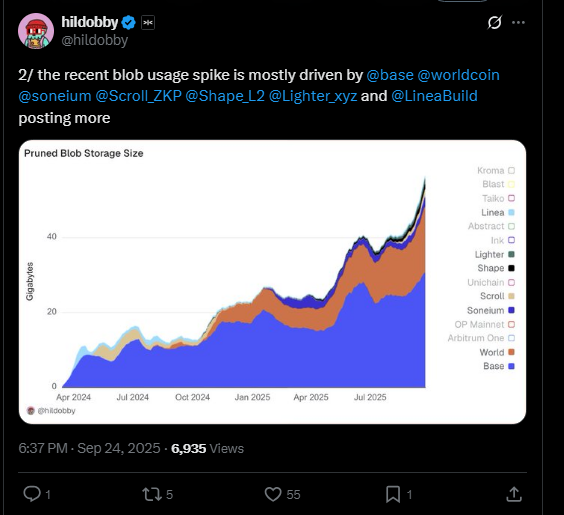
Source – X

Blockchain analyst Hildobby on X argues that this demand is being driven by large Layer 2 networks such as Base, Worldcoin, and Scroll. 

These L2s together spend more than 200,000 dollars per week on mainnet fees, using blobs to save on transaction fees.  Fusaka will increase blob capacity (6-9) to 14-21 blobs per block using phased forks, which will allow more comfortable L2 scaling and reduce fees to less than $0.1.

Vitalik Buterin emphasized that careful and slow increments in using blobs were required in order to be secure. He elaborated that there is complete availability of data, but this is limited and shared between nodes. 

The next versions will make distribution even more efficient with cell-level messaging and distributed block building. This will decrease the dependency on any one actor and enhance the decentralization of Ethereum.

PeerDAS is one of the innovations that Ethereum will use in scaling. It addresses the issue of data availability that has impeded the smooth layer 2 development. 

Fusaka offers better node verification and reconstruction of blockchain data, paving the way to the widespread use of Ethereum-based applications, such as DeFi, AI, and consumer tools.

This improvement is in line with the gas throughput expansion roadmap of Ethereum, which, in the coming years the throughput is expected to reach 150 million gas per block. 

Ethereum appears to be prepared to retain its decentralization and expand with increased user demand with Fusaka.

The post Fusaka’s PeerDAS Is Ethereum’s Scaling Breakthrough appeared first on Live Bitcoin News.

Market Opportunity
SecondLive Logo
SecondLive Price(LIVE)
$0.00003713
$0.00003713$0.00003713
-7.75%
USD
SecondLive (LIVE) Live Price Chart
Disclaimer: The articles reposted on this site are sourced from public platforms and are provided for informational purposes only. They do not necessarily reflect the views of MEXC. All rights remain with the original authors. If you believe any content infringes on third-party rights, please contact [email protected] for removal. MEXC makes no guarantees regarding the accuracy, completeness, or timeliness of the content and is not responsible for any actions taken based on the information provided. The content does not constitute financial, legal, or other professional advice, nor should it be considered a recommendation or endorsement by MEXC.

You May Also Like

Is it ‘over for Solana’? 97% network activity crash sparks fresh debate

Is it ‘over for Solana’? 97% network activity crash sparks fresh debate

The post Is it ‘over for Solana’? 97% network activity crash sparks fresh debate appeared on BitcoinEthereumNews.com. Journalist Posted: December 22, 2025 Solana
Share
BitcoinEthereumNews2025/12/22 11:02
Bitcoin 8% Gains Already Make September 2025 Its Second Best

Bitcoin 8% Gains Already Make September 2025 Its Second Best

The post Bitcoin 8% Gains Already Make September 2025 Its Second Best appeared on BitcoinEthereumNews.com. Key points: Bitcoin is bucking seasonality trends by adding 8%, making this September its best since 2012. September 2025 would need to see 20% upside to become Bitcoin’s strongest ever. BTC price volatility is at levels rarely seen before in an unusual bull cycle. Bitcoin (BTC) has gained more this September than any year since 2012, a new bull market record. Historical price data from CoinGlass and BiTBO confirms that at 8%, Bitcoin’s September 2025 upside is its second-best ever. Bitcoin avoiding “Rektember” with 8% gains September is traditionally Bitcoin’s weakest month, with average losses of around 8%. BTC/USD monthly returns (screenshot). Source: CoinGlass This year, the stakes are high for BTC price seasonality, as historical patterns demand the next bull market peak and other risk assets set repeated new all-time highs. While both gold and the S&P 500 are in price discovery, BTC/USD has coiled throughout September after setting new highs of its own the month prior. Even at “just” 8%, however, this September’s performance is currently enough to make it Bitcoin’s strongest in 13 years. The only time that the ninth month of the year was more profitable for Bitcoin bulls was in 2012, when BTC/USD gained about 19.8%. Last year, upside topped out at 7.3%. BTC/USD monthly returns. Source: BiTBO BTC price volatility vanishes The figures underscore a highly unusual bull market peak year for Bitcoin. Related: BTC ‘pricing in’ what’s coming: 5 things to know in Bitcoin this week Unlike previous bull markets, BTC price volatility has died off in 2025, against the expectations of longtime market participants based on prior performance. CoinGlass data shows volatility dropping to levels not seen in over a decade, with a particularly sharp drop from April onward. Bitcoin historical volatility (screenshot). Source: CoinGlass Onchain analytics firm Glassnode, meanwhile, highlights the…
Share
BitcoinEthereumNews2025/09/18 11:09
The 8th Hainan International Health Industry Expo opens in Sanya

The 8th Hainan International Health Industry Expo opens in Sanya

HAIKOU, China, Dec. 21, 2025 /PRNewswire/ — A report from Hainan International Media Center: On December 20, 2025, the 8th Hainan International Health Industry
Share
AI Journal2025/12/22 11:45