AI is more efficient, more accessible and more affordable; in addition, Asians are more optimistic about AI.AI is more efficient, more accessible and more affordable; in addition, Asians are more optimistic about AI.

Highlights of Stanford HAI's 2025 Artificial Intelligence Index Report

2025/04/14 16:25

Author: Stanford HAI (Stanford Artificial Intelligence Institute)

Compiled by: Felix, PANews

Stanford HAI recently released the 456-page "Artificial Intelligence Index Report 2025". Here are some key points about artificial intelligence trends:

1. AI is becoming much more powerful than imagined

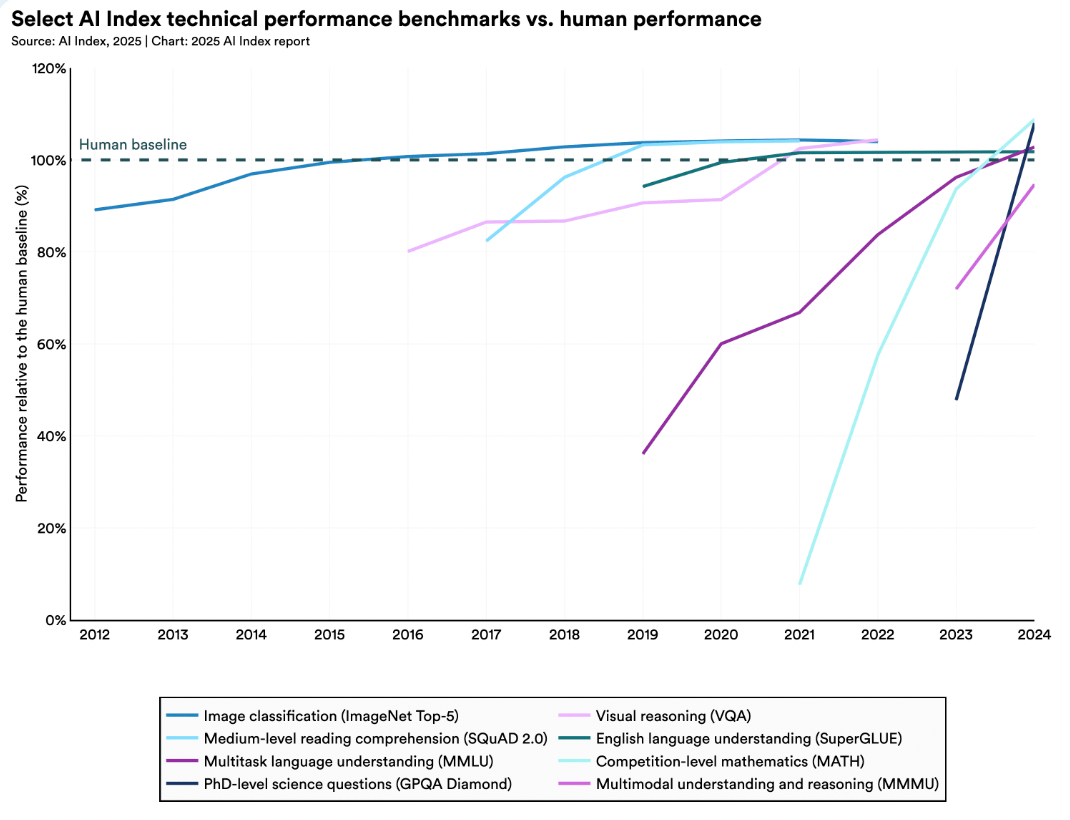
In the new benchmarks MMMU, GPQA, and SWE-bench, AI performance improved significantly: scores increased by 18.8%, 48.9%, and 67.3%, respectively. In addition to the benchmarks, AI systems made significant progress in generating high-quality videos, and in some cases, large language models (LLMs) even surpassed humans in timed programming tasks.

Note:

MMMU is a novel, carefully designed benchmark for multi-disciplinary multimodal understanding and reasoning at the university level, aiming to evaluate the expert-level multimodal understanding capabilities of underlying models on a wide range of tasks.

GPQA is a challenging dataset consisting of 448 high-quality and difficult multiple-choice questions written by experts in different fields. Experts who hold or are pursuing a PhD in the corresponding field achieve only 65% accuracy, while highly skilled non-expert verifiers achieve only 34% accuracy despite spending an average of more than 30 minutes and having unlimited access to the Internet.

SWE-bench is a benchmark for evaluating the performance of Large Language Models (LLMs) on real-world software questions collected from GitHub.
Highlights of Stanford HAI's 2025 Artificial Intelligence Index Report

2. AI is more efficient, accessible, and affordable

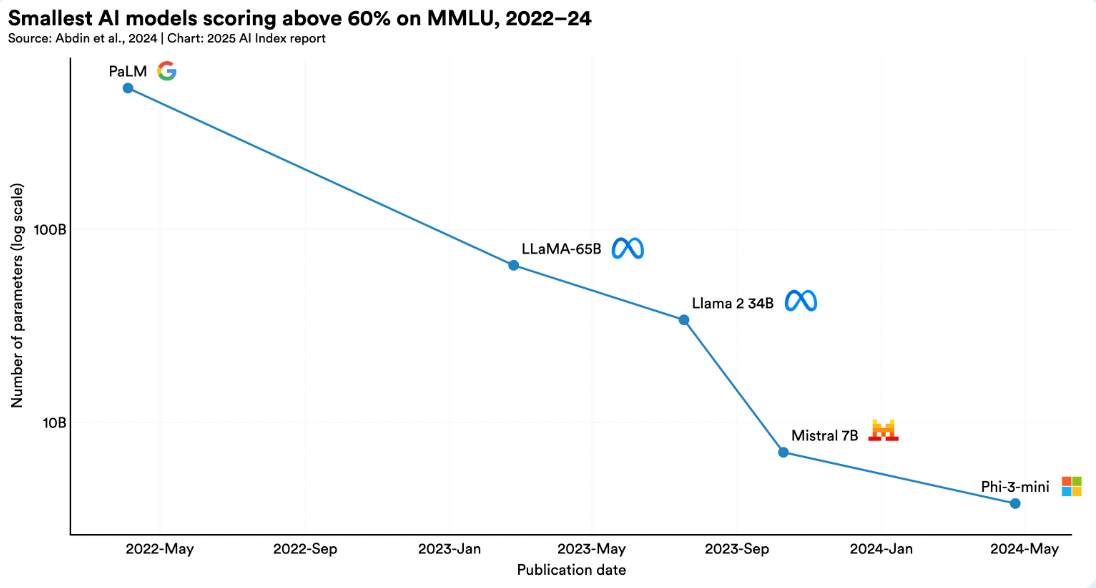
Smaller AI models with fewer parameters are becoming increasingly powerful: in just two years, the number of parameters has been reduced by about 100 times, while still scoring over 60% on the Massive Multi-Task Language Understanding (MMLU) test.

The gap between open source and closed source models is also narrowing, with the performance gap falling from 8% to just 1.7% in some benchmarks.
Highlights of Stanford HAI's 2025 Artificial Intelligence Index Report

Furthermore, the cost of inference for systems reaching the level of GPT-3.5 dropped by more than 280 times from November 2022 to October 2024. At the hardware level, costs dropped by 30% per year, while energy efficiency improved by 40% per year.

The threshold for advanced AI is rapidly decreasing. Not to mention the development of sparse models like DeepSeek, where only relevant parameters are activated to answer the user’s query under the Mixture of Experts (MoE) structure, making the whole thing more efficient.

Indeed, as smaller but more powerful AI models continue to emerge, the requirements for AI model training have been reduced, and cost-effective distributed training is expected to become mainstream in the next decade. There are currently some top projects conducting related research based on different theoretical frameworks.

3. AI is increasingly integrated into everyday life

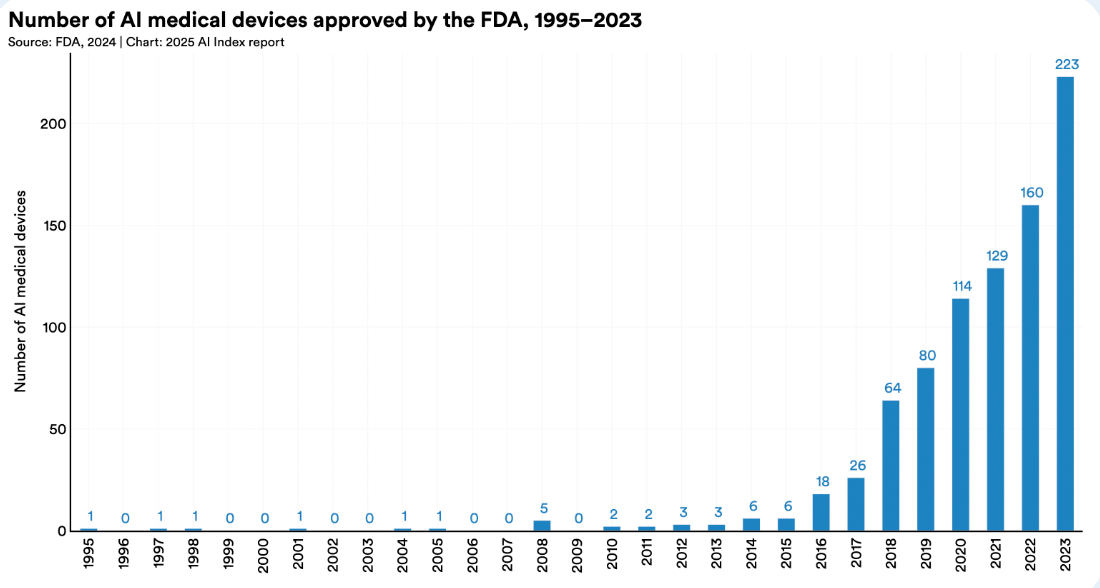
In 2023, the U.S. Food and Drug Administration (FDA) approved 223 AI-assisted medical devices, up from just six in 2015. On the roads, self-driving cars are no longer experiments: Waymo, one of the largest operators in the U.S., provides more than 150,000 self-driving rides per week, and Baidu’s Apollo Go fleet of driverless taxis is now operational in several Chinese cities.
Highlights of Stanford HAI's 2025 Artificial Intelligence Index Report

4. Corporate investment in AI has increased significantly, driving record investments and adoption

The adoption of AI in business is also accelerating: 78% of organizations are using AI in 2024, up from 55% the year before. At the same time, a growing body of research confirms that AI can increase productivity and help close skills gaps across the workforce.

In fact, product-market fit breakdowns will occur more frequently as AI causes customer expectations to grow exponentially, making existing solutions obsolete overnight, leaving incumbents with no chance to adapt.

5. Despite rising optimism about AI globally, Asians are more optimistic about AI

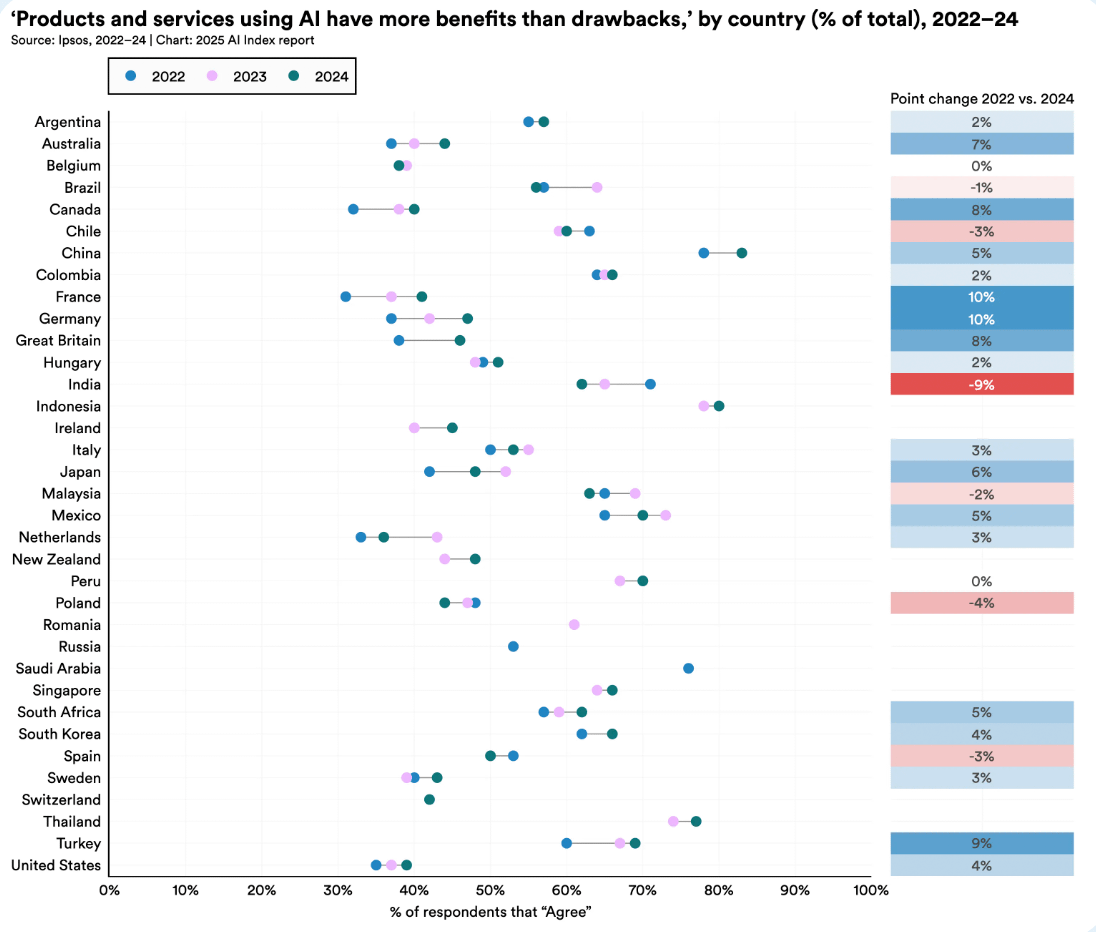
In countries such as China (83%), Indonesia (80%) and Thailand (77%), the majority believe that the benefits of AI products and services outweigh the risks. In contrast, optimism remains far lower in places such as Canada (40%), the United States (39%) and the Netherlands (36%).

However, this attitude is changing: since 2022, optimism has grown significantly in a number of previously skeptical countries, including Germany (up 10%), France (up 10%), Canada (up 8%), the United Kingdom (up 8%) and the United States (up 4%).
Highlights of Stanford HAI's 2025 Artificial Intelligence Index Report

6. The influence of artificial intelligence in scientific research is increasing, and it has become an important driving force for scientific progress

The growing importance of AI is reflected in major scientific prizes: two Nobel Prizes were awarded for research into deep learning (physics) and its application to protein folding (chemistry), while the Turing Award recognized groundbreaking contributions to reinforcement learning.

Clearly, AI is advancing at an exponential and unexpected pace, which is significant to most people. As a result, AI security is becoming increasingly important. While AI makes forgery easier, cryptography makes it more difficult. Look forward to crypto projects that can leverage the native properties of blockchain (verifiability and transparency) to build practical solutions in this area.

Related reading: Interview with Chris Dixon, founder of a16z: The intersection of artificial intelligence and encryption technology

Market Opportunity
Moonveil Logo
Moonveil Price(MORE)
$0,002792
$0,002792$0,002792
+0,21%
USD
Moonveil (MORE) Live Price Chart
Disclaimer: The articles reposted on this site are sourced from public platforms and are provided for informational purposes only. They do not necessarily reflect the views of MEXC. All rights remain with the original authors. If you believe any content infringes on third-party rights, please contact [email protected] for removal. MEXC makes no guarantees regarding the accuracy, completeness, or timeliness of the content and is not responsible for any actions taken based on the information provided. The content does not constitute financial, legal, or other professional advice, nor should it be considered a recommendation or endorsement by MEXC.

You May Also Like

The Channel Factories We’ve Been Waiting For

The Channel Factories We’ve Been Waiting For

The post The Channel Factories We’ve Been Waiting For appeared on BitcoinEthereumNews.com. Visions of future technology are often prescient about the broad strokes while flubbing the details. The tablets in “2001: A Space Odyssey” do indeed look like iPads, but you never see the astronauts paying for subscriptions or wasting hours on Candy Crush.  Channel factories are one vision that arose early in the history of the Lightning Network to address some challenges that Lightning has faced from the beginning. Despite having grown to become Bitcoin’s most successful layer-2 scaling solution, with instant and low-fee payments, Lightning’s scale is limited by its reliance on payment channels. Although Lightning shifts most transactions off-chain, each payment channel still requires an on-chain transaction to open and (usually) another to close. As adoption grows, pressure on the blockchain grows with it. The need for a more scalable approach to managing channels is clear. Channel factories were supposed to meet this need, but where are they? In 2025, subnetworks are emerging that revive the impetus of channel factories with some new details that vastly increase their potential. They are natively interoperable with Lightning and achieve greater scale by allowing a group of participants to open a shared multisig UTXO and create multiple bilateral channels, which reduces the number of on-chain transactions and improves capital efficiency. Achieving greater scale by reducing complexity, Ark and Spark perform the same function as traditional channel factories with new designs and additional capabilities based on shared UTXOs.  Channel Factories 101 Channel factories have been around since the inception of Lightning. A factory is a multiparty contract where multiple users (not just two, as in a Dryja-Poon channel) cooperatively lock funds in a single multisig UTXO. They can open, close and update channels off-chain without updating the blockchain for each operation. Only when participants leave or the factory dissolves is an on-chain transaction…
Share
BitcoinEthereumNews2025/09/18 00:09
Solana Prepares Major Consensus Upgrade with Alpenglow Protocol

Solana Prepares Major Consensus Upgrade with Alpenglow Protocol

TLDR: Alpenglow reduces Solana finality from 12.8 seconds to 100-150 milliseconds, a 100-fold improvement. Votor enables one or two-round block finalization through
Share
Blockonomi2026/01/03 02:29
Why The Green Bay Packers Must Take The Cleveland Browns Seriously — As Hard As That Might Be

Why The Green Bay Packers Must Take The Cleveland Browns Seriously — As Hard As That Might Be

The post Why The Green Bay Packers Must Take The Cleveland Browns Seriously — As Hard As That Might Be appeared on BitcoinEthereumNews.com. Jordan Love and the Green Bay Packers are off to a 2-0 start. Getty Images The Green Bay Packers are, once again, one of the NFL’s better teams. The Cleveland Browns are, once again, one of the league’s doormats. It’s why unbeaten Green Bay (2-0) is a 8-point favorite at winless Cleveland (0-2) Sunday according to betmgm.com. The money line is also Green Bay -500. Most expect this to be a Packers’ rout, and it very well could be. But Green Bay knows taking anyone in this league for granted can prove costly. “I think if you look at their roster, the paper, who they have on that team, what they can do, they got a lot of talent and things can turn around quickly for them,” Packers safety Xavier McKinney said. “We just got to kind of keep that in mind and know we not just walking into something and they just going to lay down. That’s not what they going to do.” The Browns certainly haven’t laid down on defense. Far from. Cleveland is allowing an NFL-best 191.5 yards per game. The Browns gave up 141 yards to Cincinnati in Week 1, including just seven in the second half, but still lost, 17-16. Cleveland has given up an NFL-best 45.5 rushing yards per game and just 2.1 rushing yards per attempt. “The biggest thing is our defensive line is much, much improved over last year and I think we’ve got back to our personality,” defensive coordinator Jim Schwartz said recently. “When we play our best, our D-line leads us there as our engine.” The Browns rank third in the league in passing defense, allowing just 146.0 yards per game. Cleveland has also gone 30 straight games without allowing a 300-yard passer, the longest active streak in the NFL.…
Share
BitcoinEthereumNews2025/09/18 00:41

