The post How Black Public Media Is Fighting Back After Federal Spending Cuts appeared on BitcoinEthereumNews.com. Marie Andre surrounded by photos of her son, George Desdunes, in “Hazing,” a film from Byron Hurt. Laylah Barrayn When Congress approved a Trump administration plan to rescind $9 billion in federal funding for public media, it did more than kneecap PBS, NPR and local public media stations. Black Public Media (BPM) also lost half its budget. Since 1979, the nonprofit behind AfroPoP: The Ultimate Cultural Exchange, children’s podcast Keyshawn Solves it and a slew of independent films has spent more than $17 million supporting the work of Black storytellers. And it refuses to be quieted without a fight. Aiming to offset those budget shortfalls, BPM recently launched the Black Stories Production Fund, which seeks to raise $9 million over the next two years. Its goal is to reach 1.8 million big and small donors in its first year. The fund is soliciting donations from large corporations all the way down to individual donors who can only afford to give $5. BPM plays a vital and unmatched role in the media landscape. It offers Black storytellers support and opportunities they may not receive elsewhere. Fields-Cruz is determined to preserve that independent storytelling lens. “There are stories that Black Public Media took a chance on, stories that were critical of our society, but also stories that were uplifting and engaging, stories that provided or looked at history from different perspectives, not just one perspective, so that we could have a much more rounded understanding of of the history of this country and of this world,” she says. Byron Hurt, an acclaimed independent film director whose projects have received financial support from BPM, agrees. “BPM is a very important Black institution when it comes to media, and I want to see them continue to grow. I want to see them continue to… The post How Black Public Media Is Fighting Back After Federal Spending Cuts appeared on BitcoinEthereumNews.com. Marie Andre surrounded by photos of her son, George Desdunes, in “Hazing,” a film from Byron Hurt. Laylah Barrayn When Congress approved a Trump administration plan to rescind $9 billion in federal funding for public media, it did more than kneecap PBS, NPR and local public media stations. Black Public Media (BPM) also lost half its budget. Since 1979, the nonprofit behind AfroPoP: The Ultimate Cultural Exchange, children’s podcast Keyshawn Solves it and a slew of independent films has spent more than $17 million supporting the work of Black storytellers. And it refuses to be quieted without a fight. Aiming to offset those budget shortfalls, BPM recently launched the Black Stories Production Fund, which seeks to raise $9 million over the next two years. Its goal is to reach 1.8 million big and small donors in its first year. The fund is soliciting donations from large corporations all the way down to individual donors who can only afford to give $5. BPM plays a vital and unmatched role in the media landscape. It offers Black storytellers support and opportunities they may not receive elsewhere. Fields-Cruz is determined to preserve that independent storytelling lens. “There are stories that Black Public Media took a chance on, stories that were critical of our society, but also stories that were uplifting and engaging, stories that provided or looked at history from different perspectives, not just one perspective, so that we could have a much more rounded understanding of of the history of this country and of this world,” she says. Byron Hurt, an acclaimed independent film director whose projects have received financial support from BPM, agrees. “BPM is a very important Black institution when it comes to media, and I want to see them continue to grow. I want to see them continue to…

How Black Public Media Is Fighting Back After Federal Spending Cuts

Marie Andre surrounded by photos of her son, George Desdunes, in “Hazing,” a film from Byron Hurt.

Laylah Barrayn

When Congress approved a Trump administration plan to rescind $9 billion in federal funding for public media, it did more than kneecap PBS, NPR and local public media stations. Black Public Media (BPM) also lost half its budget.

Since 1979, the nonprofit behind AfroPoP: The Ultimate Cultural Exchange, children’s podcast Keyshawn Solves it and a slew of independent films has spent more than $17 million supporting the work of Black storytellers.

And it refuses to be quieted without a fight. Aiming to offset those budget shortfalls, BPM recently launched the Black Stories Production Fund, which seeks to raise $9 million over the next two years. Its goal is to reach 1.8 million big and small donors in its first year. The fund is soliciting donations from large corporations all the way down to individual donors who can only afford to give $5.

BPM plays a vital and unmatched role in the media landscape. It offers Black storytellers support and opportunities they may not receive elsewhere. Fields-Cruz is determined to preserve that independent storytelling lens.

“There are stories that Black Public Media took a chance on, stories that were critical of our society, but also stories that were uplifting and engaging, stories that provided or looked at history from different perspectives, not just one perspective, so that we could have a much more rounded understanding of of the history of this country and of this world,” she says.

Byron Hurt, an acclaimed independent film director whose projects have received financial support from BPM, agrees.

“BPM is a very important Black institution when it comes to media, and I want to see them continue to grow. I want to see them continue to survive. I want them to weather this particular storm. I want them to receive the resources that they need to continue to support filmmakers like myself and other filmmakers,” he says. “They’re an incredible institution.”

Diversifying Black Public Media’s Funding

Fields-Cruz notes that public media funding has been in jeopardy since the 1990s, when it became part of the culture wars. She knew funding probably would be cut in the future when President Donald Trump took office, since he had threatened the action on the campaign trail. But she and others in the industry did not expect the rescission, which pulled back already-approved funds.

“I didn’t think it was going to hit us right now,” says Fields-Cruz.

Still, she was ready to act. In fact, she’d dealt with funding concerns before at BPM.

When Fields-Cruz became executive director in 2014, 99% of BPM’s support came from CPB. “I had worked at other nonprofits, and I just knew that relying so heavily on one source wasn’t healthy,” she says.

By the time BPM lost its federal funding, it had diversified its funding sources—CPB accounted for about half its funding. “I just wanted to have a diverse portfolio in case anything happened,” Fields-Cruz says. “You know, no organization should ever rely solely on one funder, whether it’s federal or private. But I’m glad that I had that vision then because it’s what is keeping us here now.”

The recission has forced some hard decisions. BPM has made cuts to its programming slate, but Fields-Cruz expects eight projects to be completed over the next year and either enter the festival circuit or play on public media stations.

Black Public Media Amplifies Black Stories

She knows many of those filmmakers, and others that BPM has supported over the years, shopped their films to other funders and commercial media without traction. She is proud of the fact that BPM gives those projects a different experience thanks to its focus on the Black experience.

“They are just so many incredible storytellers who come through Black Public Media seeking their support to help get their stories told,” says Hurt.

Fields-Cruz is determined that will continue.

“The history of Black people in this country, it’s not an easy history. Our experience hasn’t always been an easy experience, but there’s a lot of joy, there’s a lot of celebration, and there’s a lot to learn from our experiences, from the past and in the present,” says Fields-Cruz. “ As our country lives through this moment and as we grapple with free speech and the understanding of our democracy, all of those stories should be heard. And public media has been that place where you can find it.”

If efforts like the Black Stories Production Fund succeed, then Black Public Media will continue to be that place.

Source: https://www.forbes.com/sites/tonifitzgerald/2025/10/25/how-black-public-media-is-fighting-back-after-federal-spending-cuts/


Market Opportunity
BLACKHOLE Logo
BLACKHOLE Price(BLACK)
$0.04135
$0.04135$0.04135
-4.76%
USD
BLACKHOLE (BLACK) Live Price Chart
Disclaimer: The articles reposted on this site are sourced from public platforms and are provided for informational purposes only. They do not necessarily reflect the views of MEXC. All rights remain with the original authors. If you believe any content infringes on third-party rights, please contact [email protected] for removal. MEXC makes no guarantees regarding the accuracy, completeness, or timeliness of the content and is not responsible for any actions taken based on the information provided. The content does not constitute financial, legal, or other professional advice, nor should it be considered a recommendation or endorsement by MEXC.

You May Also Like

The Channel Factories We’ve Been Waiting For

The Channel Factories We’ve Been Waiting For

The post The Channel Factories We’ve Been Waiting For appeared on BitcoinEthereumNews.com. Visions of future technology are often prescient about the broad strokes while flubbing the details. The tablets in “2001: A Space Odyssey” do indeed look like iPads, but you never see the astronauts paying for subscriptions or wasting hours on Candy Crush.  Channel factories are one vision that arose early in the history of the Lightning Network to address some challenges that Lightning has faced from the beginning. Despite having grown to become Bitcoin’s most successful layer-2 scaling solution, with instant and low-fee payments, Lightning’s scale is limited by its reliance on payment channels. Although Lightning shifts most transactions off-chain, each payment channel still requires an on-chain transaction to open and (usually) another to close. As adoption grows, pressure on the blockchain grows with it. The need for a more scalable approach to managing channels is clear. Channel factories were supposed to meet this need, but where are they? In 2025, subnetworks are emerging that revive the impetus of channel factories with some new details that vastly increase their potential. They are natively interoperable with Lightning and achieve greater scale by allowing a group of participants to open a shared multisig UTXO and create multiple bilateral channels, which reduces the number of on-chain transactions and improves capital efficiency. Achieving greater scale by reducing complexity, Ark and Spark perform the same function as traditional channel factories with new designs and additional capabilities based on shared UTXOs.  Channel Factories 101 Channel factories have been around since the inception of Lightning. A factory is a multiparty contract where multiple users (not just two, as in a Dryja-Poon channel) cooperatively lock funds in a single multisig UTXO. They can open, close and update channels off-chain without updating the blockchain for each operation. Only when participants leave or the factory dissolves is an on-chain transaction…
Share
BitcoinEthereumNews2025/09/18 00:09
Franklin Templeton CEO Dismisses 50bps Rate Cut Ahead FOMC

Franklin Templeton CEO Dismisses 50bps Rate Cut Ahead FOMC

The post Franklin Templeton CEO Dismisses 50bps Rate Cut Ahead FOMC appeared on BitcoinEthereumNews.com. Franklin Templeton CEO Jenny Johnson has weighed in on whether the Federal Reserve should make a 25 basis points (bps) Fed rate cut or 50 bps cut. This comes ahead of the Fed decision today at today’s FOMC meeting, with the market pricing in a 25 bps cut. Bitcoin and the broader crypto market are currently trading flat ahead of the rate cut decision. Franklin Templeton CEO Weighs In On Potential FOMC Decision In a CNBC interview, Jenny Johnson said that she expects the Fed to make a 25 bps cut today instead of a 50 bps cut. She acknowledged the jobs data, which suggested that the labor market is weakening. However, she noted that this data is backward-looking, indicating that it doesn’t show the current state of the economy. She alluded to the wage growth, which she remarked is an indication of a robust labor market. She added that retail sales are up and that consumers are still spending, despite inflation being sticky at 3%, which makes a case for why the FOMC should opt against a 50-basis-point Fed rate cut. In line with this, the Franklin Templeton CEO said that she would go with a 25 bps rate cut if she were Jerome Powell. She remarked that the Fed still has the October and December FOMC meetings to make further cuts if the incoming data warrants it. Johnson also asserted that the data show a robust economy. However, she noted that there can’t be an argument for no Fed rate cut since Powell already signaled at Jackson Hole that they were likely to lower interest rates at this meeting due to concerns over a weakening labor market. Notably, her comment comes as experts argue for both sides on why the Fed should make a 25 bps cut or…
Share
BitcoinEthereumNews2025/09/18 00:36
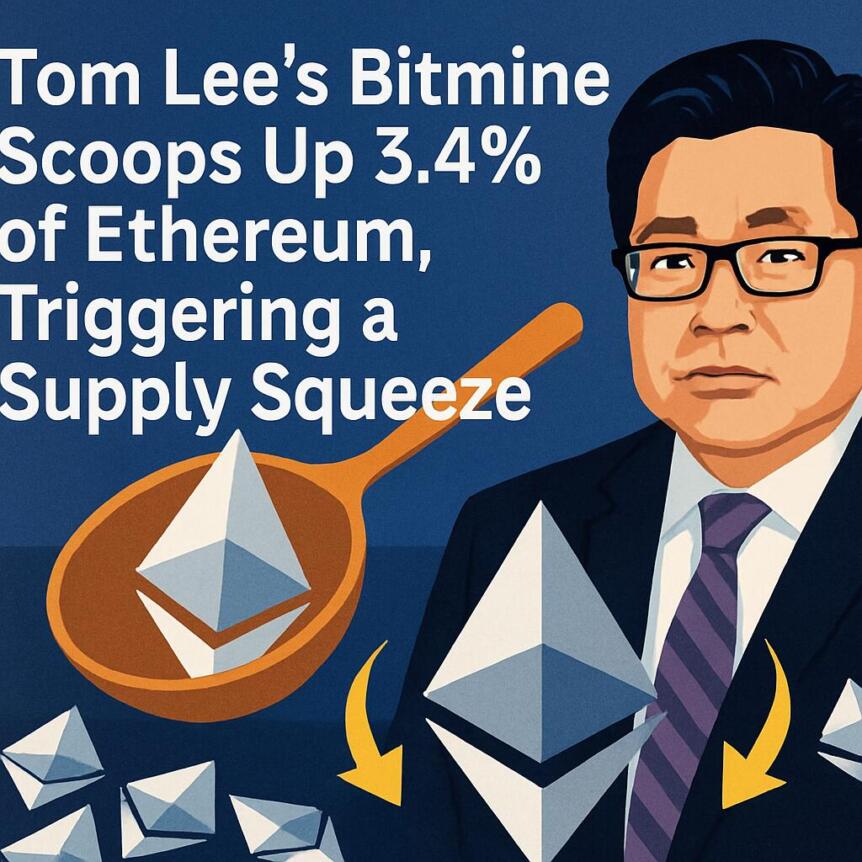
Tom Lee’s Bitmine Scoops Up 3.4% of Ethereum, Triggering a Supply Squeeze

Tom Lee’s Bitmine Scoops Up 3.4% of Ethereum, Triggering a Supply Squeeze

Bitmine Immersion now controls 3.4% of Ethereum amid shrinking exchange supply and rising institutional accumulation.
Share
Crypto Breaking News2026/01/20 16:27