On Sept 27, Hyperdrive, a Hyperliquid protocol, lost 782K in tokens after a smart contract bug enabled a hacker to empty key pools. Hyperdrive, a lending protocol that is on top of the Hyperliquid network, lost $782,000 to a smart contract exploit on Saturday night. Two large liquidity pools were emptied: the Primary USDT0 Market […] The post Hyperdrive Hack Drains $782K via Smart Contract Exploit appeared first on Live Bitcoin News.On Sept 27, Hyperdrive, a Hyperliquid protocol, lost 782K in tokens after a smart contract bug enabled a hacker to empty key pools. Hyperdrive, a lending protocol that is on top of the Hyperliquid network, lost $782,000 to a smart contract exploit on Saturday night. Two large liquidity pools were emptied: the Primary USDT0 Market […] The post Hyperdrive Hack Drains $782K via Smart Contract Exploit appeared first on Live Bitcoin News.

Hyperdrive Hack Drains $782K via Smart Contract Exploit

2025/09/29 23:00

On Sept 27, Hyperdrive, a Hyperliquid protocol, lost 782K in tokens after a smart contract bug enabled a hacker to empty key pools.

Hyperdrive, a lending protocol that is on top of the Hyperliquid network, lost $782,000 to a smart contract exploit on Saturday night. Two large liquidity pools were emptied: the Primary USDT0 Market and the Treasury USDT Market. 

About 673,000 USDT0 stablecoins and 110,244 thBILL tokens were stolen and then quickly exchanged into cross-chain assets such as BNB and ETH, and off-chain.

CertiK, a blockchain security firm, notes that the attacker used an arbitrary call in the router of the smart contract of Hyperdrive. 
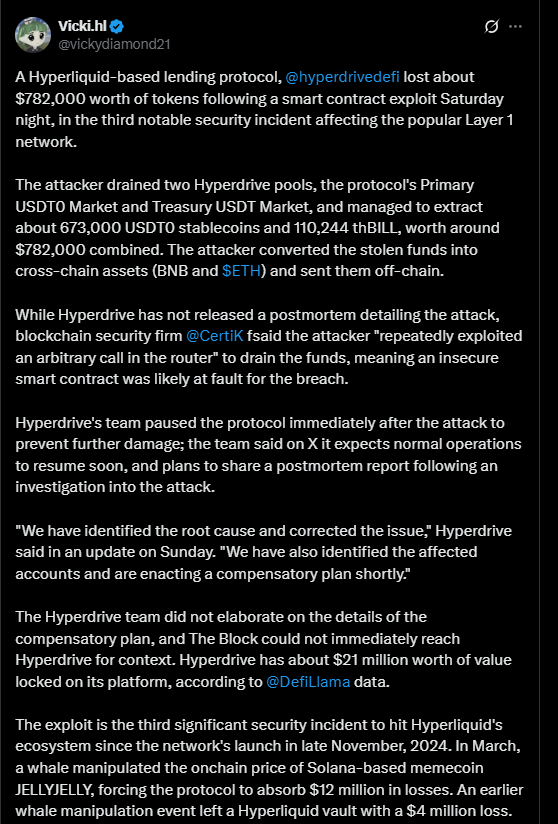
Source – X

This weakness opened this up to unauthorized withdrawals, and this opens up to inherent risks in the coding of the platform. 

Hyperdrive stopped protocol operations as soon as possible to avoid additional damage and initiated an investigation.

Root Cause Uncovered, Compensation Schemed.

The cause was identified as a defect in the router contract of Hyperdrive. The team of the protocol said that they had remedied the vulnerability and were coming up with a compensation scheme with the users who had been affected.

The compensation details are not disclosed, although Hyperdrive promised to release a postmortem report shortly after it had reviewed it.

In spite of this violation, the total value locked (TVL) of Hyperdrive is approximately 21 million. It is the third major security breach in the Hyperliquid ecosystem since its launch in November 2024. 

Whale manipulations have been a problem in the past, leading to losses of millions of dollars in associated projects.

Hyperliquid Ecosystem is engulfed by security Challenges.

Following this recent hack, the Hyperliquid ecosystem has come under extreme scrutiny. In early 2022, a whale interfered with the price on-chain of the Solana memecoin JELLYJELLY, and the protocol had to cover up to 12 million in losses. A Hyperliquid vault lost $4 million to another whale attack of whales.

The quick reaction and the compensations planned by Hyperdrive show that it is determined to rebuild trust. However, unremedied security weaknesses cast doubt upon the security of Layer 1 chain-based decentralized finance protocols based on Hyperliquid.

The post Hyperdrive Hack Drains $782K via Smart Contract Exploit appeared first on Live Bitcoin News.

Disclaimer: The articles reposted on this site are sourced from public platforms and are provided for informational purposes only. They do not necessarily reflect the views of MEXC. All rights remain with the original authors. If you believe any content infringes on third-party rights, please contact [email protected] for removal. MEXC makes no guarantees regarding the accuracy, completeness, or timeliness of the content and is not responsible for any actions taken based on the information provided. The content does not constitute financial, legal, or other professional advice, nor should it be considered a recommendation or endorsement by MEXC.

You May Also Like

The Future of Secure Messaging: Why Decentralization Matters

The Future of Secure Messaging: Why Decentralization Matters

The post The Future of Secure Messaging: Why Decentralization Matters appeared on BitcoinEthereumNews.com. From encrypted chats to decentralized messaging Encrypted messengers are having a second wave. Apps like WhatsApp, iMessage and Signal made end-to-end encryption (E2EE) a default expectation. But most still hinge on phone numbers, centralized servers and a lot of metadata, such as who you talk to, when, from which IP and on which device. That is what Vitalik Buterin is aiming at in his recent X post and donation. He argues the next steps for secure messaging are permissionless account creation with no phone numbers or Know Your Customer (KYC) and much stronger metadata privacy. In that context he highlighted Session and SimpleX and sent 128 Ether (ETH) to each to keep pushing in that direction. Session is a good case study because it tries to combine E2E encryption with decentralization. There is no central message server, traffic is routed through onion paths, and user IDs are keys instead of phone numbers. Did you know? Forty-three percent of people who use public WiFi report experiencing a data breach, with man-in-the-middle attacks and packet sniffing against unencrypted traffic among the most common causes. How Session stores your messages Session is built around public key identities. When you sign up, the app generates a keypair locally and derives a Session ID from it with no phone number or email required. Messages travel through a network of service nodes using onion routing so that no single node can see both the sender and the recipient. (You can see your message’s node path in the settings.) For asynchronous delivery when you are offline, messages are stored in small groups of nodes called “swarms.” Each Session ID is mapped to a specific swarm, and your messages are stored there encrypted until your client fetches them. Historically, messages had a default time-to-live of about two weeks…
Share
BitcoinEthereumNews2025/12/08 14:40
Grayscale Files Sui Trust as 21Shares Launches First SUI ETF Amid Rising Demand

Grayscale Files Sui Trust as 21Shares Launches First SUI ETF Amid Rising Demand

The post Grayscale Files Sui Trust as 21Shares Launches First SUI ETF Amid Rising Demand appeared on BitcoinEthereumNews.com. The Grayscale Sui Trust filing and 21Shares’ launch of the first SUI ETF highlight surging interest in regulated Sui investments. These products offer investors direct exposure to the SUI token through spot-style structures, simplifying access to the Sui blockchain’s growth without direct custody needs, amid expanding altcoin ETF options. Grayscale’s spot Sui Trust seeks to track SUI price performance for long-term holders. 21Shares’ SUI ETF provides leveraged exposure, targeting traders with 2x daily returns. Early trading data shows over 4,700 shares exchanged, with volumes exceeding $24 per unit in the debut session. Explore Grayscale Sui Trust filing and 21Shares SUI ETF launch: Key developments in regulated Sui investments for 2025. Stay informed on altcoin ETF trends. What is the Grayscale Sui Trust? The Grayscale Sui Trust is a proposed spot-style investment product filed via S-1 registration with the U.S. Securities and Exchange Commission, aimed at providing investors with direct exposure to the SUI token’s price movements. This trust mirrors the performance of SUI, the native cryptocurrency of the Sui blockchain, minus applicable fees, offering a regulated avenue for long-term participation in the network’s ecosystem. By holding SUI assets on behalf of investors, it eliminates the need for individuals to manage token storage or transactions directly. ⚡ LATEST: GRAYSCALE FILES S-1 FOR $SUI TRUSTThe “Grayscale Sui Trust,” is a spot-style ETF designed to provide direct exposure to the $SUI token. Grayscale’s goal is to mirror SUI’s market performance, minus fees, giving long-term investors a regulated, hassle-free way to… pic.twitter.com/mPQMINLrYC — CryptosRus (@CryptosR_Us) December 6, 2025 How does the 21Shares SUI ETF differ from traditional funds? The 21Shares SUI ETF, launched under the ticker TXXS, introduces a leveraged approach with 2x daily exposure to SUI’s price fluctuations, utilizing derivatives for amplified returns rather than direct spot holdings. This structure appeals to short-term…
Share
BitcoinEthereumNews2025/12/08 14:20