

I Didn’t Know How to Code. But I Knew What We Needed: An MVP
When we launched our first product, I felt like we had crossed a finish line that cost us blood. There was something alive—out in the stores, in users’ hands. But reality doesn’t let you breathe for long.
Our real workhorse was the next step and we didn’t have the luxury to do it “later, but better.”
The tech team was drowning in bugs, improvements, feedback, and a roadmap piling up on top of us. The heaviest weight wasn’t outside pressure—it was looking at the backlog, realizing how much depended on our small team, and feeling stuck.
All this while AI was moving at a ridiculous pace. And there I was, with an idea, but without knowing how to code.
Until I asked myself:
What if I just do it? What if I build the first version of the product myself, even if I don’t know how to program?
Spoiler: I did it. In 2 weeks and I’ll tell you how. Because if you’re in a similar situation, this might unlock you.
From Failing a “Hello, World” to Cloning a Repo
For context: I’m not a developer. Years ago, I tried to do a simple “Hello, World!” and failed miserably.
But this time was different. I had a concrete need and when you have a real need, no-code tools stop being “toys” to become your only way forward.
I stumbled upon a free mini-course by Ariel Mathov on LinkedIn where he explained Cursor. I watched two full lessons. That was enough to download the app, open it, and freeze…
Cursor gave me three options: clone repo, open project, or connect via SSH. I didn’t understand any of it, but that’s where the adventure began.
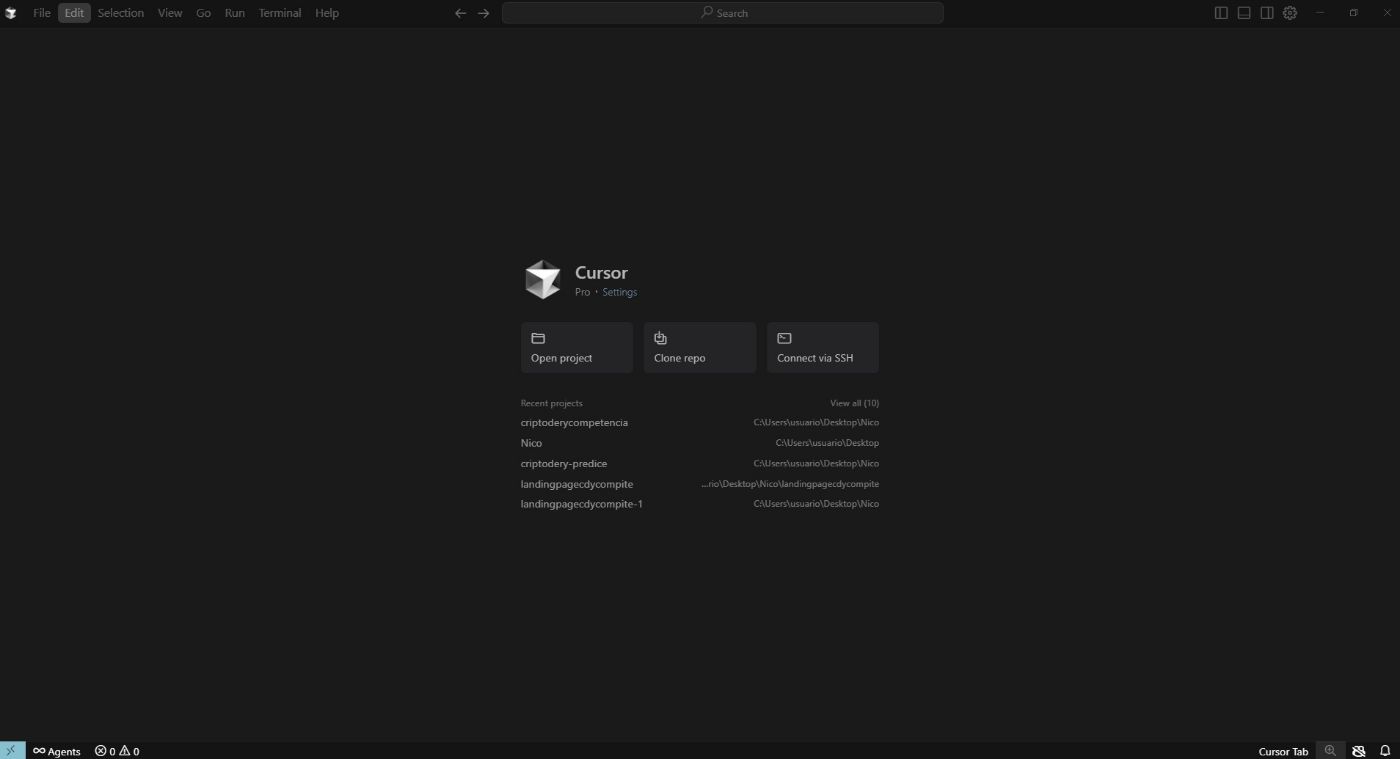
Cursor, GitHub and My First “Hello Agent”
I realized I needed a GitHub project to move forward. So, without fully understanding what I was doing, I cloned a repo, opened it in Cursor, and wrote my first message to the AI chat:
“Hello, friend.”
Cursor’s AI replied instantly. It asked me what I wanted to build. I said:
“I want to validate an idea in two weeks. Ask me whatever you need.”
It threw 50 questions at me I couldn’t answer, so I just typed: “==Yes, I want all that== 😳.”
And the show began.
Seeing Code Without Understanding It (But Trusting It Works)
Line after line, the AI agent started building with Next.js + TypeScript. It explained what it was doing:
“We’re generating a robust and scalable environment so you can test your product quickly.”
I stared at the screen like it was The Matrix. I didn’t understand a thing—but it didn’t matter.
A Note of Respect
Let me be clear: I’m not a developer, and I don’t intend to be. I have enormous respect for my colleagues who are. This article isn’t about “replacing” anyone—it’s about how AI today lets small teams unblock things faster. For me, it was a way to move forward when time was crushing us, knowing the development team could later audit, refine, and clean up what I had started—while they focused on putting out other fires.
So I listed out the features I needed—things like authentication, flows, and results tracking. The AI spun it all up in minutes.
I ran npm run dev and opened localhost:3000. And there it was: a functioning app. Some errors, sure—but it worked. It had an interface, a full flow, and even animations.
From Skeleton to Experience
I had the basic structure working but what was missing was real-time interaction between users. The AI suggested using Firebase so I opened an account, set up a database, and suddenly had a working foundation for storing and syncing information.
The rest was about iterating on what I did know: adjusting UX, adding design, writing questions by level. The tech stuff, I kept resolving with AI prompts:
“This doesn’t look right.” → “Fixed.” \n “Can you center this?” → “Done.”
In two weeks, we had a functional MVP—clean, aesthetic, and aligned with the product we wanted to validate.
What You Can Do Right Now
If you’re in a situation like mine—with a product that can’t wait or a tech team overwhelmed—try this:
\
-
==Define your ideal flow==. You don’t need to code, but you do need clarity on what you want your product to do. I didn’t at first, and I ended up redoing everything twice. \n
-
==Write prompts as if you were talking to a developer friend==. Use whatever technical terms you know; if you don’t know many, that’s fine—AI will figure it out, though it might take longer. For precision, you can even use another AI to translate your idea into “developer language.” \n
-
==Choose tools that play nicely together==. For me: Cursor + GitHub + Firebase + Vercel. \n
-
==Allow yourself to do things badly==. The first version won’t be perfect—but it will be functional. And that’s enough to test.
\
-
==Stay in touch with your developer== so they can review and refine what you build.
What I Learned: Nobody’s Too Far From Building
I didn’t become a developer. I didn’t learn TypeScript. I didn’t fully understand how Firebase stores data.
But over time, I got curious and started grasping some development logic. More importantly: I validated an idea, I had a demo to show, and I discovered I don’t need to know everything to build something that works.
If you know what you want, can explain it out loud, and are patient with an AI, you can create more than you think.
\n
You May Also Like

Unstoppable: Why No Public Company Can Ever Catch MicroStrategy’s Massive Bitcoin Holdings

Eric Trump Says Banks Tried to Shut Him Out – Turns to Bitcoin Instead
