The post Institutions want rules, and the UAE is delivering them appeared on BitcoinEthereumNews.com. Disclosure: The views and opinions expressed here belong solely to the author and do not represent the views and opinions of crypto.news’ editorial. It may come as a disappointment to crypto degens to hear that institutions aren’t chasing the next craze in crypto. Institutions just have no interest, plain and simple. Summary Speculation is fading, institutions want clarity — retail hype and memecoins are giving way to institutional demand for predictable regulation. The UAE offers a model framework — with clear disclosures, asset segregation, capital requirements, and broad license categories that anticipate institutional needs. Regulatory certainty attracts serious capital — unlike Europe and the UK, the UAE adapts rules in near real-time, balancing innovation with risk management. The next phase is institutional integration — over the coming years, banks and funds will increasingly adopt Bitcoin, stablecoins, and tokenized assets, stabilizing and legitimizing the market. For years, the global conversation around crypto has been mainly around retail speculation, viral tokens, sudden price surges, and headline-grabbing crashes. And let’s not even get started on all the celebrities cashing in on their useless tokens. In fact, within the next decade, there will come a time when people will look back and wince at the idea that such a world ever existed. But it will also mark the next stage of crypto’s maturity, which is music to the ears of institutions and is why so many banks and family offices are still standing on the sidelines, waiting for that moment to happen. Institutions want assurance Institutions are chasing certainty, not in the volatility of Bitcoin’s (BTC) price, but in clear, predictable regulations, and the United Arab Emirates has built a framework that delivers that. From transparent disclosures and rigorous client-asset segregation to clear capital requirements and proactive oversight, the UAE has built “the guardrails”… The post Institutions want rules, and the UAE is delivering them appeared on BitcoinEthereumNews.com. Disclosure: The views and opinions expressed here belong solely to the author and do not represent the views and opinions of crypto.news’ editorial. It may come as a disappointment to crypto degens to hear that institutions aren’t chasing the next craze in crypto. Institutions just have no interest, plain and simple. Summary Speculation is fading, institutions want clarity — retail hype and memecoins are giving way to institutional demand for predictable regulation. The UAE offers a model framework — with clear disclosures, asset segregation, capital requirements, and broad license categories that anticipate institutional needs. Regulatory certainty attracts serious capital — unlike Europe and the UK, the UAE adapts rules in near real-time, balancing innovation with risk management. The next phase is institutional integration — over the coming years, banks and funds will increasingly adopt Bitcoin, stablecoins, and tokenized assets, stabilizing and legitimizing the market. For years, the global conversation around crypto has been mainly around retail speculation, viral tokens, sudden price surges, and headline-grabbing crashes. And let’s not even get started on all the celebrities cashing in on their useless tokens. In fact, within the next decade, there will come a time when people will look back and wince at the idea that such a world ever existed. But it will also mark the next stage of crypto’s maturity, which is music to the ears of institutions and is why so many banks and family offices are still standing on the sidelines, waiting for that moment to happen. Institutions want assurance Institutions are chasing certainty, not in the volatility of Bitcoin’s (BTC) price, but in clear, predictable regulations, and the United Arab Emirates has built a framework that delivers that. From transparent disclosures and rigorous client-asset segregation to clear capital requirements and proactive oversight, the UAE has built “the guardrails”…

Institutions want rules, and the UAE is delivering them

Disclosure: The views and opinions expressed here belong solely to the author and do not represent the views and opinions of crypto.news’ editorial.

It may come as a disappointment to crypto degens to hear that institutions aren’t chasing the next craze in crypto. Institutions just have no interest, plain and simple.

Summary

  • Speculation is fading, institutions want clarity — retail hype and memecoins are giving way to institutional demand for predictable regulation.
  • The UAE offers a model framework — with clear disclosures, asset segregation, capital requirements, and broad license categories that anticipate institutional needs.
  • Regulatory certainty attracts serious capital — unlike Europe and the UK, the UAE adapts rules in near real-time, balancing innovation with risk management.
  • The next phase is institutional integration — over the coming years, banks and funds will increasingly adopt Bitcoin, stablecoins, and tokenized assets, stabilizing and legitimizing the market.

For years, the global conversation around crypto has been mainly around retail speculation, viral tokens, sudden price surges, and headline-grabbing crashes. And let’s not even get started on all the celebrities cashing in on their useless tokens. In fact, within the next decade, there will come a time when people will look back and wince at the idea that such a world ever existed.

But it will also mark the next stage of crypto’s maturity, which is music to the ears of institutions and is why so many banks and family offices are still standing on the sidelines, waiting for that moment to happen.

Institutions want assurance

Institutions are chasing certainty, not in the volatility of Bitcoin’s (BTC) price, but in clear, predictable regulations, and the United Arab Emirates has built a framework that delivers that. From transparent disclosures and rigorous client-asset segregation to clear capital requirements and proactive oversight, the UAE has built “the guardrails” that allow institutions to interact with digital assets confidently. 

What matters to them is clarity, predictability, and a regulatory framework they can rely on. The UAE has purpose-built virtual-asset regimes in multiple sub-jurisdictions with variations on the guidance that doesn’t react to market trends; it anticipates what institutions need. A huge advantage includes a broad scope of license categories that cover many possible business models, products, services, and use cases. In doing so, the UAE is moving crypto from a speculative pastime into a legitimate, investable asset class.

You could even go so far as to say that the UAE operates on an entirely different level compared with other jurisdictions, such as Europe’s Markets in Crypto-Assets Regulation and the UK’s Crypto-Assets Regulations Framework.

Regulatory certainty is more than a checkbox for institutions

While European and UK frameworks can be slow to adapt, the UAE combines clear rules with flexibility in a market that values innovation and the strategic role of fintech. Unlike many other jurisdictions, the UAE applies thoughtful regulation in near real-time. License categories are introduced regularly as the space evolves through proactive collaboration between the industry and regulators, with careful consideration of balancing risks and innovations. 

For institutional players, regulatory certainty is more than a checkbox; it is the foundation for institutions to get involved. Banks, pension funds, and family offices cannot commit balance-sheet capital to markets that are volatile, not just in price but in rules. 

By providing clear guidelines on disclosure, compliance, and risk management, the UAE offers a stable environment where governance and accountability coexist with growth. The UAE is sending a clear message that it values institutional engagement over short-term hype (yes, they have no interest in the 50,000% returns on memecoins). This approach doesn’t just attract capital; it cultivates long-term relationships with global financial players, building a sustainable ecosystem for digital assets.

Some might argue that hype drives adoption, and in the short term, it can. But the history of financial markets shows that sustainable growth comes from structure, not sensation. Equities, commodities, and traditional banking succeeded not because they were flashy, but because they were predictable, auditable, and secure. By applying the same principles to digital assets, the UAE is combining innovation with caution, an approach that attracts serious investors.

Institutional investors in the UAE are now able to integrate virtual assets into their portfolios without the fear of sudden regulatory surprises.

The next two years could be significant

This creates a virtuous cycle, as institutional capital flows in, markets stabilize, liquidity improves, and the broader ecosystem benefits. By acting on this fundamental truth, the UAE is building not just a market, but a legacy, one where innovation thrives within a framework of trust, and where the digital assets industry can grow responsibly for decades to come.

Over the next two years, we expect more and more investment portfolios and corporate treasuries to begin integrating virtual assets for different purposes. 

This could come in the form of simply investing in Bitcoin, using stablecoins for settlements, or integrating other newly permitted innovative products, such as tokenized real estate title deeds, which have recently been piloted in Dubai. 

It should be obvious to other jurisdictions by now that a clear, consistent, and forward-looking regulatory framework can help digital assets move from speculative curiosity to mainstream financial instruments.

Basil Al Askari

Basil Al Askari is the founder and CEO of MidChains, a regulated virtual asset trading platform based in Abu Dhabi and Dubai, UAE, focused on both retail and institutional markets.

Source: https://crypto.news/institutions-want-rules-and-the-uae-is-delivering-them/

Market Opportunity
NEAR Logo
NEAR Price(NEAR)
$1.554
$1.554$1.554
-0.51%
USD
NEAR (NEAR) Live Price Chart
Disclaimer: The articles reposted on this site are sourced from public platforms and are provided for informational purposes only. They do not necessarily reflect the views of MEXC. All rights remain with the original authors. If you believe any content infringes on third-party rights, please contact [email protected] for removal. MEXC makes no guarantees regarding the accuracy, completeness, or timeliness of the content and is not responsible for any actions taken based on the information provided. The content does not constitute financial, legal, or other professional advice, nor should it be considered a recommendation or endorsement by MEXC.

You May Also Like

The Channel Factories We’ve Been Waiting For

The Channel Factories We’ve Been Waiting For

The post The Channel Factories We’ve Been Waiting For appeared on BitcoinEthereumNews.com. Visions of future technology are often prescient about the broad strokes while flubbing the details. The tablets in “2001: A Space Odyssey” do indeed look like iPads, but you never see the astronauts paying for subscriptions or wasting hours on Candy Crush.  Channel factories are one vision that arose early in the history of the Lightning Network to address some challenges that Lightning has faced from the beginning. Despite having grown to become Bitcoin’s most successful layer-2 scaling solution, with instant and low-fee payments, Lightning’s scale is limited by its reliance on payment channels. Although Lightning shifts most transactions off-chain, each payment channel still requires an on-chain transaction to open and (usually) another to close. As adoption grows, pressure on the blockchain grows with it. The need for a more scalable approach to managing channels is clear. Channel factories were supposed to meet this need, but where are they? In 2025, subnetworks are emerging that revive the impetus of channel factories with some new details that vastly increase their potential. They are natively interoperable with Lightning and achieve greater scale by allowing a group of participants to open a shared multisig UTXO and create multiple bilateral channels, which reduces the number of on-chain transactions and improves capital efficiency. Achieving greater scale by reducing complexity, Ark and Spark perform the same function as traditional channel factories with new designs and additional capabilities based on shared UTXOs.  Channel Factories 101 Channel factories have been around since the inception of Lightning. A factory is a multiparty contract where multiple users (not just two, as in a Dryja-Poon channel) cooperatively lock funds in a single multisig UTXO. They can open, close and update channels off-chain without updating the blockchain for each operation. Only when participants leave or the factory dissolves is an on-chain transaction…
Share
BitcoinEthereumNews2025/09/18 00:09
Franklin Templeton CEO Dismisses 50bps Rate Cut Ahead FOMC

Franklin Templeton CEO Dismisses 50bps Rate Cut Ahead FOMC

The post Franklin Templeton CEO Dismisses 50bps Rate Cut Ahead FOMC appeared on BitcoinEthereumNews.com. Franklin Templeton CEO Jenny Johnson has weighed in on whether the Federal Reserve should make a 25 basis points (bps) Fed rate cut or 50 bps cut. This comes ahead of the Fed decision today at today’s FOMC meeting, with the market pricing in a 25 bps cut. Bitcoin and the broader crypto market are currently trading flat ahead of the rate cut decision. Franklin Templeton CEO Weighs In On Potential FOMC Decision In a CNBC interview, Jenny Johnson said that she expects the Fed to make a 25 bps cut today instead of a 50 bps cut. She acknowledged the jobs data, which suggested that the labor market is weakening. However, she noted that this data is backward-looking, indicating that it doesn’t show the current state of the economy. She alluded to the wage growth, which she remarked is an indication of a robust labor market. She added that retail sales are up and that consumers are still spending, despite inflation being sticky at 3%, which makes a case for why the FOMC should opt against a 50-basis-point Fed rate cut. In line with this, the Franklin Templeton CEO said that she would go with a 25 bps rate cut if she were Jerome Powell. She remarked that the Fed still has the October and December FOMC meetings to make further cuts if the incoming data warrants it. Johnson also asserted that the data show a robust economy. However, she noted that there can’t be an argument for no Fed rate cut since Powell already signaled at Jackson Hole that they were likely to lower interest rates at this meeting due to concerns over a weakening labor market. Notably, her comment comes as experts argue for both sides on why the Fed should make a 25 bps cut or…
Share
BitcoinEthereumNews2025/09/18 00:36
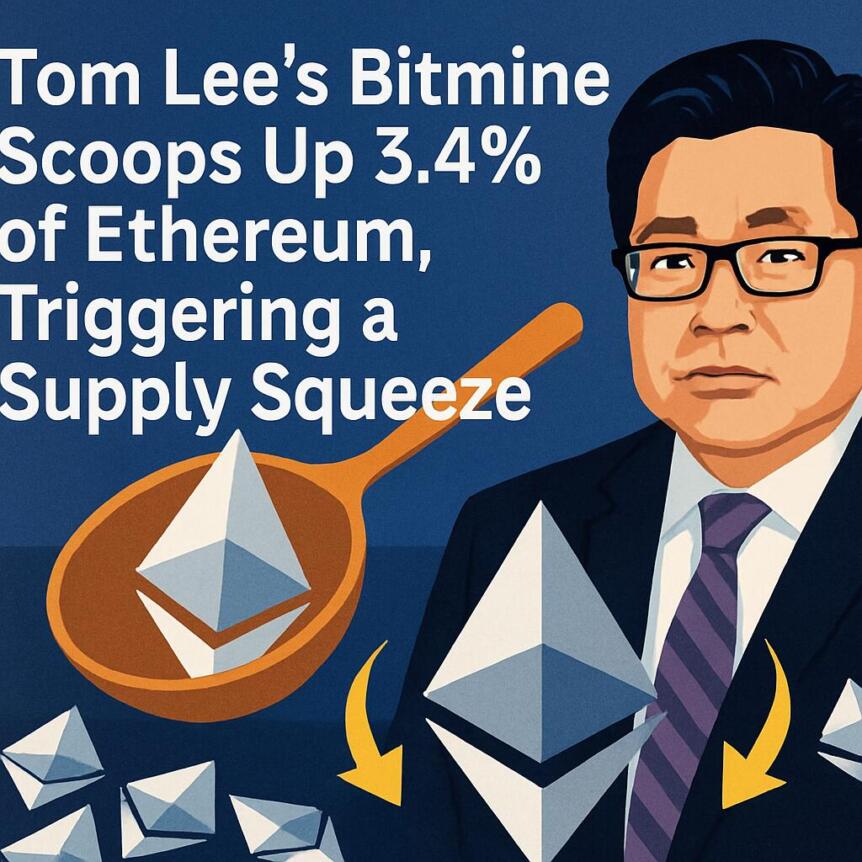
Tom Lee’s Bitmine Scoops Up 3.4% of Ethereum, Triggering a Supply Squeeze

Tom Lee’s Bitmine Scoops Up 3.4% of Ethereum, Triggering a Supply Squeeze

Bitmine Immersion now controls 3.4% of Ethereum amid shrinking exchange supply and rising institutional accumulation.
Share
Crypto Breaking News2026/01/20 16:27