A debate on X this week exposed a core question for on-chain privacy: when quantum computers are able to break elliptic-curve cryptography (ECC), will they be able to retroactively deanonymize every transaction ever made of privacy coins like Zcash? Nic Carter, co-founder of Coin Metrics and partner at Castle Island Ventures, argued that the answer […]A debate on X this week exposed a core question for on-chain privacy: when quantum computers are able to break elliptic-curve cryptography (ECC), will they be able to retroactively deanonymize every transaction ever made of privacy coins like Zcash? Nic Carter, co-founder of Coin Metrics and partner at Castle Island Ventures, argued that the answer […]

Is Zcash Quantum-Resistant Yet? Experts Weigh In

A debate on X this week exposed a core question for on-chain privacy: when quantum computers are able to break elliptic-curve cryptography (ECC), will they be able to retroactively deanonymize every transaction ever made of privacy coins like Zcash?

Nic Carter, co-founder of Coin Metrics and partner at Castle Island Ventures, argued that the answer is effectively yes for most privacy coins. “For privacy coins, even if they migrate to post-quantum cryptographic schemes, all historical transactions prior to that migration can be decrypted,” he said on October 30, 2025. “So all historical txns will be stripped of privacy in >~5y. Everything is built on ECC.”

Carter’s point is based on “harvest now, decrypt later.” Attackers don’t need to break you today. They just copy the data now and crack it once quantum is strong enough. On blockchains, that problem is worse because the data is already public and permanent. “Blockchains are uniquely bad for quantum because normally the quantum thing is ‘harvest now decrypt later’ so adversaries have to be preemptively harvesting traffic but blockchains just.. publish.. everything.. forever.”

He warned specifically that even if a privacy coin upgrades to quantum-resistant signatures in the future, old activity is still exposed once ECC falls. “While privacy coins can adopt post quantum sigs, understand that all previously hidden addresses, relationships between addresses, etc, will be revealed once ECC is broken,” Carter said. “And obviously everything is on chain so you don’t even need to harvest traffic today.”

Is Zcash Already Quantum-Resistant?

That claim triggered pushback from Zcash supporters, who argue Zcash is structurally different from something like Monero.

Mert Mumtaz (Helius) agreed that Carter’s warning applies to “many privacy coins like Monero,” but said it’s “not necessarily true for zcash’s privacy, given advanced opsec.” He acknowledged that “advanced opsec is not the norm,” but said that if it is followed, Zcash users “get you certain guarantees w.r.t information leakage.” He also said “some things are in the works to make this even stronger,” pointing to research by Zcash engineer Sean Bowe.

Bowe’s position is that Zcash’s fully shielded pool simply does not put critical sender/receiver information on the ledger in the first place. “There is no quantum computer or powerful AI that will be able to look back at the Zcash blockchain 1000 years from now and figure out who made every fully shielded transaction,” Bowe said in July this year. “That information, among other things, never even touches the ledger. It’s already gone.” His condition is clear: “To be certain about your privacy you must start by using shielded Zcash. You almost cannot even begin otherwise.”

Carter partially credits that. “Zec is definitely ahead of anyone when it comes to quantum preparedness, not denying that,” he said. But he called the “already quantum-proof” framing unrealistic in practice.

He argued that Zcash’s long-term privacy story depends on very strong assumptions that often break in the real world: “assumes pubkey never being known. assumes: no metadata collection, no exchange key leaks, perfect metadata privacy.”

He added that Zcash’s shielded pools — Sprout, Sapling, Orchard — still “rely on ECC for key exchange, viewkeys, proof verification, which are all broken” under a powerful quantum adversary. His conclusion: “unrealistic to say zec privacy is perfectly q resistant. linkages between addrs are forever encoded on the blockchain, you and Sean know that. store now decrypt later still applies.”

In other words: Zcash builders say that if you stay fully shielded, the chain itself won’t hand quantum attackers a clean map of who paid whom. Carter says that in the real world, users leak, exchanges leak, metadata leaks — and once ECC breaks, those leaks plus the permanent ledger are enough to unwind the privacy anyway.

One final note: when asked directly, Carter denied holding ZEC. “Nope.”

At press time, ZEC traded at $366.
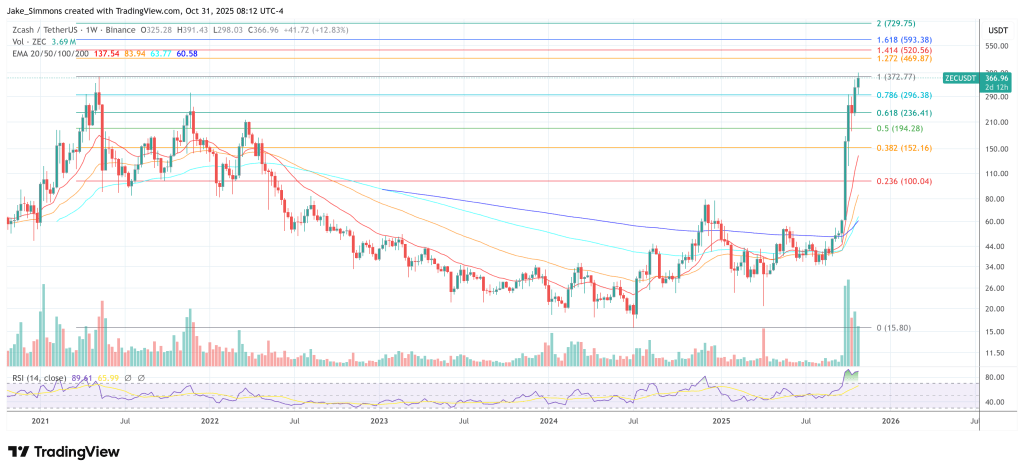
Zcash price
Market Opportunity
QUANTUM Logo
QUANTUM Price(QUANTUM)
$0.003381
$0.003381$0.003381
-2.90%
USD
QUANTUM (QUANTUM) Live Price Chart
Disclaimer: The articles reposted on this site are sourced from public platforms and are provided for informational purposes only. They do not necessarily reflect the views of MEXC. All rights remain with the original authors. If you believe any content infringes on third-party rights, please contact [email protected] for removal. MEXC makes no guarantees regarding the accuracy, completeness, or timeliness of the content and is not responsible for any actions taken based on the information provided. The content does not constitute financial, legal, or other professional advice, nor should it be considered a recommendation or endorsement by MEXC.

You May Also Like

Fed forecasts only one rate cut in 2026, a more conservative outlook than expected
Fed forecasts only one rate cut in 2026, a more conservative outlook than expected

The post Fed forecasts only one rate cut in 2026, a more conservative outlook than expected appeared on BitcoinEthereumNews.com. Federal Reserve Chairman Jerome Powell talks to reporters following the regular Federal Open Market Committee meetings at the Fed on July 30, 2025 in Washington, DC. Chip Somodevilla | Getty Images The Federal Reserve is projecting only one rate cut in 2026, fewer than expected, according to its median projection. The central bank’s so-called dot plot, which shows 19 individual members’ expectations anonymously, indicated a median estimate of 3.4% for the federal funds rate at the end of 2026. That compares to a median estimate of 3.6% for the end of this year following two expected cuts on top of Wednesday’s reduction. A single quarter-point reduction next year is significantly more conservative than current market pricing. Traders are currently pricing in at two to three more rate cuts next year, according to the CME Group’s FedWatch tool, updated shortly after the decision. The gauge uses prices on 30-day fed funds futures contracts to determine market-implied odds for rate moves. Here are the Fed’s latest targets from 19 FOMC members, both voters and nonvoters: Zoom In IconArrows pointing outwards The forecasts, however, showed a large difference of opinion with two voting members seeing as many as four cuts. Three officials penciled in three rate reductions next year. “Next year’s dot plot is a mosaic of different perspectives and is an accurate reflection of a confusing economic outlook, muddied by labor supply shifts, data measurement concerns, and government policy upheaval and uncertainty,” said Seema Shah, chief global strategist at Principal Asset Management. The central bank has two policy meetings left for the year, one in October and one in December. Economic projections from the Fed saw slightly faster economic growth in 2026 than was projected in June, while the outlook for inflation was updated modestly higher for next year. There’s a lot of uncertainty…
Share
BitcoinEthereumNews2025/09/18 02:59
While Ethereum and Hedera Hold Steady, ZKP Crypto Shakes the Market with a $1.7B Raise in Motion

While Ethereum and Hedera Hold Steady, ZKP Crypto Shakes the Market with a $1.7B Raise in Motion

Learn how Hedera and Ethereum are shaping up, and why analysts say ZKP crypto’s $1.7B auction makes it the best crypto to buy before demand overtakes supply.
Share
coinlineup2026/01/21 12:00
Massachusetts Can Ban Kalshi Sports Markets for Now, Judge Rules

Massachusetts Can Ban Kalshi Sports Markets for Now, Judge Rules

The post Massachusetts Can Ban Kalshi Sports Markets for Now, Judge Rules appeared on BitcoinEthereumNews.com. In brief A Massachusetts judge allowed state regulators
Share
BitcoinEthereumNews2026/01/21 12:23