The post Jimmy Fallon On The Future Of Late Night And Being A Super Marketer appeared on BitcoinEthereumNews.com. As late-night television declines, The Tonight Show host is preparing for tomorrow by building an entertainment empire based on his irrepressible joy. With the launch of his new marketing competition show, On Brand, he’s getting down to business. IN his 11 years as host of The Tonight Show, Jimmy Fallon has always been an idea machine—constantly dreaming up new comedy segments, new products, even entirely new programs. He once pitched NBC a drama about a murderous priest who takes his own confession, thus absolving his soul of sin. “They didn’t like that,” Fallon says, with a characteristic giggle. “So off-brand for me, but you got to take those swings, man.” The 51-year-old comedian’s own personal brand—hotwiring an encyclopedic love of pop culture with his hyper-enthusiastic positivity—has defined his late-night talk show, and in recent years, become an even more natural fit on game shows he has produced such as Password and That’s My Jam. It’s a collection of jobs for which NBC has made him one of the highest-paid hosts on TV, with a contract that Forbes estimates at $16 million annually. That doesn’t mean Fallon is immune to the pressures of television’s structural decline. While Johnny Carson was the undisputed King of Late Night as the Tonight Show host for nearly 30 years, Fallon ranks third in viewership in his time slot (behind Stephen Colbert and Jimmy Kimmel), averaging 1.2 million viewers per night, and the show’s ad revenue is down 35% from 2022 to 2024, according to ad data provider iSpot TV. The abrupt cancellation in July of The Late Show with Stephen Colbert—which CBS claimed was losing $40 million per year—prompted many to declare the imminent demise of late night, adding a level of urgency to Fallon’s side hustles. Into this turbulent landscape he is launching On… The post Jimmy Fallon On The Future Of Late Night And Being A Super Marketer appeared on BitcoinEthereumNews.com. As late-night television declines, The Tonight Show host is preparing for tomorrow by building an entertainment empire based on his irrepressible joy. With the launch of his new marketing competition show, On Brand, he’s getting down to business. IN his 11 years as host of The Tonight Show, Jimmy Fallon has always been an idea machine—constantly dreaming up new comedy segments, new products, even entirely new programs. He once pitched NBC a drama about a murderous priest who takes his own confession, thus absolving his soul of sin. “They didn’t like that,” Fallon says, with a characteristic giggle. “So off-brand for me, but you got to take those swings, man.” The 51-year-old comedian’s own personal brand—hotwiring an encyclopedic love of pop culture with his hyper-enthusiastic positivity—has defined his late-night talk show, and in recent years, become an even more natural fit on game shows he has produced such as Password and That’s My Jam. It’s a collection of jobs for which NBC has made him one of the highest-paid hosts on TV, with a contract that Forbes estimates at $16 million annually. That doesn’t mean Fallon is immune to the pressures of television’s structural decline. While Johnny Carson was the undisputed King of Late Night as the Tonight Show host for nearly 30 years, Fallon ranks third in viewership in his time slot (behind Stephen Colbert and Jimmy Kimmel), averaging 1.2 million viewers per night, and the show’s ad revenue is down 35% from 2022 to 2024, according to ad data provider iSpot TV. The abrupt cancellation in July of The Late Show with Stephen Colbert—which CBS claimed was losing $40 million per year—prompted many to declare the imminent demise of late night, adding a level of urgency to Fallon’s side hustles. Into this turbulent landscape he is launching On…

Jimmy Fallon On The Future Of Late Night And Being A Super Marketer

As late-night television declines, The Tonight Show host is preparing for tomorrow by building an entertainment empire based on his irrepressible joy. With the launch of his new marketing competition show, On Brand, he’s getting down to business.


IN his 11 years as host of The Tonight Show, Jimmy Fallon has always been an idea machine—constantly dreaming up new comedy segments, new products, even entirely new programs. He once pitched NBC a drama about a murderous priest who takes his own confession, thus absolving his soul of sin. “They didn’t like that,” Fallon says, with a characteristic giggle. “So off-brand for me, but you got to take those swings, man.”

The 51-year-old comedian’s own personal brand—hotwiring an encyclopedic love of pop culture with his hyper-enthusiastic positivity—has defined his late-night talk show, and in recent years, become an even more natural fit on game shows he has produced such as Password and That’s My Jam. It’s a collection of jobs for which NBC has made him one of the highest-paid hosts on TV, with a contract that Forbes estimates at $16 million annually.

That doesn’t mean Fallon is immune to the pressures of television’s structural decline. While Johnny Carson was the undisputed King of Late Night as the Tonight Show host for nearly 30 years, Fallon ranks third in viewership in his time slot (behind Stephen Colbert and Jimmy Kimmel), averaging 1.2 million viewers per night, and the show’s ad revenue is down 35% from 2022 to 2024, according to ad data provider iSpot TV. The abrupt cancellation in July of The Late Show with Stephen Colbert—which CBS claimed was losing $40 million per year—prompted many to declare the imminent demise of late night, adding a level of urgency to Fallon’s side hustles.

Into this turbulent landscape he is launching On Brand with Jimmy Fallon on September 30, a new NBC reality competition show in the mold of Shark Tank and The Apprentice in which contestants with no marketing experience pitch campaigns for major brands such as Pillsbury, Dunkin’ and Southwest Airlines. The winning ad campaigns will appear in real life the day after an episode airs, creating what Fallon hopes is a symbiotic relationship with brands that makes the show a profit center. “It’s a new type of show,” he says, “and I think it’s a new type of business model, too.”

Fallon has always had a talent for branding. His version of The Tonight Show is perhaps best-known for its signature segments (“Thank You Notes”), games (“Egg Russian Roulette”) and sing-alongs (“Lip Sync Battle,” which also became a spin-off show) that travel widely on the internet, where he has more than 100 million followers across TikTok, Instagram and X, far more than any other late-night host.

Off air, he has collaborated on a series of whimsical products, including $195 shoes that change colors when they wear down (“Gobstompers”), pajamas with pockets (“P’Jimmies,” $78), $48 phone cases (“Pocket Dials”), sunglasses you can twirl like a fid­get spinner (“Spinnies,” $95), a roller coaster at Universal Orlando (“Race Through New York”), a Ben & Jerry’s ice cream flavor (“The Tonight Dough”), best-selling children’s books (Your Baby’s First Word Will Be DADA) and an album of original Christmas songs (Holiday Seasoning).

“If not for what he’s doing today, Jimmy should have absolutely been a marketer,” says Bozoma Saint John, the former chief marketing officer of Netflix and chief brand officer at Uber, who is Fallon’s cohost for On Brand. “He has a real ability to take an idea and make it better. And that’s really, at the end of the day, what marketing is.”

Fallon’s most well-defined brand remains his own. Since joining the cast of Saturday Night Live at 24 in 1998, he has been known for an inability to suppress his joyfulness, as in the background of iconic sketches like “More Cowbell.” When he left the show in 2004, executive produ­cer Lorne Michaels had already pegged Fallon as a natural talk show host, and after a few years making mostly unsuc­cessful movies like 2004’s Taxi and 2005’s Fever Pitch, Michaels helped him secure the Late Night time slot vaca­ted by Conan O’Brien in 2009.

Fallon performed well in a crowded landscape, and when Jay Leno abdicated his Tonight Show throne for the second and final time in 2014, NBC moved the program back to its original location in New York and named the then 39-year-old Fallon the sixth host in its history.

In those early years, his youthful exuberance proved to be ratings gold. Fallon averaged more than 4 million viewers in his first season, a staggering number by today’s standards, and dominated late night for the better part of three years. Then Colbert overtook him in the wake of Donald Trump’s election in 2016 by leaning hard into partisan politics.

A Wizard Called Boz: Joining Fallon as a mentor for On Brand is Bozoma Saint John, the former chief marketing officer of Netflix, who is now a cast member of The Real Housewives of Beverly Hills.

David Holloway/Getty Images

While Fallon regularly pokes fun at Trump, he also famously tousled the future president’s hair on his show. “I think everyone has to be able to laugh. I mean, on both sides of whatever your political beliefs are,” he says. “You got to make jokes. And sometimes it’s too close to this side, sometimes it’s too close to that side, but if you can keep a balance. It feels one-sided, but this guy’s given us a lot to play with.”

Fallon is equally ingratiating with his celebrity guests, often calling them “pal” or “bud” and summoning an inexhaustible excitement for the projects they’re promoting. “I’ve had guests on where they’re, like, ‘I hope you didn’t see this movie, it’s so bad,’ ” he recalls. “I’ll just be, like, ‘We don’t have to get into details. There’s always something good about every project.’ ”

Finding a silver lining in the future of The Tonight Show requires similarly unbridled optimism. Though it still produced the most ad revenue ($78.3 million, per iSpot) in the category last year, the gap between its nearest competitor has shrunk from $30 million in 2022 to just $1.7 million in 2024. And Fallon’s massive social media following doesn’t make up for the revenue decline. In September, NBC made the decision to reduce the show’s budget by moving to four days a week.

But don’t prewrite The Tonight Show’s obituary just yet. “As a media property, it’s pretty darn valuable and really hard to re-create,” says veteran media analyst Jason Damata, CEO of the Los Angeles–based marketing agency Fabric Media.

NBC agrees, for now, because this fall it will run four special Tonight Show episodes on Sundays, using its most important program, Sunday Night Football, as a lead-in. “Which is great,” Fallon says, “because that’s kind of the only show people are watching on television right now.”

He says he will also be closely monitoring the ratings for On Brand, but even more important to the show’s success will be the campaigns it creates, which could attract brands to appear in future seasons.

“I want every company that we’re working with to write down where they’re at right now and then see where they are after On Brand happens,” he says. “I think their numbers will go up, and that’ll prove that the show’s working.”

More from Forbes

ForbesSouth Park’s Creators Are Now BillionairesForbesWhy Paramount’s $7.7 Billion UFC Gamble Will Pay OffForbesThe Highest-Paid TV Hosts Of 2025

Source: https://www.forbes.com/sites/mattcraig/2025/09/28/jimmy-fallon-on-the-future-of-late-night-and-being-a-super-marketer/

Market Opportunity
FUTURECOIN Logo
FUTURECOIN Price(FUTURE)
$0.12502
$0.12502$0.12502
-0.26%
USD
FUTURECOIN (FUTURE) Live Price Chart
Disclaimer: The articles reposted on this site are sourced from public platforms and are provided for informational purposes only. They do not necessarily reflect the views of MEXC. All rights remain with the original authors. If you believe any content infringes on third-party rights, please contact [email protected] for removal. MEXC makes no guarantees regarding the accuracy, completeness, or timeliness of the content and is not responsible for any actions taken based on the information provided. The content does not constitute financial, legal, or other professional advice, nor should it be considered a recommendation or endorsement by MEXC.

You May Also Like

Husky Inu (HINU) Completes Move To $0.00020688

Husky Inu (HINU) Completes Move To $0.00020688

Husky Inu (HINU) has completed its latest price jump, rising from $0.00020628 to $0.00020688. The price jump is part of the project’s pre-launch phase, which began on April 1, 2025.
Share
Cryptodaily2025/09/18 01:10
US Senate Releases Draft Crypto Bill Establishing Clear Regulatory Framework for Digital Assets

US Senate Releases Draft Crypto Bill Establishing Clear Regulatory Framework for Digital Assets

TLDR: Bill resolves SEC-CFTC conflict by assigning clear regulatory authority over securities and commodities respectively. Ancillary assets category exempts network
Share
Blockonomi2026/01/14 04:57
Unprecedented Surge: Gold Price Hits Astounding New Record High

Unprecedented Surge: Gold Price Hits Astounding New Record High

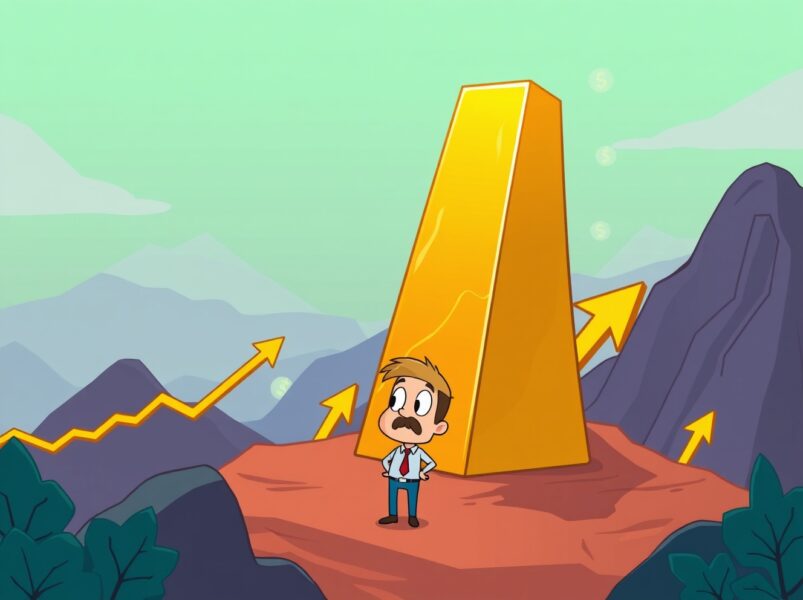
BitcoinWorld Unprecedented Surge: Gold Price Hits Astounding New Record High While the world often buzzes with the latest movements in Bitcoin and altcoins, a traditional asset has quietly but powerfully commanded attention: gold. This week, the gold price has once again made headlines, touching an astounding new record high of $3,704 per ounce. This significant milestone reminds investors, both traditional and those deep in the crypto space, of gold’s enduring appeal as a store of value and a hedge against uncertainty. What’s Driving the Record Gold Price Surge? The recent ascent of the gold price to unprecedented levels is not a random event. Several powerful macroeconomic forces are converging, creating a perfect storm for the precious metal. Geopolitical Tensions: Escalating conflicts and global instability often drive investors towards safe-haven assets. Gold, with its long history of retaining value during crises, becomes a preferred choice. Inflation Concerns: Persistent inflation in major economies erodes the purchasing power of fiat currencies. Consequently, investors seek assets like gold that historically maintain their value against rising prices. Central Bank Policies: Many central banks globally are accumulating gold at a significant pace. This institutional demand provides a strong underlying support for the gold price. Furthermore, expectations around interest rate cuts in the future also make non-yielding assets like gold more attractive. These factors collectively paint a picture of a cautious market, where investors are looking for stability amidst a turbulent economic landscape. Understanding Gold’s Appeal in Today’s Market For centuries, gold has held a unique position in the financial world. Its latest record-breaking performance reinforces its status as a critical component of a diversified portfolio. Gold offers a tangible asset that is not subject to the same digital vulnerabilities or regulatory shifts that can impact cryptocurrencies. While digital assets offer exciting growth potential, gold provides a foundational stability that appeals to a broad spectrum of investors. Moreover, the finite supply of gold, much like Bitcoin’s capped supply, contributes to its perceived value. The current market environment, characterized by economic uncertainty and fluctuating currency values, only amplifies gold’s intrinsic benefits. It serves as a reliable hedge when other asset classes, including stocks and sometimes even crypto, face downward pressure. How Does This Record Gold Price Impact Investors? A soaring gold price naturally raises questions for investors. For those who already hold gold, this represents a significant validation of their investment strategy. For others, it might spark renewed interest in this ancient asset. Benefits for Investors: Portfolio Diversification: Gold often moves independently of other asset classes, offering crucial diversification benefits. Wealth Preservation: It acts as a robust store of value, protecting wealth against inflation and economic downturns. Liquidity: Gold markets are highly liquid, allowing for relatively easy buying and selling. Challenges and Considerations: Opportunity Cost: Investing in gold means capital is not allocated to potentially higher-growth assets like equities or certain cryptocurrencies. Volatility: While often seen as stable, gold prices can still experience significant fluctuations, as evidenced by its rapid ascent. Considering the current financial climate, understanding gold’s role can help refine your overall investment approach. Looking Ahead: The Future of the Gold Price What does the future hold for the gold price? While no one can predict market movements with absolute certainty, current trends and expert analyses offer some insights. Continued geopolitical instability and persistent inflationary pressures could sustain demand for gold. Furthermore, if global central banks continue their gold acquisition spree, this could provide a floor for prices. However, a significant easing of inflation or a de-escalation of global conflicts might reduce some of the immediate upward pressure. Investors should remain vigilant, observing global economic indicators and geopolitical developments closely. The ongoing dialogue between traditional finance and the emerging digital asset space also plays a role. As more investors become comfortable with both gold and cryptocurrencies, a nuanced understanding of how these assets complement each other will be crucial for navigating future market cycles. The recent surge in the gold price to a new record high of $3,704 per ounce underscores its enduring significance in the global financial landscape. It serves as a powerful reminder of gold’s role as a safe haven asset, a hedge against inflation, and a vital component for portfolio diversification. While digital assets continue to innovate and capture headlines, gold’s consistent performance during times of uncertainty highlights its timeless value. Whether you are a seasoned investor or new to the market, understanding the drivers behind gold’s ascent is crucial for making informed financial decisions in an ever-evolving world. Frequently Asked Questions (FAQs) Q1: What does a record-high gold price signify for the broader economy? A record-high gold price often indicates underlying economic uncertainty, inflation concerns, and geopolitical instability. Investors tend to flock to gold as a safe haven when they lose confidence in traditional currencies or other asset classes. Q2: How does gold compare to cryptocurrencies as a safe-haven asset? Both gold and some cryptocurrencies (like Bitcoin) are often considered safe havens. Gold has a centuries-long history of retaining value during crises, offering tangibility. Cryptocurrencies, while newer, offer decentralization and can be less susceptible to traditional financial system failures, but they also carry higher volatility and regulatory risks. Q3: Should I invest in gold now that its price is at a record high? Investing at a record high requires careful consideration. While the price might continue to climb due to ongoing market conditions, there’s also a risk of a correction. It’s crucial to assess your personal financial goals, risk tolerance, and consider diversifying your portfolio rather than putting all your capital into a single asset. Q4: What are the main factors that influence the gold price? The gold price is primarily influenced by global economic uncertainty, inflation rates, interest rate policies by central banks, the strength of the U.S. dollar, and geopolitical tensions. Demand from jewelers and industrial uses also play a role, but investment and central bank demand are often the biggest drivers. Q5: Is gold still a good hedge against inflation? Historically, gold has proven to be an effective hedge against inflation. When the purchasing power of fiat currencies declines, gold tends to hold its value or even increase, making it an attractive asset for preserving wealth during inflationary periods. To learn more about the latest crypto market trends, explore our article on key developments shaping Bitcoin’s price action. This post Unprecedented Surge: Gold Price Hits Astounding New Record High first appeared on BitcoinWorld.
Share
Coinstats2025/09/18 02:30