Lately, there have been low volumes coming into the crypto market as crypto prices continue to drop and the big investors take a break. Almost all areas of the crypto market, from the big cryptocurrencies to the small memecoins, are currently facing a drop in price. Today, on-chain data recorded the move of about 3.94M […]Lately, there have been low volumes coming into the crypto market as crypto prices continue to drop and the big investors take a break. Almost all areas of the crypto market, from the big cryptocurrencies to the small memecoins, are currently facing a drop in price. Today, on-chain data recorded the move of about 3.94M […]

Libra Insiders Shift $4M During Market Slump, Invest in Solana

Libra
  • On-chain data detected the movement of about $3.94 million USDC from the Libra liquidity pool.
  • This move has raised concerns across the crypto community, especially as the overall market volumes remain low and the prices continue to fall.

Lately, there have been low volumes coming into the crypto market as crypto prices continue to drop and the big investors take a break. Almost all areas of the crypto market, from the big cryptocurrencies to the small memecoins, are currently facing a drop in price. Today, on-chain data recorded the move of about 3.94M USDC from the Libra liquidity pool and due to Libra’s history, this move has raised many eyebrows in the crypto community.

Insider Libra Wallets Move Funds Across Blockchains

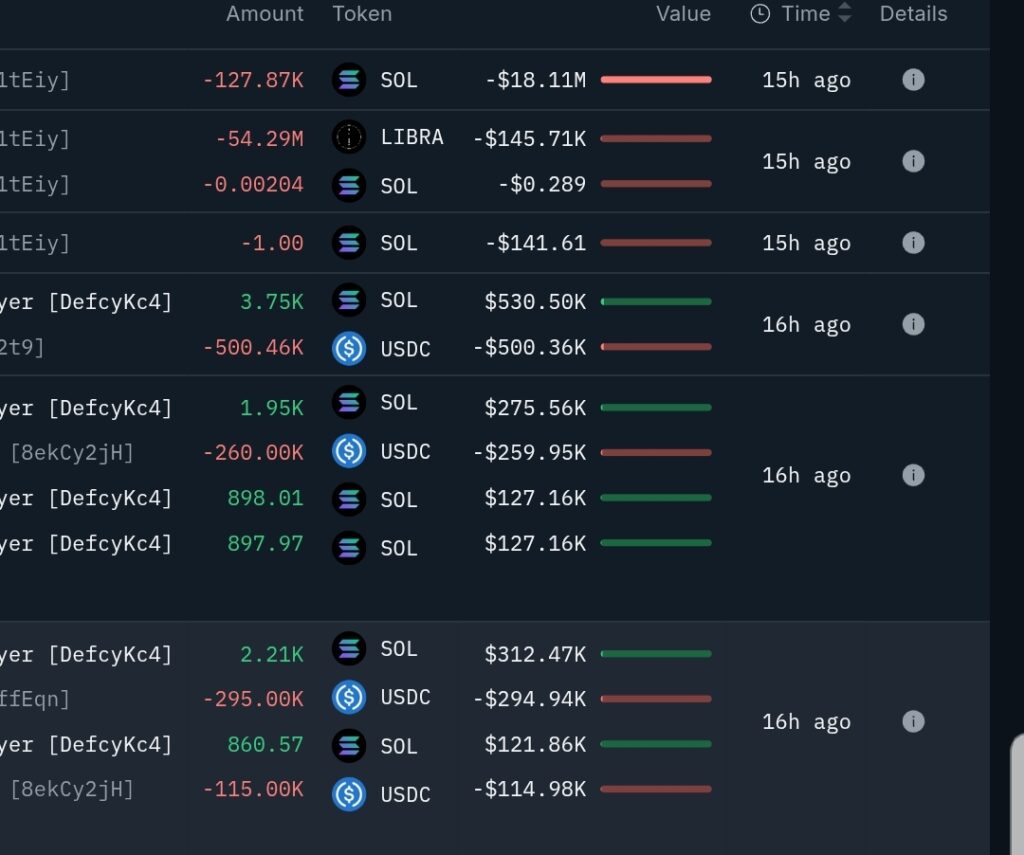
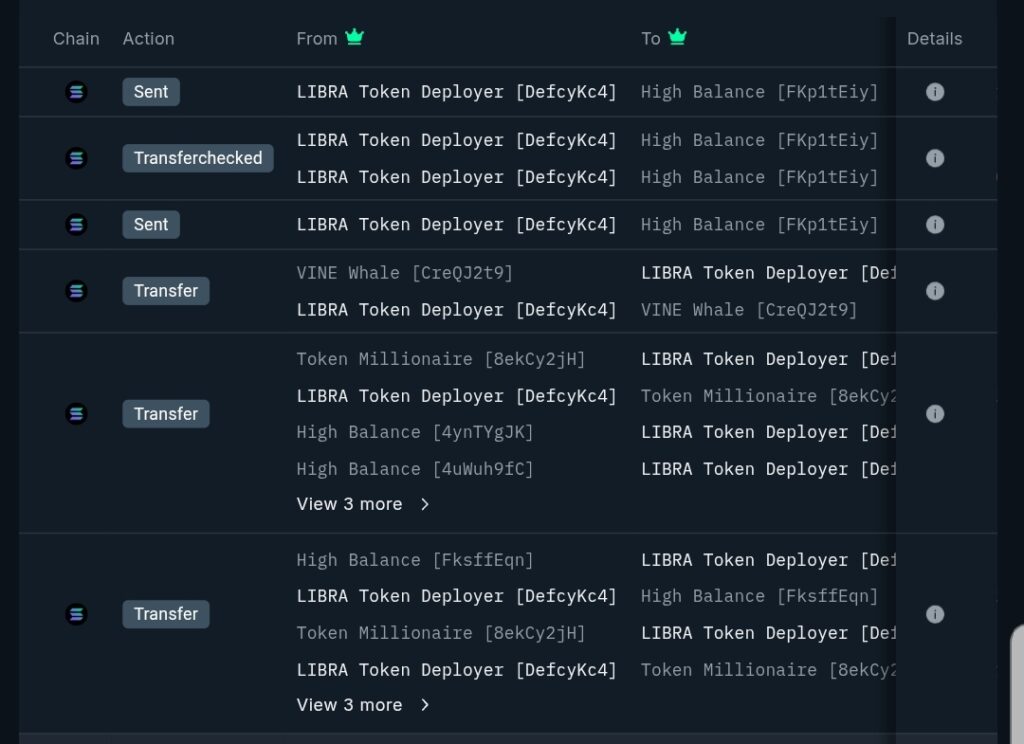
According to the report, the memecoin project, Libra, moved money across different blockchains. It is supposed that it was insiders that made the move and withdrew millions of dollars from the collapsed token. Immediately, they moved this money; they moved it into Solana, thereby capitalizing on the recent dip in the crypto market.

Two wallets identified as “Defcy” and “61yKS” played a major role in these movements. The “Defcy” wallet is labeled as the Libra Deployer, while the “61yKS” wallet is labeled as “Libra: Wallet.” Together, these two wallets removed almost $4 million that was locked in liquidity from the Libra ecosystem before sending the funds to Solana.

Also Read: BNB Chain Urges Users to Migrate Funds as Legacy Multi-Sig Wallet Nears Shutdown
Source: Nansen

Data also showed that the Libra Deployer wallet held an additional $13 million in USDC before making the move. At the same time, the “61yKS” wallet was managing around $44 million in USDC earlier this week. Because these wallets are still active, many people are now questioning how much control investigators actually have over the remaining funds locked up in Libra.

Global Investigations and Insider Cashouts Continue

After Libra collapsed in the beginning of this year, there were at least eight insider wallets that cashed out around $107 million in liquidity. It was this and many other suspicious actions that drew the eyes of investigators. But looking back, the withdrawal of these insider wallets caused the token’s market cap to fall by about $4 billion in just a few hours.

After the collapse, different countries started to look into the case. In the United States, a federal judge froze $57.6 million in USDC in May as part of a class-action lawsuit against Kelsier Ventures and its three co-founders: Gideon, Thomas, and Hayden Davis. The three of them were accused of misleading investors. Later in August, the judge, Jennifer Rochon, lifted the freeze and then explained that investors would not suffer permanent damage because the frozen money was still recoverable.

In all, despite the fact that the freeze has been removed, the wallet’s activity shows that parts of the project’s liquidity are still being moved around.

Also Read: Brazil Plans to Tax Crypto Transactions for Cross-Border Payments

Market Opportunity
Overtake Logo
Overtake Price(TAKE)
$0.04251
$0.04251$0.04251
-1.61%
USD
Overtake (TAKE) Live Price Chart
Disclaimer: The articles reposted on this site are sourced from public platforms and are provided for informational purposes only. They do not necessarily reflect the views of MEXC. All rights remain with the original authors. If you believe any content infringes on third-party rights, please contact [email protected] for removal. MEXC makes no guarantees regarding the accuracy, completeness, or timeliness of the content and is not responsible for any actions taken based on the information provided. The content does not constitute financial, legal, or other professional advice, nor should it be considered a recommendation or endorsement by MEXC.

You May Also Like

The Channel Factories We’ve Been Waiting For

The Channel Factories We’ve Been Waiting For

The post The Channel Factories We’ve Been Waiting For appeared on BitcoinEthereumNews.com. Visions of future technology are often prescient about the broad strokes while flubbing the details. The tablets in “2001: A Space Odyssey” do indeed look like iPads, but you never see the astronauts paying for subscriptions or wasting hours on Candy Crush.  Channel factories are one vision that arose early in the history of the Lightning Network to address some challenges that Lightning has faced from the beginning. Despite having grown to become Bitcoin’s most successful layer-2 scaling solution, with instant and low-fee payments, Lightning’s scale is limited by its reliance on payment channels. Although Lightning shifts most transactions off-chain, each payment channel still requires an on-chain transaction to open and (usually) another to close. As adoption grows, pressure on the blockchain grows with it. The need for a more scalable approach to managing channels is clear. Channel factories were supposed to meet this need, but where are they? In 2025, subnetworks are emerging that revive the impetus of channel factories with some new details that vastly increase their potential. They are natively interoperable with Lightning and achieve greater scale by allowing a group of participants to open a shared multisig UTXO and create multiple bilateral channels, which reduces the number of on-chain transactions and improves capital efficiency. Achieving greater scale by reducing complexity, Ark and Spark perform the same function as traditional channel factories with new designs and additional capabilities based on shared UTXOs.  Channel Factories 101 Channel factories have been around since the inception of Lightning. A factory is a multiparty contract where multiple users (not just two, as in a Dryja-Poon channel) cooperatively lock funds in a single multisig UTXO. They can open, close and update channels off-chain without updating the blockchain for each operation. Only when participants leave or the factory dissolves is an on-chain transaction…
Share
BitcoinEthereumNews2025/09/18 00:09
Gold Hits $3,700 as Sprott’s Wong Says Dollar’s Store-of-Value Crown May Slip

Gold Hits $3,700 as Sprott’s Wong Says Dollar’s Store-of-Value Crown May Slip

The post Gold Hits $3,700 as Sprott’s Wong Says Dollar’s Store-of-Value Crown May Slip appeared on BitcoinEthereumNews.com. Gold is strutting its way into record territory, smashing through $3,700 an ounce Wednesday morning, as Sprott Asset Management strategist Paul Wong says the yellow metal may finally snatch the dollar’s most coveted role: store of value. Wong Warns: Fiscal Dominance Puts U.S. Dollar on Notice, Gold on Top Gold prices eased slightly to $3,678.9 […] Source: https://news.bitcoin.com/gold-hits-3700-as-sprotts-wong-says-dollars-store-of-value-crown-may-slip/
Share
BitcoinEthereumNews2025/09/18 00:33
ZKP Crypto Presale Auction: 8,000x Returns Slipping Away with Each Burned Coin

ZKP Crypto Presale Auction: 8,000x Returns Slipping Away with Each Burned Coin

Zero Knowledge Proof (ZKP) operates a 450-day crypto ICO, burning unsold coins each day. Supply drops through phases, plus a strong deflationary design might create
Share
coinlineup2026/01/23 01:00