Michael Saylor’s Big Bet: The Strategy Behind Strategy’s Bitcoin Accumulation & Bitcoin Hyper’s Opportunity

Michael Saylor plays 4D chess.
Not only did Saylor begin as a Bitcoin critic and change to a Bitcoin booster, but he also took a tech company and turned it into the world’s largest Bitcoin treasury. Along the way, he invented the whole idea of crypto treasury.
And along the way, he inspired a host of imitators, including:
- Countries – The United States and El Salvador have established Bitcoin reserves.
- Companies – Rivals like Metaplanet are playing catch-up to amass as much BTC as possible
- Blockchains – Look around now, and you’ll find Ethereum treasuries, Solana treasuries, and even Dogecoin treasuries
 As of 2025, the company holds approximately 640,031 $BTC, acquired at an average cost in the tens of thousands per coin – far below the current price of $120K.
How did Saylor’s Strategy get here? And what does it all mean for retail investors – and for Bitcoin Layer 2 projects like Bitcoin Hyper ($HYPER)?
Time to dive in.
How Strategy Keeps Accumulating Bitcoin
Why Strategy is accumulating $BTC is obvious, with Bitcoin’s price so high. The real question is – how is Strategy able to keep buying Bitcoin even as the token price increases?
Well, several reasons!
Multi-Pronged FinancingStrategy doesn’t rely on operating cash to fund its Bitcoin acquisitions. Its legacy software business (when it was known as MicroStrategy) yields minimal free cash. Instead, the company uses a toolkit of capital-market instruments:
- Convertible senior notes: often zero- or low-coupon debt that investors can later convert into equity
- Preferred stock issuances (‘Stretch’ offerings), marketed explicitly to raise capital for $BTC purchases
- Equity issuance via at-the-market (ATM) offerings, which leverages investor demand and Strategy’s stock premium over NAV
By funneling proceeds from these sources directly into Bitcoin purchases, Strategy manages to keep buying $BTC dip or ATH.
Since the value of the above – especially stock and equity issuances – relies heavily on the underlying value Strategy’s $BTC holdings, Saylor has essentially created a capital-raising flywheel built around Bitcoin itself.
Accumulation Philosophy: As Much $BTC as PossibleSaylor’s approach treats Bitcoin not as a speculative hold but as a core reserve asset. In other words, he likely wouldn’t consider it a ‘bet’ in the gambling sense.
Instead, Saylor embraces Bitcoin’s inherent volatility; any dips become buying opportunities, and he holds the long view through turbulence.
 He argues that Bitcoin’s fixed 21M supply, resistance to debasement, and network effects make it a superior treasury asset compared to cash or even gold.
Saylor goes a step further, predicting a truly breathtaking upside scenario: if institutional investors allocate even 10% of their capital toward Bitcoin, the resulting demand could push the price toward $1M per $BTC.
The assumption is based on a number of factors, including an even tighter supply than the 21M $BTC, since a significant number – potentially 3.7M $BTC – is considered permanently lost.
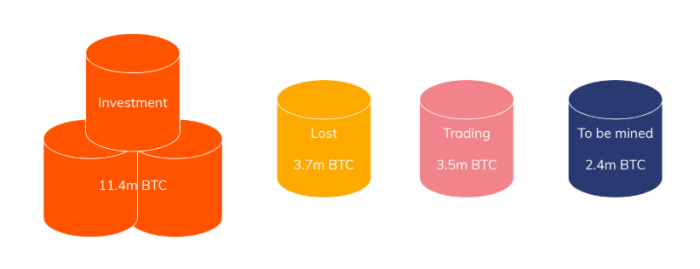
Working in Saylor’s favor: the more Bitcoin treasuries there are, the more Bitcoin is being held (and not traded), and the tighter the liquid supply gets – further driving up Bitcoin’s price.
Currently, the top 100 Bitcoin treasuries hold over 1M Bitcoin between them – nearly 5% of all Bitcoin that will ever exist.
Risks and Criticisms: Yes, There Are Some
Saylor’s plan isn’t without risks. Here are a few of the more pressing ones:
- Shareholder pressure: The company’s reliance on equity issuance means dilution is a constant risk. The entire plan relies on Strategy’s stock trading at a premium over the Bitcoin NAV per share. If that premium collapses, any new equity issuance becomes costly to shareholders; each new share would claim a smaller slice of the Bitcoin pie.
- Accounting and impairments: Because of standard accounting rules, Strategy must book impairment losses when Bitcoin’s market price drops below the cost basis. That applies even if the decline is temporary and later reversed.
- Liquidity and funding: With limited operational cash flow, Strategy depends on fresh capital markets. If investor sentiment sours or credit conditions tighten, raising new funds could become difficult.
- Market and external risks: The success of Saylor’s thesis hinges on continued institutional adoption of Bitcoin. If that demand falters, the upside may not materialize.
In extreme scenarios, the company might be forced to sell Bitcoin, potentially derailing the entire flywheel.
But what if there’s a way to add another layer to Bitcoin’s utility and deepen both retail and institutional interest?
Bitcoin Hyper ($HYPER) could strengthen Bitcoin’s economy even further with a powerful, scalable Layer 2. And along the way, the $HYPER token could just be the next crypto to explode.
Bitcoin Hyper ($HYPER) – Faster, Cheaper Transactions and DeFi-Ready Bitcoin
Bitcoin Hyper ($HYPER) targets Bitcoin’s weaknesses carefully.
To overcome Bitcoin’s low average TPS, Bitcoin Hyper uses a Canonical Bridge to wrap $BTC and deploy it on the Layer 2. There, powered by the Solana Virtual Machine, the wrapped $BTC can be transacted at Solana’s native TPS – potentially thousands of transactions per second.
The result is a hybrid solution combining the flexibility and scalability of the SVM and wrapped $BTC with the reliability of Bitcoin’s native Layer 1.All transactions settle, in the end, on Bitcoin’s original layer for all that hardcore security.
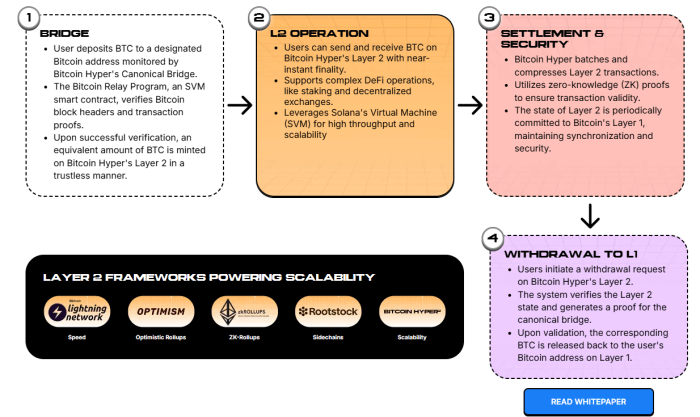
The potential for a fully scalable solution that doesn’t compromise Bitcoin’s reliability is already drawing strong interest.
Yesterday,, the $HYPER presale has rocketed past $20M, powered recently by a wave of whale buys in the past 24 hours:
- $196.6K
- $145K
- $56.9K
- $29.8K
- $11.8K
- $10.4K
The momentum is growing as investors learn exactly what Bitcoin Hyper is; increasingly, they like what they see.
See why our own Bitcoin Hyper price prediction shows the token price could skyrocket from $0.013035 to $0.32 for gains of 2,355% by the end of the year.
Don’t overlook the potential of Bitcoin Hyper – check out the presale page today.
Michael Saylor’s pivot of Strategy into a Bitcoin-first entity is among the most aggressive and public corporate crypto bets.
It has so far paid off handsomely; Strategy’s Bitcoin holdings have appreciated 61% over the course of his purchases for over $29B in unrealized gains.Ultimately, Strategy’s fate will likely rest on how well the pieces of this high-stakes puzzle continue to align. That’s precisely where Bitcoin Hyper ($HYPER) comes in, with the ability to provide more Bitcoin utility and further support Saylor’s strategic flywheel.
Authored by Bogdan Patru for Bitcoinist – https://bitcoinist.com/michael-saylors-big-bitcoin-bet-next-crypto-to-explode-is-bitcoin-hyper
You May Also Like

XAG/USD regains $85.00, bearish risks persist

Trend Research Stuns Market: Deposits $57.1M in Borrowed ETH to Binance After Catastrophic $747M Loss