The Near Foundation proposes cutting NEAR's yearly inflation from 5% to 2.5% through node-level governance voting that started October 28, requiring 80% validator consensus. The post NEAR Inflation Halving Voting Starts, 12% Missing for Approval appeared first on Coinspeaker.The Near Foundation proposes cutting NEAR's yearly inflation from 5% to 2.5% through node-level governance voting that started October 28, requiring 80% validator consensus. The post NEAR Inflation Halving Voting Starts, 12% Missing for Approval appeared first on Coinspeaker.

NEAR Inflation Halving Voting Starts, 12% Missing for Approval

The Near Foundation is proposing an inflation halving for NEAR NEAR $2.24 24h volatility: 4.4% Market cap: $2.85 B Vol. 24h: $199.70 M , effectively reducing the token’s yearly tail emission from 5% to 2.5%. Voting started on October 28, with node-level governance, and 68.41% of all block-producing validators already signaled to favor the reduction—missing less than 12% staking weight for approval.

As reported by Coinspeaker last week, on October 21, the nearcore v2.9.0 release proposed one key change to the Near Protocol: cut emissions from 5% to 2.5%. Validators who favor this change can upgrade to the backwards-compatible Protocol Version 81, while those who oppose it need to remain in Protocol Version 80, not upgrading. Stake delegators can redelegate to new validators accordingly, directly influencing the vote outcome.

The voting ends in 23 days from October 23, with a “NO” outcome, keeping NEAR’s inflation as is, or when the 80% staking threshold is met, activating in the following epoch. An epoch is a unit of time that equals 43,200 blocks, lasting between seven and eight hours at a 600-millisecond block time.

Data Coinspeaker gathered from NearSpace at the time of this writing shows 67 block producers already upgraded to Protocol Version 81, temporarily signaling a “YES” to NEAR’s inflation halving. Together, they sum up to 68.41% of the needed 80% staking to approve the proposal.

Meanwhile, 33 validators still did not upgrade, remaining in Protocol Version 80, temporarily signaling a “NO.” This scenario could change in the following 23 days as validators can upgrade or downgrade their nodes and NEAR investors can redelegate to new validators according to their choices.
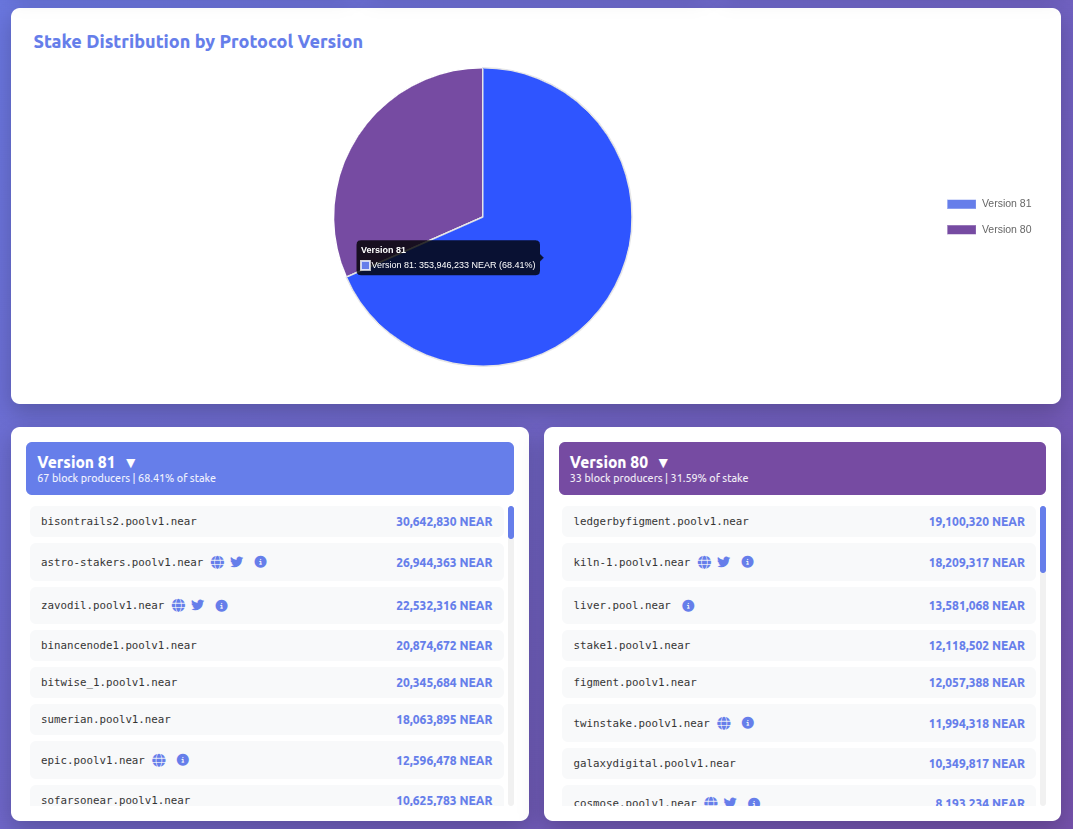
NEAR: Stake distribution by protocol version, as of October 28 | Source: NearSpace.info

NEAR: Stake distribution by protocol version, as of October 28 | Source: NearSpace.info

Controversy Around NEAR Inflation Halving Governance Mechanism

Interestingly, validators are voting directly against their own short-term benefit, bringing controversy to the process. If the network approves this proposal, validators should expect to receive half of the yearly rewards they now receive at the same percentage of the total staked tokens.

This has sparked some public discussions from industry-level staking providers like ChorusOne, who manifested against the reduction and, especially, against the governance mechanism being used for this proposal. Yet, Illia Polosukhin, NEAR co-founder, explained this same mechanism has been used for Near Protocol governance since its mainnet launch five years ago, being a normal procedure.

On the other hand, institutional crypto investors like Andrei Gachev from DWF Labs promised on June 11 that he would “buy another 10 [million] NEAR on [the] secondary market” if NEAR reduced the inflation to 2.5%, as is being voted right now. This would add to DWF Labs’ disclosed position of 5 million NEAR held liquid and 6 million NEAR staked with validators.

With NEAR currently trading at $2.30 per token, the next few days will play a significant role in defining the future of the project from an economic perspective, initiating discussions around potential improvements in its tokenomics, which should be discussed, proposed, and voted on independently, per official communication on this ongoing proposal.

This all happens as MultiversX—another sharded blockchain similar to NEAR—has just voted favorably to remove the previously promised hard cap and add a theoretical maximum tail emission of 8.75% to EGLD EGLD $9.53 24h volatility: 2.4% Market cap: $272.56 M Vol. 24h: $19.90 M .
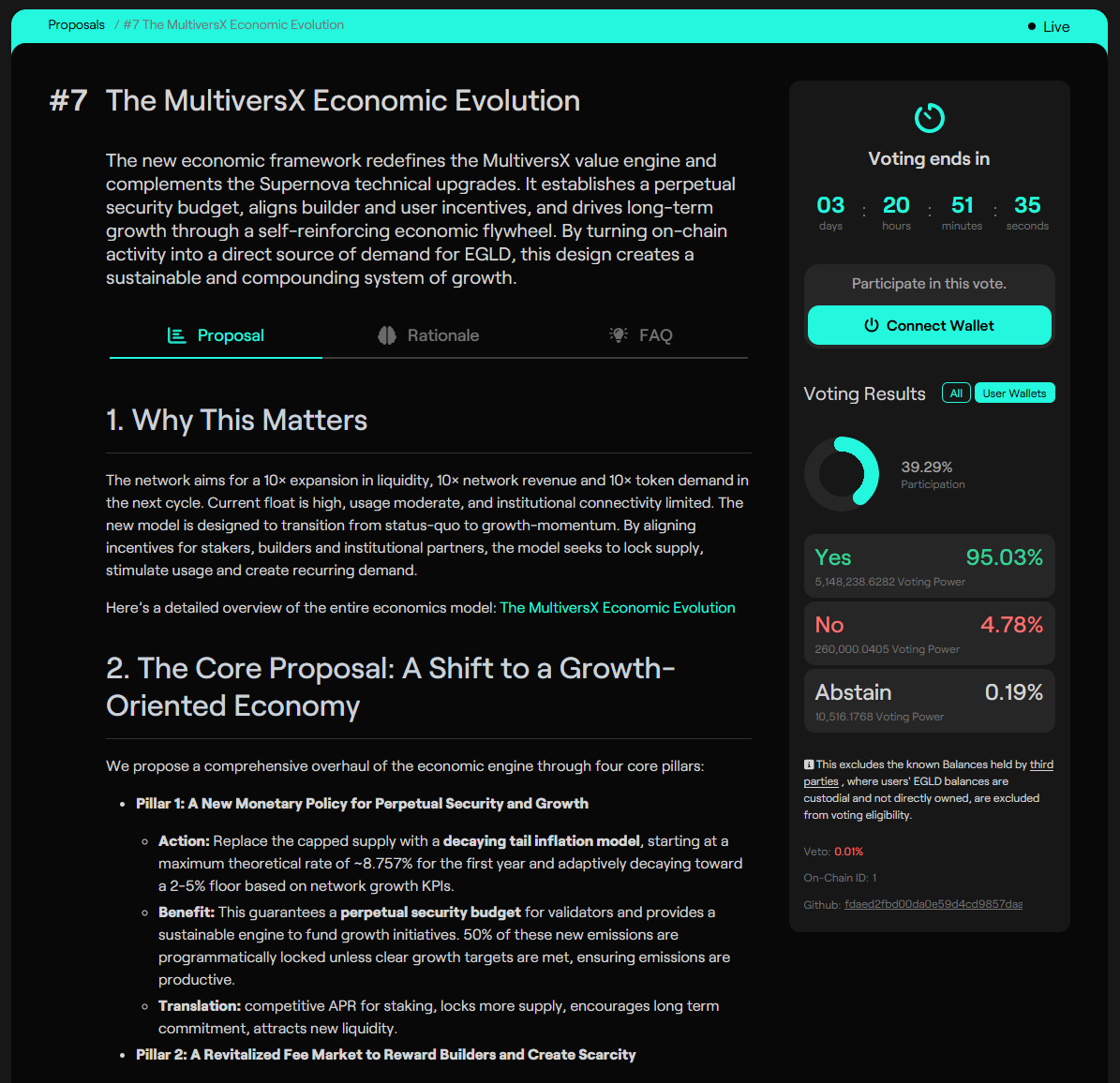
The MultiversX Economic Evolution| Source: Governance.multiversx.co

The MultiversX Economic Evolution | Source: Governance.multiversx.co

next

The post NEAR Inflation Halving Voting Starts, 12% Missing for Approval appeared first on Coinspeaker.

Market Opportunity
NEAR Logo
NEAR Price(NEAR)
$1.861
$1.861$1.861
+2.70%
USD
NEAR (NEAR) Live Price Chart
Disclaimer: The articles reposted on this site are sourced from public platforms and are provided for informational purposes only. They do not necessarily reflect the views of MEXC. All rights remain with the original authors. If you believe any content infringes on third-party rights, please contact [email protected] for removal. MEXC makes no guarantees regarding the accuracy, completeness, or timeliness of the content and is not responsible for any actions taken based on the information provided. The content does not constitute financial, legal, or other professional advice, nor should it be considered a recommendation or endorsement by MEXC.

You May Also Like

Is Doge Losing Steam As Traders Choose Pepeto For The Best Crypto Investment?

Is Doge Losing Steam As Traders Choose Pepeto For The Best Crypto Investment?

The post Is Doge Losing Steam As Traders Choose Pepeto For The Best Crypto Investment? appeared on BitcoinEthereumNews.com. Crypto News 17 September 2025 | 17:39 Is dogecoin really fading? As traders hunt the best crypto to buy now and weigh 2025 picks, Dogecoin (DOGE) still owns the meme coin spotlight, yet upside looks capped, today’s Dogecoin price prediction says as much. Attention is shifting to projects that blend culture with real on-chain tools. Buyers searching “best crypto to buy now” want shipped products, audits, and transparent tokenomics. That frames the true matchup: dogecoin vs. Pepeto. Enter Pepeto (PEPETO), an Ethereum-based memecoin with working rails: PepetoSwap, a zero-fee DEX, plus Pepeto Bridge for smooth cross-chain moves. By fusing story with tools people can use now, and speaking directly to crypto presale 2025 demand, Pepeto puts utility, clarity, and distribution in front. In a market where legacy meme coin leaders risk drifting on sentiment, Pepeto’s execution gives it a real seat in the “best crypto to buy now” debate. First, a quick look at why dogecoin may be losing altitude. Dogecoin Price Prediction: Is Doge Really Fading? Remember when dogecoin made crypto feel simple? In 2013, DOGE turned a meme into money and a loose forum into a movement. A decade on, the nonstop momentum has cooled; the backdrop is different, and the market is far more selective. With DOGE circling ~$0.268, the tape reads bearish-to-neutral for the next few weeks: hold the $0.26 shelf on daily closes and expect choppy range-trading toward $0.29–$0.30 where rallies keep stalling; lose $0.26 decisively and momentum often bleeds into $0.245 with risk of a deeper probe toward $0.22–$0.21; reclaim $0.30 on a clean daily close and the downside bias is likely neutralized, opening room for a squeeze into the low-$0.30s. Source: CoinMarketcap / TradingView Beyond the dogecoin price prediction, DOGE still centers on payments and lacks native smart contracts; ZK-proof verification is proposed,…
Share
BitcoinEthereumNews2025/09/18 00:14
Botanix launches stBTC to deliver Bitcoin-native yield

Botanix launches stBTC to deliver Bitcoin-native yield

The post Botanix launches stBTC to deliver Bitcoin-native yield appeared on BitcoinEthereumNews.com. Botanix Labs has launched stBTC, a liquid staking token designed to turn Bitcoin into a yield-bearing asset by redistributing network gas fees directly to users. The protocol will begin yield accrual later this week, with its Genesis Vault scheduled to open on Sept. 25, capped at 50 BTC. The initiative marks one of the first attempts to generate Bitcoin-native yield without relying on inflationary token models or centralized custodians. stBTC works by allowing users to deposit Bitcoin into Botanix’s permissionless smart contract, receiving stBTC tokens that represent their share of the staking vault. As transactions occur, 50% of Botanix network gas fees, paid in BTC, flow back to stBTC holders. Over time, the value of stBTC increases relative to BTC, enabling users to redeem their original deposit plus yield. Botanix estimates early returns could reach 20–50% annually before stabilizing around 6–8%, a level similar to Ethereum staking but fully denominated in Bitcoin. Botanix says that security audits have been completed by Spearbit and Sigma Prime, and the protocol is built on the EIP-4626 vault standard, which also underpins Ethereum-based staking products. The company’s Spiderchain architecture, operated by 16 independent entities including Galaxy, Alchemy, and Fireblocks, secures the network. If adoption grows, Botanix argues the system could make Bitcoin a productive, composable asset for decentralized finance, while reinforcing network consensus. This is a developing story. This article was generated with the assistance of AI and reviewed by editor Jeffrey Albus before publication. Get the news in your inbox. Explore Blockworks newsletters: Source: https://blockworks.co/news/botanix-launches-stbtc
Share
BitcoinEthereumNews2025/09/18 02:37
Fed Decides On Interest Rates Today—Here’s What To Watch For

Fed Decides On Interest Rates Today—Here’s What To Watch For

The post Fed Decides On Interest Rates Today—Here’s What To Watch For appeared on BitcoinEthereumNews.com. Topline The Federal Reserve on Wednesday will conclude a two-day policymaking meeting and release a decision on whether to lower interest rates—following months of pressure and criticism from President Donald Trump—and potentially signal whether additional cuts are on the way. President Donald Trump has urged the central bank to “CUT INTEREST RATES, NOW, AND BIGGER” than they might plan to. Getty Images Key Facts The central bank is poised to cut interest rates by at least a quarter-point, down from the 4.25% to 4.5% range where they have been held since December to between 4% and 4.25%, as Wall Street has placed 100% odds of a rate cut, according to CME’s FedWatch, with higher odds (94%) on a quarter-point cut than a half-point (6%) reduction. Fed governors Christopher Waller and Michelle Bowman, both Trump appointees, voted in July for a quarter-point reduction to rates, and they may dissent again in favor of a large cut alongside Stephen Miran, Trump’s Council of Economic Advisers’ chair, who was sworn in at the meeting’s start on Tuesday. It’s unclear whether other policymakers, including Kansas City Fed President Jeffrey Schmid and St. Louis Fed President Alberto Musalem, will favor larger cuts or opt for no reduction. Fed Chair Jerome Powell said in his Jackson Hole, Wyoming, address last month the central bank would likely consider a looser monetary policy, noting the “shifting balance of risks” on the U.S. economy “may warrant adjusting our policy stance.” David Mericle, an economist for Goldman Sachs, wrote in a note the “key question” for the Fed’s meeting is whether policymakers signal “this is likely the first in a series of consecutive cuts” as the central bank is anticipated to “acknowledge the softening in the labor market,” though they may not “nod to an October cut.” Mericle said he…
Share
BitcoinEthereumNews2025/09/18 00:23