This article presents an ablation study showing that the proposed IIL method performs well with larger networksThis article presents an ablation study showing that the proposed IIL method performs well with larger networks

Network Size and Task Number: Ablation Study on IIL Performance and Stability

2025/11/12 23:30

Abstract and 1 Introduction

  1. Related works

  2. Problem setting

  3. Methodology

    4.1. Decision boundary-aware distillation

    4.2. Knowledge consolidation

  4. Experimental results and 5.1. Experiment Setup

    5.2. Comparison with SOTA methods

    5.3. Ablation study

  5. Conclusion and future work and References

    \

Supplementary Material

  1. Details of the theoretical analysis on KCEMA mechanism in IIL
  2. Algorithm overview
  3. Dataset details
  4. Implementation details
  5. Visualization of dusted input images
  6. More experimental results

12. More experimental results

12.1. Ablation study on network size

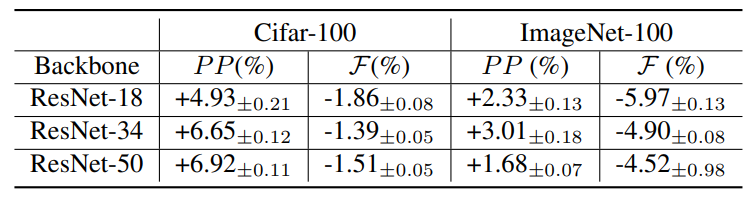
\ To investigate the impact of network size on the proposed method, we compare the performance of ResNet-18, ResNet-34 and ResNet-50 on the ImageNet-100. As shown in Tab. 5, the proposed method performs well with bigger

\ Table 5. Impact of the network size on the proposed method.
\ Table 6. Performance of the proposed method with different IIL task numbers.

\ network size. When the network size is larger, more parameters can be utilized for new knowledge learning with the proposed decision boundary-aware distillation. Hence, consolidating knowledge from student to teacher causes less forgetting.

\ 12.2. Ablation study on the task number

\ As mentioned in Sec. 7, our method accumulates the error along with the consecutive IIL tasks. However, such a kind of error accumulates slowly and mainly affects the performance on old tasks, i.e. forgetting rate. We further study the impact of task length on the performance of the proposed method by splitting the incremental data into different number of subsets. As shown in Tab. 6, with the incremental of task number, the performance promotion changes less but the forgetting rate increased slightly. Minor variation of performance promotion reveals that the proposed method is stable in learning new knowledge, irrespective of the number of tasks. The acquisition of new knowledge primarily hinges on the volume of new data involved. Although we increase the task number in the experiments, the total number of new data utilized in IIL phase is the same. While increasing the task number will increase the EMA steps, which causes more forgetting on the old data. Experimental results in Tab. 6 well validate our analysis in Sec. 7.

\ Compared to the performance promotion, forgetting on the old data is negligible. Noteworthy, when the task number is relatively small, such as 5 in Tab. 6, the proposed method slightly boosts the model’s performance on the base data. This behavior is similar with full-data model, which demonstrates the capability of our method in accumulating knowledge from new data.

\ 12.3. Detailed comparison between the KC-EMA and vanilla EMA

\ The performance of vanilla EMA and the proposed KCEMA during training is shown in Fig. 11. As can be seen, the student model’s accuracy initially plummets due to the introduction of new data. However, around the 10th epoch,

\ Figure 11. Comparison between the proposed KC-EMA and vanilla EMA during training in the first IIL task, where t denotes the teacher model and s denotes the student model. Result is achieved on Cifar-100.
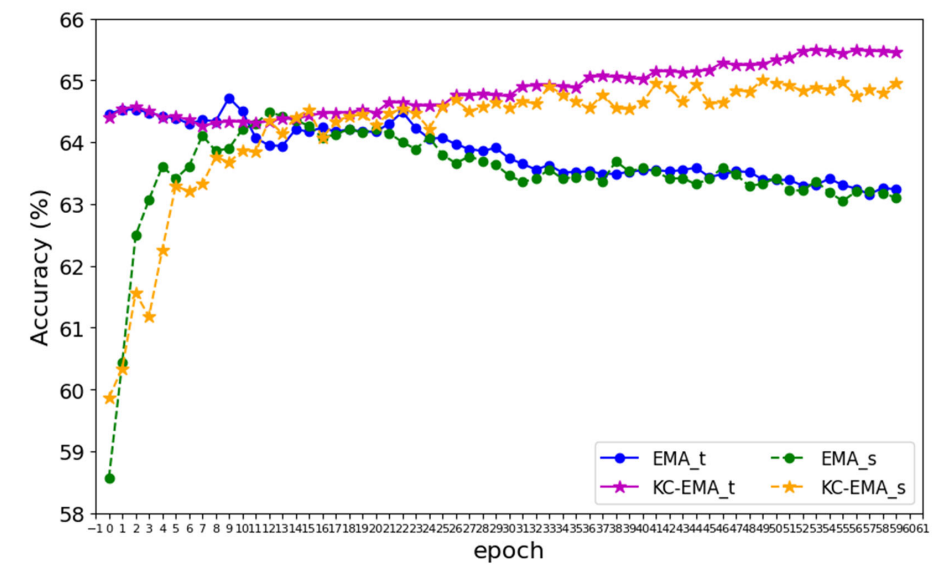
\ there’s a resurgence in accuracy for both the KC-EMA and vanilla EMA models. Therefore, we empirically set a freezing epoch of 10 in the proposed method.

\ When EMA is applied post the 10th epoch, the teacher model in the vanilla EMA is rapidly drawn towards the student model. This homogenization, however, doesn’t enhance either model. Instead, it leads to a decline in test accuracy due to overfitting to the new data. In contrast, with KC-EMA, both the teacher and student models exhibit gradual growth,, which indicates a knowledge accumulation in these two models. On one hand, consolidating new knowledge to the teacher model improves its test performance. On the other hand, a teacher model equipped with new knowledge liberates the student model to learn new data. That is, constraints from the teacher in distillation is alleviated.

\

:::info Authors:

(1) Qiang Nie, Hong Kong University of Science and Technology (Guangzhou);

(2) Weifu Fu, Tencent Youtu Lab;

(3) Yuhuan Lin, Tencent Youtu Lab;

(4) Jialin Li, Tencent Youtu Lab;

(5) Yifeng Zhou, Tencent Youtu Lab;

(6) Yong Liu, Tencent Youtu Lab;

(7) Qiang Nie, Hong Kong University of Science and Technology (Guangzhou);

(8) Chengjie Wang, Tencent Youtu Lab.

:::


:::info This paper is available on arxiv under CC BY-NC-ND 4.0 Deed (Attribution-Noncommercial-Noderivs 4.0 International) license.

:::

\

Disclaimer: The articles reposted on this site are sourced from public platforms and are provided for informational purposes only. They do not necessarily reflect the views of MEXC. All rights remain with the original authors. If you believe any content infringes on third-party rights, please contact [email protected] for removal. MEXC makes no guarantees regarding the accuracy, completeness, or timeliness of the content and is not responsible for any actions taken based on the information provided. The content does not constitute financial, legal, or other professional advice, nor should it be considered a recommendation or endorsement by MEXC.

You May Also Like

UK and US Seal $42 Billion Tech Pact Driving AI and Energy Future

UK and US Seal $42 Billion Tech Pact Driving AI and Energy Future

The post UK and US Seal $42 Billion Tech Pact Driving AI and Energy Future appeared on BitcoinEthereumNews.com. Key Highlights Microsoft and Google pledge billions as part of UK US tech partnership Nvidia to deploy 120,000 GPUs with British firm Nscale in Project Stargate Deal positions UK as an innovation hub rivaling global tech powers UK and US Seal $42 Billion Tech Pact Driving AI and Energy Future The UK and the US have signed a “Technological Prosperity Agreement” that paves the way for joint projects in artificial intelligence, quantum computing, and nuclear energy, according to Reuters. Donald Trump and King Charles review the guard of honour at Windsor Castle, 17 September 2025. Image: Kirsty Wigglesworth/Reuters The agreement was unveiled ahead of U.S. President Donald Trump’s second state visit to the UK, marking a historic moment in transatlantic technology cooperation. Billions Flow Into the UK Tech Sector As part of the deal, major American corporations pledged to invest $42 billion in the UK. Microsoft leads with a $30 billion investment to expand cloud and AI infrastructure, including the construction of a new supercomputer in Loughton. Nvidia will deploy 120,000 GPUs, including up to 60,000 Grace Blackwell Ultra chips—in partnership with the British company Nscale as part of Project Stargate. Google is contributing $6.8 billion to build a data center in Waltham Cross and expand DeepMind research. Other companies are joining as well. CoreWeave announced a $3.4 billion investment in data centers, while Salesforce, Scale AI, BlackRock, Oracle, and AWS confirmed additional investments ranging from hundreds of millions to several billion dollars. UK Positions Itself as a Global Innovation Hub British Prime Minister Keir Starmer said the deal could impact millions of lives across the Atlantic. He stressed that the UK aims to position itself as an investment hub with lighter regulations than the European Union. Nvidia spokesman David Hogan noted the significance of the agreement, saying it would…
Share
BitcoinEthereumNews2025/09/18 02:22
Major Banks Rush to Get Crypto Charters in 2025

Major Banks Rush to Get Crypto Charters in 2025

The post Major Banks Rush to Get Crypto Charters in 2025 appeared on BitcoinEthereumNews.com. Key Highlights In the latest statement, the OCC revealed a major development that approves new federally chartered banks This might open the door for crypto and fintech companies to become regulated institutions An OCC official has raised his support for the authority of existing trust banks to hold digital assets for clients, stating that they have legally provided this custody service for decades and that crypto is not different  The U.S.’s leading banking regulator has revealed that many new federally chartered banks are going to be approved soon and stated that firms working with digital assets should have a clear regulatory framework to become regulated banks.  Our first public panel of the day: @USComptroller Jonathan Gould delivers a keynote and sits for a conversation to discuss the @USOCC’s modernization agenda and GENIUS Act implementation. Tune in to watch the livestream here: https://t.co/6gK6lZakdz — Blockchain Association (@BlockchainAssn) December 8, 2025 US Regulator Welcomes New Crypto-Friendly Banks Comptroller of the Currency’s head, Jonathan V. Gould, shared a statement at a Blockchain Association Summit on December 8, where he unveiled the regulator’s plan to integrate financial innovations into the existing financial infrastructure. In his official statement, he slammed the last 15 years of “completely stagnated” new bank formations by blaming regulators for discouraging applicants.  “Over the past 15 years, de novo chartering has completely stagnated. In the late 1990s, the OCC received over 100 de novo charter applications each year, and nearly 50 per year in the early 2000s. But from 2011 through 2024, the OCC received, on average, less than four charter applications per year,” he said. Jonathan V. Gould further added into his statement, “Following the financial crisis, there were years when the OCC received only one or two charter applications—as well as years when the OCC did not receive a…
Share
BitcoinEthereumNews2025/12/09 05:26