This paper presents the first framework to deliberately train neural networks for accuracy and agreement between feature attribution techniques: PEAR (Post hoc Explainer Agreement Regularizer). In addition to the conventional task loss, PEAR incorporates a correlation-based consensus loss that combines Pearson and Spearman correlation measures, promoting alignment across explainers like Grad and Integrated Gradients. By using a soft ranking approximation to address differentiability issues, the loss function is completely trainable by backpropagation. Tested on three OpenML tabular datasets, multilayer perceptrons trained using PEAR surpass linear baselines in accuracy and explanation consensus, and in certain instances, even compete with XGBoost. The findings advance reliable and interpretable AI by showing that consensus-aware training successfully reduces explanation disagreement while maintaining prediction performance.This paper presents the first framework to deliberately train neural networks for accuracy and agreement between feature attribution techniques: PEAR (Post hoc Explainer Agreement Regularizer). In addition to the conventional task loss, PEAR incorporates a correlation-based consensus loss that combines Pearson and Spearman correlation measures, promoting alignment across explainers like Grad and Integrated Gradients. By using a soft ranking approximation to address differentiability issues, the loss function is completely trainable by backpropagation. Tested on three OpenML tabular datasets, multilayer perceptrons trained using PEAR surpass linear baselines in accuracy and explanation consensus, and in certain instances, even compete with XGBoost. The findings advance reliable and interpretable AI by showing that consensus-aware training successfully reduces explanation disagreement while maintaining prediction performance.

Notes on Training Neural Networks for Consensus

2025/09/21 13:46

Abstract and 1. Introduction

1.1 Post Hoc Explanation

1.2 The Disagreement Problem

1.3 Encouraging Explanation Consensus

  1. Related Work

  2. Pear: Post HOC Explainer Agreement Regularizer

  3. The Efficacy of Consensus Training

    4.1 Agreement Metrics

    4.2 Improving Consensus Metrics

    [4.3 Consistency At What Cost?]()

    4.4 Are the Explanations Still Valuable?

    4.5 Consensus and Linearity

    4.6 Two Loss Terms

  4. Discussion

    5.1 Future Work

    5.2 Conclusion, Acknowledgements, and References

Appendix

3 PEAR: POST HOC EXPLAINER AGREEMENT REGULARIZER

Our contribution is the first effort to train models to be both accurate and to be explicitly regularized via consensus between local explainers. When neural networks are trained naturally (i.e. with a single task-specific loss term like cross-entropy), disagreement between post hoc explainers often arises. Therefore, we include an additional loss term to measure the amount of explainer disagreement during training to encourage consensus between explanations. Since human-aligned notions of explanation consensus can be captured by more than one agreement metric (listed in A.3), we aim to improve several agreement metrics with one loss function.[2]

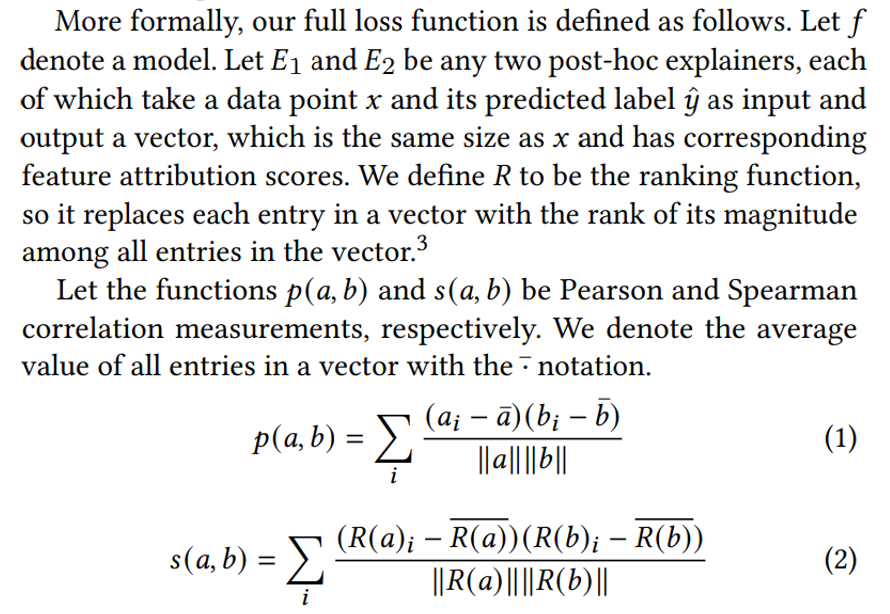
\ Our consensus loss term is a convex combination of the Pearson and Spearman correlation measurements between the vectors of attribution scores (Spearman correlation is just the Pearson correlation on the ranks of a vector).

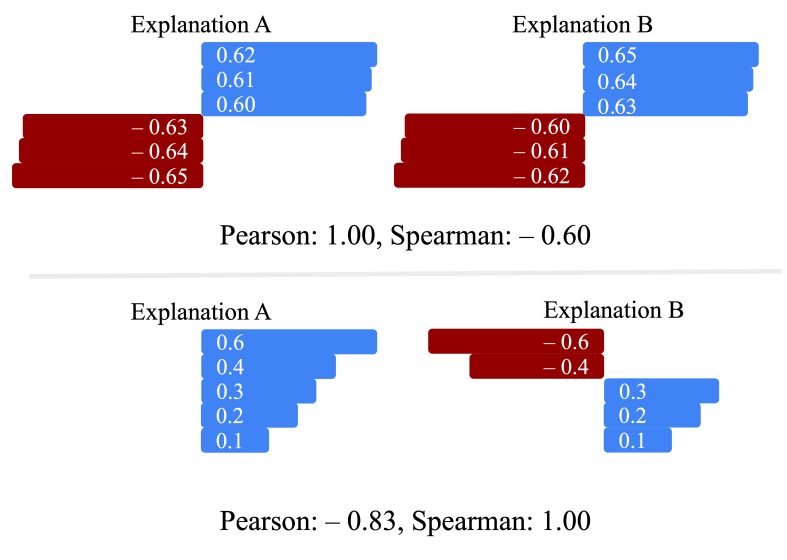
\ To paint a clearer picture of the need for two terms in the loss, consider the examples shown in Figure 3. In the upper example, the raw feature scores are very similar and the Pearson correlation coefficient is in fact 1 (to machine precision). However, when we rank these scores by magnitude, there is a big difference in their ranks as indicated by the Spearman value. Likewise, in the lower portion of Figure 3 we show that two explanations with identical magnitudes will show a low Pearson correlation coefficient. Since some of the metrics we use to measure disagreement involve ranking and others do not, we conclude that a mixture of these two terms in the loss is appropriate.

\ While the example in Figure 3 shows two explanation vectors with similar scale, different explanation methods do not always

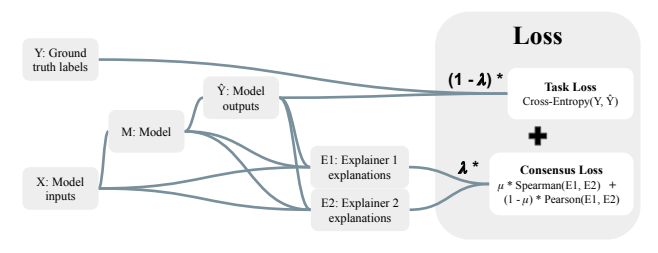
\ Figure 2: Our loss function measures the task loss between the model outputs and ground truth (task loss), as well as the disagreement between explainers (consensus loss). The weight given to the consensus loss term is controlled by a hyperparameter 𝜆. The consensus loss term term is a convex combination of the Spearman and Pearson correlation measurements between feature importance scores, since increasing both rank correlation (Spearman) and raw-score correlation (Pearson) are useful for improving explainer consensus on our many agreement metrics.
\ Figure 3: Example feature attribution vectors where Pearson and Spearman show starkly different scores. Recall, both Pearson and Spearman correlation range from −1 to +1. Both of these pairs of vectors satisfy some human-aligned notions of consensus. But in each circumstance, one of the correlation metrics gives a low similarity score. Thus, in order to successfully encourage explainer consensus (by all of our metrics), we use both types of correlation in our consensus loss term.

\ align. Some explainers have the sums of their attribution scores constrained by various rules, whereas other explainers have no such constraints. The correlation measurements we use in our loss provide more latitude when comparing explainers than a direct difference measurement like mean absolute error or mean squared error, allowing our correlation measurement.

\
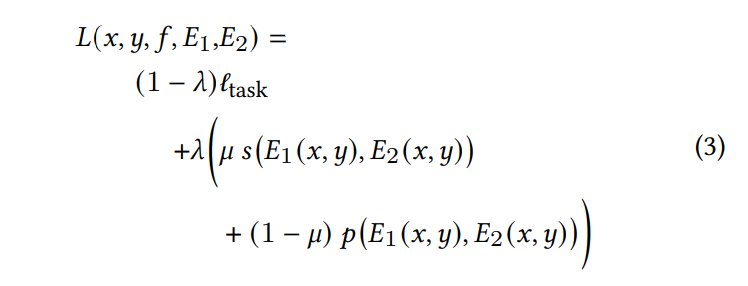
\ We refer to the first term in the loss function as the task loss, or ℓtask, and for our classification tasks we use cross-entropy loss. A graphical depiction of the flow from data to loss value is shown in Figure 2. Formally, our complete loss function can be expressed as follows with two hyperparameters 𝜆, 𝜇 ∈ [0, 1]. We weight the influence of our consensus term with 𝜆, so lower values give more priority to task loss. We weight the influence between the two explanation correlation terms with 𝜇, so lower values give more weight to Pearson correlation and higher values give more weight to Spearman correlation.

\
3.1 Choosing a Pair of Explainer

The consensus loss term is defined for any two explainers in general, but since we train with standard backpropagation we need these explainers to be differentiable. With this constraint in mind, and with some intuition about the objective of improving agreement metrics, we choose to train for consensus between Grad and IntGrad. If Grad and IntGrad align, then the function should become more locally linear in logit space. IntGrad computes the average gradient along a path in input space toward each point being explained. So, if we train the model to have a local gradient at each point (Grad) closer to the average gradient along a path to the point (IntGrad), then perhaps an easy way for the model to accomplish that training objective would be for the gradient along the whole path to equal the local gradient from Grad. This may push the model to be more similar to a linear model. This is something we investigate with qualitative and quantitative analysis in Section 4.

3.2 Differentiability

On the note of differentiability, the ranking function 𝑅 is not differentiable. We substitute a soft ranking function from the torchsort package [3]. This provides a floating point approximation of the ordering of a vector rather than an exact integer computation of the ordering of a vector, which allows for differentiation

4 THE EFFICACY OF CONSENSUS TRAINING

In this section we present each experiment with the hypothesis it is designed to test. The datasets we use for our experiments are Bank Marketing, California Housing, and Electricity, three binary classification datasets available on the OpenML database [39]. For each dataset, we use a linear model’s performance (logistic regression) as a lower bound of realistic performance because linear models are considered inherently explainable.

\ The models we train to study the impact of our consensus loss term are multilayer perceptrons (MLPs). While the field of tabular deep learning is still growing, and MLPs may be an unlikely choice for most data scientists on tabular data, deep networks provide the flexibility to adapt training loops for multiple objectives [1, 10, 17, 28, 31, 35]. We also verify that our MLPs outperform linear models on each dataset, because if deep models trained to reach consensus are less accurate than a linear model, we would be better off using the linear model.

\ We include XGBoost [6] as a point of comparison for our approach, as it has become a widely popular method with high performance and strong consensus metrics on many tabular datasets (figures in Appendix A.7). There are cases where we achieve more explainer consensus than XGBoost, but this point is tangential as we are invested in exploring a loss for training neural networks.

\ For further details on our datasets and model training hyperparameters, see Appendices A.1 and A.2.

\

:::info Authors:

(1) Avi Schwarzschild, University of Maryland, College Park, Maryland, USA and Work completed while working at Arthur (avi1umd.edu);

(2) Max Cembalest, Arthur, New York City, New York, USA;

(3) Karthik Rao, Arthur, New York City, New York, USA;

(4) Keegan Hines, Arthur, New York City, New York, USA;

(5) John Dickerson†, Arthur, New York City, New York, USA ([email protected]).

:::


:::info This paper is available on arxiv under CC BY 4.0 DEED license.

:::

[2] The PEAR package will be publicly for download on the Package Installer for Python (pip), and it is also available upon request from the authors.

\ [3] When more than one of the entries have the same magnitude, they get a common ranking value equal to the average rank if they were ordered arbitrarily.

Disclaimer: The articles reposted on this site are sourced from public platforms and are provided for informational purposes only. They do not necessarily reflect the views of MEXC. All rights remain with the original authors. If you believe any content infringes on third-party rights, please contact [email protected] for removal. MEXC makes no guarantees regarding the accuracy, completeness, or timeliness of the content and is not responsible for any actions taken based on the information provided. The content does not constitute financial, legal, or other professional advice, nor should it be considered a recommendation or endorsement by MEXC.

You May Also Like

The Future of Secure Messaging: Why Decentralization Matters

The Future of Secure Messaging: Why Decentralization Matters

The post The Future of Secure Messaging: Why Decentralization Matters appeared on BitcoinEthereumNews.com. From encrypted chats to decentralized messaging Encrypted messengers are having a second wave. Apps like WhatsApp, iMessage and Signal made end-to-end encryption (E2EE) a default expectation. But most still hinge on phone numbers, centralized servers and a lot of metadata, such as who you talk to, when, from which IP and on which device. That is what Vitalik Buterin is aiming at in his recent X post and donation. He argues the next steps for secure messaging are permissionless account creation with no phone numbers or Know Your Customer (KYC) and much stronger metadata privacy. In that context he highlighted Session and SimpleX and sent 128 Ether (ETH) to each to keep pushing in that direction. Session is a good case study because it tries to combine E2E encryption with decentralization. There is no central message server, traffic is routed through onion paths, and user IDs are keys instead of phone numbers. Did you know? Forty-three percent of people who use public WiFi report experiencing a data breach, with man-in-the-middle attacks and packet sniffing against unencrypted traffic among the most common causes. How Session stores your messages Session is built around public key identities. When you sign up, the app generates a keypair locally and derives a Session ID from it with no phone number or email required. Messages travel through a network of service nodes using onion routing so that no single node can see both the sender and the recipient. (You can see your message’s node path in the settings.) For asynchronous delivery when you are offline, messages are stored in small groups of nodes called “swarms.” Each Session ID is mapped to a specific swarm, and your messages are stored there encrypted until your client fetches them. Historically, messages had a default time-to-live of about two weeks…
Share
BitcoinEthereumNews2025/12/08 14:40
Grayscale Files Sui Trust as 21Shares Launches First SUI ETF Amid Rising Demand

Grayscale Files Sui Trust as 21Shares Launches First SUI ETF Amid Rising Demand

The post Grayscale Files Sui Trust as 21Shares Launches First SUI ETF Amid Rising Demand appeared on BitcoinEthereumNews.com. The Grayscale Sui Trust filing and 21Shares’ launch of the first SUI ETF highlight surging interest in regulated Sui investments. These products offer investors direct exposure to the SUI token through spot-style structures, simplifying access to the Sui blockchain’s growth without direct custody needs, amid expanding altcoin ETF options. Grayscale’s spot Sui Trust seeks to track SUI price performance for long-term holders. 21Shares’ SUI ETF provides leveraged exposure, targeting traders with 2x daily returns. Early trading data shows over 4,700 shares exchanged, with volumes exceeding $24 per unit in the debut session. Explore Grayscale Sui Trust filing and 21Shares SUI ETF launch: Key developments in regulated Sui investments for 2025. Stay informed on altcoin ETF trends. What is the Grayscale Sui Trust? The Grayscale Sui Trust is a proposed spot-style investment product filed via S-1 registration with the U.S. Securities and Exchange Commission, aimed at providing investors with direct exposure to the SUI token’s price movements. This trust mirrors the performance of SUI, the native cryptocurrency of the Sui blockchain, minus applicable fees, offering a regulated avenue for long-term participation in the network’s ecosystem. By holding SUI assets on behalf of investors, it eliminates the need for individuals to manage token storage or transactions directly. ⚡ LATEST: GRAYSCALE FILES S-1 FOR $SUI TRUSTThe “Grayscale Sui Trust,” is a spot-style ETF designed to provide direct exposure to the $SUI token. Grayscale’s goal is to mirror SUI’s market performance, minus fees, giving long-term investors a regulated, hassle-free way to… pic.twitter.com/mPQMINLrYC — CryptosRus (@CryptosR_Us) December 6, 2025 How does the 21Shares SUI ETF differ from traditional funds? The 21Shares SUI ETF, launched under the ticker TXXS, introduces a leveraged approach with 2x daily exposure to SUI’s price fluctuations, utilizing derivatives for amplified returns rather than direct spot holdings. This structure appeals to short-term…
Share
BitcoinEthereumNews2025/12/08 14:20