

Nvidia prepares a new AI chip for China: the B30A surpasses the H20
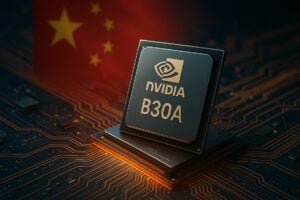
Nvidia is preparing to revolutionize the AI chip market in China once again. According to sources close to the company, the semiconductor giant is developing a new processor based on the latest Blackwell architecture, intended to surpass in power the H20 model currently available on the Chinese market.
The new chip, known by the provisional name B30A, could represent a turning point in technological relations between the United States and China, in a context of commercial tensions and increasingly stringent regulations.
A next-generation chip: features and innovations
The B30A stands out for its single-die design: all the main components of the integrated circuit are made on a single piece of silicon, unlike the more sophisticated dual-die configurations like that of Nvidia’s B300 acceleration card.
According to sources, this design choice should provide about half the raw computing power compared to the B300, but with significant advantages in terms of efficiency and costs.
Despite the technical specifications not yet being fully defined, the B30A is expected to include high-bandwidth memory and Nvidia’s NVLink technology, which allows ultra-fast data transmission between processors.
These features are already present in the H20, the chip based on the previous Hopper architecture, but the new solution promises superior performance thanks to the technological evolution introduced by Blackwell.
Timelines and market outlook
Nvidia aims to deliver the first samples of the B30A to Chinese clients as early as next month, to start testing and gather feedback from the market.
However, the development phase is not yet complete and the specifications may undergo further changes before the official launch. The sources, who preferred to remain anonymous, emphasize how the project is still in a delicate phase and subject to many variables, particularly on the regulatory front.
In an official statement, Nvidia reiterated its commitment to evaluate a variety of products for the corporate roadmap, with the goal of competing in the market to the extent permitted by government regulations. “Everything we offer is with the full approval of the competent authorities and designed exclusively for advantageous commercial use,” the company emphasized.
The role of Trump and regulatory uncertainties
Last week, United States President Donald Trump opened up to the possibility that Nvidia could sell more advanced chips in China. A statement that has sparked new hopes among industry operators, but does not resolve the doubts about the real possibilities of obtaining the green light from U.S. authorities.
Sources highlight how the prospects for approval are far from certain, due to deeply rooted fears in Washington of granting China excessive access to artificial intelligence technology developed in the United States.
The United States Department of Commerce has not released official comments on the issue, leaving many questions open about the future of AI chip exports to China.
China and Nvidia: a strategic relationship
China represents a fundamental market for Nvidia, having generated 13% of the company’s revenue in the last financial year. Access to the latest generation AI chips is one of the main points of friction in trade relations between the United States and China, with direct repercussions on the growth strategies of the main players in the technology sector.
The new B30A could allow Nvidia to strengthen its position in China, offering local customers a more powerful solution compared to the H20, but without violating the restrictions imposed by the US government.
However, the success of this operation will largely depend on political decisions and geopolitical dynamics that characterize the relationship between the two superpowers.
The challenges of regulation and the future of AI chips
The case of the B30A highlights the difficulties that technology companies must face in balancing innovation, competitiveness, and compliance with international regulations. Nvidia is at the center of a complex game, where every move can have significant consequences not only on the commercial level but also on the diplomatic one.
The possibility of introducing a Blackwell-based AI chip into the Chinese market represents a strategic opportunity, but also a calculated risk.
U.S. authorities continue to closely monitor the development of artificial intelligence technologies, fearing that excessive openness could favor China’s technological growth in sectors considered sensitive for national security.
Conclusions: a game still open
The launch of the new B30A chip marks a crucial moment for Nvidia and the entire semiconductor sector. The ability to innovate while staying within the limits imposed by international regulations will be decisive for the future of the company and for global technological balances.
While China eagerly awaits the arrival of a new generation of AI chips, the world watches closely Nvidia’s next moves and the decisions that will come from Washington.
In a context of uncertainty and global competition, the challenge of AI chips is confirmed as one of the main battlegrounds between the United States and China, with implications that go far beyond the simple technological market.

You May Also Like

Vitalik Buterin Maps Quantum Upgrade to Ethereum to Replace Core Cryptography

Power Protocol Surges 96%: On-Chain Data Reveals Why POWER Entered Top 115
