Data analytics firm Palantir saw a 48% increase in sales revenue in the second half of 2025 as it rides the high waves of an AI momentum. Is the crypto AI sector next on the surge list? According to data…Data analytics firm Palantir saw a 48% increase in sales revenue in the second half of 2025 as it rides the high waves of an AI momentum. Is the crypto AI sector next on the surge list? According to data…

Palantir revenues soar above estimates toppling $1b – will crypto AIs follow suit?

Data analytics firm Palantir saw a 48% increase in sales revenue in the second half of 2025 as it rides the high waves of an AI momentum. Is the crypto AI sector next on the surge list?

Summary
  • Palantir has risen by 48%, going beyond $1 billion in revenue.
  • The AI and crypto sector has shown growth amidst the boom of AI momentum.

According to data from CNBC’s latest report, the artificial intelligence software provider recently saw its revenue surpass the $1 billion mark in quarterly revenue for the first time in history. Previously, analysts predicted that its revenue would reach somewhere within the $940 million, but the financial books have gone beyond that.

The 48% surge was attributed to high demand for its artificial intelligence services. Just last week, the U.S. Army said it might purchase services of up to $10 billion from the company over a decade. If it comes to fruition, this could further spike its revenue overtime.

On August 5, the stock price for Palantir Technologies went up by 4.14%. Its pre-market price even soared to higher levels exceeding $168 from its previous close at $160.66. In the past month, the stock has seen a 15.48% surge following news of the rumored investment in its AI technology from the U.S. Army.
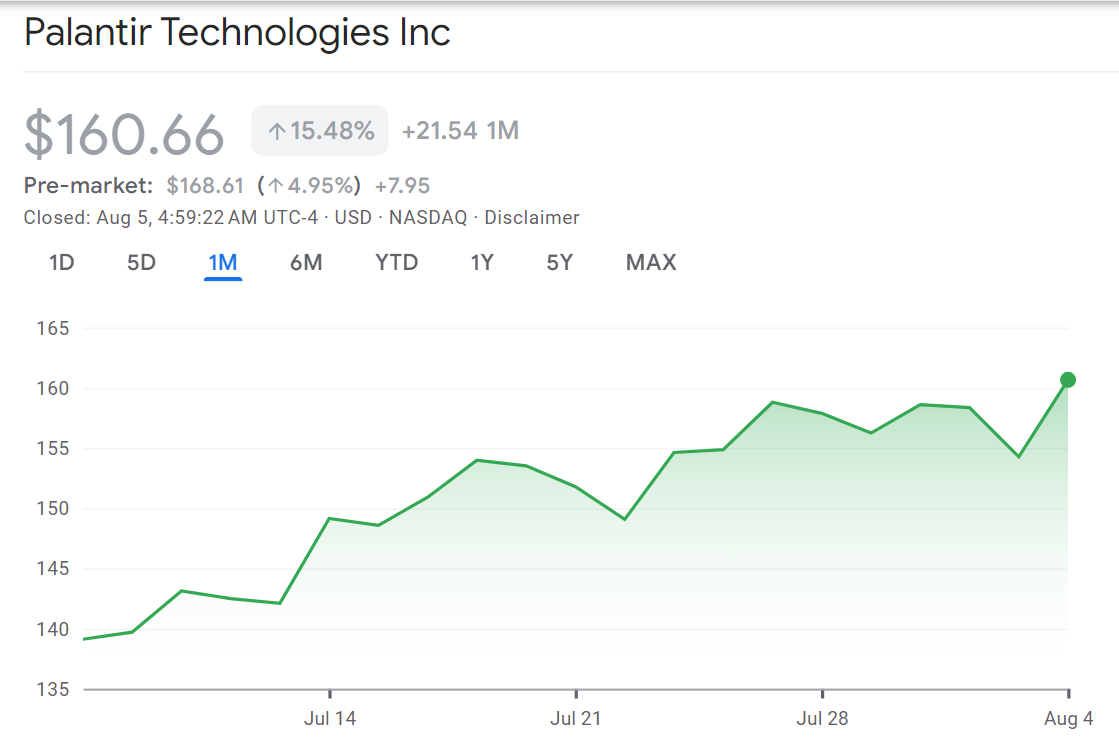
Stock price chart for Palantir Technologies in the past month, August 5, 2025 | Source: Google Finance

In fact, after the results of its quarterly earnings came out, the AI technologies firm reportedly raised its annual revenue forecast for the second time this year. This time around, Palantir Technologies raised its revenue prediction to somewhere between $4.14 billion and $4.15 billion this year, up from its earlier forecast of between $3.89 billion and $3.90 billion.

According to Reuters, the company is expecting a bigger boom in demand regarding AI-linked services, specifically from businesses and governments.

AI is booming, will the AI and crypto sector reap rewards?

Following news of the Palantir revenue surpassing $1 billion, the overall market cap for AI and crypto saw a slight boost. In the past 24 hours, it reached $27.8 billion after rising by 1%. The largest portion comes from the AI agents sector, which saw a 1.91% rise.

Within the same time period as the Palantir surge, the current market cap for AI tokens has surged roughly by 24% in the past month reaching beyond $30 billion a few times within the week, according to data from CoinGecko.

While the AI token sector is still small compared to total crypto market cap, which stands at $3.9 trillion, its recent growth outpaces broader crypto sectors. CoinGecko notes that AI tokens now account for around 0.8% to 0.9% of the overall market.

Data shows that from July 5 to August 5, the same day as Palantir, the largest growth was shown on the AI Applications sector which demonstrated a significant increase 33.32%, rising from $1.04 billion to as much as $1.39 billion. Following behind is Bittensor Subnets which has risen by 26.68%.
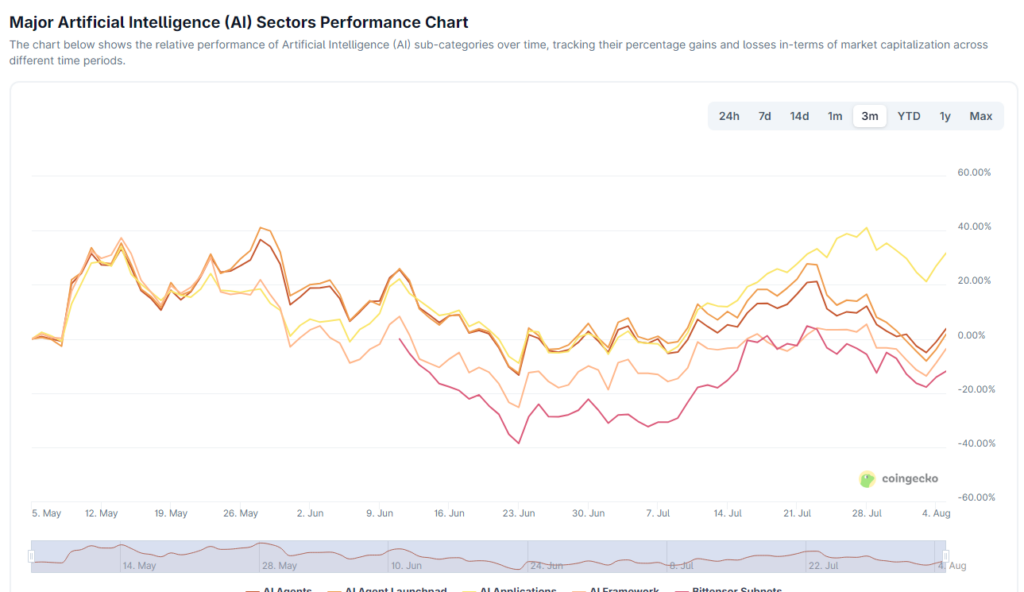
Palantir revenues soar above estimates toppling $1b - will crypto AIs follow suit? - 1

Performance for the AI Agent sector rose by 3.82% to $6.12 billion. Meanwhile, AI Agent launchpads increased by 1.75% to $3.53 billion. Even with the small boost that was signified by Palantir’s revenue surge, it is possible that the sector will continue to see gains as the artificial intelligence industry continues to gain momentum.

Here are some tokens that are poised for a boom in the near-future in the aftermath of Palantir’s revenue spike.

Rising tokens amidst AI boom

Mamo

Mamo is currently trading at $0.16, with notable volume of daily trading volume $11.8 million and a market cap estimated around $53 million. The token recently hit an all-time high near $0.18 in mid‑July 2025, and is now trading approximately 15% below that peak.

Performance over the last month has been strong, with 30‑day gains exceeding 170%, showing an increase in investor interest in its DeFi automation narrative.

NEAR Protocol

NEAR (NEAR) has shown strong momentum, with its price up approximately 18.6% over the past month. By mid‑July, NEAR surged 12% to reach a peak of around $3.04, driven by increasing AI integration activity on its chain. At press time, NEAR has seen a slight boost of 1.6%, reaching $2.50.

In the past month, the token has surged by 18.2%. If NEAR can break through the $3.00 level, it may consolidate and test overhead resistance.
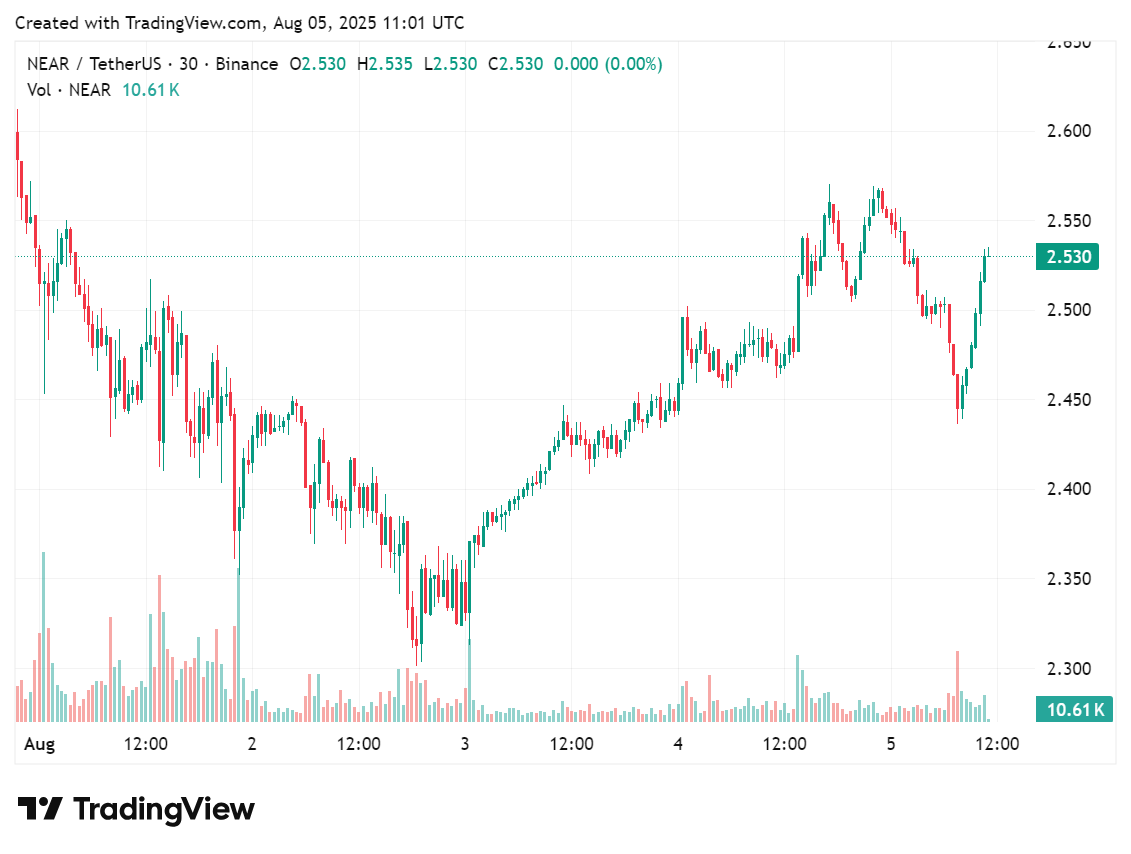
Price chart for NEAR in the past few days, August , 2025 | Source: crypto.news

Bittensor

Bittensor (TAO) has been trading in a wide range between $330 and $440 in recent weeks, with notable price swings and high volatility. At press time, TAO is trading at a price of $351, having dropped slightly by 1.4%.

Despite the dip, TAO remains one of the largest crypto AI tokens by market cap, and its unique use case as a decentralized machine learning protocol continues to drive interest. If it can shoot above $400, it may be able to climb up to the $480–$500 range.

Market Opportunity
Waves Logo
Waves Price(WAVES)
$0.6952
$0.6952$0.6952
+2.11%
USD
Waves (WAVES) Live Price Chart
Disclaimer: The articles reposted on this site are sourced from public platforms and are provided for informational purposes only. They do not necessarily reflect the views of MEXC. All rights remain with the original authors. If you believe any content infringes on third-party rights, please contact [email protected] for removal. MEXC makes no guarantees regarding the accuracy, completeness, or timeliness of the content and is not responsible for any actions taken based on the information provided. The content does not constitute financial, legal, or other professional advice, nor should it be considered a recommendation or endorsement by MEXC.

You May Also Like

Slate Milk Raises $23 Million Series B Round To Bolster Protein Drink’s Rapid Growth

Slate Milk Raises $23 Million Series B Round To Bolster Protein Drink’s Rapid Growth

The post Slate Milk Raises $23 Million Series B Round To Bolster Protein Drink’s Rapid Growth appeared on BitcoinEthereumNews.com. Slate Classic Chocolate milk shake Slate A new slate of functional beverages is about to dominate the ready-to-drink shelf, ushering in a more modern era of easily incorporating more protein in our diets. Today, Slate Milk cofounders Manny Lubin and Josh Belinsky reveal the brand has raised a $23 million Series B funding round. Led by Foundership, a new fund by Yasso frozen greek yogurt cofounders Drew Harrington and Amanda Klane, the money will allow Slate to continue its momentum towards ubiquity as it hits 100,000 points of distribution across 20,000 stores nationwide by the end of 2025. Slate also reveals that it is rolling out several line extensions including a 20 gram protein Strawberry milk at Sprouts Farmers Market, a 30 gram protein Cookies & Cream milk at Target, and a 30 gram protein Salted Caramel flavor at Walmart and Albertsons banner stores. New “Ultra” 42 gram protein options in Chocolate, Vanilla and Salted Caramel will also be available in retailers across the country. “Stores where we may have just had our ready-to-drink lattes, now we’re adding our shakes, and vice versa. We’re adding new partners and executing deeper with our existing partners,” Lubin tells me. The impressive growth is due to Slate’s early entry into the high-protein product space slightly before it caught mainstream attention–ready to execute immediately once consumers craved it most. Slate’s macronutrient ratios are practically unbeatable, largely due to the utilization of ultra-filtered milk. It’s a protein drink that writes a new script about who protein drinks are for. “We’re not sons of dairy farmers. We had no milk history,” Lubin says “We’re just a couple of dudes from the burbs of Boston who like chocolate milk.” Slate cofounder Manny Lubin Slate Another Clean Slate Slate’s brand has evolved significantly in just the past six…
Share
BitcoinEthereumNews2025/09/19 03:08
The HackerNoon Newsletter: New frontiers in Human AI Interface (9/19/2025)

The HackerNoon Newsletter: New frontiers in Human AI Interface (9/19/2025)

How are you, hacker? 🪐 What’s happening in tech today, September 19, 2025? The HackerNoon Newsletter brings the HackerNoon homepage straight to your inbox. On this day, First Smiley Emoticon Created by Fahlman in 1982, US-led Invasion Restores Democracy to Haiti in 1994, New Zealand Grants Women's Suffrage in 1893, and we present you with these top quality stories. From Spacecraft From the 90s, or Why Humanity Uses Last Centurys Technology in Space to New frontiers in Human AI Interface, let’s dive right in. Spacecraft From the 90s, or Why Humanity Uses Last Centurys Technology in Space By @nftbro [ 9 Min read ] In “small space”, the priorities are different: low cost, rapid iteration, and the use of CubeSats on Raspberry Pi and Linux containers. Read More. New frontiers in Human AI Interface By @zbruceli [ 12 Min read ] Recent tech advances are breaking free from 20 years of 5-inch screen limits, unlocking full human senses in computing through AI interfaces and wearables. Read More. Microsoft’s LinkedIn Still Sucks, But Outsmarting Its Algorithm Is Hilariously Easy By @frankmorgan [ 3 Min read ] A cheeky experiment uses ChatGPT to slip LinkedIn’s walled garden, proving off-platform links still win—and why MS’s Dismal Platform must pivot or die. Read More. AI Startup Surge Risks Repeating Tech’s Last Funding Mania By @youcefhq [ 4 Min read ] The AI startup frenzy and FOMO are inflating round sizes and valuations. But too much capital too early often leads to mediocre outcomes. Remake of 2020–22? Read More. Passive Income in Crypto: Why Waiting for Altseason Is a Bad Strategy By @MichaelJerlis [ 4 Min read ] Discover the most reliable passive income strategies in crypto for 2025 — from tokenized treasuries to staking, lending, farming, and more. Read More. 🧑‍💻 What happened in your world this week? It's been said that writing can help consolidate technical knowledge, establish credibility, and contribute to emerging community standards. Feeling stuck? We got you covered ⬇️⬇️⬇️ ANSWER THESE GREATEST INTERVIEW QUESTIONS OF ALL TIME We hope you enjoy this worth of free reading material. Feel free to forward this email to a nerdy friend who'll love you for it.See you on Planet Internet! With love, The HackerNoon Team ✌️
Share
Hackernoon2025/09/20 00:02
Bitcoin devs cheer block reconstruction stats, ignore security budget concerns

Bitcoin devs cheer block reconstruction stats, ignore security budget concerns

The post Bitcoin devs cheer block reconstruction stats, ignore security budget concerns appeared on BitcoinEthereumNews.com. This morning, Bitcoin Core developers celebrated improved block reconstruction statistics for node operators while conveniently ignoring the reason for these statistics — the downward trend in fees for Bitcoin’s security budget. Reacting with heart emojis and thumbs up to a green chart showing over 80% “successful compact block reconstructions without any requested transactions,” they conveniently omitted red trend lines of the fees that Bitcoin users pay for mining security which powered those green statistics. Block reconstructions occur when a node requests additional information about transactions within a compact block. Although compact blocks allow nodes to quickly relay valid bundles of transactions across the internet, the more frequently that nodes can reconstruct without extra, cumbersome transaction requests from their peers is a positive trend. Because so many nodes switched over in August to relay transactions bidding 0.1 sat/vB across their mempools, nodes now have to request less transaction data to reconstruct blocks containing sub-1 sat/vB transactions. After nodes switched over in August to accept and relay pending transactions bidding less than 1 sat/vB, disparate mempools became harmonized as most nodes had a better view of which transactions would likely join upcoming blocks. As a result, block reconstruction times improved, as nodes needed less information about these sub-1 sat/vB transactions. In July, several miners admitted that user demand for Bitcoin blockspace had persisted at such a low that they were willing to accept transaction fees of just 0.1 satoshi per virtual byte — 90% lower than their prior 1 sat/vB minimum. With so many blocks partially empty, they succumbed to the temptation to accept at least something — even 1 billionth of one bitcoin (BTC) — rather than $0 to fill up some of the excess blockspace. Read more: Bitcoin’s transaction fees have fallen to a multi-year low Green stats for block reconstruction after transaction fees crash After…
Share
BitcoinEthereumNews2025/09/18 04:07