A Significant Step in Blockchain-Powered Finance. The cooperation between Ripple and Thunes partnership has made great progress, altering how money transfers across borders. Ripple, a major blockchain payments company, and Thunes, a Singapore-based payment infrastructure provider, have announced an extension of their partnership to make international payments quicker, cheaper, and more accessible. This revitalized collaboration is more than simply a financial agreement. It’s a strategic move that places Ripple as a significant player in connecting traditional banking with blockchain, while also allowing Thunes to expand its network into new areas. Why This Expansion Matters Individuals and corporations frequently experience delays, high costs, and frustration while making cross-border payments. The relationship between Ripple and Thunes partnership addresses these issues directly. By combining Ripple’s blockchain-powered infrastructure with Thunes’ SmartX Treasury System, the cooperation enables real-time payments in local currencies in over 130 countries. Ripple’s Payments network now processes over $70 billion yearly and serves over 90 payment markets. With Thunes’ access to 4 billion bank accounts and 80 currencies, the alliance establishes a new benchmark for worldwide financial transactions. Analysts point out that this integration addresses long-standing concerns with botched transfers and compliance delays. Financial analyst Marcus Tan stated, “This partnership strengthens efficiency and trust in an area where customers demand both speed and transparency.” Impact on XRP and Global Adoption While Ripple stresses its technology, the increased relationship may indirectly help XRP adoption. As more banks, fintechs, and enterprises adopt Ripple Payments, the need for XRP liquidity may rise. Historically, agreements like these have resulted in increases in XRP market activity. Experts believe that Ripple’s expanding presence in Asia, Africa, and Latin America will encourage more people to adopt digital assets. The Ripple and Thunes partnership promotes financial inclusion by addressing last-mile payout issues in underprivileged communities. Looking ahead: Predictions Market experts believe that increased collaboration will accelerate the institutional adoption of blockchain-powered payments. Ripple’s emphasis on regulatory compliance and transparency enhances its position as governments and central banks explore tokenized finance. Analysts predict that if adoption develops at the predicted rate, the Ripple and Thunes partnership will process twice as much as it does now within the next three years. This would establish Ripple as a global leader in digital settlements. Conclusio The extended Ripple and Thunes partnership marks a watershed moment in global banking, combining blockchain innovation with established payment rails. By removing inefficiencies and increasing access, the alliance is poised to determine the future of international payments. For cryptocurrency traders, investors, and institutions, this development indicates that blockchain will play an increasingly important role in regular financial systems. Also read: Ripple’s RLUSD Push Into Japan Could Spark the Next Stablecoin War Glossary Ripple – A blockchain company focused on real-time cross-border payments. Thunes – A global payment infrastructure provider headquartered in Singapore. Cross-Border Payments – Transactions involving two parties in different countries. XRP – The native cryptocurrency of the XRP Ledger, often used for liquidity in Ripple’s ecosystem. Liquidity – The ease with which assets can be converted into cash or other currencies. Financial Inclusion – Expanding access to financial services for underserved populations. FAQs for Ripple and Thunes partnership What is the Ripple and Thunes partnership about?It is a collaboration between Ripple and Thunes to expand blockchain-powered cross-border payment services globally. How many countries are included?The partnership spans over 130 countries, with access to 4 billion bank accounts and 80 currencies. Will this affect XRP price?While not directly tied to XRP, greater use of Ripple’s payment infrastructure could boost liquidity demand, which may influence XRP prices. Why is this important for global finance?The partnership addresses high costs, slow processing, and failed transfers, making global payments faster, cheaper, and more reliable. Read More: Ripple and Thunes Partnership Expands: What This Means for XRP Holders">Ripple and Thunes Partnership Expands: What This Means for XRP HoldersA Significant Step in Blockchain-Powered Finance. The cooperation between Ripple and Thunes partnership has made great progress, altering how money transfers across borders. Ripple, a major blockchain payments company, and Thunes, a Singapore-based payment infrastructure provider, have announced an extension of their partnership to make international payments quicker, cheaper, and more accessible. This revitalized collaboration is more than simply a financial agreement. It’s a strategic move that places Ripple as a significant player in connecting traditional banking with blockchain, while also allowing Thunes to expand its network into new areas. Why This Expansion Matters Individuals and corporations frequently experience delays, high costs, and frustration while making cross-border payments. The relationship between Ripple and Thunes partnership addresses these issues directly. By combining Ripple’s blockchain-powered infrastructure with Thunes’ SmartX Treasury System, the cooperation enables real-time payments in local currencies in over 130 countries. Ripple’s Payments network now processes over $70 billion yearly and serves over 90 payment markets. With Thunes’ access to 4 billion bank accounts and 80 currencies, the alliance establishes a new benchmark for worldwide financial transactions. Analysts point out that this integration addresses long-standing concerns with botched transfers and compliance delays. Financial analyst Marcus Tan stated, “This partnership strengthens efficiency and trust in an area where customers demand both speed and transparency.” Impact on XRP and Global Adoption While Ripple stresses its technology, the increased relationship may indirectly help XRP adoption. As more banks, fintechs, and enterprises adopt Ripple Payments, the need for XRP liquidity may rise. Historically, agreements like these have resulted in increases in XRP market activity. Experts believe that Ripple’s expanding presence in Asia, Africa, and Latin America will encourage more people to adopt digital assets. The Ripple and Thunes partnership promotes financial inclusion by addressing last-mile payout issues in underprivileged communities. Looking ahead: Predictions Market experts believe that increased collaboration will accelerate the institutional adoption of blockchain-powered payments. Ripple’s emphasis on regulatory compliance and transparency enhances its position as governments and central banks explore tokenized finance. Analysts predict that if adoption develops at the predicted rate, the Ripple and Thunes partnership will process twice as much as it does now within the next three years. This would establish Ripple as a global leader in digital settlements. Conclusio The extended Ripple and Thunes partnership marks a watershed moment in global banking, combining blockchain innovation with established payment rails. By removing inefficiencies and increasing access, the alliance is poised to determine the future of international payments. For cryptocurrency traders, investors, and institutions, this development indicates that blockchain will play an increasingly important role in regular financial systems. Also read: Ripple’s RLUSD Push Into Japan Could Spark the Next Stablecoin War Glossary Ripple – A blockchain company focused on real-time cross-border payments. Thunes – A global payment infrastructure provider headquartered in Singapore. Cross-Border Payments – Transactions involving two parties in different countries. XRP – The native cryptocurrency of the XRP Ledger, often used for liquidity in Ripple’s ecosystem. Liquidity – The ease with which assets can be converted into cash or other currencies. Financial Inclusion – Expanding access to financial services for underserved populations. FAQs for Ripple and Thunes partnership What is the Ripple and Thunes partnership about?It is a collaboration between Ripple and Thunes to expand blockchain-powered cross-border payment services globally. How many countries are included?The partnership spans over 130 countries, with access to 4 billion bank accounts and 80 currencies. Will this affect XRP price?While not directly tied to XRP, greater use of Ripple’s payment infrastructure could boost liquidity demand, which may influence XRP prices. Why is this important for global finance?The partnership addresses high costs, slow processing, and failed transfers, making global payments faster, cheaper, and more reliable. Read More: Ripple and Thunes Partnership Expands: What This Means for XRP Holders">Ripple and Thunes Partnership Expands: What This Means for XRP Holders

Ripple and Thunes Partnership Expands: What This Means for XRP Holders

2025/09/03 19:00
4 min read

A Significant Step in Blockchain-Powered Finance.

The cooperation between Ripple and Thunes partnership has made great progress, altering how money transfers across borders. Ripple, a major blockchain payments company, and Thunes, a Singapore-based payment infrastructure provider, have announced an extension of their partnership to make international payments quicker, cheaper, and more accessible.

This revitalized collaboration is more than simply a financial agreement. It’s a strategic move that places Ripple as a significant player in connecting traditional banking with blockchain, while also allowing Thunes to expand its network into new areas.

Why This Expansion Matters

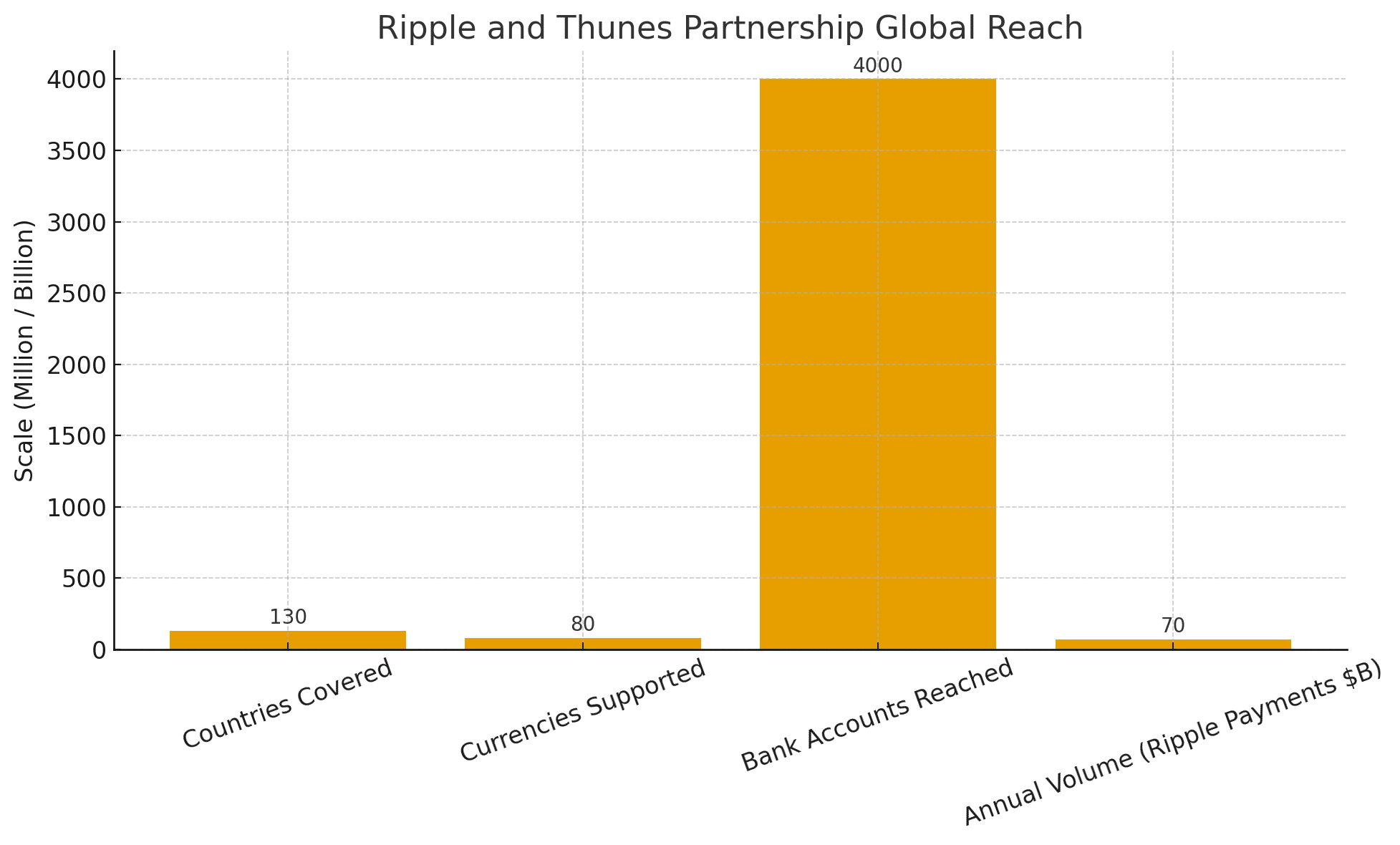
Individuals and corporations frequently experience delays, high costs, and frustration while making cross-border payments. The relationship between Ripple and Thunes partnership addresses these issues directly. By combining Ripple’s blockchain-powered infrastructure with Thunes’ SmartX Treasury System, the cooperation enables real-time payments in local currencies in over 130 countries.

Ripple’s Payments network now processes over $70 billion yearly and serves over 90 payment markets. With Thunes’ access to 4 billion bank accounts and 80 currencies, the alliance establishes a new benchmark for worldwide financial transactions.

Analysts point out that this integration addresses long-standing concerns with botched transfers and compliance delays. Financial analyst Marcus Tan stated, “This partnership strengthens efficiency and trust in an area where customers demand both speed and transparency.”
XRP holders

Impact on XRP and Global Adoption

While Ripple stresses its technology, the increased relationship may indirectly help XRP adoption. As more banks, fintechs, and enterprises adopt Ripple Payments, the need for XRP liquidity may rise. Historically, agreements like these have resulted in increases in XRP market activity.

Experts believe that Ripple’s expanding presence in Asia, Africa, and Latin America will encourage more people to adopt digital assets. The Ripple and Thunes partnership promotes financial inclusion by addressing last-mile payout issues in underprivileged communities.

Looking ahead: Predictions

Market experts believe that increased collaboration will accelerate the institutional adoption of blockchain-powered payments. Ripple’s emphasis on regulatory compliance and transparency enhances its position as governments and central banks explore tokenized finance.
Ripple news today

Analysts predict that if adoption develops at the predicted rate, the Ripple and Thunes partnership will process twice as much as it does now within the next three years. This would establish Ripple as a global leader in digital settlements.

Conclusio

The extended Ripple and Thunes partnership marks a watershed moment in global banking, combining blockchain innovation with established payment rails. By removing inefficiencies and increasing access, the alliance is poised to determine the future of international payments.

For cryptocurrency traders, investors, and institutions, this development indicates that blockchain will play an increasingly important role in regular financial systems.

Also read: Ripple’s RLUSD Push Into Japan Could Spark the Next Stablecoin War

Glossary

Ripple – A blockchain company focused on real-time cross-border payments.

Thunes – A global payment infrastructure provider headquartered in Singapore.

Cross-Border Payments – Transactions involving two parties in different countries.

XRP – The native cryptocurrency of the XRP Ledger, often used for liquidity in Ripple’s ecosystem.

Liquidity – The ease with which assets can be converted into cash or other currencies.

Financial Inclusion – Expanding access to financial services for underserved populations.

FAQs for Ripple and Thunes partnership

What is the Ripple and Thunes partnership about?
It is a collaboration between Ripple and Thunes to expand blockchain-powered cross-border payment services globally.

How many countries are included?
The partnership spans over 130 countries, with access to 4 billion bank accounts and 80 currencies.

Will this affect XRP price?
While not directly tied to XRP, greater use of Ripple’s payment infrastructure could boost liquidity demand, which may influence XRP prices.

Why is this important for global finance?
The partnership addresses high costs, slow processing, and failed transfers, making global payments faster, cheaper, and more reliable.

Read More: Ripple and Thunes Partnership Expands: What This Means for XRP Holders">Ripple and Thunes Partnership Expands: What This Means for XRP Holders

Market Opportunity
RealLink Logo
RealLink Price(REAL)
$0.05283
$0.05283$0.05283
+0.53%
USD
RealLink (REAL) Live Price Chart
Disclaimer: The articles reposted on this site are sourced from public platforms and are provided for informational purposes only. They do not necessarily reflect the views of MEXC. All rights remain with the original authors. If you believe any content infringes on third-party rights, please contact [email protected] for removal. MEXC makes no guarantees regarding the accuracy, completeness, or timeliness of the content and is not responsible for any actions taken based on the information provided. The content does not constitute financial, legal, or other professional advice, nor should it be considered a recommendation or endorsement by MEXC.

You May Also Like

Thunderclap Review 2026: Is it the Best Social Media Service for Instant Gains?

Thunderclap Review 2026: Is it the Best Social Media Service for Instant Gains?

TLDR: Is Thunderclap legit? Yes, Thunderclap is a legitimate social media growth service designed to help users increase their followers, engagement, and overall
Share
AI Journal2026/02/20 21:10
The GENIUS Act Is Already Law. Banks Shouldn’t Try to Rewrite It Now
The GENIUS Act Is Already Law. Banks Shouldn’t Try to Rewrite It Now

The post The GENIUS Act Is Already Law. Banks Shouldn’t Try to Rewrite It Now appeared on BitcoinEthereumNews.com. Healthy competition drives innovation and better products for consumers; it is at the center of American economic leadership. Unfortunately, now that the bipartisan GENIUS Act has been signed into law, major legacy financial institutions seem to be having second thoughts about the innovations that stablecoins can bring to financial markets. Bank lobbying groups and public affairs teams have been peppering Congress with complaints about the law, urging members to reopen debate and introduce changes to the legislation that will ensure the stablecoin market doesn’t grow too quickly, protecting banks’ profits and stifling consumer choice. This reactionary response is both overblown and unnecessary. What legacy financial firms should do instead is embrace competition and offer exciting new products and services that consumers want, not try to kneecap emerging players through anti-innovation rules and regulations. The GENIUS Act was carefully designed with a thorough bipartisan process to strengthen consumer safeguards, ensure regulatory oversight, and preserve financial stability. Efforts to roll back its provisions are less about protecting families and more about protecting entrenched banking interests from the competition that helps ensure the U.S. banking system stays the strongest and most innovative in the world. Critics warn that allowing stablecoins to provide rewards could lead to massive deposit outflows from community banks, with figures as high as $6.6 trillion cited. But closer examination shows this fear is unfounded. A July 2025 analysis by consulting firm Charles River Associates found no statistically significant relationship between stablecoin adoption and community bank deposit outflows. In fact, the overwhelming majority of stablecoin reserves remain in the traditional financial system — either in commercial bank accounts or in short-term Treasuries — where they continue to support liquidity and credit in the broader U.S. economy. The dire estimates rely on unrealistic assumptions that every dollar of stablecoin issuance permanently…
Share
BitcoinEthereumNews2025/09/18 09:39
What next for XRP as volatility sinks to 2024 lows

What next for XRP as volatility sinks to 2024 lows

Markets Share Share this article
Copy linkX (Twitter)LinkedInFacebookEmail
What next for XRP as volatility sinks to 202
Share
Coindesk2026/02/20 21:08