SHIB gets a major legitimacy upgrade by joining Bitcoin and ETH in Japan’s elite Green List. Japan’s FSA proposed cutting crypto tax rates from 55% to 20%, potentially increasing SHIB’s appeal to retail and institutional investors. Shiba Inu (SHIB), the second-biggest memecoin by market capitalization, has officially joined Japan’s “Green List.” This is a major [...]]]>SHIB gets a major legitimacy upgrade by joining Bitcoin and ETH in Japan’s elite Green List. Japan’s FSA proposed cutting crypto tax rates from 55% to 20%, potentially increasing SHIB’s appeal to retail and institutional investors. Shiba Inu (SHIB), the second-biggest memecoin by market capitalization, has officially joined Japan’s “Green List.” This is a major [...]]]>

SHIB Recognized Alongside BTC and ETH in Japan’s Elite Green List

  • SHIB gets a major legitimacy upgrade by joining Bitcoin and ETH in Japan’s elite Green List.
  • Japan’s FSA proposed cutting crypto tax rates from 55% to 20%, potentially increasing SHIB’s appeal to retail and institutional investors.

Shiba Inu (SHIB), the second-biggest memecoin by market capitalization, has officially joined Japan’s “Green List.” This is a major regulatory milestone for SHIB as it is now in the same trusted category as top cryptocurrencies Bitcoin (BTC) and Ethereum (ETH).

SHIB Receives Japan’s Legitimacy Nod

As explained by the Shiba Inu team on X, SHIB’s inclusion on the Green List is about official recognition and potential tax relief. This could supercharge adoption and price momentum for the SHIB meme token.

The Green List is an official whitelist maintained by Japan’s Virtual and Crypto Assets Exchange Association (JVCEA). This is a self-regulatory body overseen by the Financial Services Agency (FSA).

The Green List identifies a select group of pre-approved cryptocurrencies that meet strict criteria for safety, transparency, issuer stability, and low volatility risk. 
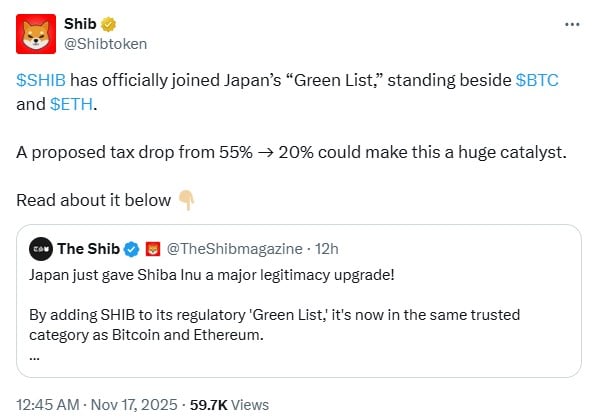
Shiba Inu in Japan's Green List Shiba Inu in Japan’s Green List | Source: SHIB

Being on the list allows quicker, unconditional listings on Japan’s exchanges without lengthy reviews. It signals to investors and institutions that the asset is vetted and low-risk.

JVCEA officially confirmed Shiba Inu’s green list status on November 12, 2025. SHIB is now listed across eight member exchanges, well above the three-exchange minimum required for green list inclusion.

This is a big win for Shiba Inu as it joins elite blockchains like Bitcoin and Ethereum. Some other top cryptocurrencies on the list include XRP, Litecoin (LTC), and Polygon (POL).

In Japan, crypto gains are taxed as miscellaneous income on annual tax returns. This means progressive rates up to 55% for high earners, one of the highest rates globally. 

However, the FSA is pushing to reclassify 105 qualifying cryptos, including the Green List assets, as financial products under the Financial Instruments and Exchange Act. This would shift taxation to a flat 20% capital gains rate. 

The bill is expected to pass by year-end 2025, but implementation could start as early as April 1, 2026.

Implications for SHIB Price

Lower taxes equate to more buying power for Japanese investors. It could unlock institutional inflows, boost liquidity, and make SHIB more appealing for portfolios. Analysts estimate this could inject trillions of yen back into the market, with SHIB positioned to benefit directly as a newly approved asset.

SHIB, often dismissed as a memecoin, now has regulatory stamps from Japan and hints of U.S. interest. Combined with its ecosystem, it signals maturity and real-world utility.

News like this often sparks short-term pumps and adoption in the long-term. Additionally, Japan’s move could inspire other nations to greenlight Shiba Inu.

As of this writing, the SHIB price is currently down 1.09% over the previous day to $0.0000090. However, the market activity is high as indicated by the trading volume. This key metric has surged 24.9% to $142.4 million.

In a recent study, we reported that renewed investor attention could lead to upward price moves as demand picks up.

Crucially, the Shiba Inu network has continued with ecosystem partnerships. As detailed in our last news piece, the Shiba Inu network partnered with telecom outfit Unity to give the SHIB token real-world utility.

Meanwhile, Japan’s FSA is currently reviewing a proposal that could allow banks to hold Bitcoin. Additionally, three of Japan’s largest banks are reportedly collaborating to issue a joint yen-pegged stablecoin.

]]>
Market Opportunity
SHIBAINU Logo
SHIBAINU Price(SHIB)
$0,000007872
$0,000007872$0,000007872
-0,02%
USD
SHIBAINU (SHIB) Live Price Chart
Disclaimer: The articles reposted on this site are sourced from public platforms and are provided for informational purposes only. They do not necessarily reflect the views of MEXC. All rights remain with the original authors. If you believe any content infringes on third-party rights, please contact [email protected] for removal. MEXC makes no guarantees regarding the accuracy, completeness, or timeliness of the content and is not responsible for any actions taken based on the information provided. The content does not constitute financial, legal, or other professional advice, nor should it be considered a recommendation or endorsement by MEXC.

You May Also Like

The Channel Factories We’ve Been Waiting For

The Channel Factories We’ve Been Waiting For

The post The Channel Factories We’ve Been Waiting For appeared on BitcoinEthereumNews.com. Visions of future technology are often prescient about the broad strokes while flubbing the details. The tablets in “2001: A Space Odyssey” do indeed look like iPads, but you never see the astronauts paying for subscriptions or wasting hours on Candy Crush.  Channel factories are one vision that arose early in the history of the Lightning Network to address some challenges that Lightning has faced from the beginning. Despite having grown to become Bitcoin’s most successful layer-2 scaling solution, with instant and low-fee payments, Lightning’s scale is limited by its reliance on payment channels. Although Lightning shifts most transactions off-chain, each payment channel still requires an on-chain transaction to open and (usually) another to close. As adoption grows, pressure on the blockchain grows with it. The need for a more scalable approach to managing channels is clear. Channel factories were supposed to meet this need, but where are they? In 2025, subnetworks are emerging that revive the impetus of channel factories with some new details that vastly increase their potential. They are natively interoperable with Lightning and achieve greater scale by allowing a group of participants to open a shared multisig UTXO and create multiple bilateral channels, which reduces the number of on-chain transactions and improves capital efficiency. Achieving greater scale by reducing complexity, Ark and Spark perform the same function as traditional channel factories with new designs and additional capabilities based on shared UTXOs.  Channel Factories 101 Channel factories have been around since the inception of Lightning. A factory is a multiparty contract where multiple users (not just two, as in a Dryja-Poon channel) cooperatively lock funds in a single multisig UTXO. They can open, close and update channels off-chain without updating the blockchain for each operation. Only when participants leave or the factory dissolves is an on-chain transaction…
Share
BitcoinEthereumNews2025/09/18 00:09
Franklin Templeton CEO Dismisses 50bps Rate Cut Ahead FOMC
Franklin Templeton CEO Dismisses 50bps Rate Cut Ahead FOMC

The post Franklin Templeton CEO Dismisses 50bps Rate Cut Ahead FOMC appeared on BitcoinEthereumNews.com. Franklin Templeton CEO Jenny Johnson has weighed in on whether the Federal Reserve should make a 25 basis points (bps) Fed rate cut or 50 bps cut. This comes ahead of the Fed decision today at today’s FOMC meeting, with the market pricing in a 25 bps cut. Bitcoin and the broader crypto market are currently trading flat ahead of the rate cut decision. Franklin Templeton CEO Weighs In On Potential FOMC Decision In a CNBC interview, Jenny Johnson said that she expects the Fed to make a 25 bps cut today instead of a 50 bps cut. She acknowledged the jobs data, which suggested that the labor market is weakening. However, she noted that this data is backward-looking, indicating that it doesn’t show the current state of the economy. She alluded to the wage growth, which she remarked is an indication of a robust labor market. She added that retail sales are up and that consumers are still spending, despite inflation being sticky at 3%, which makes a case for why the FOMC should opt against a 50-basis-point Fed rate cut. In line with this, the Franklin Templeton CEO said that she would go with a 25 bps rate cut if she were Jerome Powell. She remarked that the Fed still has the October and December FOMC meetings to make further cuts if the incoming data warrants it. Johnson also asserted that the data show a robust economy. However, she noted that there can’t be an argument for no Fed rate cut since Powell already signaled at Jackson Hole that they were likely to lower interest rates at this meeting due to concerns over a weakening labor market. Notably, her comment comes as experts argue for both sides on why the Fed should make a 25 bps cut or…
Share
BitcoinEthereumNews2025/09/18 00:36
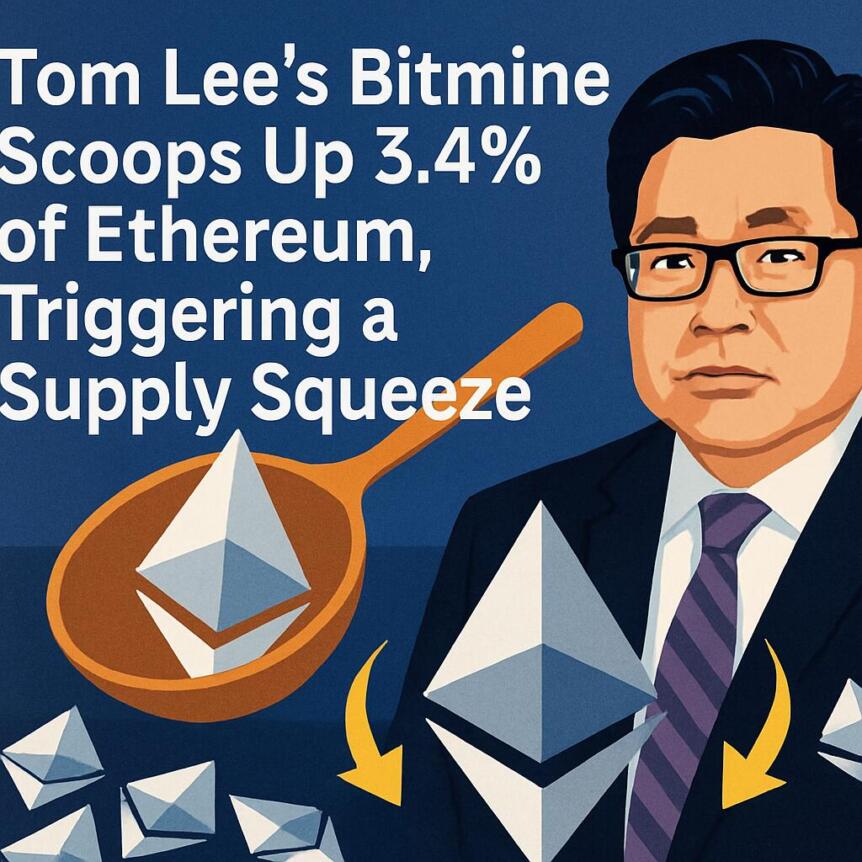
Tom Lee’s Bitmine Scoops Up 3.4% of Ethereum, Triggering a Supply Squeeze

Tom Lee’s Bitmine Scoops Up 3.4% of Ethereum, Triggering a Supply Squeeze

Bitmine Immersion now controls 3.4% of Ethereum amid shrinking exchange supply and rising institutional accumulation.
Share
Crypto Breaking News2026/01/20 16:27