The XRP price pumped 5% over the past 24 hours to trade at $2.49 as of 2:47 a.m. EST as trading volume surged 55% to [...]The XRP price pumped 5% over the past 24 hours to trade at $2.49 as of 2:47 a.m. EST as trading volume surged 55% to [...]

Singapore To Trial Tokenized MAS Bills With CBDC Settlement

The Monetary Authority of Singapore (MAS) has announced plans to trial the issuance of tokenized MAS bills to primary dealers that will be settled with a central bank digital currency (CBDC).

During a speech at the Singapore FinTech Festival, MAS Director Chia Der Jiun said that three Singapore banks, DBS, OCBC, and UOB, have successfully conducted interbank overnight lending transactions using the first live trial issuance of a Singapore dollar wholesale CBDC for settlement.

“As the next bound, MAS will trial the issuance of tokenized MAS Bills to Primary Dealers and settled with CBDC,” he said, adding that details of the trial will be released next year. 

Still Some Work To Be Done Before Tokenized Assets Can Achieve “Escape Velocity”

The MAS Director said that tokenized assets, which he referred to as “asset-backed” tokens, are “without a doubt” out of the experimentation phase. 

“Bonds have been issued natively and settled on chain. Money market funds have been tokenized. Major banks have offered tokenized cash management services to corporate treasuries,” he said. 

However, the MAS Director added that these assets have not yet achieved “escape velocity.”  

He then said that analysts predict that markets are headed for a future where “most financial assets” will be tokenized, traded, and settled on chain.” To reach this future, however, the MAS Director says “significant progress on several fronts” is required first. 

Firstly, he believes that market participants must show use cases that demonstrate “value and stability for their clients.” These firms also need to build “participation and liquidity” for the sector to reach its potential, according to the MAS director. 

He also mentioned three “critical developments” that need to happen.

The first of those developments is that asset-backed tokens must be standardized and the networks that house these tokens need to be interoperable. 

Next, he said, there needs to be a “deep pool of safe and reliable settlement assets.” Lastly, institutional-grade networks are needed to facilitate activity around the tokens, he added. 

He then said that the industry needs to avoid a situation where there is fragmentation or too much centralization in the market.

To achieve that, the MAS Director says “co-opetition” is needed, where firms cooperate to build a marketplace for asset-backed tokens while competing to bring new products to the market. 

Singapore MAS Has Finalized Stablecoin Regulatory Regime

The Director also said MAS has made progress with proposed stablecoin regulation. He said that the MAS has finalized its regulatory regime for these tokens and will now work on preparing draft legislation.

“Under our regime, we have given importance to sound reserve backing and redemption reliability,” he said.

The MAS classifies stablecoins as “digital payment tokens” under the Payment Services Act. It introduced a framework back in August 2023 for single-currency stablecoins pegged to the Singapore dollar as well as major currencies such as the US dollar and the euro. 

In his speech, the Director warned that unregulated stablecoins have a “patchy record” of maintaining their pegs to the underlying asset. He also said that if this issue is not addressed, it could trigger systemic runs similar to the 2008 money market fund failures. 

US Stablecoins Currently Dominate The Market

The effort to regulate stablecoins in Singapore comes after the US established a regulatory framework for the tokens in July when President Trump signed the GENIUS Act into law. This move has since kicked off a global stablecoin race, and has also seen an increasing number of traditional finance firms begin to explore stablecoins. 

Currently, the market is dominated by stablecoins that are pegged to the US dollar. The largest of these tokens is Tether’s USDT, which has a market cap of more than $184 billion. Second is Circle’s USDC, with its total capitalization of more than $76 billion.

The rest of the top ten largest stablecoins are all tokens that are pegged to the greenback. 

Largest stablecoins by market cap (Source: CoinMarketCap)

The largest non-USD stablecoin is Circle’s EURC, which has a much smaller capitalization compared to USDT of over $298.7 million. After EURC, the next-biggest non-USD stablecoin is EURS with a market cap of over $139 million.

Market Opportunity
Massa Logo
Massa Price(MAS)
$0.00495
$0.00495$0.00495
-0.40%
USD
Massa (MAS) Live Price Chart
Disclaimer: The articles reposted on this site are sourced from public platforms and are provided for informational purposes only. They do not necessarily reflect the views of MEXC. All rights remain with the original authors. If you believe any content infringes on third-party rights, please contact [email protected] for removal. MEXC makes no guarantees regarding the accuracy, completeness, or timeliness of the content and is not responsible for any actions taken based on the information provided. The content does not constitute financial, legal, or other professional advice, nor should it be considered a recommendation or endorsement by MEXC.

You May Also Like

The Channel Factories We’ve Been Waiting For

The Channel Factories We’ve Been Waiting For

The post The Channel Factories We’ve Been Waiting For appeared on BitcoinEthereumNews.com. Visions of future technology are often prescient about the broad strokes while flubbing the details. The tablets in “2001: A Space Odyssey” do indeed look like iPads, but you never see the astronauts paying for subscriptions or wasting hours on Candy Crush.  Channel factories are one vision that arose early in the history of the Lightning Network to address some challenges that Lightning has faced from the beginning. Despite having grown to become Bitcoin’s most successful layer-2 scaling solution, with instant and low-fee payments, Lightning’s scale is limited by its reliance on payment channels. Although Lightning shifts most transactions off-chain, each payment channel still requires an on-chain transaction to open and (usually) another to close. As adoption grows, pressure on the blockchain grows with it. The need for a more scalable approach to managing channels is clear. Channel factories were supposed to meet this need, but where are they? In 2025, subnetworks are emerging that revive the impetus of channel factories with some new details that vastly increase their potential. They are natively interoperable with Lightning and achieve greater scale by allowing a group of participants to open a shared multisig UTXO and create multiple bilateral channels, which reduces the number of on-chain transactions and improves capital efficiency. Achieving greater scale by reducing complexity, Ark and Spark perform the same function as traditional channel factories with new designs and additional capabilities based on shared UTXOs.  Channel Factories 101 Channel factories have been around since the inception of Lightning. A factory is a multiparty contract where multiple users (not just two, as in a Dryja-Poon channel) cooperatively lock funds in a single multisig UTXO. They can open, close and update channels off-chain without updating the blockchain for each operation. Only when participants leave or the factory dissolves is an on-chain transaction…
Share
BitcoinEthereumNews2025/09/18 00:09
Franklin Templeton CEO Dismisses 50bps Rate Cut Ahead FOMC
Franklin Templeton CEO Dismisses 50bps Rate Cut Ahead FOMC

The post Franklin Templeton CEO Dismisses 50bps Rate Cut Ahead FOMC appeared on BitcoinEthereumNews.com. Franklin Templeton CEO Jenny Johnson has weighed in on whether the Federal Reserve should make a 25 basis points (bps) Fed rate cut or 50 bps cut. This comes ahead of the Fed decision today at today’s FOMC meeting, with the market pricing in a 25 bps cut. Bitcoin and the broader crypto market are currently trading flat ahead of the rate cut decision. Franklin Templeton CEO Weighs In On Potential FOMC Decision In a CNBC interview, Jenny Johnson said that she expects the Fed to make a 25 bps cut today instead of a 50 bps cut. She acknowledged the jobs data, which suggested that the labor market is weakening. However, she noted that this data is backward-looking, indicating that it doesn’t show the current state of the economy. She alluded to the wage growth, which she remarked is an indication of a robust labor market. She added that retail sales are up and that consumers are still spending, despite inflation being sticky at 3%, which makes a case for why the FOMC should opt against a 50-basis-point Fed rate cut. In line with this, the Franklin Templeton CEO said that she would go with a 25 bps rate cut if she were Jerome Powell. She remarked that the Fed still has the October and December FOMC meetings to make further cuts if the incoming data warrants it. Johnson also asserted that the data show a robust economy. However, she noted that there can’t be an argument for no Fed rate cut since Powell already signaled at Jackson Hole that they were likely to lower interest rates at this meeting due to concerns over a weakening labor market. Notably, her comment comes as experts argue for both sides on why the Fed should make a 25 bps cut or…
Share
BitcoinEthereumNews2025/09/18 00:36
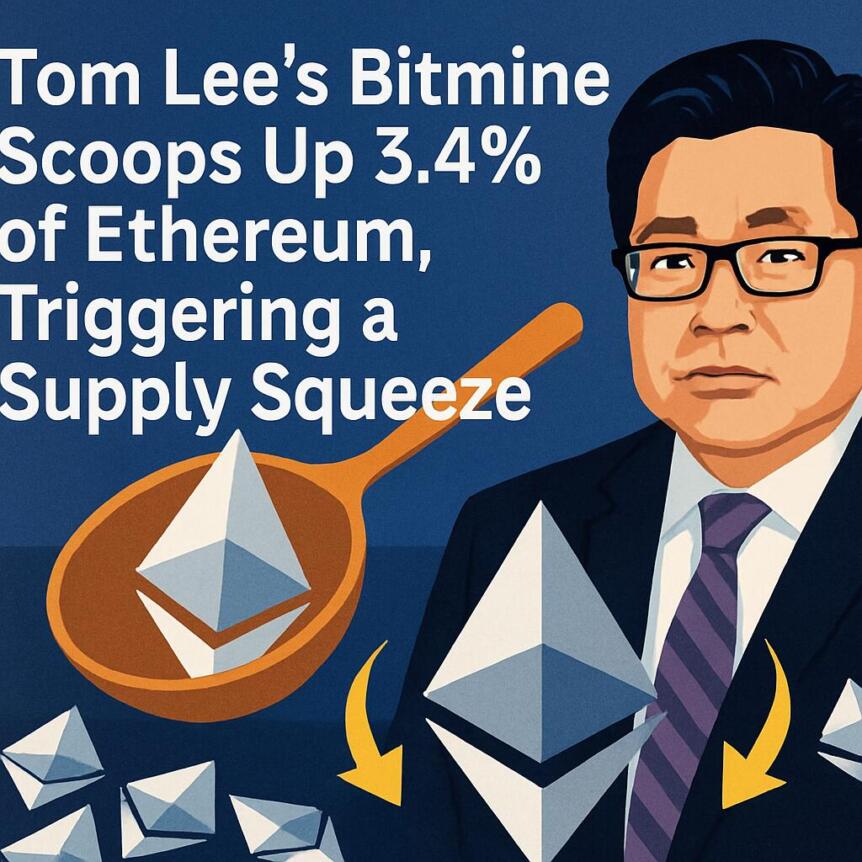
Tom Lee’s Bitmine Scoops Up 3.4% of Ethereum, Triggering a Supply Squeeze

Tom Lee’s Bitmine Scoops Up 3.4% of Ethereum, Triggering a Supply Squeeze

Bitmine Immersion now controls 3.4% of Ethereum amid shrinking exchange supply and rising institutional accumulation.
Share
Crypto Breaking News2026/01/20 16:27