Solana (SOL) continues to gain traction among corporate treasuries, mirroring the trend seen with Bitcoin and Ethereum. Public companies are increasingly holding Solana assets, which not only supports the token’s credibility but also showcases how traditional finance is integrating digital assets into their strategic holdings. As Solana’s ecosystem matures, its treasury activity presents a compelling [...]Solana (SOL) continues to gain traction among corporate treasuries, mirroring the trend seen with Bitcoin and Ethereum. Public companies are increasingly holding Solana assets, which not only supports the token’s credibility but also showcases how traditional finance is integrating digital assets into their strategic holdings. As Solana’s ecosystem matures, its treasury activity presents a compelling [...]

Solana Takes Center Stage to Boost Its Corporate Crypto War Chest

For feedback or concerns regarding this content, please contact us at [email protected]
Solana Takes Center Stage To Boost Its Corporate Crypto War Chest

Solana (SOL) continues to gain traction among corporate treasuries, mirroring the trend seen with Bitcoin and Ethereum. Public companies are increasingly holding Solana assets, which not only supports the token’s credibility but also showcases how traditional finance is integrating digital assets into their strategic holdings. As Solana’s ecosystem matures, its treasury activity presents a compelling alternative to ETFs, offering more active management and strategic growth potential within the crypto markets.

  • Solana treasuries have accumulated over 6.3 million SOL, representing more than 1.6% of the circulating supply.
  • Major institutions are holding Solana to leverage its high throughput and low transaction costs, with many aligning toward long-term investment strategies.
  • Unlike ETFs, Solana treasury companies actively stake and deploy assets, participating in DeFi to generate yield.
  • Market analysts believe Solana ETFs are poised for approval once regulatory uncertainties resolve, boosting institutional adoption.
  • Solana’s growing treasury activity helps counteract inflation, with the network’s inflation rate set to decline to 1.5% over time.

Why Solana DATs look promising

Ranked as the sixth-largest cryptocurrency by market capitalization, Solana’s blockchain is often viewed as a viable competitor to Ethereum in the smart contract and DeFi spaces. Known for its high throughput and low transaction fees, Solana presents a compelling treasury asset, though its institutional adoption still lags behind Bitcoin and Ether.

Currently, Solana treasury holdings total approximately 2.46% of the total SOL supply, valued at nearly $3 billion. The largest holders include Forward Industries with 1.249%, and smaller allocations are held by DeFi Development Corp (DFDV), Upexi, and Sharps Technology.

DFDV, formerly a real estate platform, has been one of the top performers following its rebranding to focus on Solana treasuries. Source: Google Finance

Joseph Onorati, CEO of DFDV, commented, “We evaluated multiple layer 1 blockchains, and Solana emerged as the clear front-runner in technology. While Ethereum maintains the mindshare, Solana surpasses it across usage metrics and efficiency, yet trades at a fraction of Ethereum’s market cap.” He sees significant growth opportunities for Solana from this position.

Until now, no spot Solana ETFs exist, but market experts expect approval once the U.S. Securities and Exchange Commission (SEC) resumes normal operations following the ongoing government shutdown. Such ETFs would allow investors to gain exposure passively, mirroring the asset’s price movements.
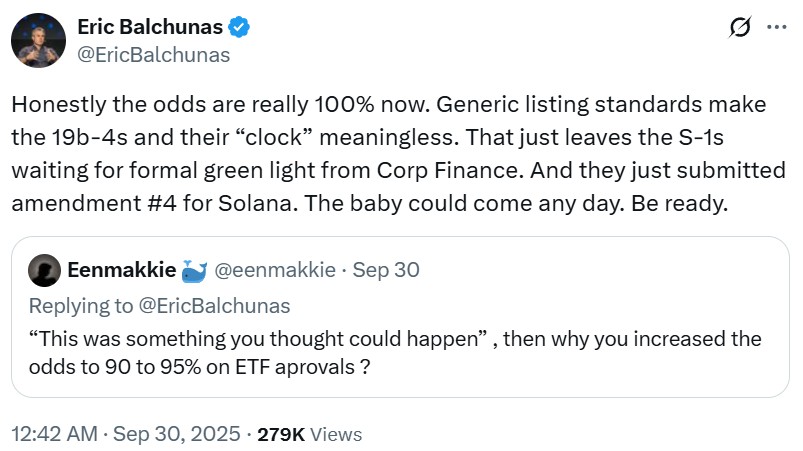
Cryptocurrencies, Investments, Trading, Solana, Stock Exchange, FeaturesBloomberg analyst Eric Balchunas predicts a near-certain approval for Solana ETFs. Source: Eric Balchunas

Unlike ETFs, which passively track prices, Solana treasury companies can actively deploy their holdings. For example, DFDV stakes SOL by running its own validator nodes and engaging in DeFi yield farming, aiming to grow their asset base even in flat markets. Although ETF providers are beginning to include staking features, DATs maintain greater operational flexibility for expanding their token holdings.

“Digital asset treasuries are a superior vehicle and are expected to eventually replace ETFs entirely,” Onorati stated.

Furthermore, Solana’s ecosystem familiarity is a key advantage. With widespread industry awareness, many institutional investors are willing to hold Solana long-term, which helps deepen its market penetration. Despite initial setbacks from the FTX collapse, which negatively affected Solana’s reputation, visibility from the incident has ultimately increased awareness of its active ecosystem and ongoing projects.

In March 2024, FTX’s estate announced the sale of 41 million SOL tokens at a 68% discount to institutional investors. This large transaction helped lock in billions of dollars’ worth of SOL under long-term vesting, turning a potential market overhang into a significant institutional bet on Solana’s future growth.

Constraints in Solana DAT models

While promising, Solana treasury models face challenges such as limited liquidity and competition for investor capital. Compared to Bitcoin and Ether, Solana’s treasury holdings and trading volume are relatively thin, which could impact market stability. Tim Chen, strategy lead at Mantle, noted, “Liquidity comparison really matters — Ethereum proxies are growing, and Solana DATs trade far less.”

Additionally, concentration risk remains a concern if a single entity accumulates a large share of SOL, raising questions about market influence and stability. Currently, the largest holders control only a few percent of supply, but further accumulation could attract regulatory or market scrutiny.

Crypto economist Thomas Chen categorized digital asset treasuries into three types: Bitcoin as a store of value, Ethereum and Solana as evolving but mature options, and other altcoins as higher risk with potential for dynamic use cases. He emphasized that these models are still in early phases but could outperform larger-cap assets if implemented effectively.

Solana DATs go global

Solana treasury activity is expanding internationally, with DFDV launching treasury franchises in South Korea and Japan. These efforts aim to adapt Solana’s treasury models to different regulatory and economic environments, similar to innovative strategies seen in Japan’s Metaplanet and Nakamoto models. While some critics see these initiatives as rebranding efforts, Onorati argues they’re about efficiency and fast-tracking market entry.

As Solana’s corporate adoption accelerates, its treasury activity not only helps stabilize the coin’s inflation rate — which is programmed to decline to 1.5% — but also signals growing institutional confidence. Long-term holders benefit from these strategies, which counteract token dilution and foster ecosystem expansion.

Ultimately, Solana’s treasury movement exemplifies how crypto-native mechanics are integrating into traditional corporate finance, paving the way for broader institutional participation and real-world impact on the blockchain. As the network continues to develop, it could redefine how companies engage with digital assets and leverage blockchain technology for strategic growth.

This article was originally published as Solana Takes Center Stage to Boost Its Corporate Crypto War Chest on Crypto Breaking News – your trusted source for crypto news, Bitcoin news, and blockchain updates.

Disclaimer: The articles reposted on this site are sourced from public platforms and are provided for informational purposes only. They do not necessarily reflect the views of MEXC. All rights remain with the original authors. If you believe any content infringes on third-party rights, please contact [email protected] for removal. MEXC makes no guarantees regarding the accuracy, completeness, or timeliness of the content and is not responsible for any actions taken based on the information provided. The content does not constitute financial, legal, or other professional advice, nor should it be considered a recommendation or endorsement by MEXC.

You May Also Like

Steel Dynamics (STLD) Stock Dips Following Disappointing Q1 Earnings Forecast

Steel Dynamics (STLD) Stock Dips Following Disappointing Q1 Earnings Forecast

Steel Dynamics (STLD) stock dropped 1.3% premarket after issuing Q1 EPS guidance of $2.73–$2.77, significantly below the $3.24 Wall Street consensus. The post Steel
Share
Blockonomi2026/03/17 21:45
EUR/CHF slides as Euro struggles post-inflation data

EUR/CHF slides as Euro struggles post-inflation data

The post EUR/CHF slides as Euro struggles post-inflation data appeared on BitcoinEthereumNews.com. EUR/CHF weakens for a second straight session as the euro struggles to recover post-Eurozone inflation data. Eurozone core inflation steady at 2.3%, headline CPI eases to 2.0% in August. SNB maintains a flexible policy outlook ahead of its September 25 decision, with no immediate need for easing. The Euro (EUR) trades under pressure against the Swiss Franc (CHF) on Wednesday, with EUR/CHF extending losses for the second straight session as the common currency struggles to gain traction following Eurozone inflation data. At the time of writing, the cross is trading around 0.9320 during the American session. The latest inflation data from Eurostat showed that Eurozone price growth remained broadly stable in August, reinforcing the European Central Bank’s (ECB) cautious stance on monetary policy. The Core Harmonized Index of Consumer Prices (HICP), which excludes volatile items such as food and energy, rose 2.3% YoY, in line with both forecasts and the previous month’s reading. On a monthly basis, core inflation increased by 0.3%, unchanged from July, highlighting persistent underlying price pressures in the bloc. Meanwhile, headline inflation eased to 2.0% YoY in August, down from 2.1% in July and slightly below expectations. On a monthly basis, prices rose just 0.1%, missing forecasts for a 0.2% increase and decelerating from July’s 0.2% rise. The inflation release follows last week’s ECB policy decision, where the central bank kept all three key interest rates unchanged and signaled that policy is likely at its terminal level. While officials acknowledged progress in bringing inflation down, they reiterated a cautious, data-dependent approach going forward, emphasizing the need to maintain restrictive conditions for an extended period to ensure price stability. On the Swiss side, disinflation appears to be deepening. The Producer and Import Price Index dropped 0.6% in August, marking a sharp 1.8% annual decline. Broader inflation remains…
Share
BitcoinEthereumNews2025/09/18 03:08
New York Regulators Push Banks to Adopt Blockchain Analytics

New York Regulators Push Banks to Adopt Blockchain Analytics

New York’s top financial regulator urged banks to adopt blockchain analytics, signaling tighter oversight of crypto-linked risks. The move reflects regulators’ concern that traditional institutions face rising exposure to digital assets. While crypto-native firms already rely on monitoring tools, the Department of Financial Services now expects banks to use them to detect illicit activity. NYDFS Outlines Compliance Expectations The notice, issued on Wednesday by Superintendent Adrienne Harris, applies to all state-chartered banks and foreign branches. In its industry letter, the New York State Department of Financial Services (NYDFS) emphasized that blockchain analytics should be integrated into compliance programs according to each bank’s size, operations, and risk appetite. The regulator cautioned that crypto markets evolve quickly, requiring institutions to update frameworks regularly. “Emerging technologies introduce evolving threats that require enhanced monitoring tools,” the notice stated. It stressed the need for banks to prevent money laundering, sanctions violations, and other illicit finance linked to virtual currency transactions. To that end, the Department listed specific areas where blockchain analytics can be applied: Screening customer wallets with crypto exposure to assess risks. Verifying the origin of funds from virtual asset service providers (VASPs). Monitoring the ecosystem holistically to detect money laundering or sanctions exposure. Identifying and assessing counterparties, such as third-party VASPs. Evaluating expected versus actual transaction activity, including dollar thresholds. Weighing risks tied to new digital asset products before rollout. These examples highlight how institutions can tailor monitoring tools to strengthen their risk management frameworks. The guidance expands on NYDFS’s Virtual Currency-Related Activities (VCRA) framework, which has governed crypto oversight in the state since 2022. Regulators Signal Broader Impact Market observers say the notice is less about new rules and more about clarifying expectations. By formalizing the role of blockchain analytics in traditional finance, New York is reinforcing the idea that banks cannot treat crypto exposure as a niche concern. Analysts also believe the approach could ripple beyond New York. Federal agencies and regulators in other states may view the guidance as a blueprint for aligning banking oversight with the realities of digital asset adoption. For institutions, failure to adopt blockchain intelligence tools may invite regulatory scrutiny and undermine their ability to safeguard customer trust. With crypto now firmly embedded in global finance, New York’s stance suggests that blockchain analytics are no longer optional for banks — they are essential to protecting the financial system’s integrity.
Share
Coinstats2025/09/18 08:49