

2026-02-10 Tuesday
Crypto News
Indulge in the Hottest Crypto News and Market Updates

Solana Price Faces Pullback Risk — A 3% Trigger Awaits
The post Solana Price Faces Pullback Risk — A 3% Trigger Awaits appeared on BitcoinEthereumNews.com. Solana (SOL) is flashing warning signs again. It may have gained nearly 9% over the past week, but the Solana price is still down around 6% for the month — a clear sign that buyers are losing momentum. On-chain data shows that long-term holders are cutting exposure and large investors are staying on the sidelines. Together, these trends point to a growing risk of a short-term pullback that could extend beyond 3% if key support levels give way. Sponsored Sponsored Holders Drive the Selling as Big Money Stays Cautious Steady outflows from mid- and long-term holders are undermining Solana’s recent strength. Glassnode’s HODL Waves metric — which tracks how long coins stay untouched before being moved — shows a clear drop among conviction holders. Wallets holding Solana for 1–2 years have reduced their share of the supply from 20.33% to 18.48%, while 3–6 month holders fell from 12.7% to 11.55% this month. Solana Holders Dumping Hard: Glassnode Want more token insights like this? Sign up for Editor Harsh Notariya’s Daily Crypto Newsletter here. This change signals profit-taking among patient investors, a bearish development that often precedes short-term corrections. The Chaikin Money Flow (CMF) — a tool that measures big-money inflows and outflows — adds to this view. After briefly rising above zero on October 27, CMF turned negative again and has failed to recover since. That means institutional buyers are not adding aggressively, even after recent dips. Sponsored Sponsored During recovery or range-bound moves, these big money flows often offset the cohort-based selling waves. That isn’t happening currently. Instead, CMF turning negative is adding to the “sell” pressure, strengthening the Solana price pullback narrative. Big Money Flow Restricted: TradingView Unless CMF climbs back above 0.06, Solana’s recovery will likely stay weak. These combined on-chain and big-money signals show why sellers remain in…
Share
Author: BitcoinEthereumNews2025/10/30 17:22
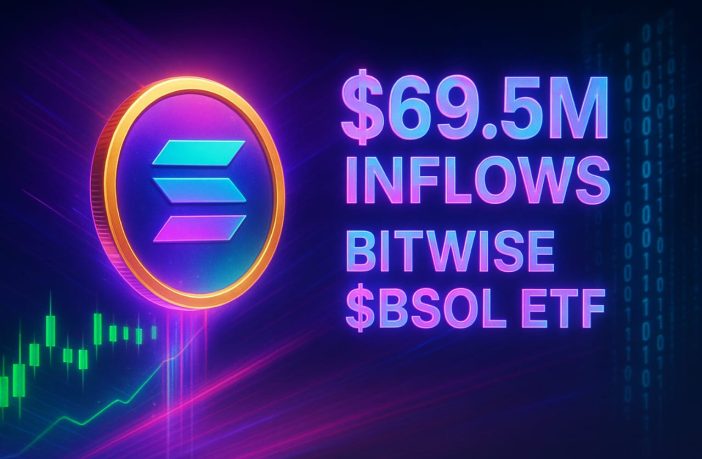
Bitwise Solana ETF Opens Strong With $69.5M Inflows, A Bold New Era for $SOL
The Solana ecosystem just scored one of its biggest wins of 2025. On October 28, Bitwise officially launched the first-ever U.S. Solana spot ETF, the Bitwise Solana Staking ETF (ticker: $BSOL), and it didn’t take long to make waves. In its first 24 hours, the ETF recorded a jaw-dropping $69.5 million in net inflows, pushing [...]
Share
Author: Null TX2025/10/30 16:41

Solana Ecosystem Buyback Guide: Decoding the Buyback Mechanisms and Real Impact of 9 Major Projects
Author: fabiano.sol Compiled by: Tim, PANews There are over a dozen projects on Solana that are currently undergoing buybacks, but: Who is conducting 100% buybacks? Who destroys the tokens after the buyback? A complete guide to Solana's ecosystem buyback program. 1.deBridge deBridge is using 100% of its revenue to buy back its own tokens, and the specific handling plan after the buyback is yet to be announced. To date, they have repurchased 3% of the token supply. At this rate, they will be able to repurchase nearly 20% of the circulating supply within a year. 2. Marinede Marinade uses 50% of its monthly revenue to buy back MNDE tokens. Marinade boasts an annualized revenue of $170 million, which could generate significant buying interest for a token with a market capitalization of only $140 million. The future use of these repurchased tokens will be determined by the DAO. 3. Jupiter Jupiter is using 50% of its protocol revenue to buy back its own tokens. They transferred the repurchased tokens to a burn address. To date, Jupiter has repurchased 95 million JUP tokens, representing 1.37% of the total supply. Tomorrow we will discuss a plan for handling the repurchased tokens. 4. Jito The Jito platform will use 1.5% of TipRouter fees to periodically buy back JTO tokens and then burn them. Based on current market prices, this move will result in the repurchase and burning of more than 11 million JTO tokens annually (representing 1.1% of the total supply). 5. Bonk Bonk has introduced several token buyback and burn measures. In this case, I will only focus on LetsBONK. The LetsBONK project will use 50% of its revenue to buy back BONK tokens from the open market and burn them. 6. Metaplex 50% of the protocol's revenue will be allocated to the DAO each month, specifically for MTPLX token buybacks. In the past 30 days, the Metaplex protocol has generated $1.56 million in revenue, of which 50% (i.e., $780,000) was used to buy back approximately 3.5 million MPLX tokens for the Metaplex DAO, representing more than 0.3% of the total supply. 7. Raydium Raydium tokens have an extremely low annual issuance of only 1.9 million (total supply is 555 million). Raydium will use 12% of its transaction fees to buy back RAY tokens. This brings the repurchase ratio to 5% of the current circulating supply. 8. Pump Fun The Pump.fun platform currently generates over $1 million in daily revenue and uses 100% of that revenue to buy back tokens. In September, they bought back $55 million worth of PUMP tokens, which would allow them to buy back approximately 30% of the circulating supply within a year. 9. Streamflow 39% of the Streamflow protocol's revenue is being used to buy back STREAM tokens and distribute them to stakers. Taking July 2025 as an example, this means that 39% of the $247,000 in revenue that month (i.e., $96,330) will be used for STREAM token buybacks and staking reward distributions. Recently, Magic Eden also launched a token buyback mechanism, which has repurchased 111,000 ME tokens and will use them all for staking rewards (the scale is expected to expand further in the future). Step Finance has also invested all of its platform revenue (including revenue from businesses such as Solanafloor and Remora Markets) into token buybacks.
Share
Author: PANews2025/10/30 16:25

Solana (SOL) Price: New ETF Records $72 Million in Trading Volume on Day Two
TLDR Bitwise Solana Staking ETF generated $72.4 million in trading volume on its second day, exceeding its $56 million debut The BSOL fund attracted $69.5 million in first-day inflows and holds nearly $292 million in total assets Grayscale and REX Osprey also launched Solana ETFs, adding $4 million and $18 million in volume respectively Solana [...] The post Solana (SOL) Price: New ETF Records $72 Million in Trading Volume on Day Two appeared first on CoinCentral.
Share
Author: Coincentral2025/10/30 15:49

Top Crypto to Buy Now: Solana (SOL) and Little Pepe (LILPEPE) to Lead Next Big Climb
The post Top Crypto to Buy Now: Solana (SOL) and Little Pepe (LILPEPE) to Lead Next Big Climb appeared first on Coinpedia Fintech News Investor attitude is trending toward high-utility, community-driven assets as institutional inflows resume. This rebound could be led by blockchain powerhouse Solana (SOL) and meme Layer-2 token Little Pepe (LILPEPE), which is shaking up Ethereum’s ecosystem. Solana promotes scalability and DeFi adoption, whereas Little Pepe promotes culture, community, and meme coin utility. They indicate where smart …
Share
Author: CoinPedia2025/10/30 14:47

HumidiFi DEX to launch WET token on Jupiter’s DTF platform
The post HumidiFi DEX to launch WET token on Jupiter’s DTF platform appeared on BitcoinEthereumNews.com. One of Solana’s leading trading platforms is taking a new step that could reshape how tokens are launched across the network. Summary HumidiFi DEX will debut its WET token on Jupiter’s DTF ICO platform. The Solana-based DEX processes up to 40% of network DEX volume. DTF grants JUP stakers exclusive access and introduces a controlled token sale format. HumidiFi, a leading decentralized exchange on Solana, will launch its native WET token through Jupiter’s new Decentralized Token Formation platform, the first project to debut on the service. Jupiter (JUP) confirmed the news in an Oct. 30 post on X, marking a major milestone for both platforms as Solana’s (SOL) decentralized sector continues to expand. Solana’s prop AMM leader enters the token market Launched in June 2025, HumidiFi has become one of Solana’s most active DEXs, handling between 35% and 40% of all Solana DEX volume. The platform specializes in proprietary automated market makers (prop AMMs) — sometimes described as “dark pools” — that route trades privately through aggregators like Jupiter to reduce slippage, front-running, and MEV attacks. In the past month alone, HumidiFi processed more than $34 billion in transactions, recently surpassing competitors such as Raydium, Meteora, and PumpSwap. On its busiest day, its 24-hour trading volume reached $1.1 billion, a record for the Solana-based DEX. Although HumidiFi has grown, its “dark AMM” model has sparked concerns about transparency because its operators are still partially anonymous, and community members have demanded audits to ensure user safety. WET launch debuts Jupiter’s DTF platform The WET token launch, set for Oct. 30, is the first to use Jupiter’s DTF platform, a new system for structured, community-backed token offerings. The DTF model allows JUP token stakers exclusive early access to token sales while controlling initial supply to avoid post-launch volatility. While no public price for WET has been revealed, it will…
Share
Author: BitcoinEthereumNews2025/10/30 14:22

Solana ETFs finally launched: So why isn’t SOL trading far above $200?
SOL investors bet on an ETF approval and set price targets from $300 to $1,000. The ETFs are live now, but Solana price still trades below $200. Did traders sell the news? Key points: SOL remains pinned below $200 even as Solana ETF daily trading volumes impressed analysts. Analysts say SOL price action could mirror ETH’s lagging performance after the Ethereum spot ETFs launched. Read more
Share
Author: Coinstats2025/10/30 13:37

Publicly Traded Firm Adds $20 Million in Solana, Expands Holdings Beyond 2.3 Million SOL
A publicly listed company with a strong focus on the Solana ecosystem has made another significant investment this month, purchasing 100,000 SOL worth approximately $20 million. The move pushes its total Solana holdings past 2.3 million SOL, signaling growing institutional confidence in the blockchain’s long-term potential. The company also revealed that its staked Solana tokens […]
Share
Author: Coinstats2025/10/30 12:32

A smart money address spent 102 SOL to purchase 2.9 million GHOST.
PANews reported on October 30 that, according to Lookonchain monitoring, the smart money address "LeBron" spent 102 SOL (worth $18,300) to purchase 2.9 million GHOST. LeBron previously earned $8.9 million on MELANIA, $4.56 million on LIBRA, $3.2 million on TRUMP, and $1 million on HARRYBOLZ.
Share
Author: PANews2025/10/30 10:33
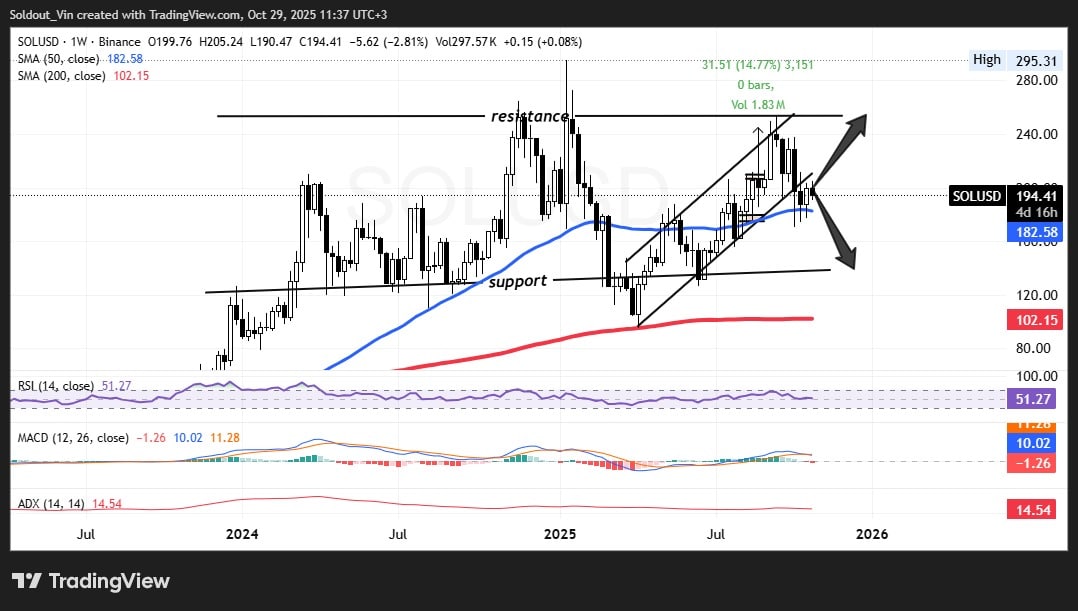
Solana Price Prediction: SOL Slips 4% Despite Record Debut Volume For Bitwise Spot SOL ETF
Western Union plans to launch a Solana-based dollar stablecoin in 2026 through Anchorage Digital, extending its move into digital payments. The new token, called the [...]
Share
Author: Insidebitcoins2025/10/29 23:51