šŸ“Œ Table of Contents What is Sui? The Silicon Valley Blockchain Revolution From Facebook’s Crypto Ruins: The Birth of Sui Move Language & Performance: Why Sui is Different Ecosystem & Partnerships: Where Sui Stands Today Real-World Applications: DeFi, NFTs & Gaming SUI Tokenomics Explained Sui in 2025: Growth, Challenges & Milestones FAQ: 10 Unanswered Questions [...]]]>šŸ“Œ Table of Contents What is Sui? The Silicon Valley Blockchain Revolution From Facebook’s Crypto Ruins: The Birth of Sui Move Language & Performance: Why Sui is Different Ecosystem & Partnerships: Where Sui Stands Today Real-World Applications: DeFi, NFTs & Gaming SUI Tokenomics Explained Sui in 2025: Growth, Challenges & Milestones FAQ: 10 Unanswered Questions [...]]]>

Sui Blockchain Explained (2025): Move Language, High-Speed Layer-1 & The Future of Web3

2025/10/02 21:16

šŸ“Œ Table of Contents

  • What is Sui? The Silicon Valley Blockchain Revolution
  • From Facebook’s Crypto Ruins: The Birth of Sui
  • Move Language & Performance: Why Sui is Different
  • Ecosystem & Partnerships: Where Sui Stands Today
  • Real-World Applications: DeFi, NFTs & Gaming
  • SUI Tokenomics Explained
  • Sui in 2025: Growth, Challenges & Milestones
  • FAQ: 10 Unanswered Questions About Sui

šŸš€ What is Sui? The Silicon Valley Blockchain Revolution

While Ethereum struggles with scalability, a new blockchain from Silicon Valley promises a revolution: Can Sui deliver what others only claim?

šŸŒ From Facebook’s Crypto Ruins: The Birth of Sui

Sui was born in 2022 when former engineers from Meta’s failed Diem project founded Mysten Labs. Drawing on years of experience in high-performance systems, they launched Sui’s mainnet in May 2023 with backing from a16z and Coinbase Ventures. The vision: a blockchain for mass adoption, especially in gaming, NFTs, and DeFi, but without the regulatory baggage that doomed Facebook’s Libra.
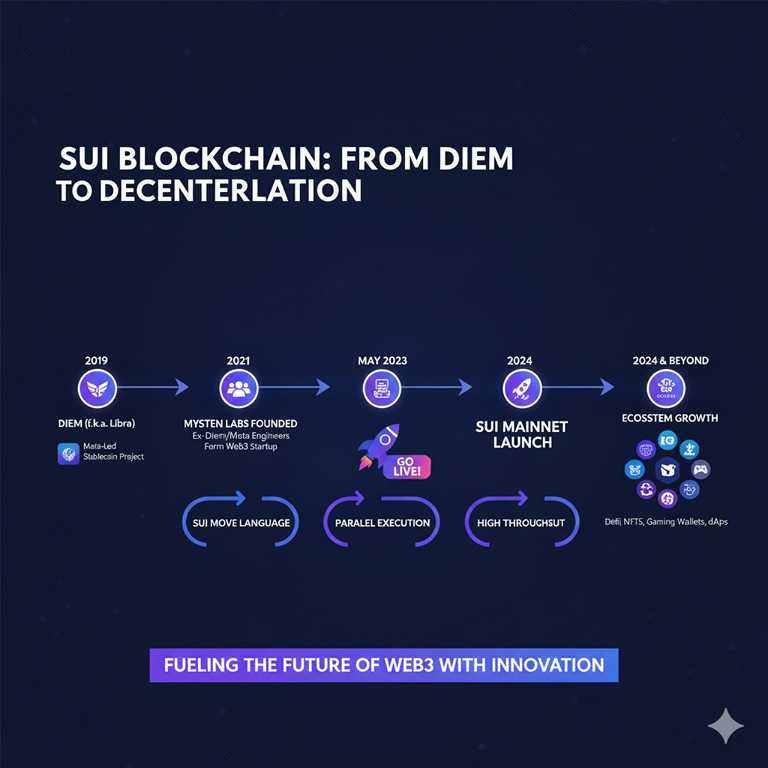
graphic illustrating the progression from Diem to Mysten Labs, the Sui Mainnet Launch in 2023, and subsequent Ecosystem Growth

āš™ Move Language & Performance: Why Sui is Different

At the heart of Sui lies the Move programming language, developed for Diem but now fully unleashed. Unlike Ethereum’s Solidity, Move treats digital assets as independent objects with their own properties. This architecture allows Sui to theoretically handle 100,000+ TPS with <400ms latency, dwarfing Ethereum’s 15 TPS.

BlockchainTransactions per Second (TPS)Latency
Ethereum (Mainnet)~15>10 seconds
Solana~65,000 (theoretical)400–600ms
Sui100,000+<400ms

🌐 Ecosystem & Partnerships: Where Sui Stands Today

The strength of a blockchain lies in its ecosystem. In DeFi, Cetus Protocol has emerged as Sui’s leading DEX, while Scallop provides lending and borrowing infrastructure. In NFTs and gaming, BlueMove and OriginX show promise, though liquidity still trails Solana and Avalanche.
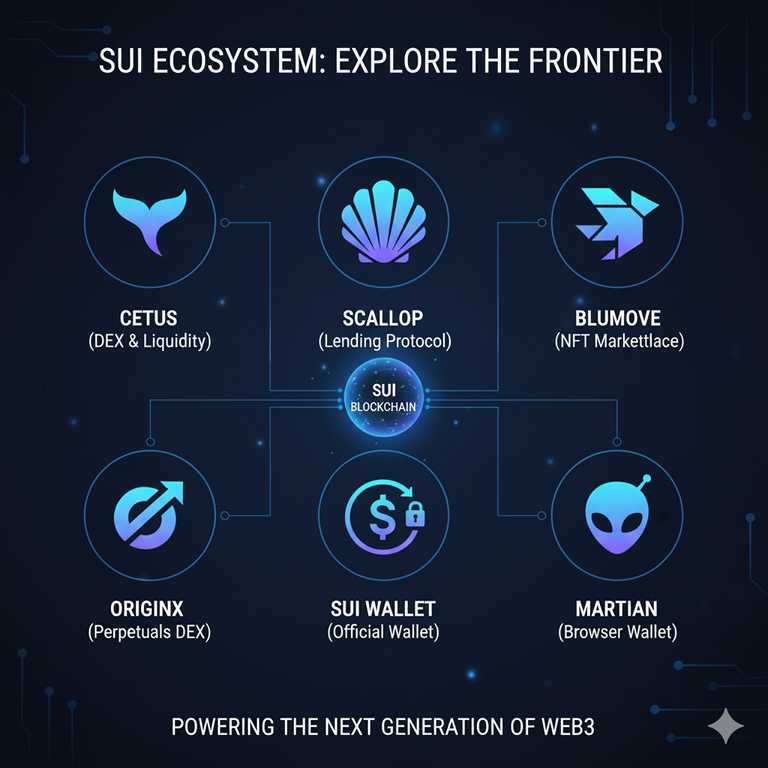
ogos of Cetus, Scallop, BlueMove, OriginX, Sui Wallet, and Martian

šŸŽ® Real-World Applications: DeFi, NFTs & Gaming

Sui demonstrates strengths beyond theory:

  • DeFi: Near-instant token swaps, low slippage, minimal fees.
  • NFTs: Affordable minting for small creators, unlike Ethereum’s gas-heavy model.
  • Gaming: Cost-effective, high-frequency asset transactions for in-game economies.
  • Micropayments: Content creators can sell digital goods for cents—unviable on Ethereum.

šŸ’° SUI Tokenomics Explained

Sui has a fixed max supply of 10 billion SUI, unlike Ethereum’s theoretically unlimited supply. Token utilities include:

  1. Transaction fees
  2. Staking for validator security
  3. Governance rights

UtilityFunctionCurrent Impact
FeesKeep the network runningUltra-low compared to Ethereum
StakingValidators secure the networkRewards ~3–5% annually
GovernanceProtocol upgrade votingGrowing role in decision-making

šŸ“° Sui in 2025: Growth, Challenges & Milestones

2025 brought new gaming partnerships (often under NDA), steady DeFi growth, and improved NFT marketplace activity. Network upgrades further reduced latency, underscoring Sui’s tech advantage. Yet, mass adoption remains elusive, with active wallets and daily transactions still below major competitors.

ā“ FAQ: 10 Unanswered Questions About Sui

1. Can Sui maintain its performance under massive real-world usage?
Current stress tests demonstrate impressive throughput and low latency, but true scalability will only be proven once millions of users and complex dApps interact on-chain simultaneously. Network upgrades planned for 2025–2026 aim to address this.
2. How does Sui handle regulatory compliance compared to Ethereum or Solana?
Unlike Facebook’s Libra, Sui does not face direct political scrutiny. Mysten Labs structures partnerships with regional incubators and ensures projects follow local KYC/AML requirements. However, global regulatory harmonization remains a challenge.
3. Will Sui become the go-to blockchain for gaming?
Sui’s architecture is ideal for gaming—low fees and fast transactions fit in-game economies. Several studios are already testing pilots, but it must still compete with Solana, ImmutableX, and Polygon, which have established ecosystems.
4. How sustainable are Sui’s staking rewards long term?
Initial staking rewards range from 3–5% annually. As circulating supply grows via token unlocks, yields will likely decrease. Long-term sustainability depends on balancing validator incentives with token scarcity.
5. What risks exist for early investors and token unlocks?
Vesting schedules gradually release tokens into circulation, which could pressure prices if demand does not scale equally. Institutional holders could realize gains, creating volatility during major unlock periods.
6. Does Sui plan to support Layer-2 or cross-chain interoperability?
Discussions around cross-chain bridges and interoperability with Ethereum Virtual Machine (EVM) ecosystems are ongoing. While promising, no fully deployed Layer-2 solutions exist yet. Integration with Cosmos IBC and other protocols may follow.
7. How does Sui secure against validator centralization risks?
Sui uses Proof-of-Stake, where decentralization depends on validator distribution. Mysten Labs encourages broad staking participation, but avoiding dominance by a few validators remains a core governance challenge.
8. Can Sui challenge Solana and Ethereum in DeFi liquidity depth?
Sui’s DeFi protocols (like Cetus and Scallop) show steady growth, but liquidity remains a fraction of Solana or Ethereum. For Sui to compete, it must attract larger capital inflows and cross-chain liquidity providers.
9. How attractive is Sui for NFT creators compared to Polygon?
Sui provides cheaper and faster NFT minting, which helps small artists. However, Polygon’s strong marketplace integrations and partnerships with brands give it a stronger network effect. Adoption will depend on whether Sui can onboard major NFT platforms.
10. What milestones must Sui hit in 2026 for mass adoption?
Key milestones include:
– Launching robust developer tools and SDKs
– Scaling gaming integrations with AAA studios
– Expanding liquidity depth in DeFi
– Growing daily active wallets beyond competitors
If achieved, Sui could emerge as a mainstream Layer-1 contender.
]]>
Disclaimer: The articles reposted on this site are sourced from public platforms and are provided for informational purposes only. They do not necessarily reflect the views of MEXC. All rights remain with the original authors. If you believe any content infringes on third-party rights, please contact [email protected] for removal. MEXC makes no guarantees regarding the accuracy, completeness, or timeliness of the content and is not responsible for any actions taken based on the information provided. The content does not constitute financial, legal, or other professional advice, nor should it be considered a recommendation or endorsement by MEXC.

You May Also Like

The Future of Secure Messaging: Why Decentralization Matters

The Future of Secure Messaging: Why Decentralization Matters

The post The Future of Secure Messaging: Why Decentralization Matters appeared on BitcoinEthereumNews.com. From encrypted chats to decentralized messaging Encrypted messengers are having a second wave. Apps like WhatsApp, iMessage and Signal made end-to-end encryption (E2EE) a default expectation. But most still hinge on phone numbers, centralized servers and a lot of metadata, such as who you talk to, when, from which IP and on which device. That is what Vitalik Buterin is aiming at in his recent X post and donation. He argues the next steps for secure messaging are permissionless account creation with no phone numbers or Know Your Customer (KYC) and much stronger metadata privacy. In that context he highlighted Session and SimpleX and sent 128 Ether (ETH) to each to keep pushing in that direction. Session is a good case study because it tries to combine E2E encryption with decentralization. There is no central message server, traffic is routed through onion paths, and user IDs are keys instead of phone numbers. Did you know? Forty-three percent of people who use public WiFi report experiencing a data breach, with man-in-the-middle attacks and packet sniffing against unencrypted traffic among the most common causes. How Session stores your messages Session is built around public key identities. When you sign up, the app generates a keypair locally and derives a Session ID from it with no phone number or email required. Messages travel through a network of service nodes using onion routing so that no single node can see both the sender and the recipient. (You can see your message’s node path in the settings.) For asynchronous delivery when you are offline, messages are stored in small groups of nodes called ā€œswarms.ā€ Each Session ID is mapped to a specific swarm, and your messages are stored there encrypted until your client fetches them. Historically, messages had a default time-to-live of about two weeks…
Share
BitcoinEthereumNews2025/12/08 14:40
Grayscale Files Sui Trust as 21Shares Launches First SUI ETF Amid Rising Demand

Grayscale Files Sui Trust as 21Shares Launches First SUI ETF Amid Rising Demand

The post Grayscale Files Sui Trust as 21Shares Launches First SUI ETF Amid Rising Demand appeared on BitcoinEthereumNews.com. The Grayscale Sui Trust filing and 21Shares’ launch of the first SUI ETF highlight surging interest in regulated Sui investments. These products offer investors direct exposure to the SUI token through spot-style structures, simplifying access to the Sui blockchain’s growth without direct custody needs, amid expanding altcoin ETF options. Grayscale’s spot Sui Trust seeks to track SUI price performance for long-term holders. 21Shares’ SUI ETF provides leveraged exposure, targeting traders with 2x daily returns. Early trading data shows over 4,700 shares exchanged, with volumes exceeding $24 per unit in the debut session. Explore Grayscale Sui Trust filing and 21Shares SUI ETF launch: Key developments in regulated Sui investments for 2025. Stay informed on altcoin ETF trends. What is the Grayscale Sui Trust? The Grayscale Sui Trust is a proposed spot-style investment product filed via S-1 registration with the U.S. Securities and Exchange Commission, aimed at providing investors with direct exposure to the SUI token’s price movements. This trust mirrors the performance of SUI, the native cryptocurrency of the Sui blockchain, minus applicable fees, offering a regulated avenue for long-term participation in the network’s ecosystem. By holding SUI assets on behalf of investors, it eliminates the need for individuals to manage token storage or transactions directly. ⚔ LATEST: GRAYSCALE FILES S-1 FOR $SUI TRUSTThe ā€œGrayscale Sui Trust,ā€ is a spot-style ETF designed to provide direct exposure to the $SUI token. Grayscale’s goal is to mirror SUI’s market performance, minus fees, giving long-term investors a regulated, hassle-free way to… pic.twitter.com/mPQMINLrYC — CryptosRus (@CryptosR_Us) December 6, 2025 How does the 21Shares SUI ETF differ from traditional funds? The 21Shares SUI ETF, launched under the ticker TXXS, introduces a leveraged approach with 2x daily exposure to SUI’s price fluctuations, utilizing derivatives for amplified returns rather than direct spot holdings. This structure appeals to short-term…
Share
BitcoinEthereumNews2025/12/08 14:20